
Contents


Sajama
Sajama, at 6542m, is the highest mountain of Bolivia. An enormous extinct volcano, the standard route to the summit involves mostly straightforward glacier travel above the high camp at ~5675m, which can itself be hiked from rough 4×4 accessible parking at ~4875m. Whilst technically simple during the normal May to September climbing season, Sajama is enormously prominent and hugely exposed; the mountain experiences frequent, violent windstorms. I ascended to the summit of Sajama, via its normal Northwest Ridge route and accompanied by Bolivian mountain guide Marcelo ‘Chelo’ Gomez, on August 5th, six days after arriving in La Paz.
Trip Report


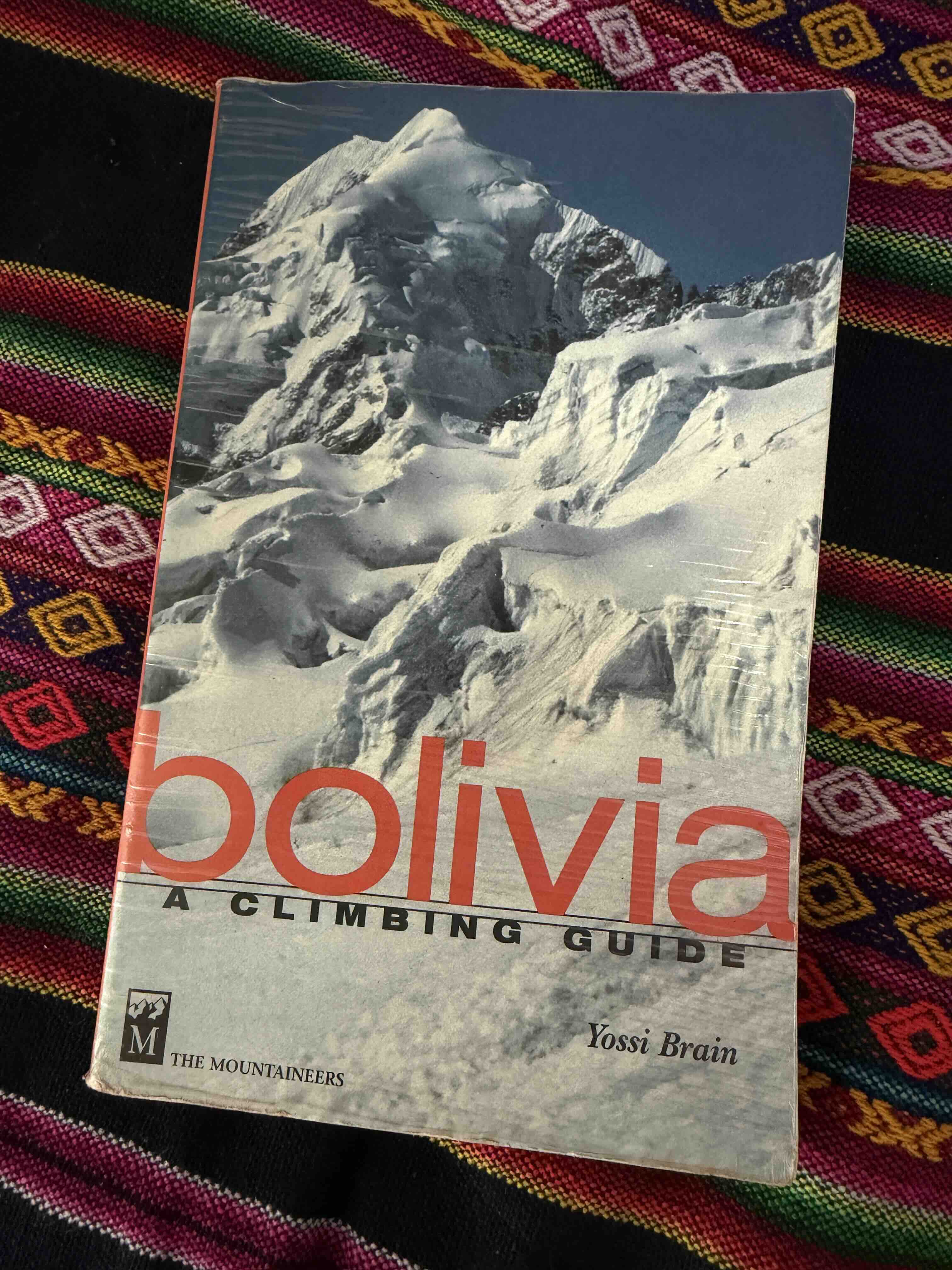
I visited Bolivia in the summer of 2025 with the primary objective of making an ascent of 6485m Illampu, a gorgeous tectonic pyramid far north of Sajama. I had been interested in attempting Illampu for many years, ever since seeing its complex summit looming on the front cover of Yossi Brain’s Bolivia guidebook, and reading about its challenging, airy routes. Illampu kept coming into focus for me; it came up in conversation in various basecamps, a friend had stories of his first ascent on one of its harder direct lines, and Brain’s cover photo continued to inspire me from the bookshelf.
Ultimately my 2025 trip was quite disappointing; I failed rather low on Illampu, vomiting into the Bergshrund at the base of the route as my highpoint. Food poisoning from a rest day in La Paz, after Sajama, proved too persistent to shake, and left me weak and compromised for the majority of my time in Bolivia.
My visit to Sajama National Park was intended only as a preparatory warmup for Illampu, and indeed, I had never intended to attempt Sajama itself on this trip! My original plan going into the summer was to ascend lower and easier 6000m walkups, then head to Illampu once properly acclimated for more technical climbing. Looking back, it is remarkable that I summited Sajama at all, and as I write with the benefit of hindsight, Sajama stands in my mind as a proud, memorable ‘consolation prize’ outcome to the summer. At the very outset, my flights to Bolivia were delayed by over 30 hours, time which I was forced to spend waiting around in the San Salvador and Bogota airports. It is interesting to note that it is quite possible this time wasn’t entirely wasted; given the Bogota airport stands at 2550m, I reckon that spending a day sitting around there may have contributed to preliminary acclimatization. I ultimately arrived in La Paz two days later than planned, and frenetically rushed through my early acclimatization schedule so as to maintain enough time for a proper Illampu attempt. I had planned to spend a few days sport climbing near La Paz for active acclimatization – this became one day, the afternoon of my arrival! The sudden elevation gain was ruinous, and whilst I managed to onsight a few scrappy routes, I found myself getting totally gassed, lightheaded and dizzy, when linking more than a few moderate movements together. I was not acclimated well at all, and due to time-frames throughout the duration of the entire trip I never really adapted fully.
Further delay struck on the road to Sajama town from La Paz. Apparently a conflict had broken out between police and smugglers, and the two lane road was blocked by both a burning car and a burning 18-wheeler full of contraband! This bizarre, incredibly sketchy scene cost us several hours, and had us arriving into Sajama much later than planned. Far behind schedule, there was nothing to do but grin and bear it, and adapt the plan towards seeing if I could move faster. I aggressively pushed, in the hopes of expediting my acclimatization. Ironically, ‘pushing it’ often meant sleeping early, eating loads of food, hydrating more than I normally would, napping a lot, finding every opportunity possible to take downtime and maximize recovery. It seemed to work, as I managed an uncomfortable summit of 6052m Acotango, a volcano adjacent to Sajama, on my fourth day in Bolivia. Prior to this trip, my fastest time to 6000m ‘from sea level’ had been 8 full days, when on Pik Lenin in 2017. Starting with ‘day 1 from sea level’ in Bogota Airport at 2550m, I managed to ascend to 6000m in five days from sea level on this trip.
From the summit of Acotango, Sajama immediately caught my eye and tugged at my sense of ambition – it’s an impressive, ruggedly gorgeous volcanic cone from all aspects, and when viewed from high on Acotango takes on a surreal, alien aspect. The southern Bolivian volcanos are remarkably prominent to begin with, but it is their unique environment which largely contributes to making them so unusual to look upon. Standing above desolate Altiplano, there is no mountain range or obstruction of any sort to the clarity of their figure, and with uniquely low humidity and clean air in the remote high-elevation national park, the range of visibility is incredible. Atop Acotango, thoroughly thrashed by elevation, viewing Sajama and Los Payachetas, the twin volcanos Parinacota and Pomerape, all three peaks took on a sort of ferocity to my eye. They’re so clear, abrupt, and ‘factual’; their landscape looks like it shouldn’t exist, but it unapologetically does exist, and the mountains look close enough to grasp if merely reaching out. Could an ascent of Sajama be made by investing an additional day and a half, if returning to La Paz directly from the summit? Chelo assured me that we could pull it off, given my pace on Acotango. On return to our hostel in Sajama town, I immediately went into hibernation mode, taking a two hour nap and managing ten hours of sleep overnight.


The climbing on Sajama was fairly accessible the entire way. Reaching the high camp involves a short drive and an easy trek, and the route to the top is never steep or exposed. Fields of sharp penitentes – snow ‘blade’ or ‘wave’ formations unique to equatorial mountains – did pose an interesting obstacle above high camp, but were not difficult to navigate. The high camp itself was comfortable, with numerous established tent platforms and rock walls, and the route had a well broken boot pack from frequent climber traffic. I summited Sajama on my 7th day from sea level (counting Bogota as day 1), or on my 6th data from La Paz – an absolutely unprecedented rapid ascent for me, personally, and this pace of ascent made for a significant challenge due to inadequate acclimation. On summit day I struggled to maintain output, was especially sluggish when ascending the final ~100m, and felt intensely miserable atop the summit plateau! The summit is broad and featureless, scoured raw by harsh wind, and felt unpleasantly cold in the early morning – we departed out tent at 2:55 a.m. and reached the top at 7:15 a.m. My pace felt miserably slow at the time, but I did pass almost all but one of the climbers who left earlier and were on the route ahead of me – it’s very hard to gauge how the balance of fitness and terrible acclimation impacted my speed.


Views from the top were clear, but I was so slammed by altitude that I wasn’t able to properly enjoy them! Sajama’s early morning shadow stretched out far below us, reaching all the way to Los Payachatas. I took photos from all perspectives, Chelo took my photo, and another Bolivian climber took a photo of Chelo and I – we quickly began to descend. The climb down was very quick, and we found ourselves in high camp at 9:15 a.m. From there a quick descent to our car, and a long drive, took us back to La Paz on the same afternoon as the summit. It’s surreal how rapid access to high peaks can be in South America, as compared to the great ranges in Asia where significant, multi-day approaches are often required.
One rest day fit into my remaining schedule, and within this singular day of downtime I managed to pick up fairly severe food poisoning in La Paz. In spite of Immodium, I was sick and weak for the remainder of the trip, and had a tough time even getting into the highcamp for Illampu. On Illampu I managed to reach the base of the route, the bergshrund, where I repeatedly vomited, felt thoroughly miserable, and decided to bail. Ironically, the Illampu leg of my trip which was responsible for stimulating such a rushed pace on Sajama, was significantly more expensive and time consuming than Sajama, and was ultimately far, far worse of an experience than the pre-acclimatization ‘warmup’. Food poisoning when traveling is often out of our control, but I found myself wondering how awesome the trip might have been if I’d just gone solo and spent the entire time within the Sajama region!
Perhaps a return to Bolivia is in my future? It might make sense to go for a longer time-frame on the next visit, with a partner, and incorporate more sport climbing into the trip – the rock around La Paz is certainly interesting, and there appears to be quite a lot of potential for a ‘mixed’ rock and altitude trip! Illampu is still on my radar – possibly with a warmup on both of the Los Payachatas volcanoes next time?
Images


