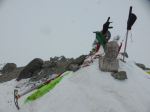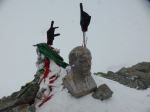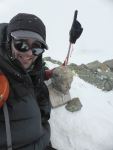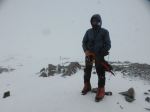
Pik Kommunizma / Pik Ismoil Somoni – August, 2023

Contents

  1. Pik Kommunizma / Pik Ismoil Somoni
  2. Basecamp and Access
  3. Route Description
  4. Trip Report and Schedule
  5. Images
  6. Thoughts on Pik Kommunizma

Pik Kommunizma / Pik Ismoil Somoni

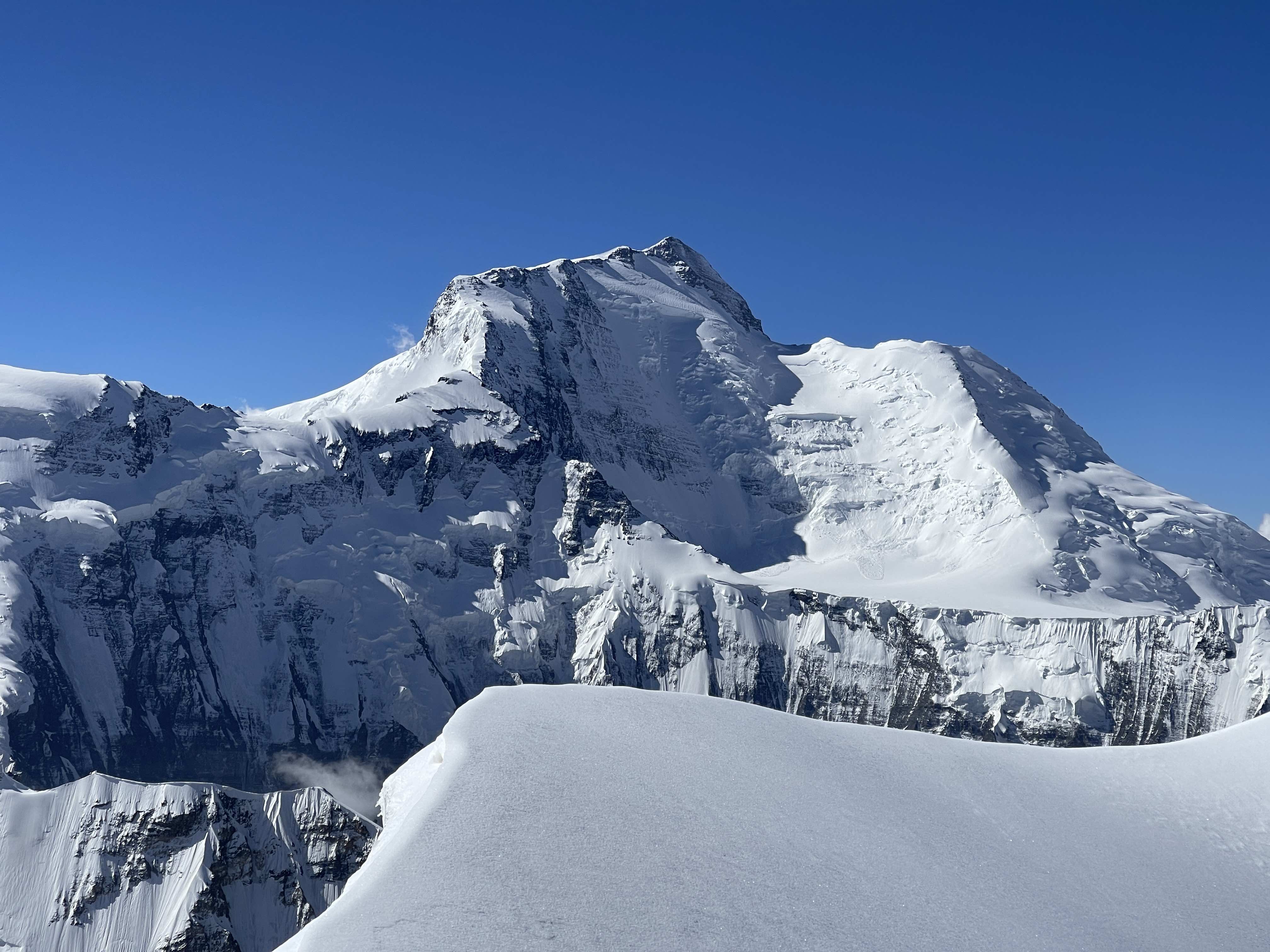
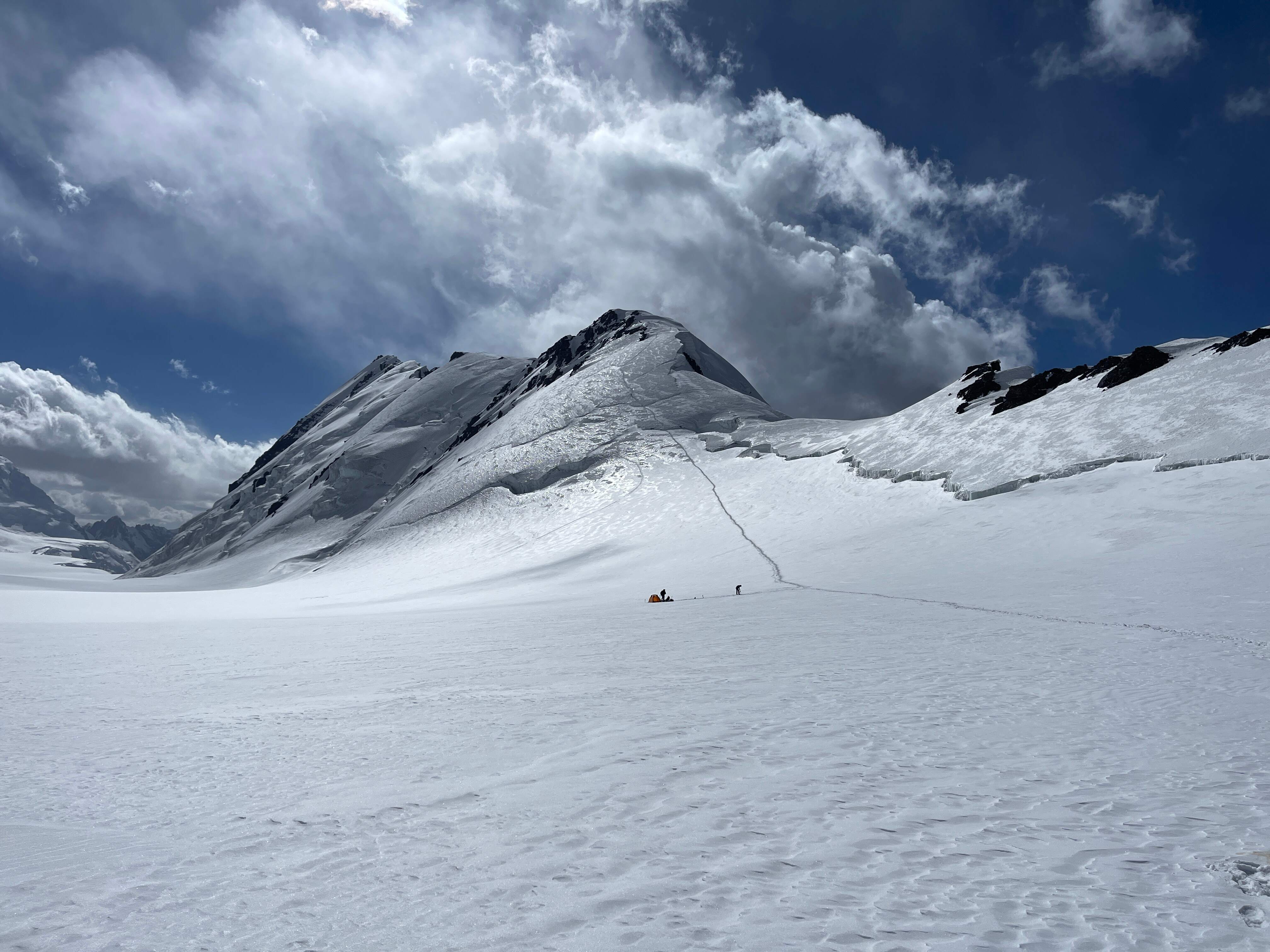
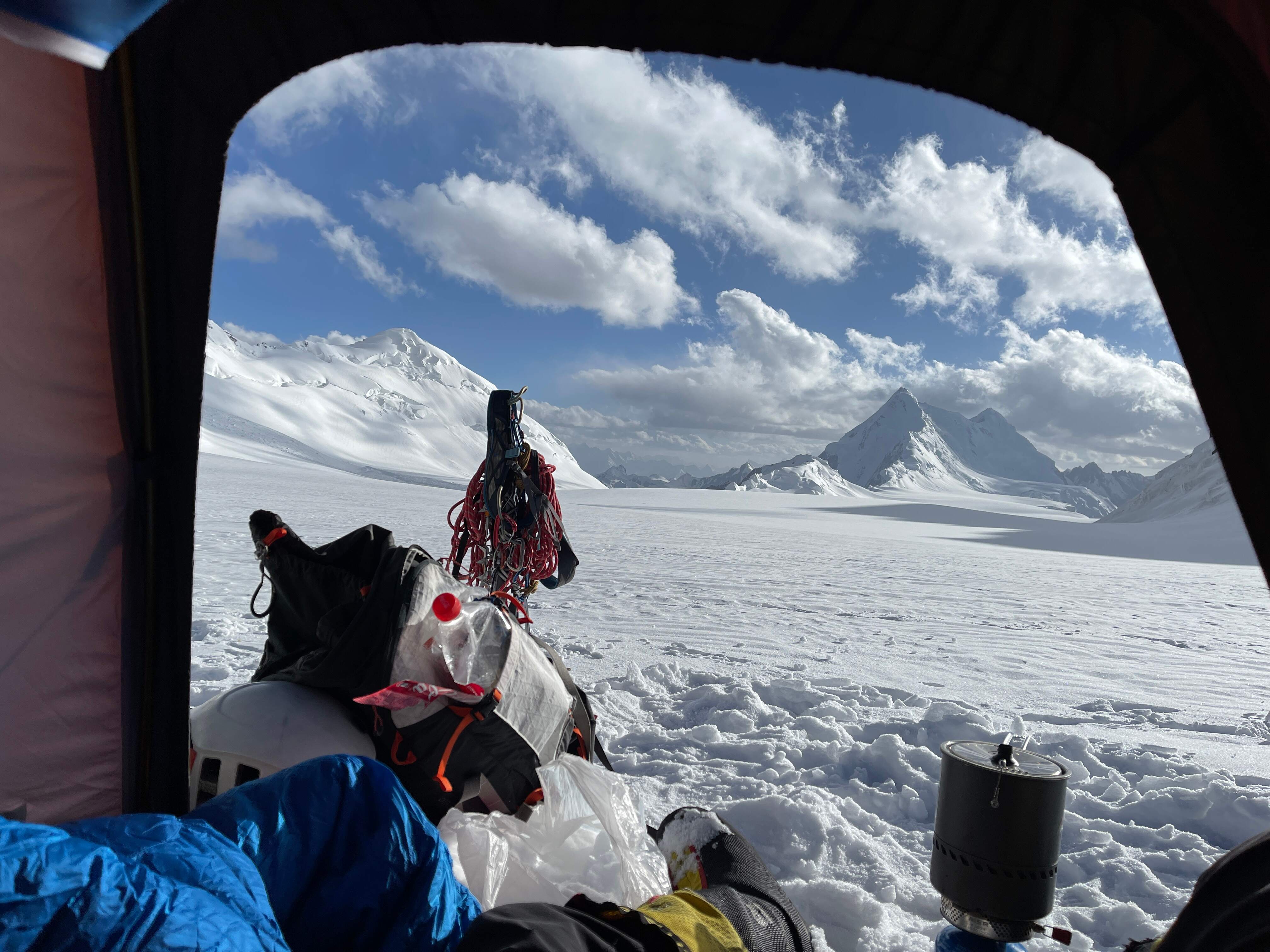
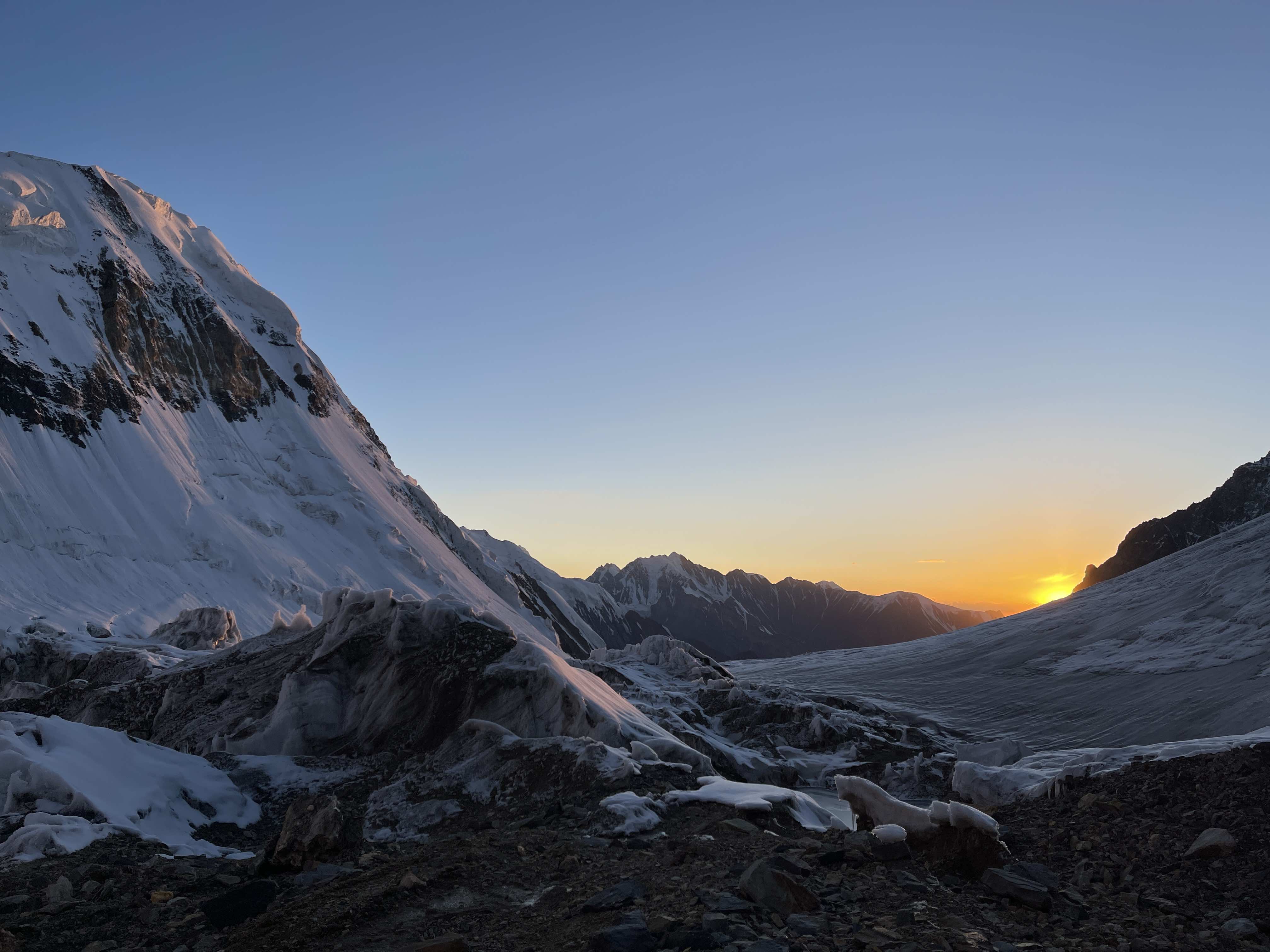
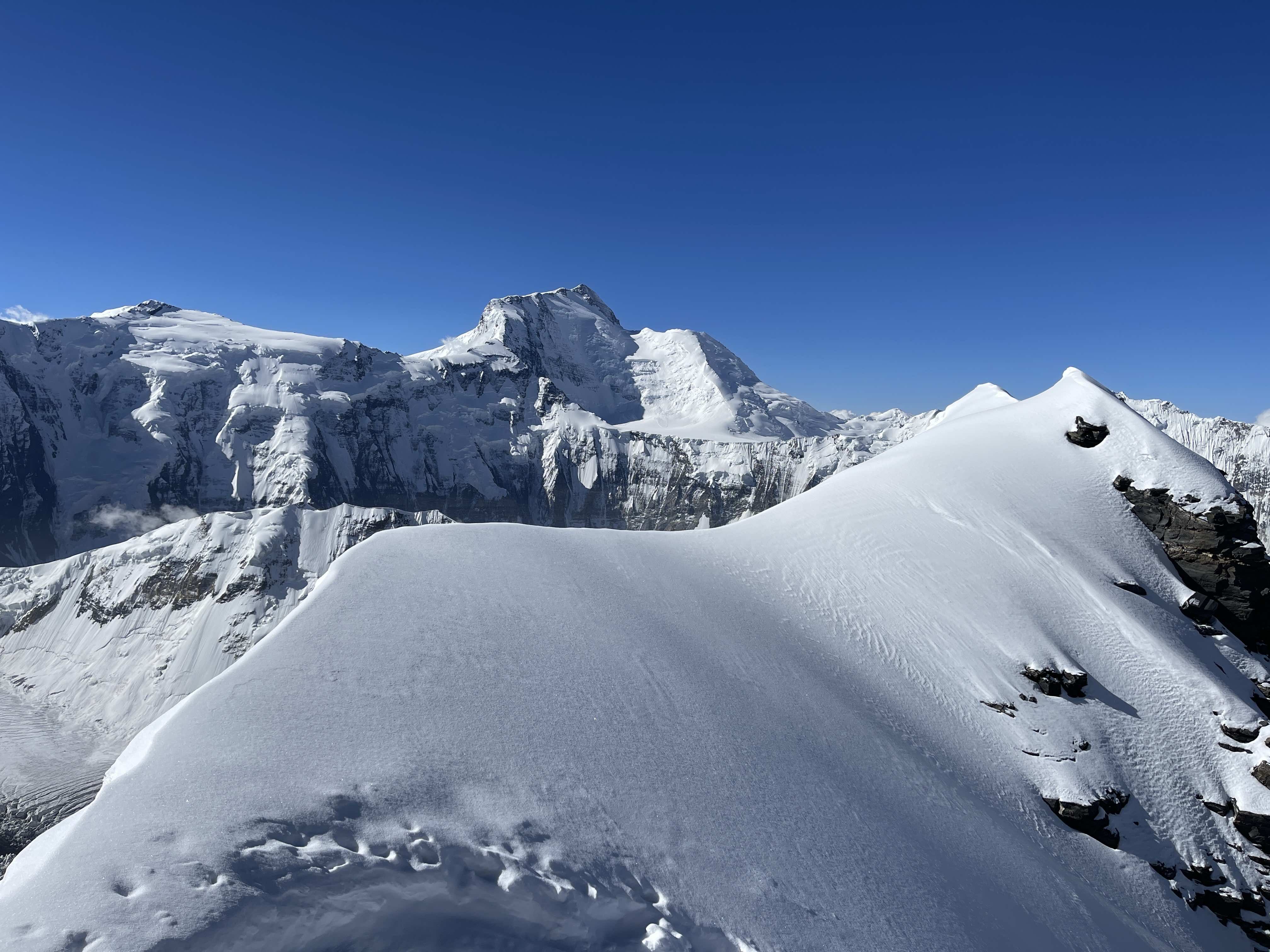
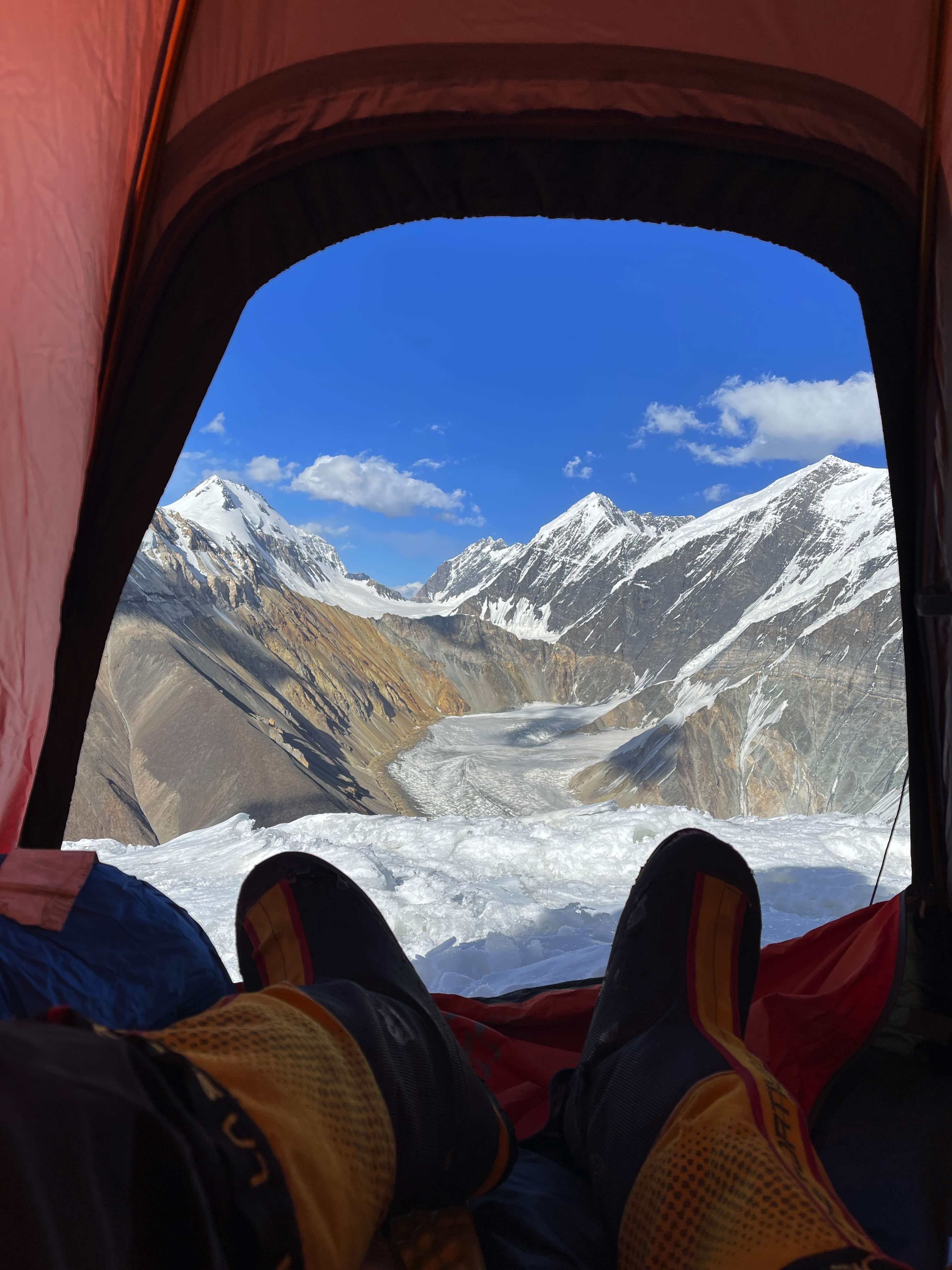
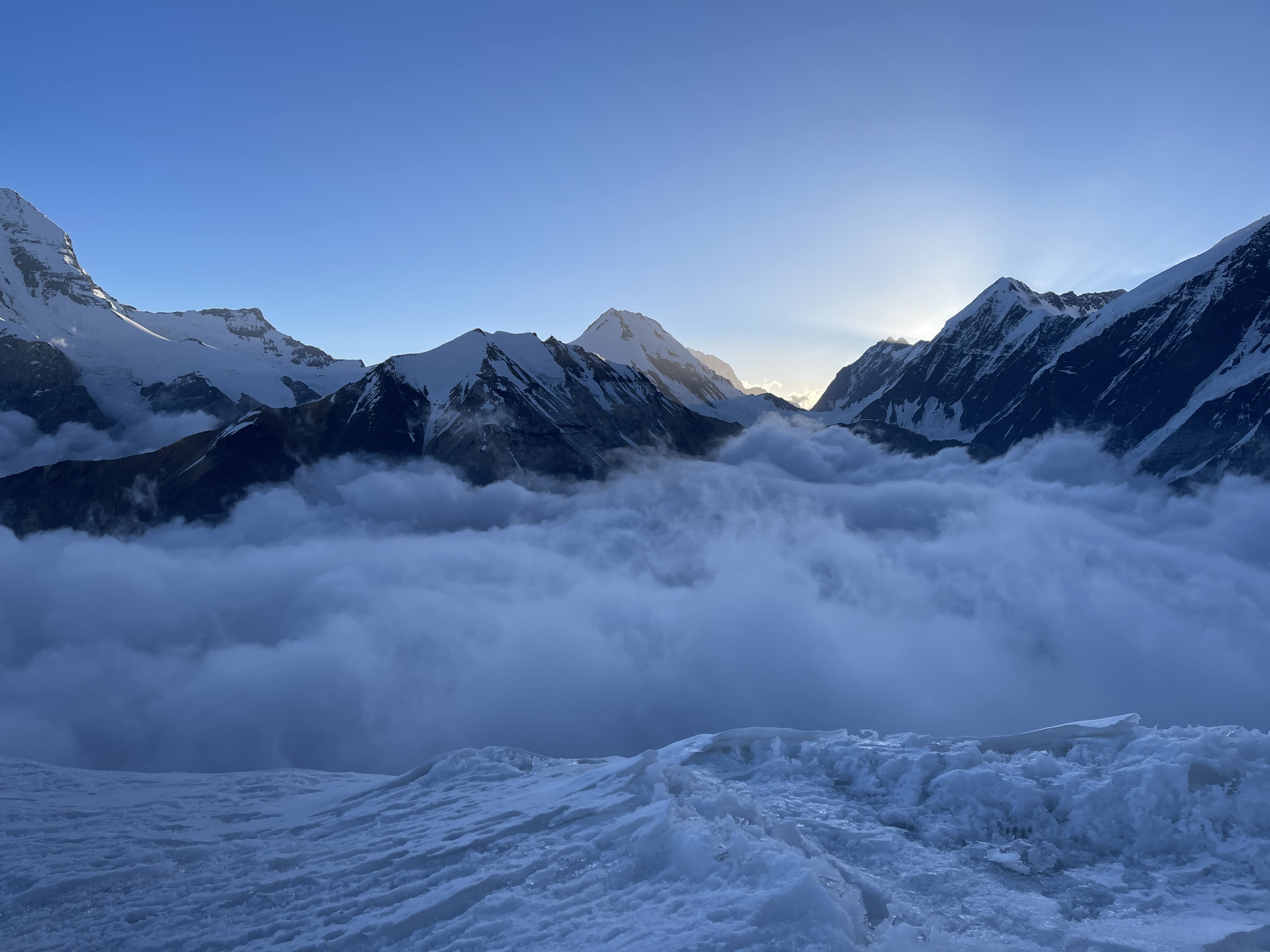
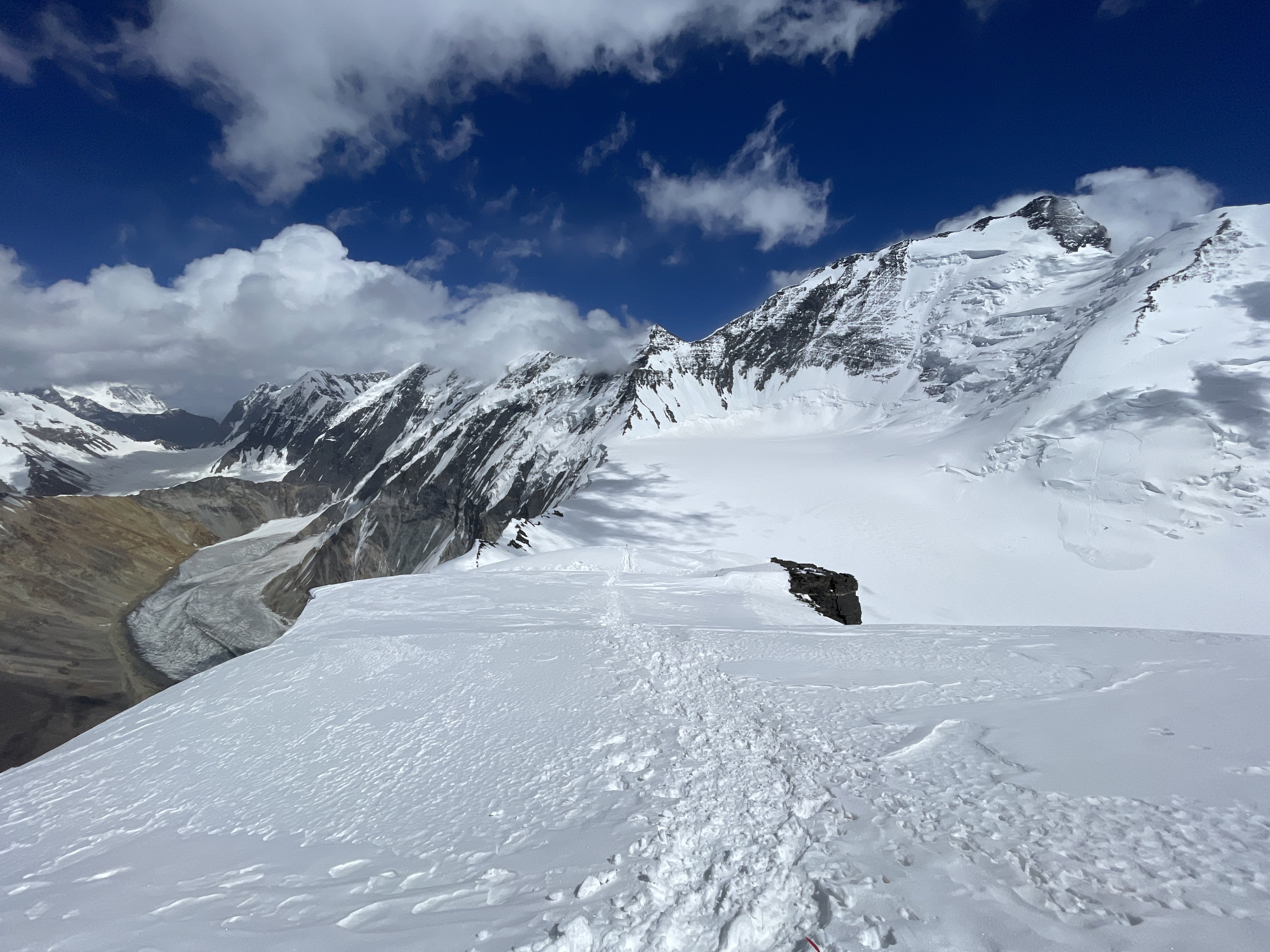
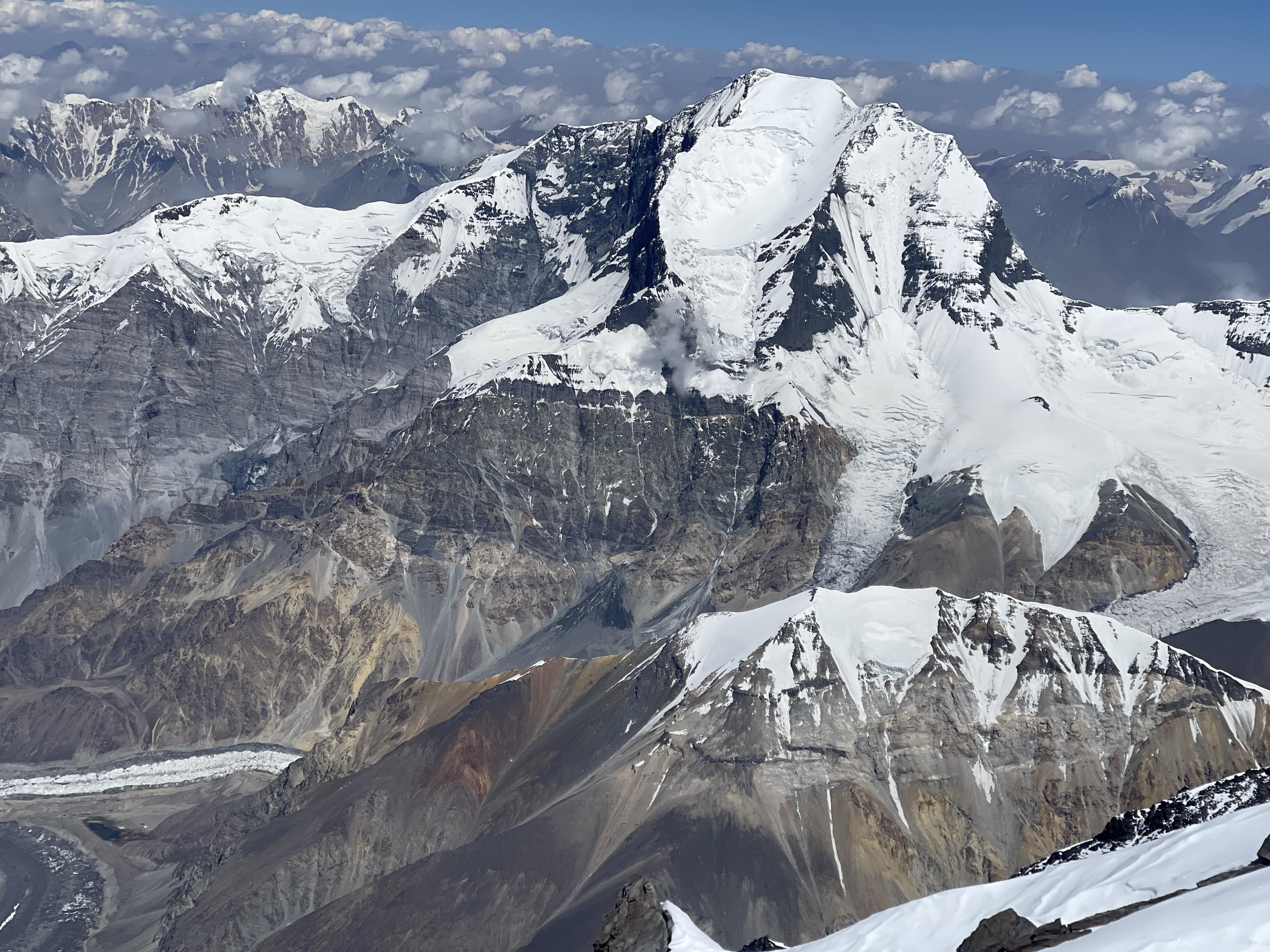
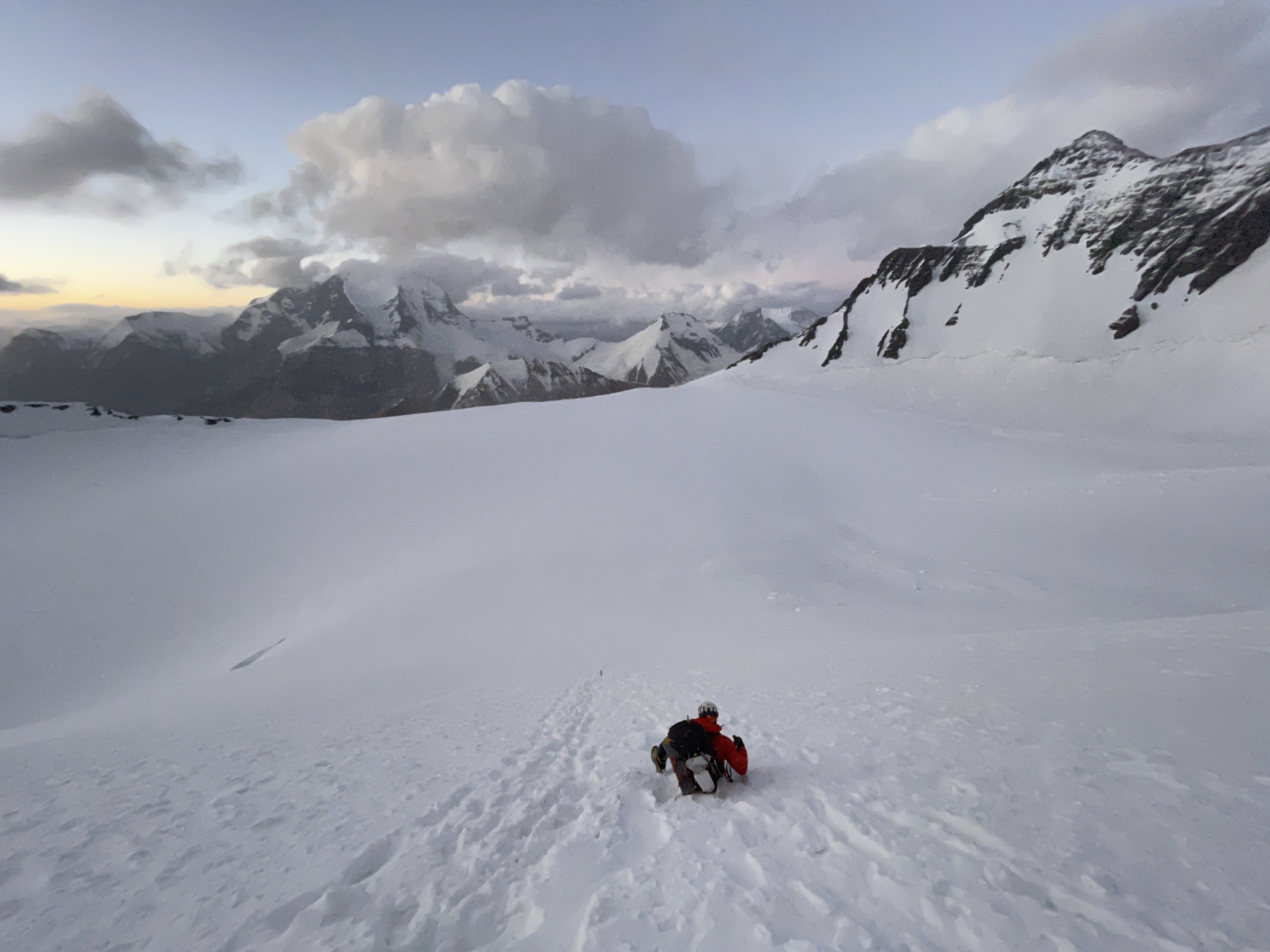
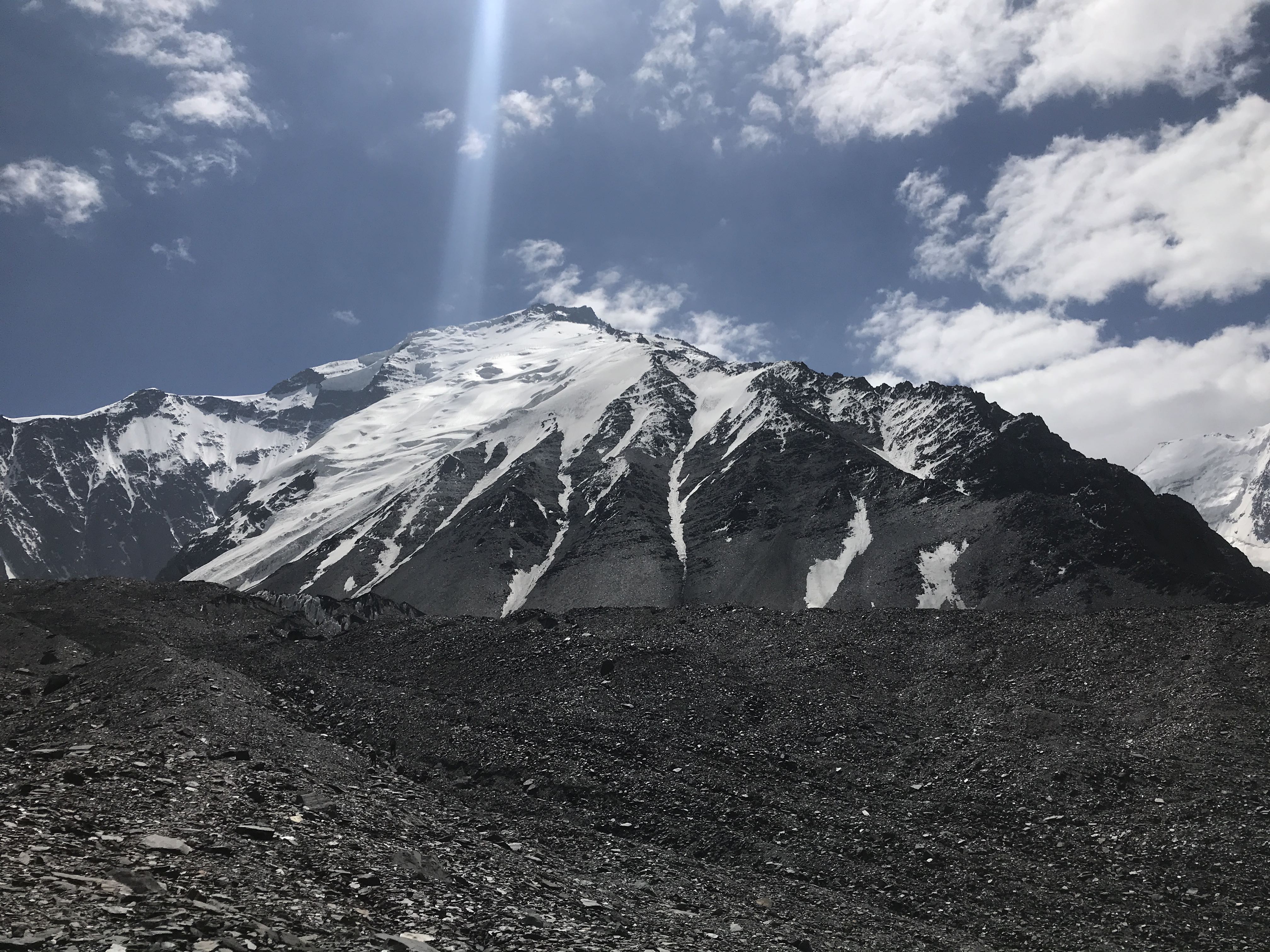
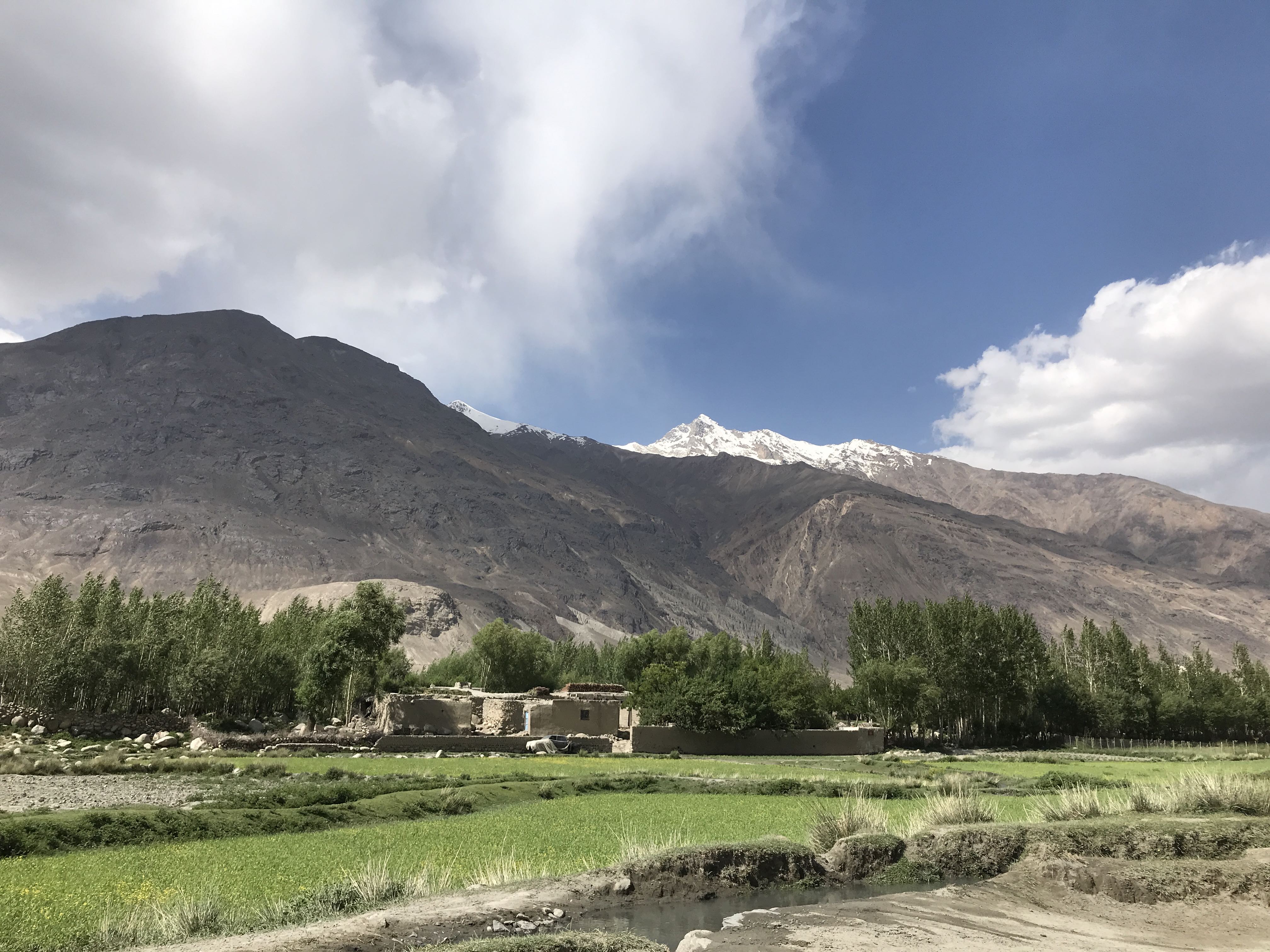
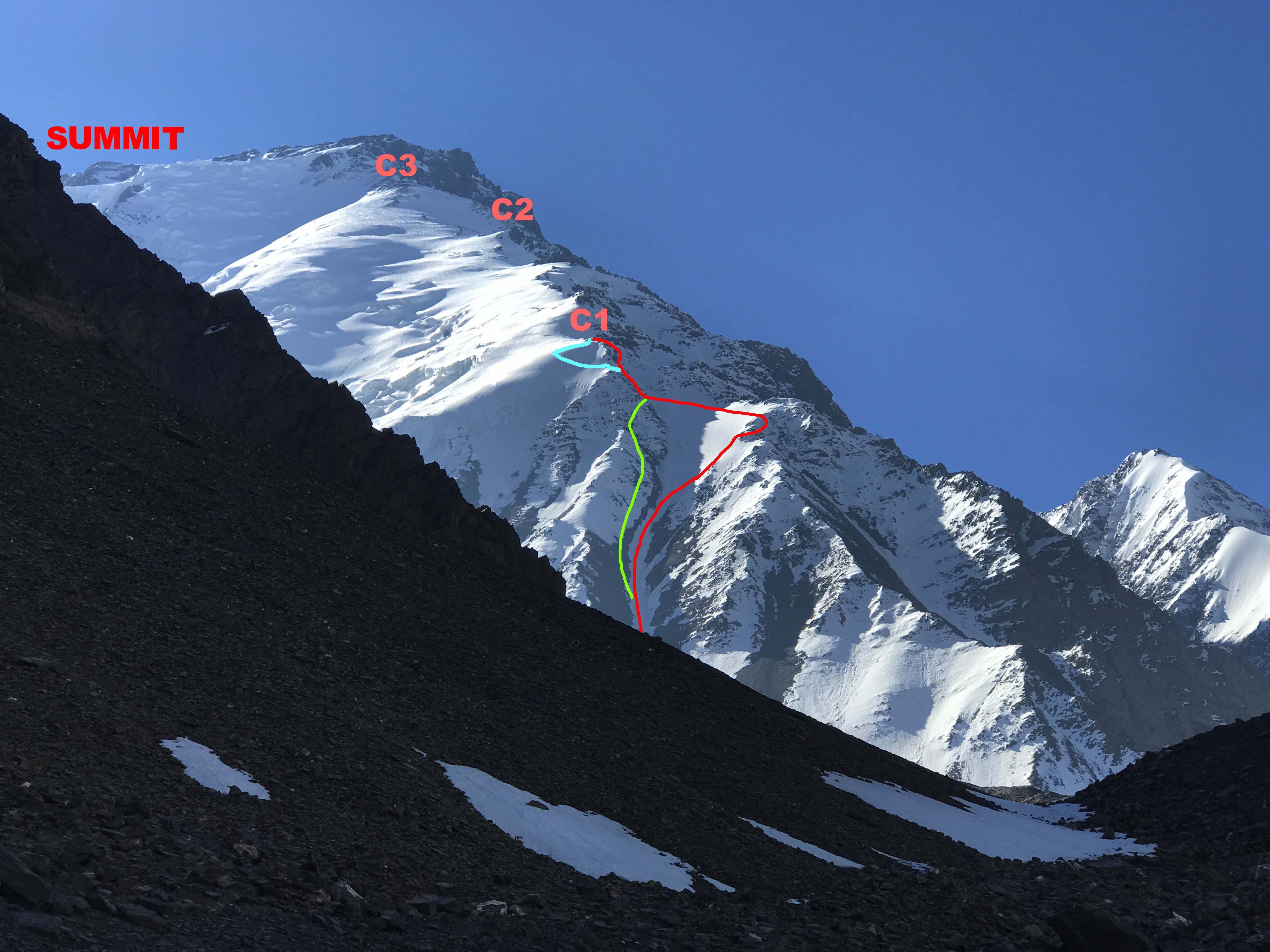
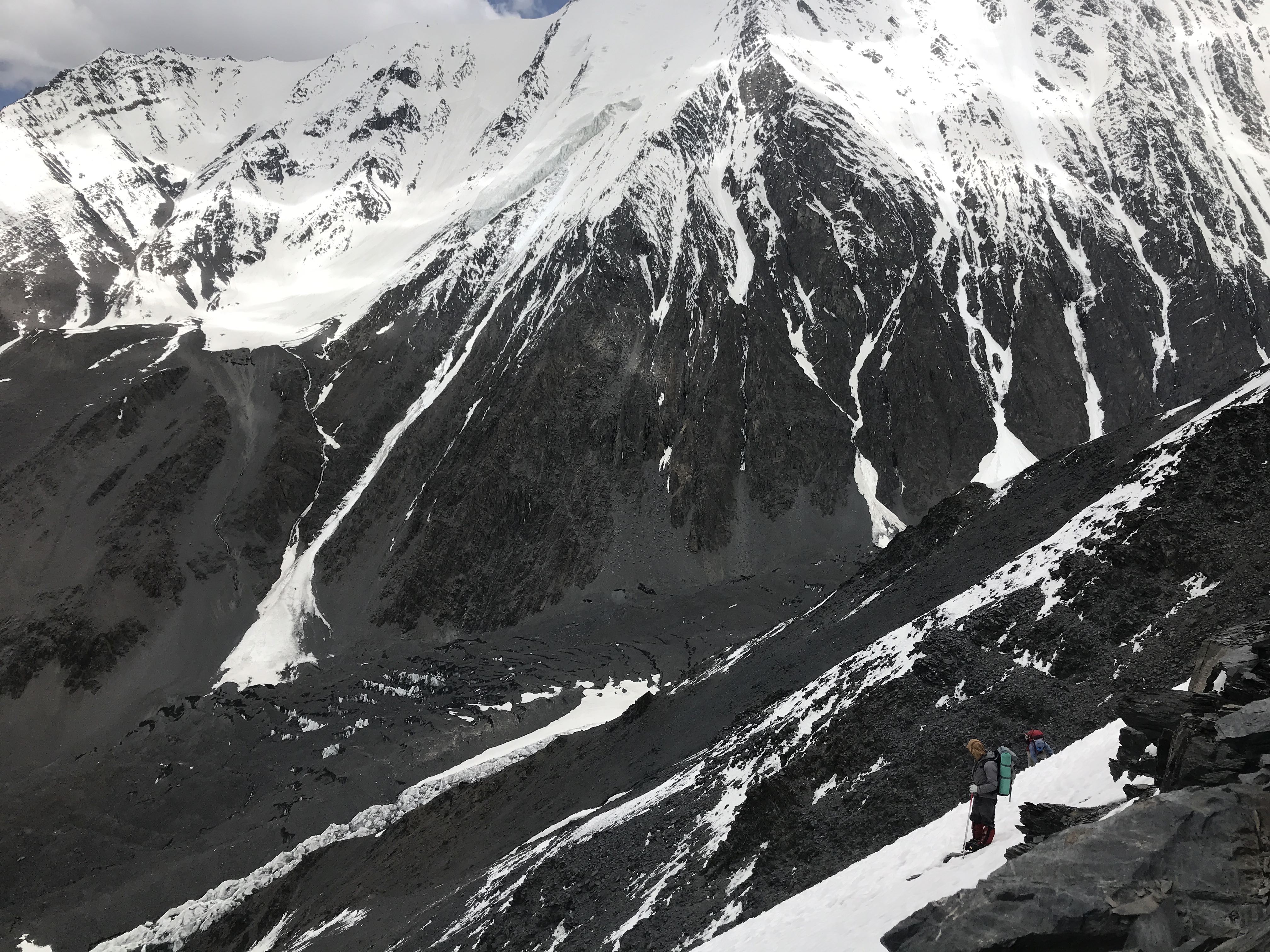
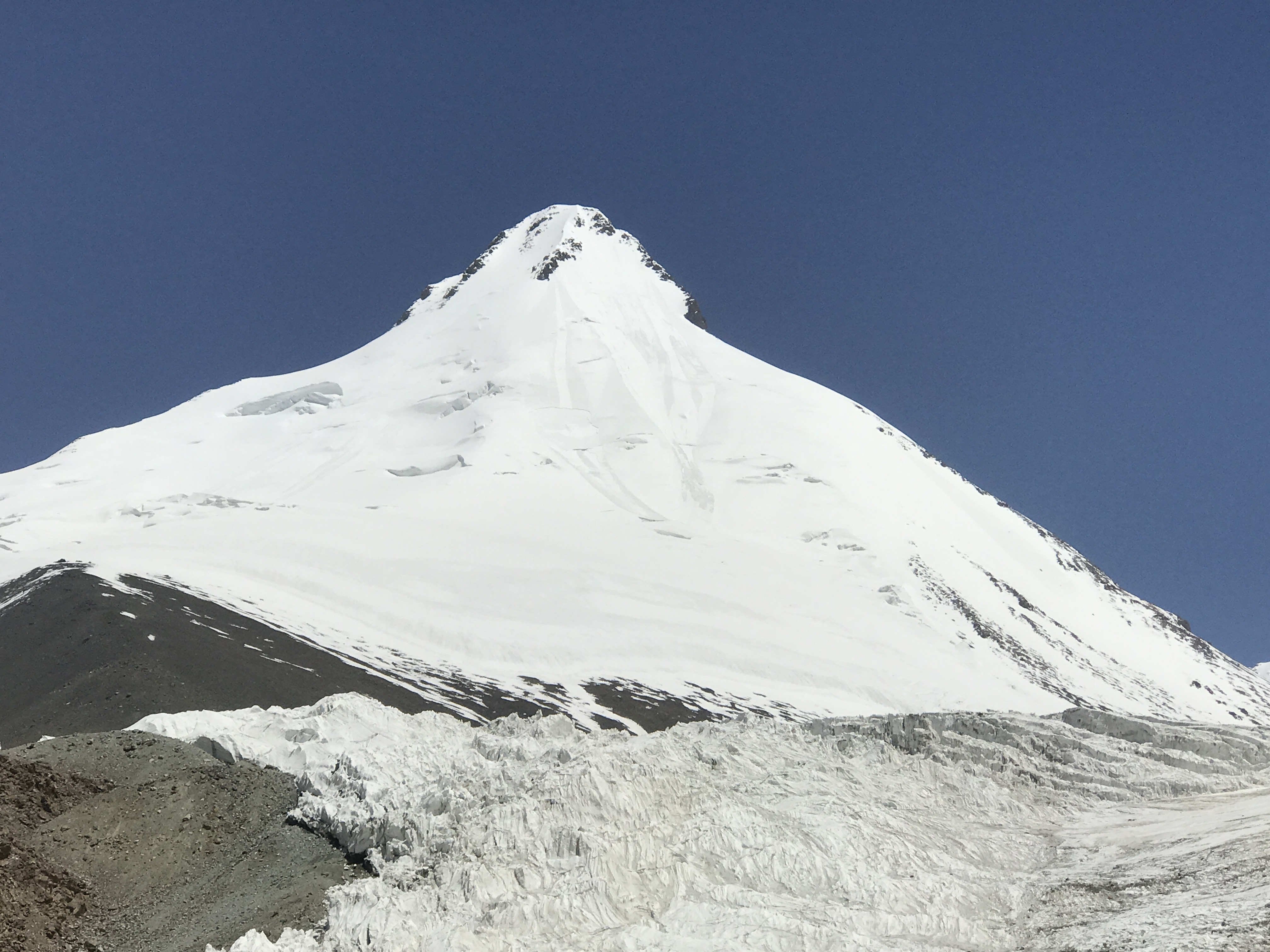
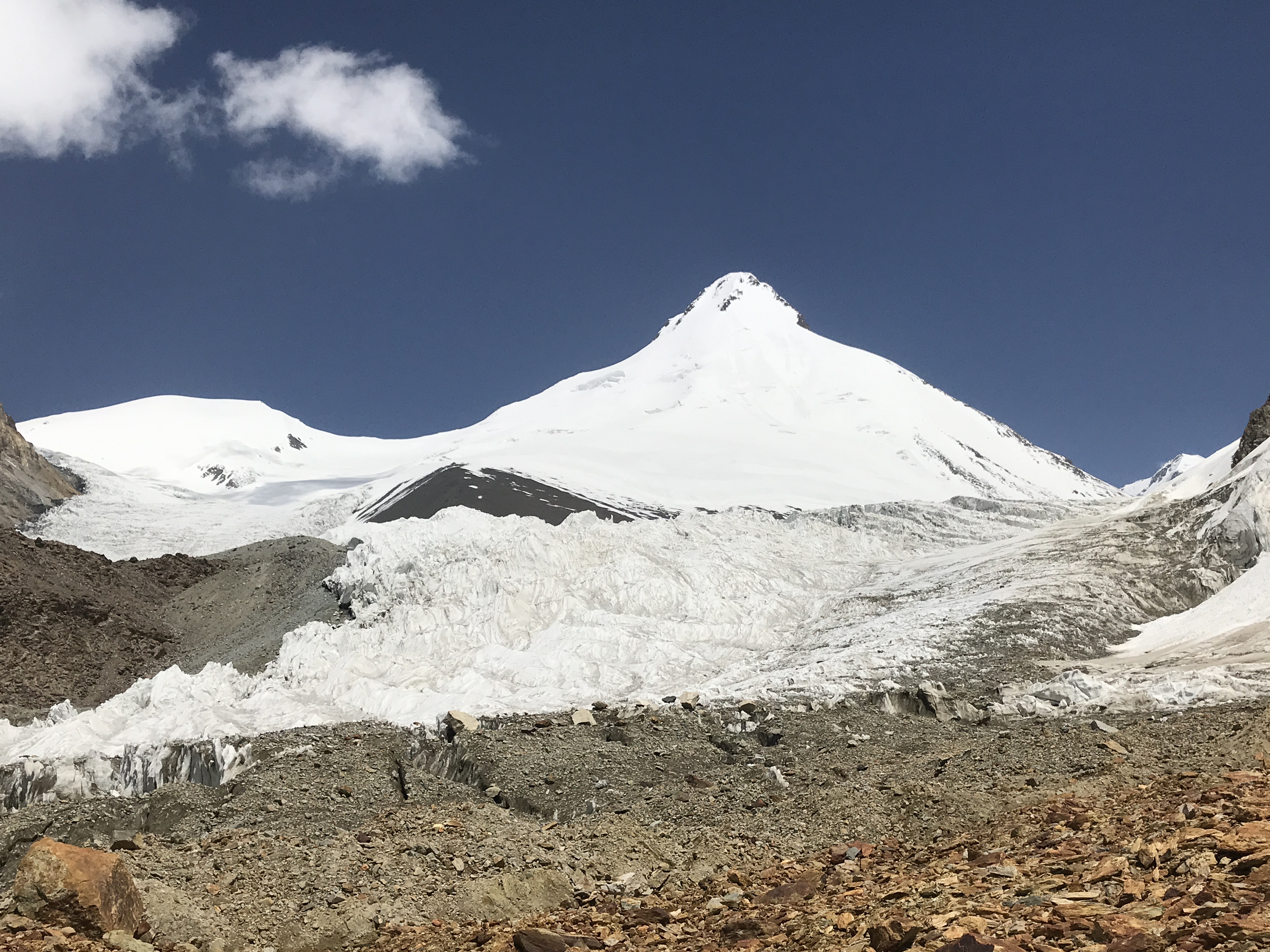
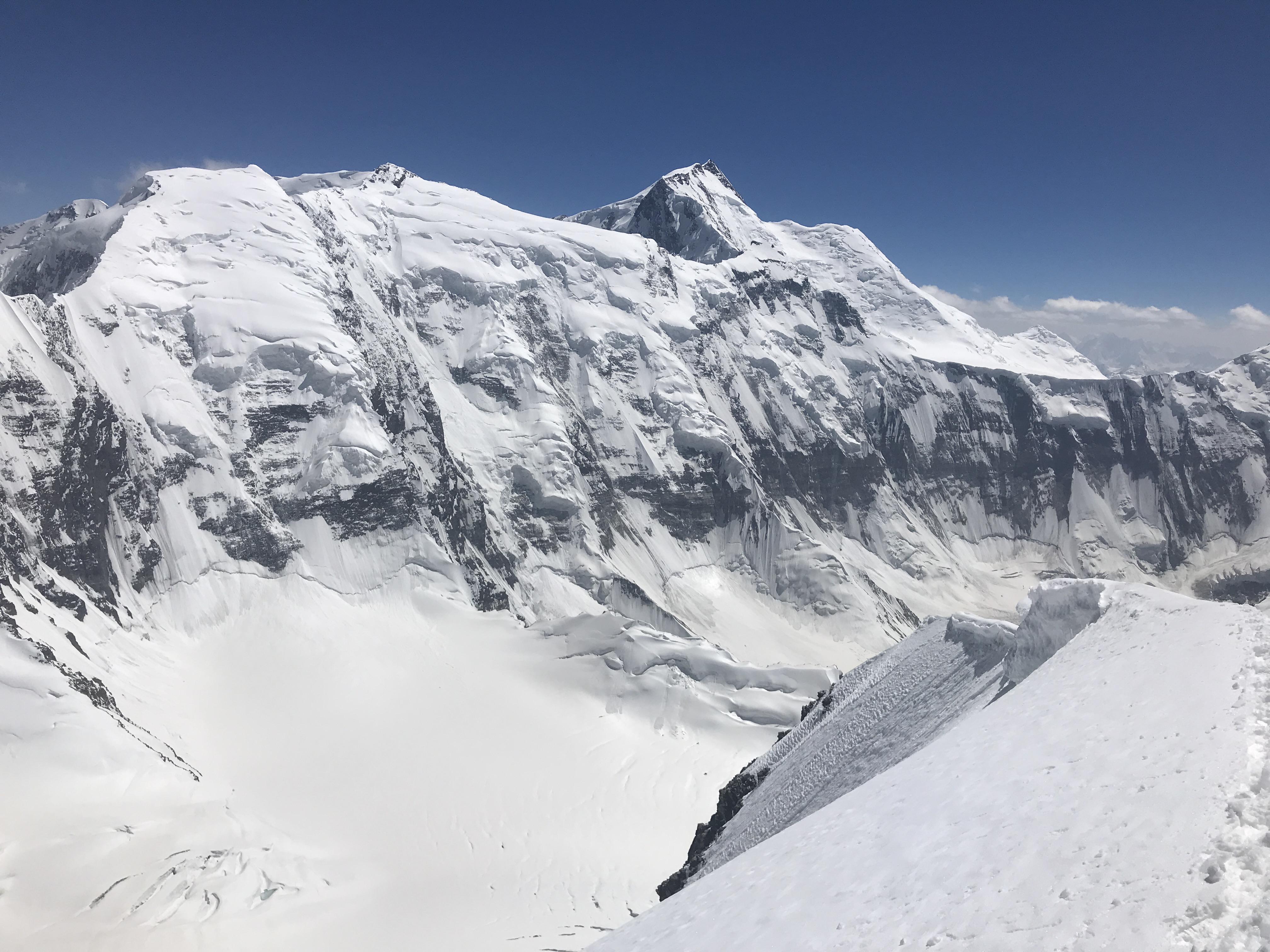
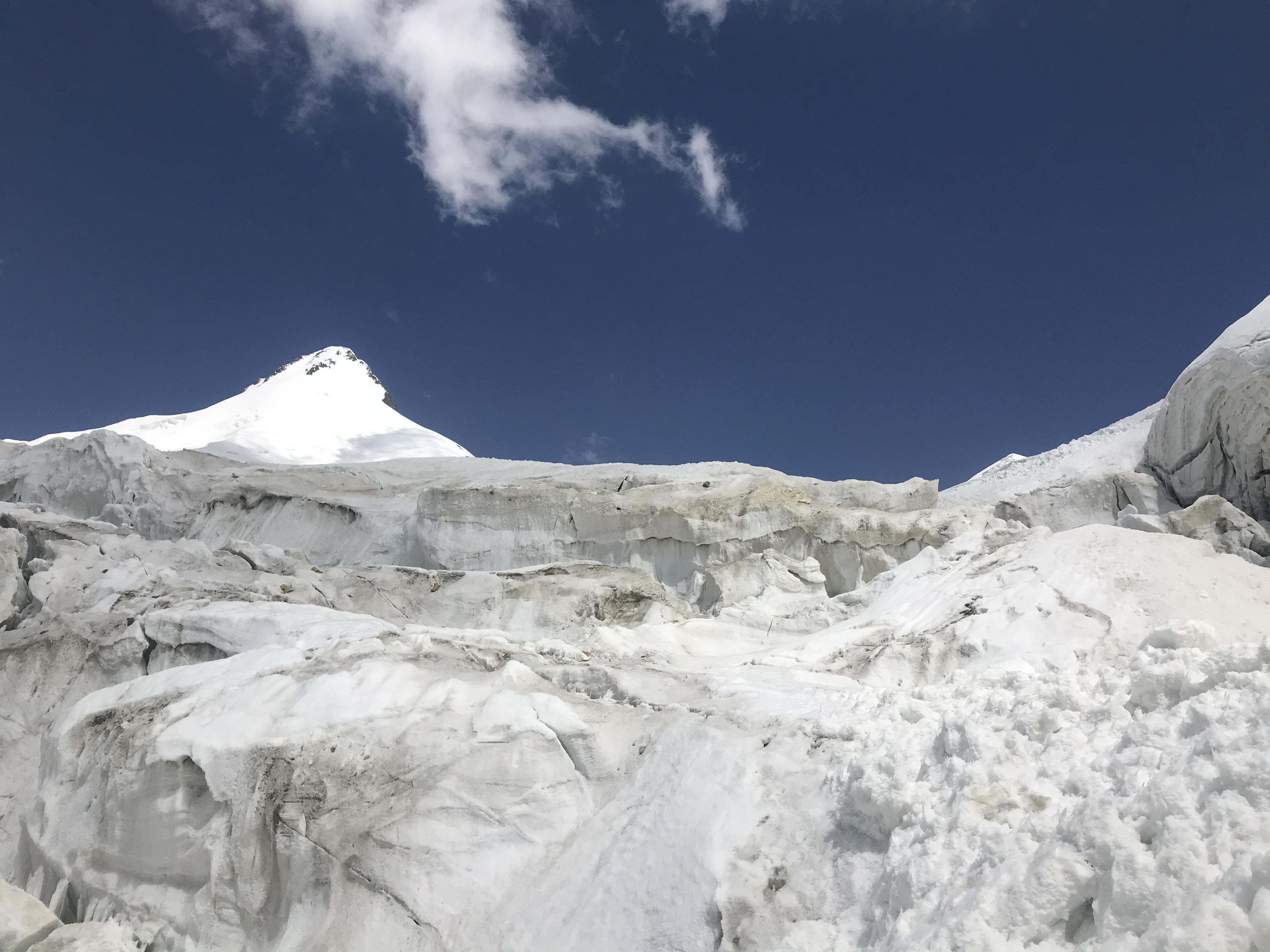
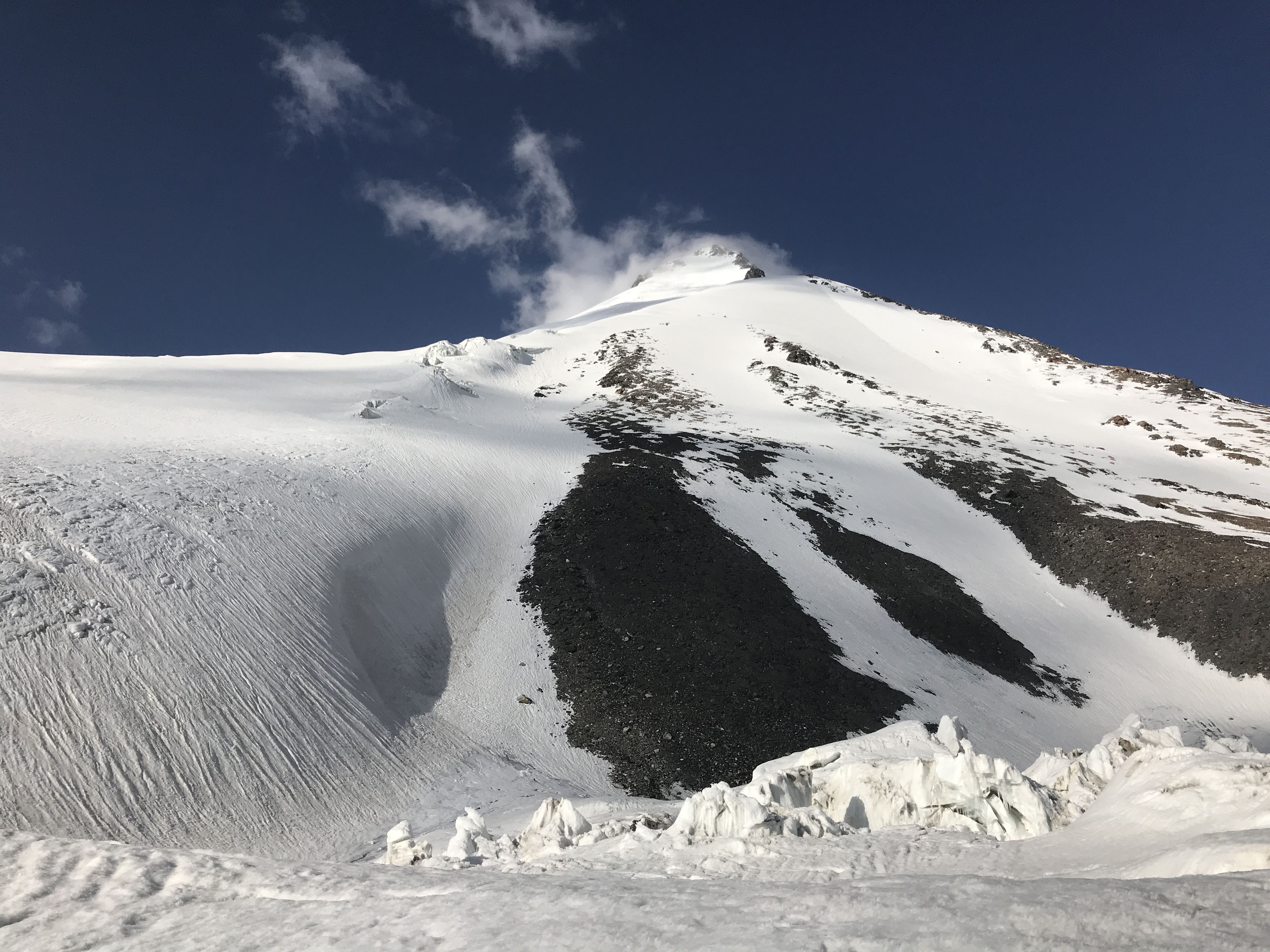
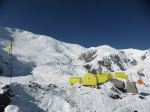
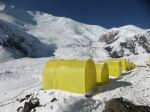
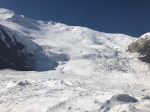
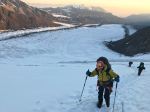
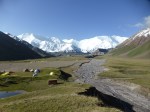
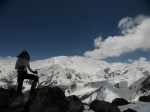
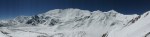
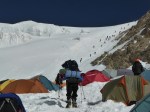
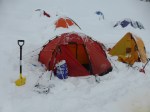
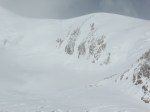
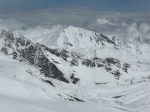
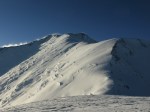
Pik Kommunizma, the Pamir Plateau, and the Borodkin Spur as seen from the summit of 7105m Pik Korzhenevskaya.
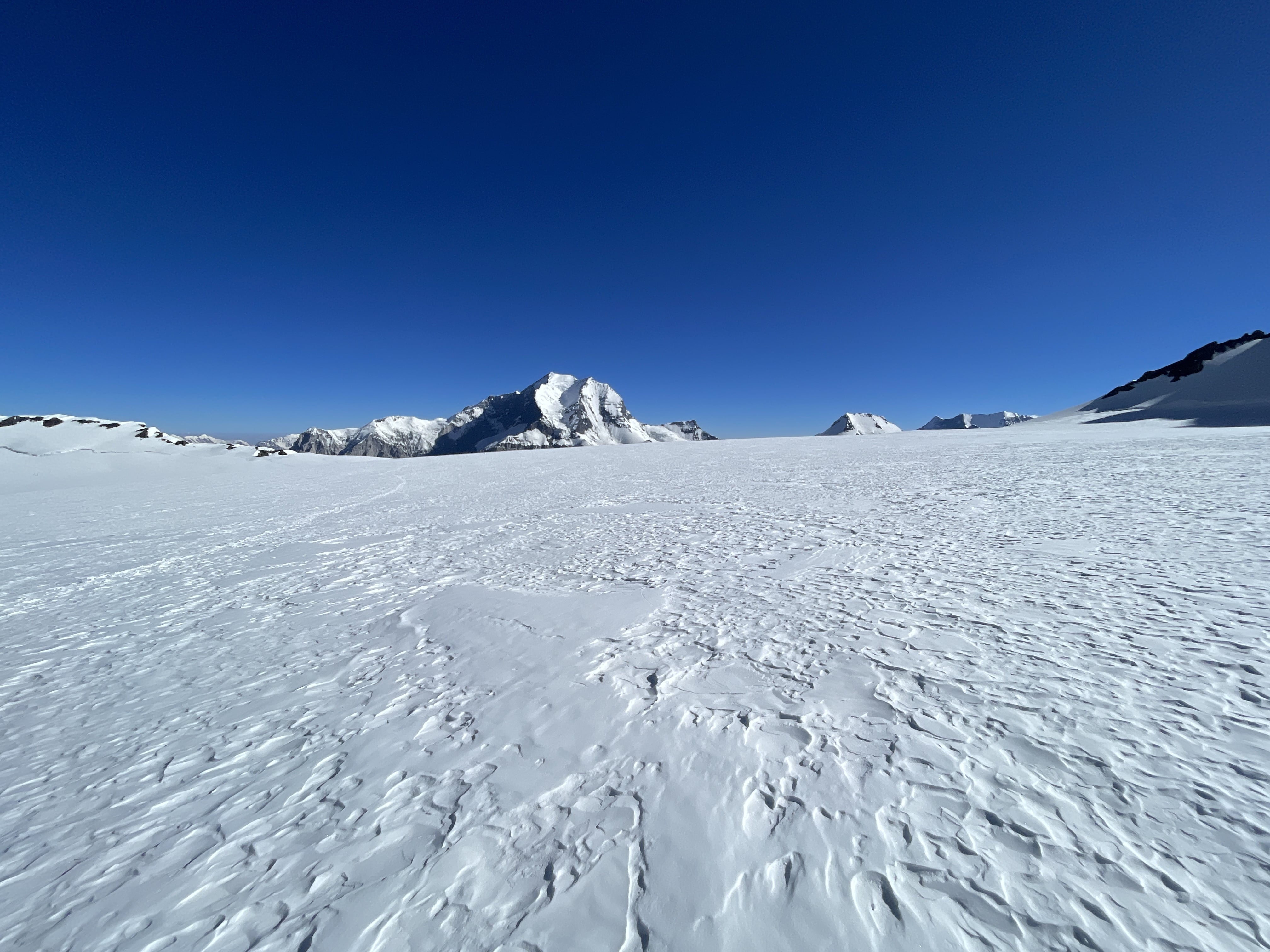
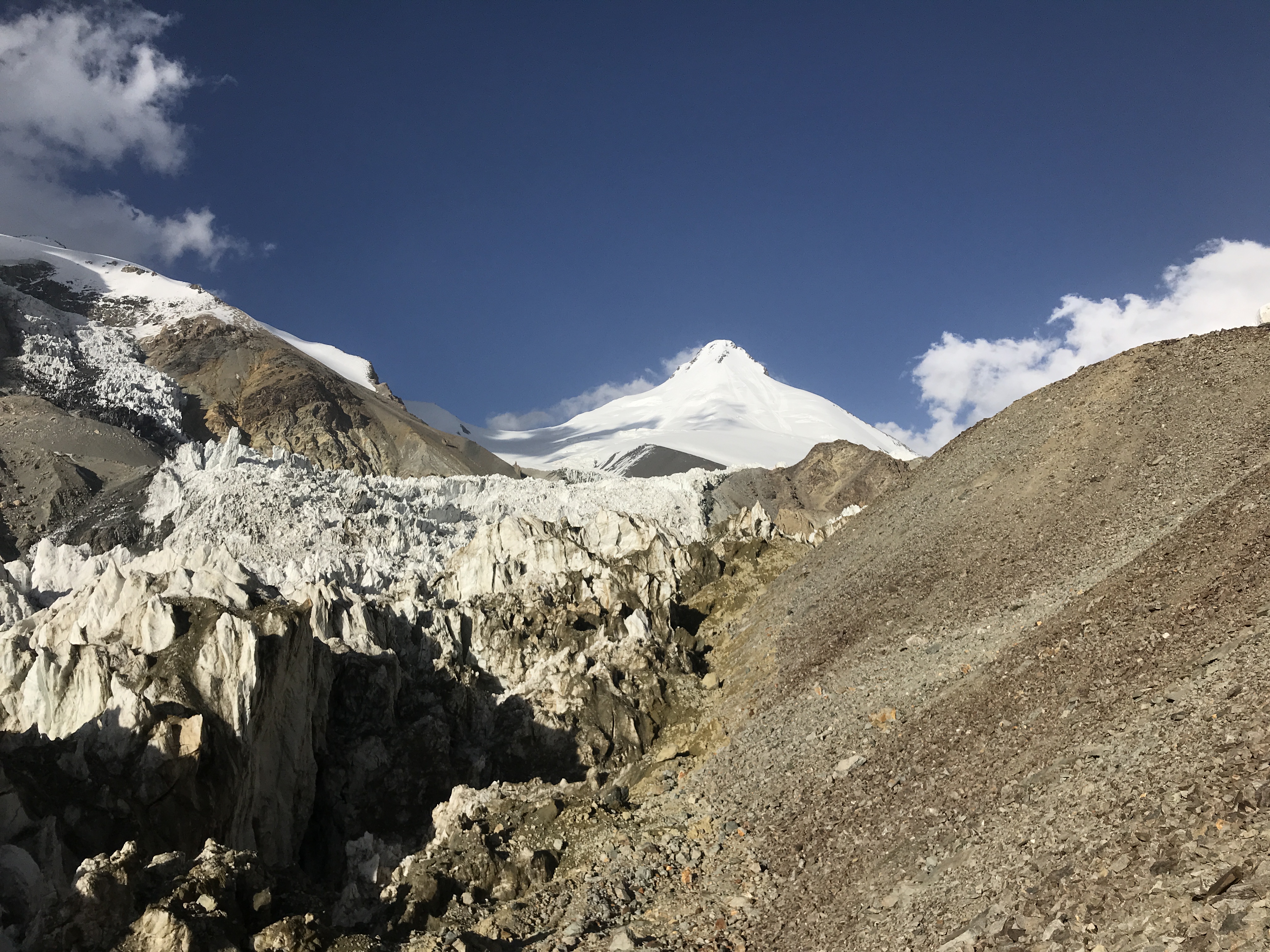
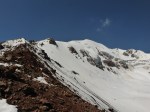
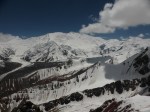
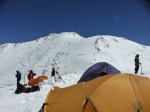
Pik Kommunizma as seen from 6100m camp on Pik Korzhenevskaya.
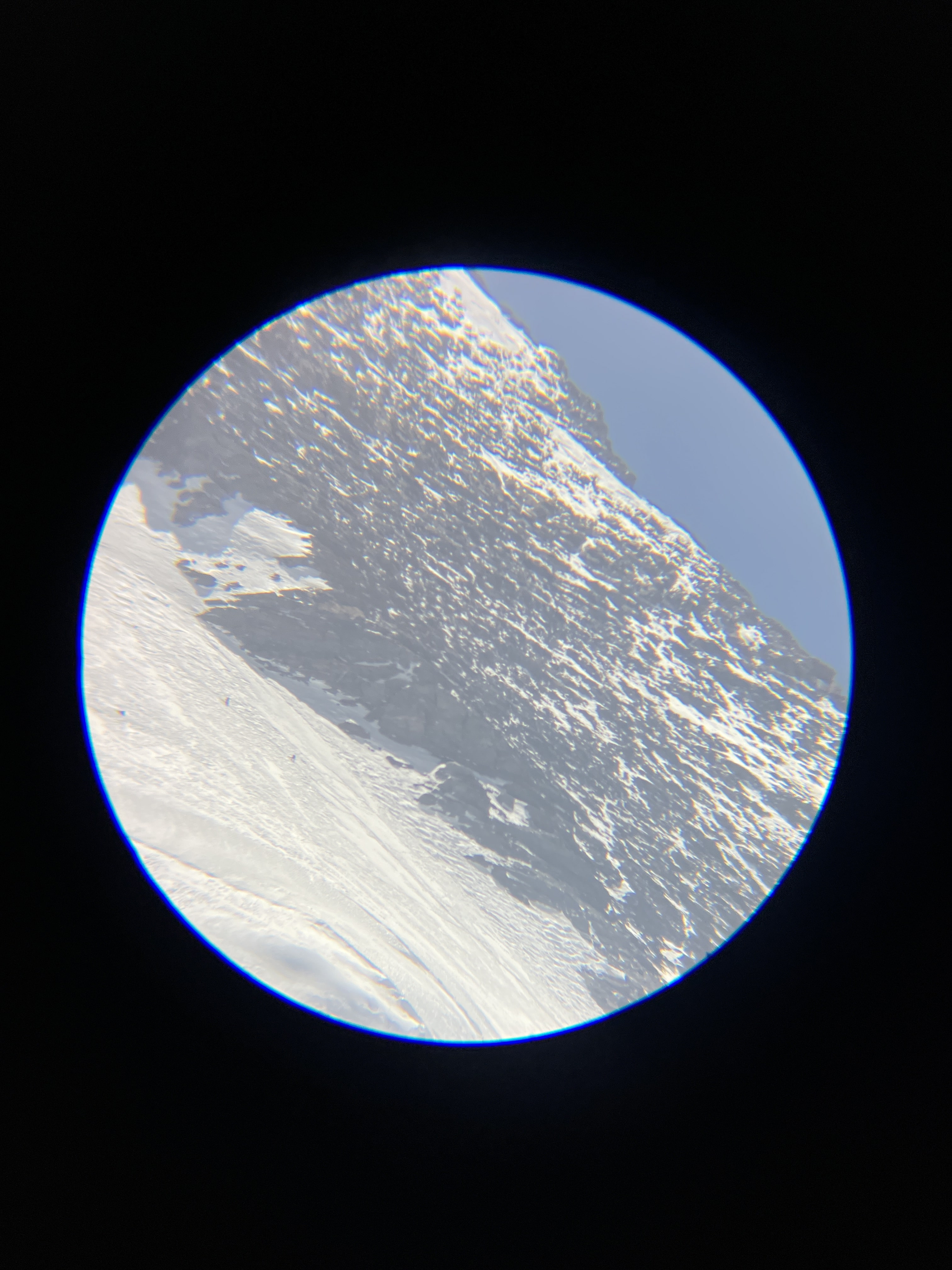
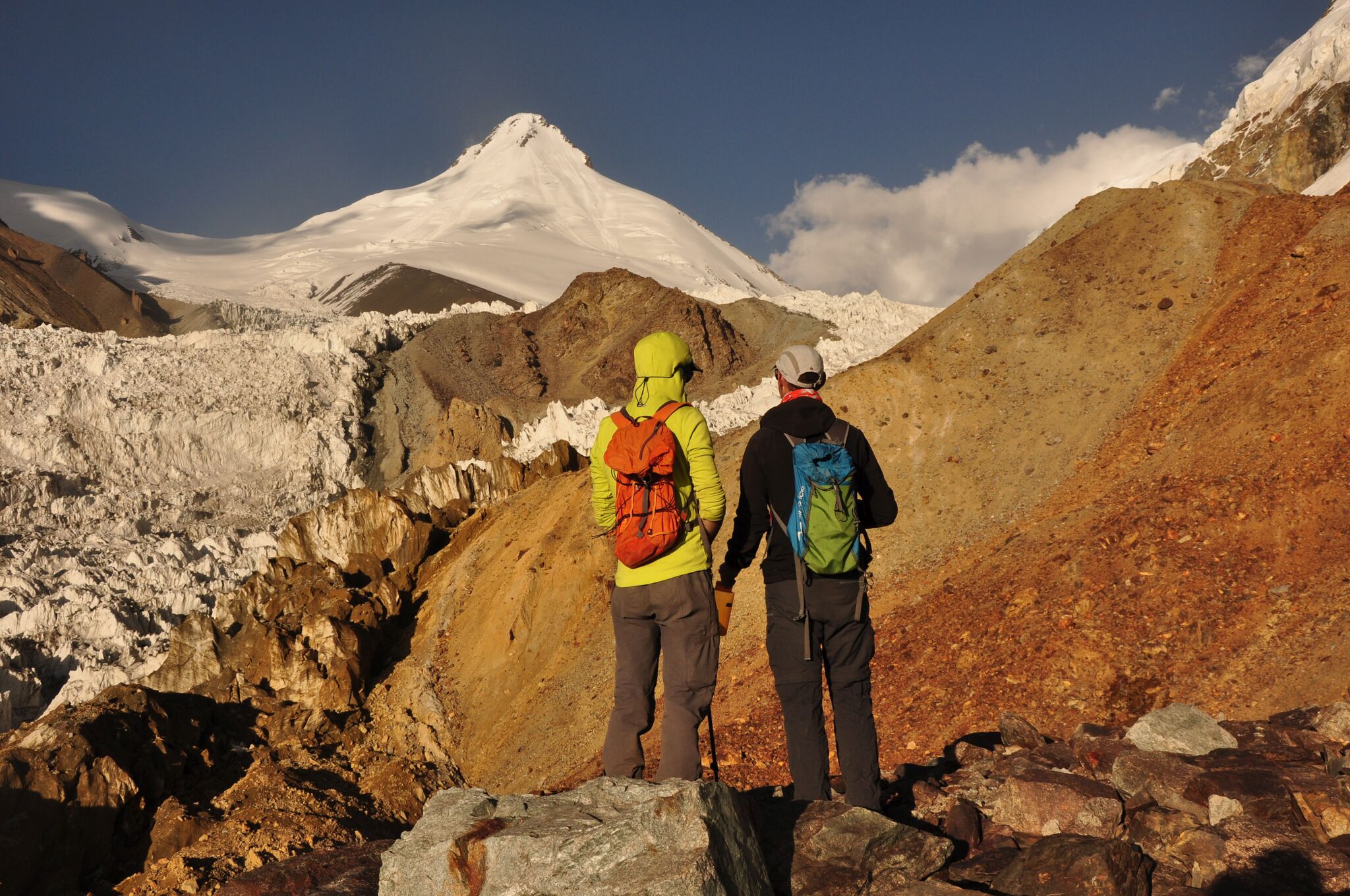
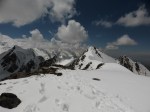
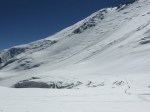
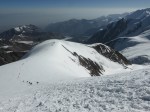
Pik Kommunizma as seen from near the summit of 6230m Pik Chetyreh.

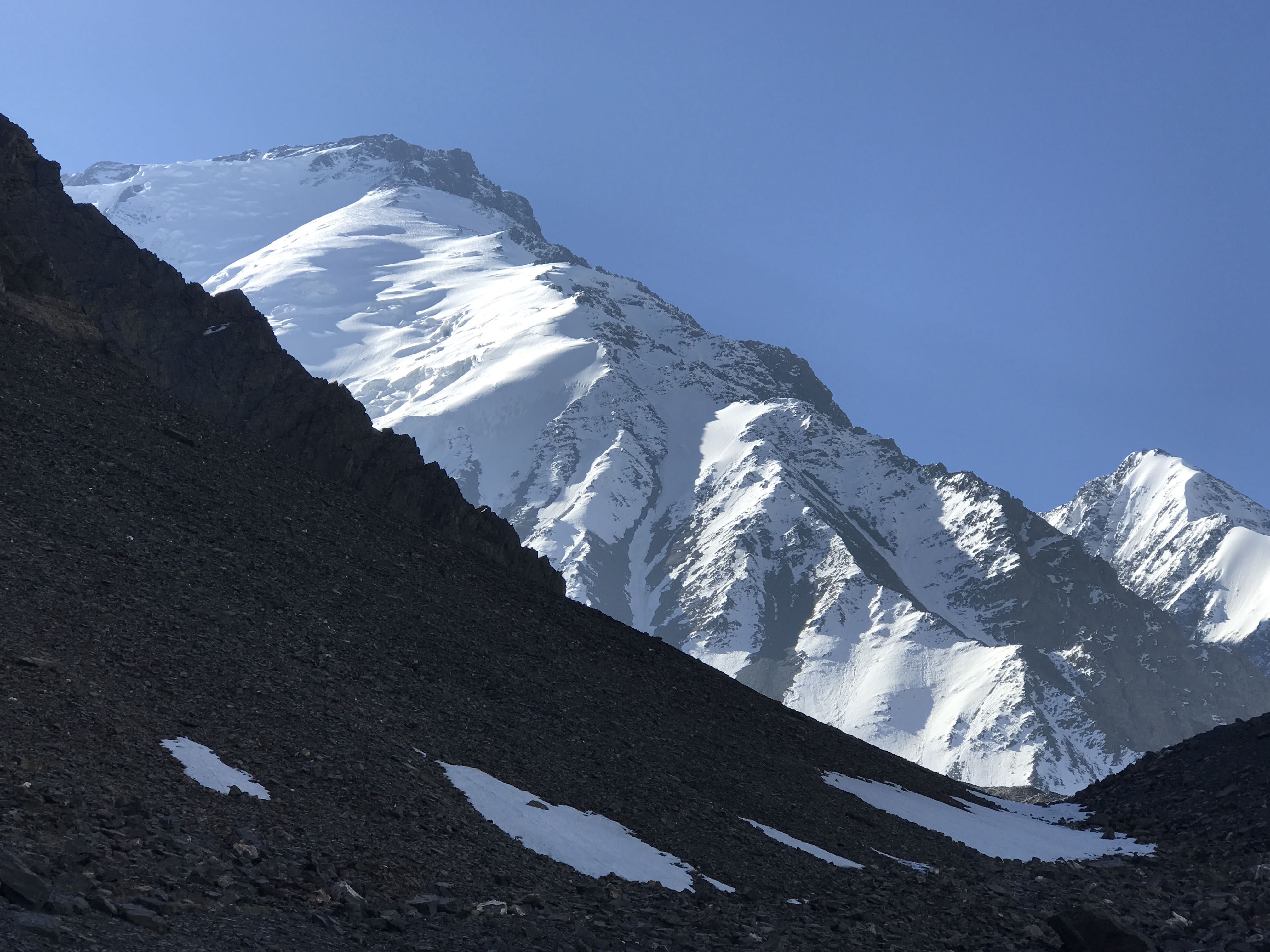
The highest mountain of the Pamir range, the highest mountain of the former Soviet Union, the highpoint of modern day Tajikistan, the world’s 50th highest mountain, one of the five 7000m Snow Leopard peaks. 7495m Pik Kommunizma, renamed as Pik Ismoil Somoni by the Tajik state in 1998, is an absolutely enormous mountain which utterly dominates its surroundings. A primordial axe-head ridge of black rock, Kommunizma rises above the high Pamir Plateau, which is itself guarded on all sides by severe walls and high ridges of shining snow. Climbing Kommunizma by the normal route is akin to climbing three mountains; the ~6250m Borodkin Spur from ~4300m basecamp, 7007m Pik Dushanbe from the ~5850m Pamir Plateau, and finally Kommunizma itself. The normal route is long and circuitous, ‘uphill both ways’, exposed to inclement weather and to some degree of objective hazard.

I first set eyes on Pik Kommunizma in 2018 during an ascent of Pik Korzhenevskaya, a nearby 7105m mountain which shares basecamp. My timing and strategy were insufficient to make an attempt in 2018, but Kommunizma’s presence was nonetheless a constant. The distinctive summit ridge was always there, looming on the horizon, clearly visible from each of the lower peaks which I climbed on that expedition. In 2023 I found an opportunity to return for a proper attempt, and was ultimately successful in summiting.

Basecamp and Access

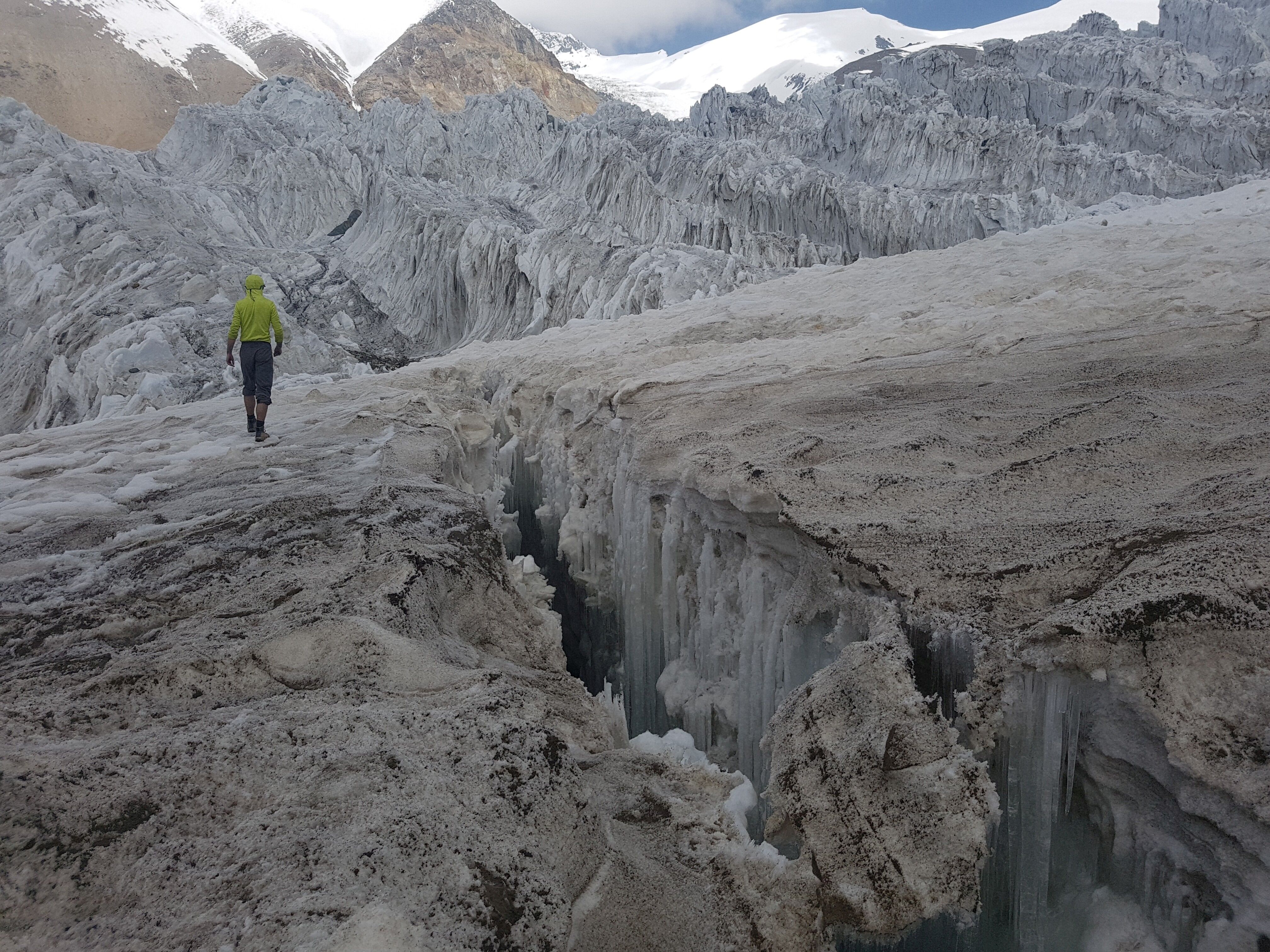
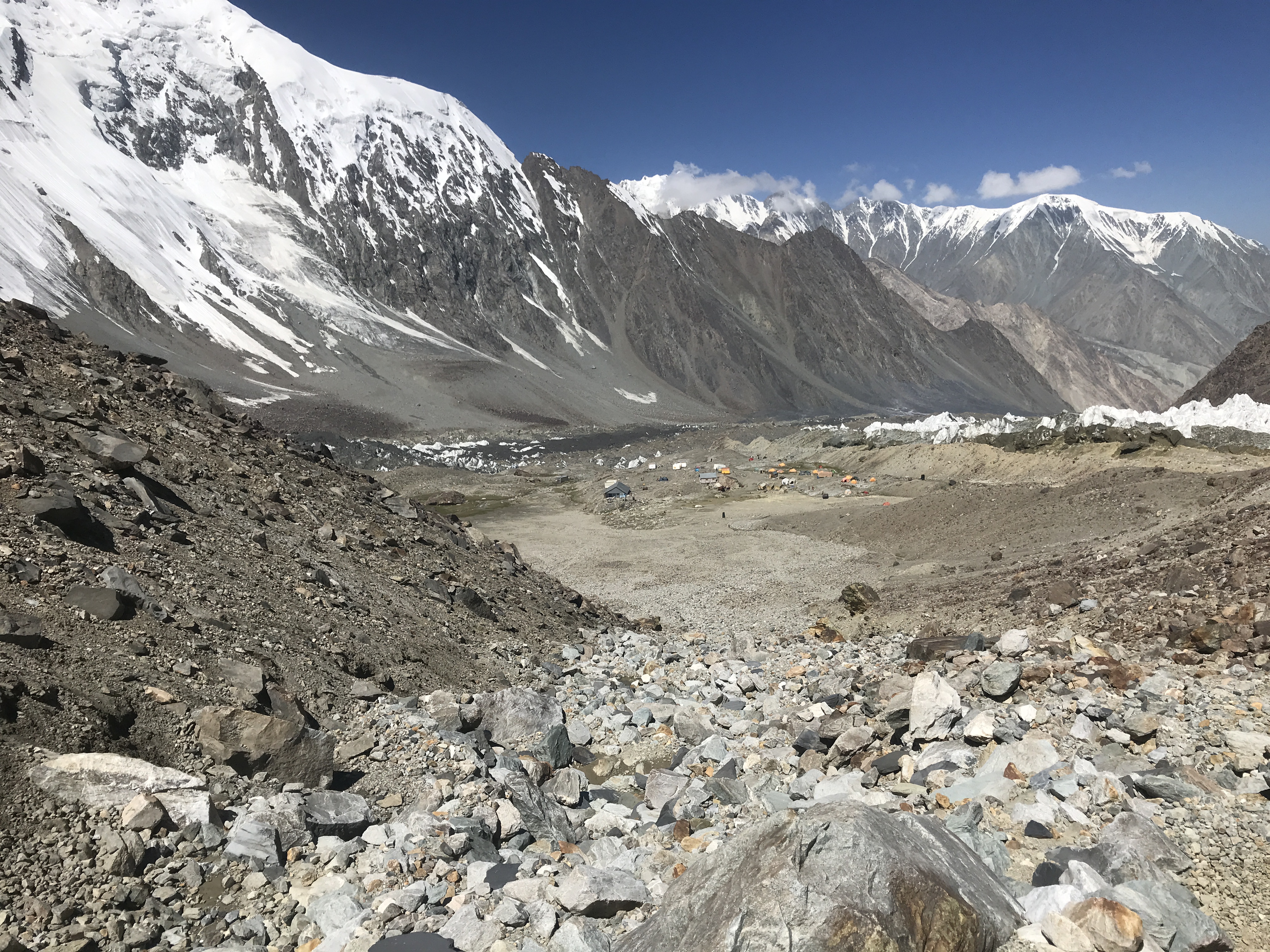
The vast majority of the time Pik Kommunizma is climbed from Moskvina Glades Basecamp, as the normal route and all of the mountain’s most well-known variations begin here.  Moskvina is a decades-old location which has seen use, in various incarnations, since Soviet times – although I did learn during this particular visit that the original basecamp which was employed in the earliest years of the area’s climbing is located significantly lower down the valley than present day.  Moskvina is a rare oasis of greenery in a high altitude desert; there is a small lake (albeit polluted with rusted oil drums, amongst other ancient detritus), enough grass grows to attract herds of mountain goats, and several streams flow in from various glaciers.

Moskvina has been dramatically upgraded and improved since my 2018 expedition to Pik Korzhenevskaya.  It is now one of the better basecamps that I have had the pleasure of staying in.  The ‘old Moskvina’ of 2018 was an absolute dump, rife with food insecurity, stomach issues likely stemming from bad water, poor sanitation, leaky tents, and generally miserable facilities.  The ‘Moskvina of today’ offers 24/7 hot water, a free hot shower at any time of day one pleases, an indoors hand-washing station with abundant hand soap, clean cooking and eating facilities, an excellent revamped Russian sauna, water sourced from glacial runoff well above living quarters, and solid operations management facilitated by Ak-Sai – an operator of good reputation and considerable renown on the Snow Leopard peaks.  The staff at Moskvina this year were competent, friendly, and accommodating throughout my one month stay – especially the kitchen staff and the head basecamp manager. The situation at Moskvina has been massively improved and modernized, and I would be very surprised if there isn’t eventually an attendant rise in climber interest with the area as a result.

The basecamp package cost me $3,300 $USD, inclusive of a shared tent, three meals per day for 30 days (I ended up staying in basecamp between 7.29 and 8.25), all permits, use of facilities, a hotel stay on either end of the trip, airport transfers, and helicopter rides both in and out.  The only area for improvement which I could really pin down as significant, would be the rather limited stock of for-purchase goods such as beer and soft drinks; everything was sold out within a week of helicopter restocking.  The pay-per-use satellite internet connection was somewhat dodgy, but good enough for basic usage and always fairly refunded when non-functional – certainly much better than nothing.

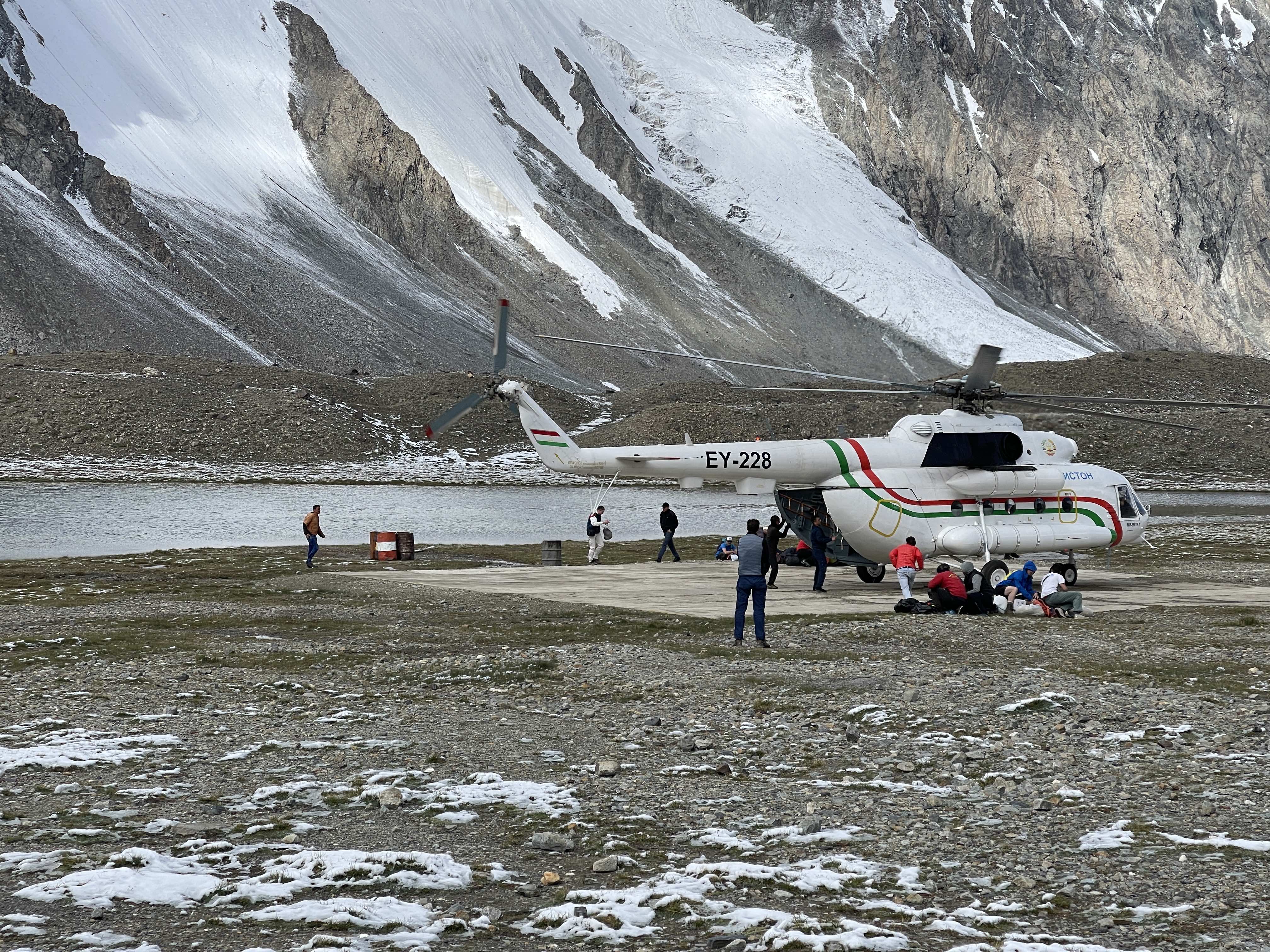
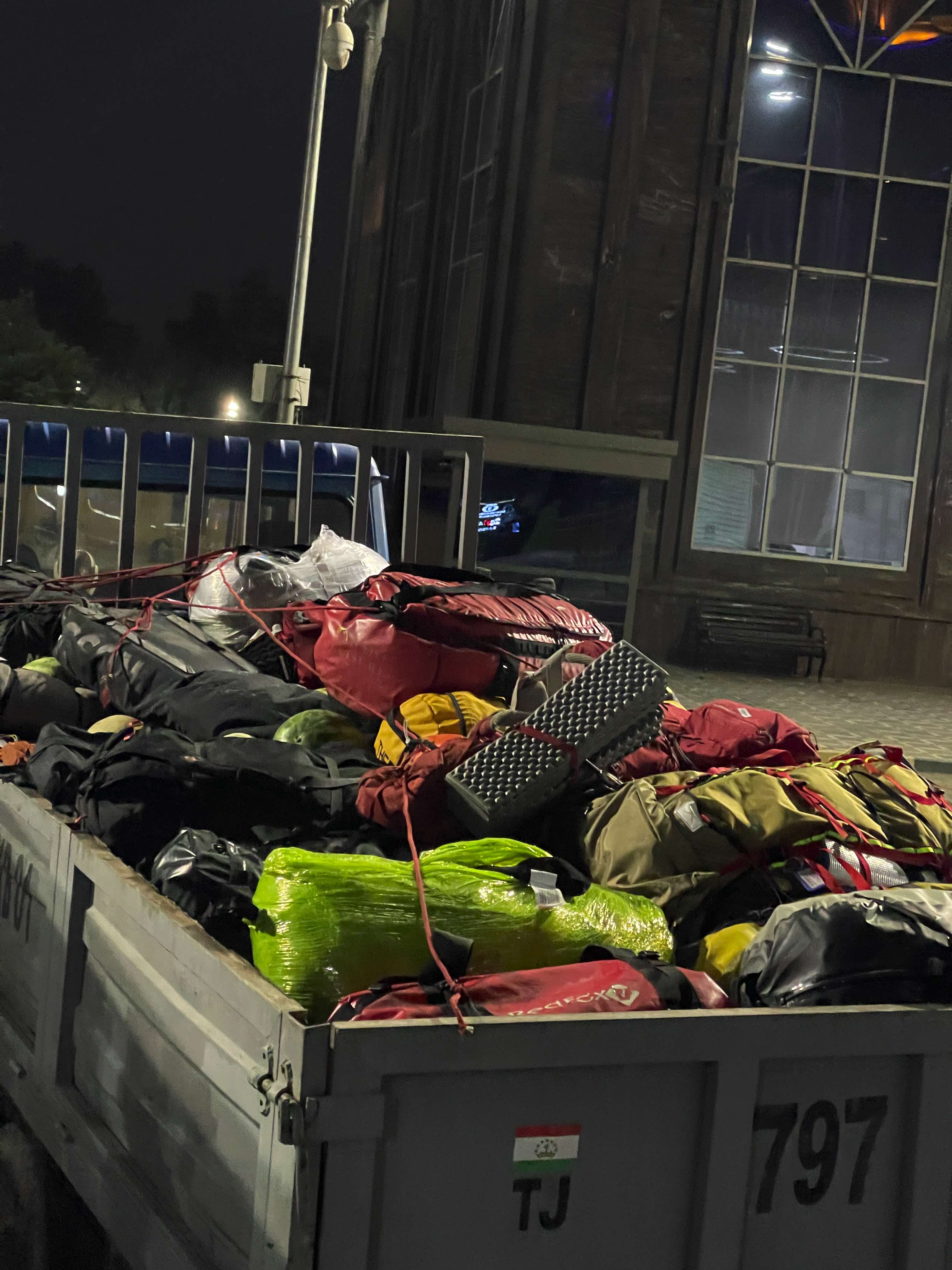
Moskvina is traditionally accessed by helicopter, although the lengthy approach trek is definitely possible and seems to attract interest from a few brave souls every season.  In 2023 most helicopters flew from Djirgital, a small town an 8 hour drive from Dushanbe on very rough mountain roads.  A few flights did run directly from Dushanbe, specifically the first flight in and the last flight out; the helicopter was provided by a Tajik airline this year, and we infer that it is parked and maintained at the Dushanbe airport.  The helicoper flight takes about 40 minutes from Djirgital, and is incredibly scenic, offering magnificent views of the Pamirs and tantalizing first glimpses of Pik Korzhenevskaya and Pik Kommunizma.  Helicopter flights were managed externally, but booked alongside the basecamp package; there’s no independent booking, and the helicopter is specifically offered as a part of the logistics operation for climbers. 
Route Description
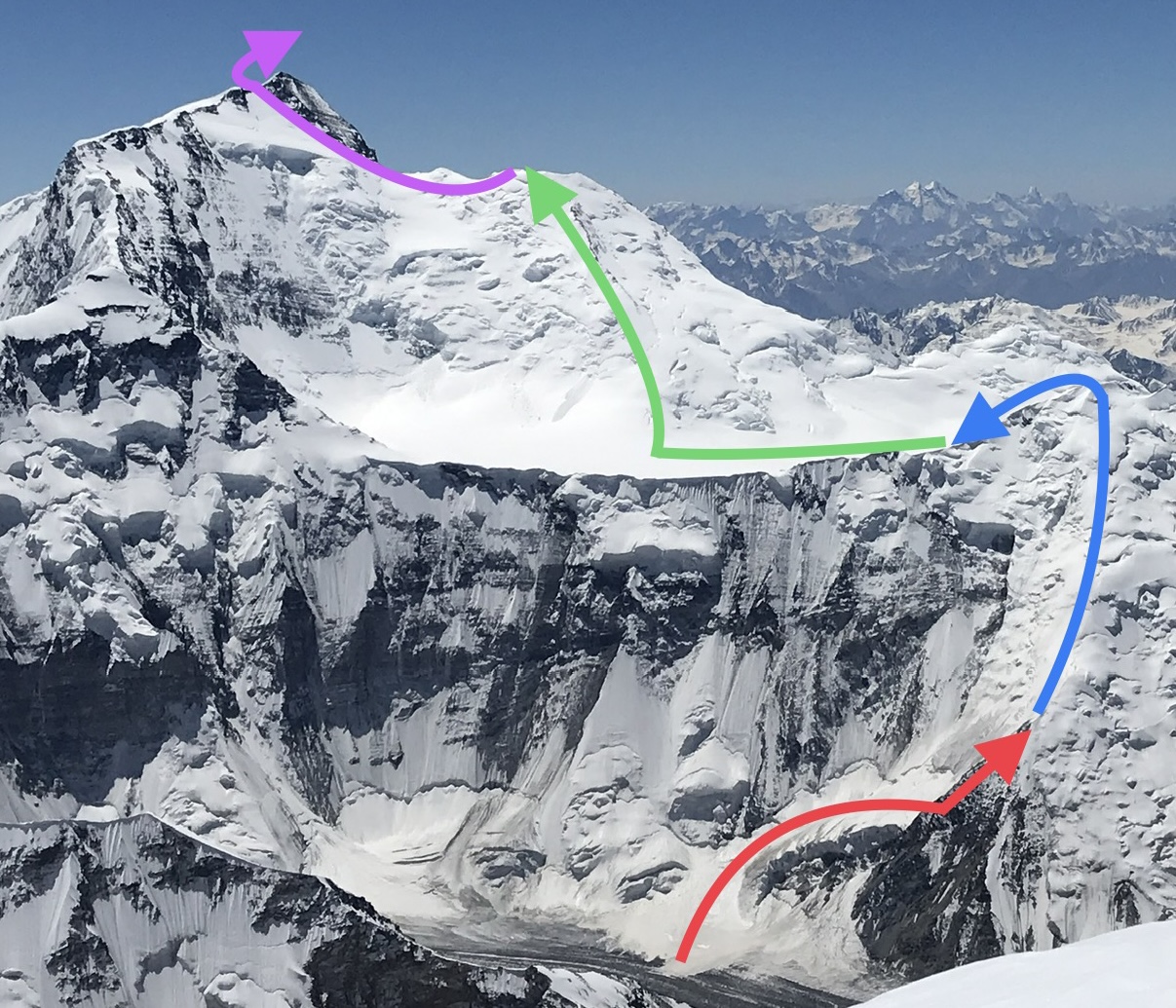
Ramp to ~5200m Rock Camp: Red
~5200m Rock Camp to ~5850m Pamir Plateau: Blue
~5850m Pamir Plateau to ~6950m Pik Dushanbe: Green
~6950m Pik Dushanbe to Summit: Purple

~4300m Moskvina Basecamp to Ramp

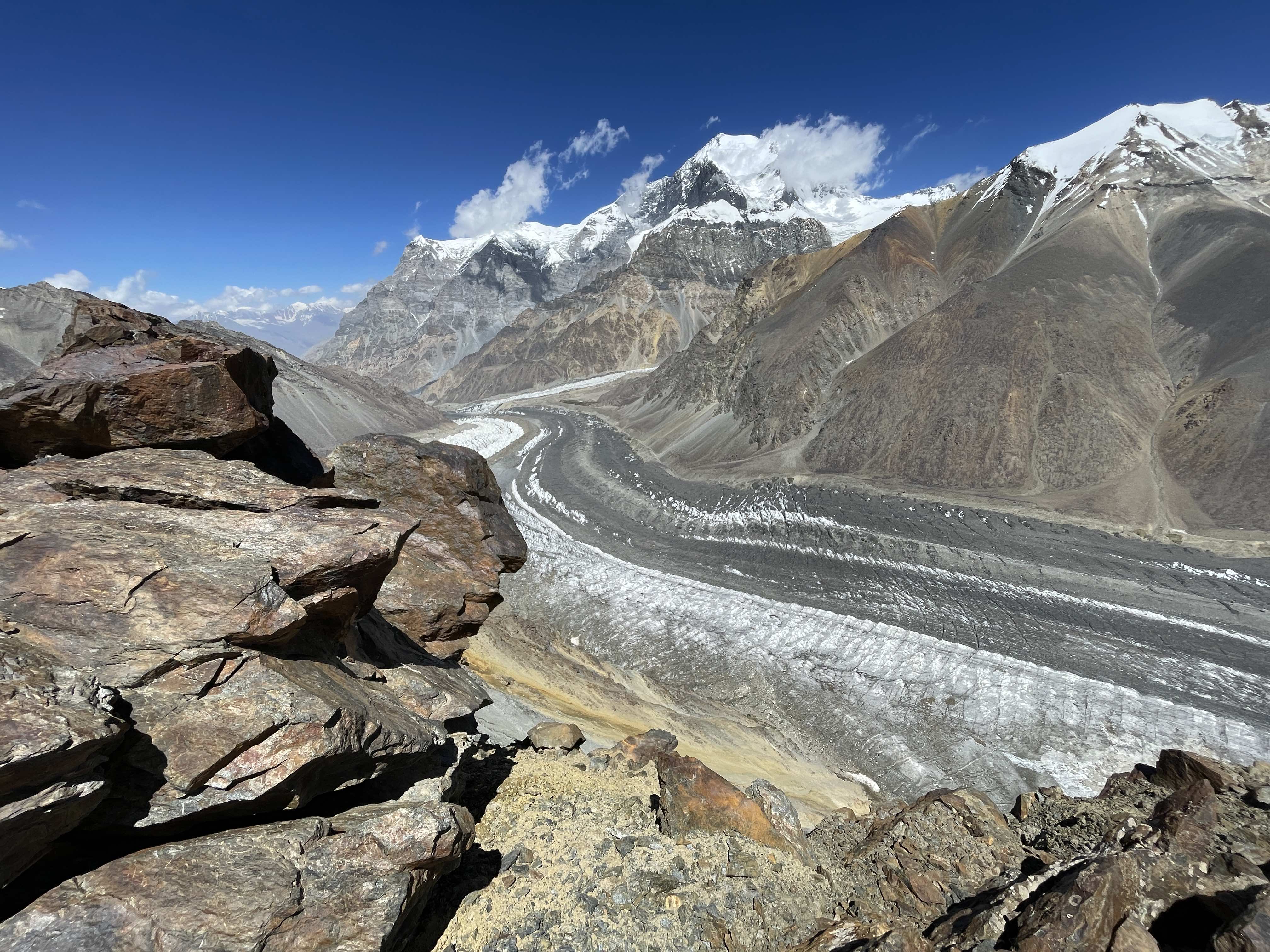
A moderate moraine hike with several variations through the rocks and lower glacier, with one small river crossing. Quite well cairned throughout, straightforward directly up the valley. A wide, open space below the ramp presents a good cache spot, and has a simple helicopter pad marked out with white rocks.

Ramp to ~5200m Rock Camp on the Borodkin Spur
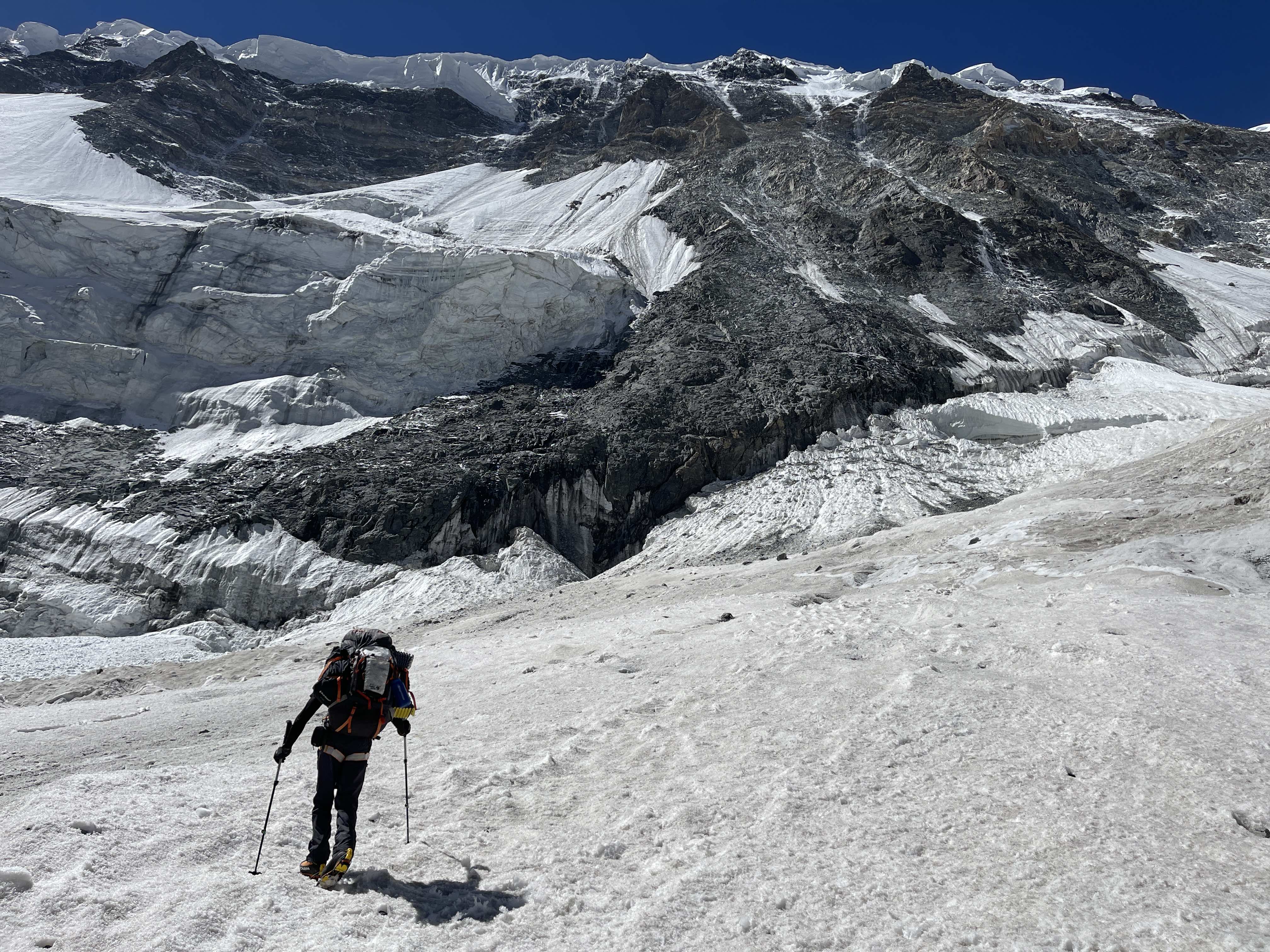
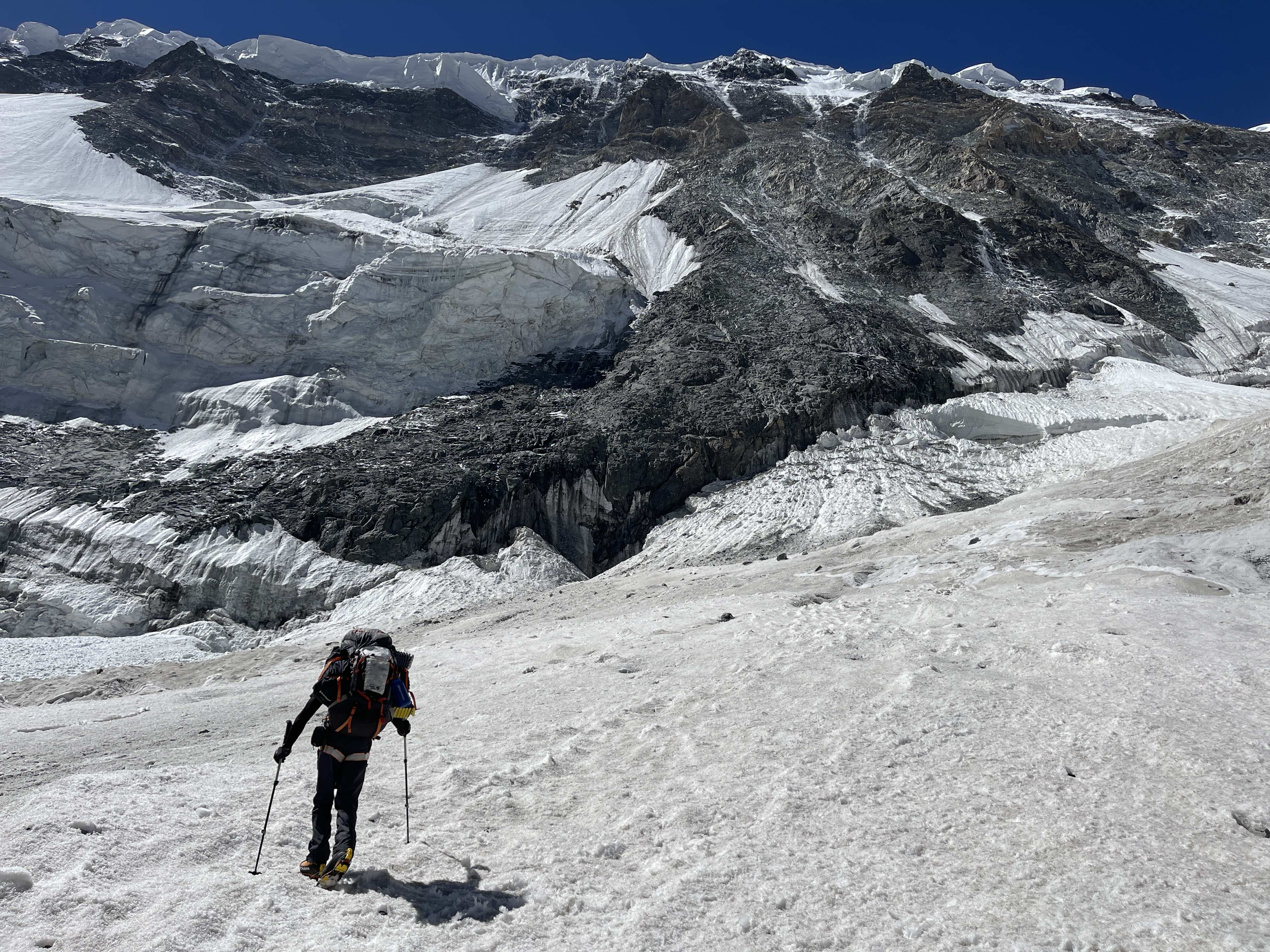
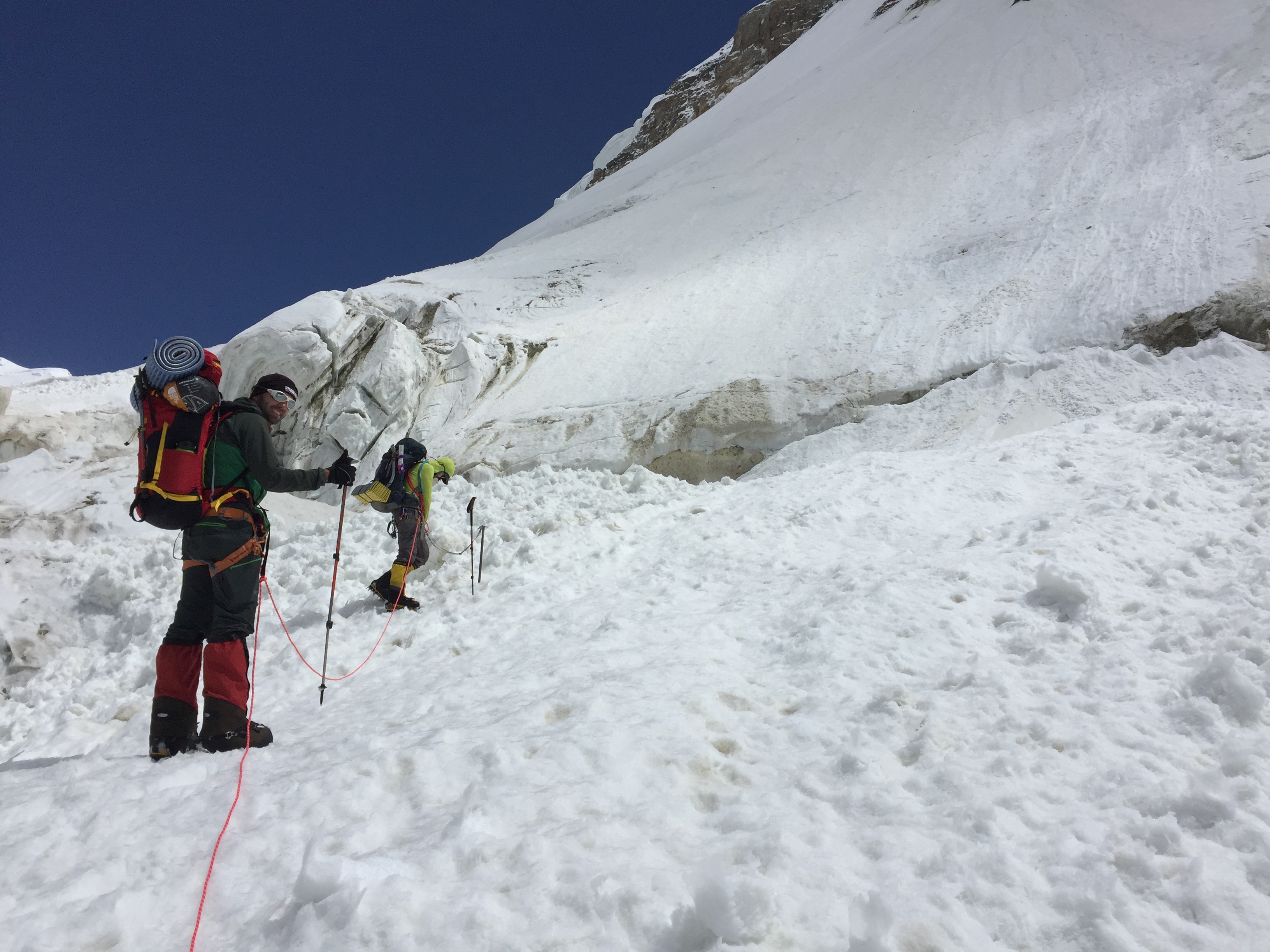
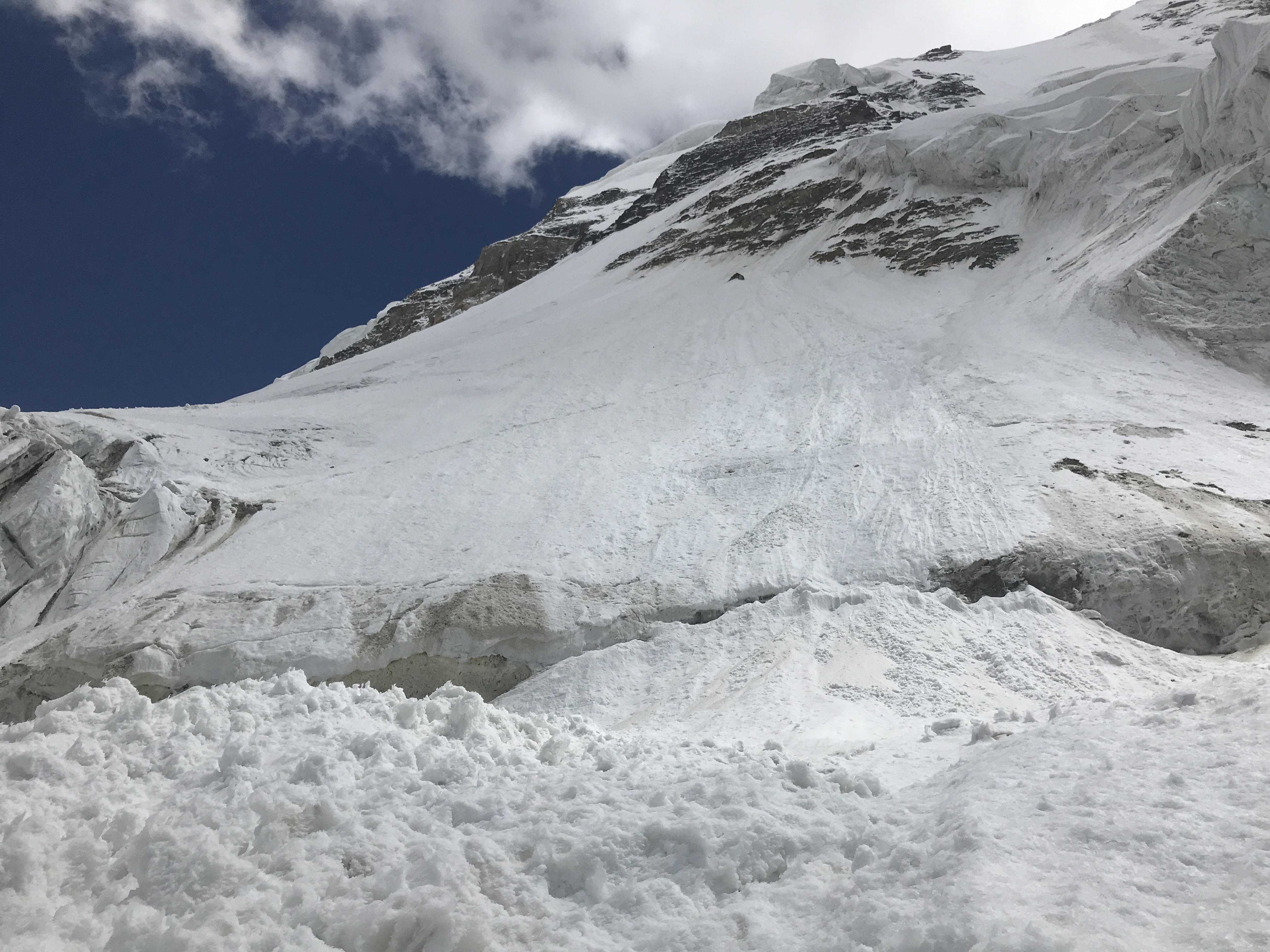
The infamous ramp remains objectively dangerous, exposed to avalanche from serac collapse, but is definitely less risky than in years prior. Conditions were very dry throughout my time in Moskvina this season, and the ramp area was no exception. Most of the giant, hanging seracs seemed to be stable, and only one upper corner was responsible for the majority of releases. Several large slides did hit the route, but never when climbers were present. The largest slides seemed to be in evenings, perhaps due to freeze / thaw cycles. Moving briskly, exposure to the most dangerous sections of the ramp was limited to around 15 minutes on descent. The rockfall and collapsing lower glacier of Korzhenevskaya, found at around 5000m, felt significantly riskier than Kommunizma’s ramp did.

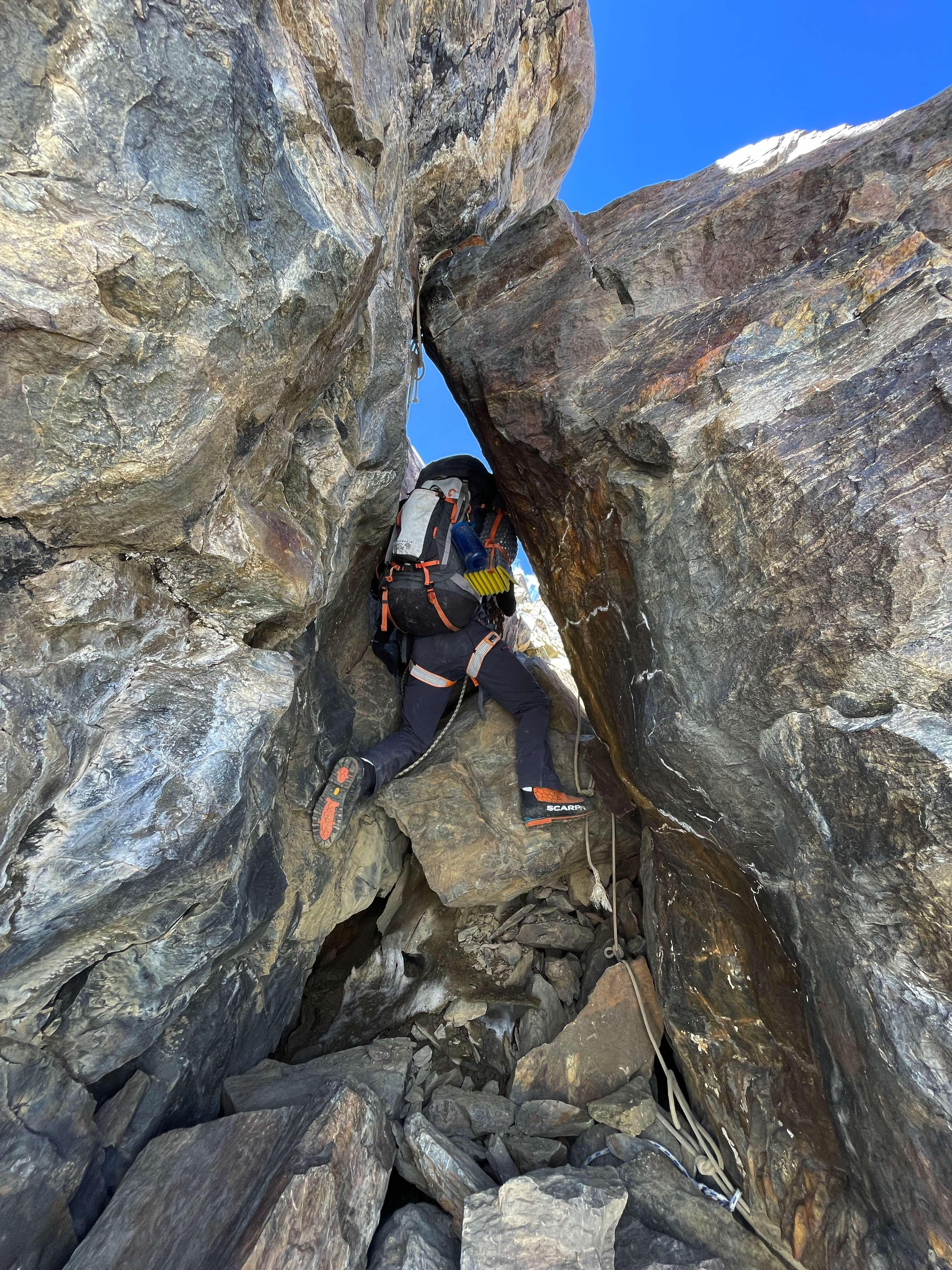
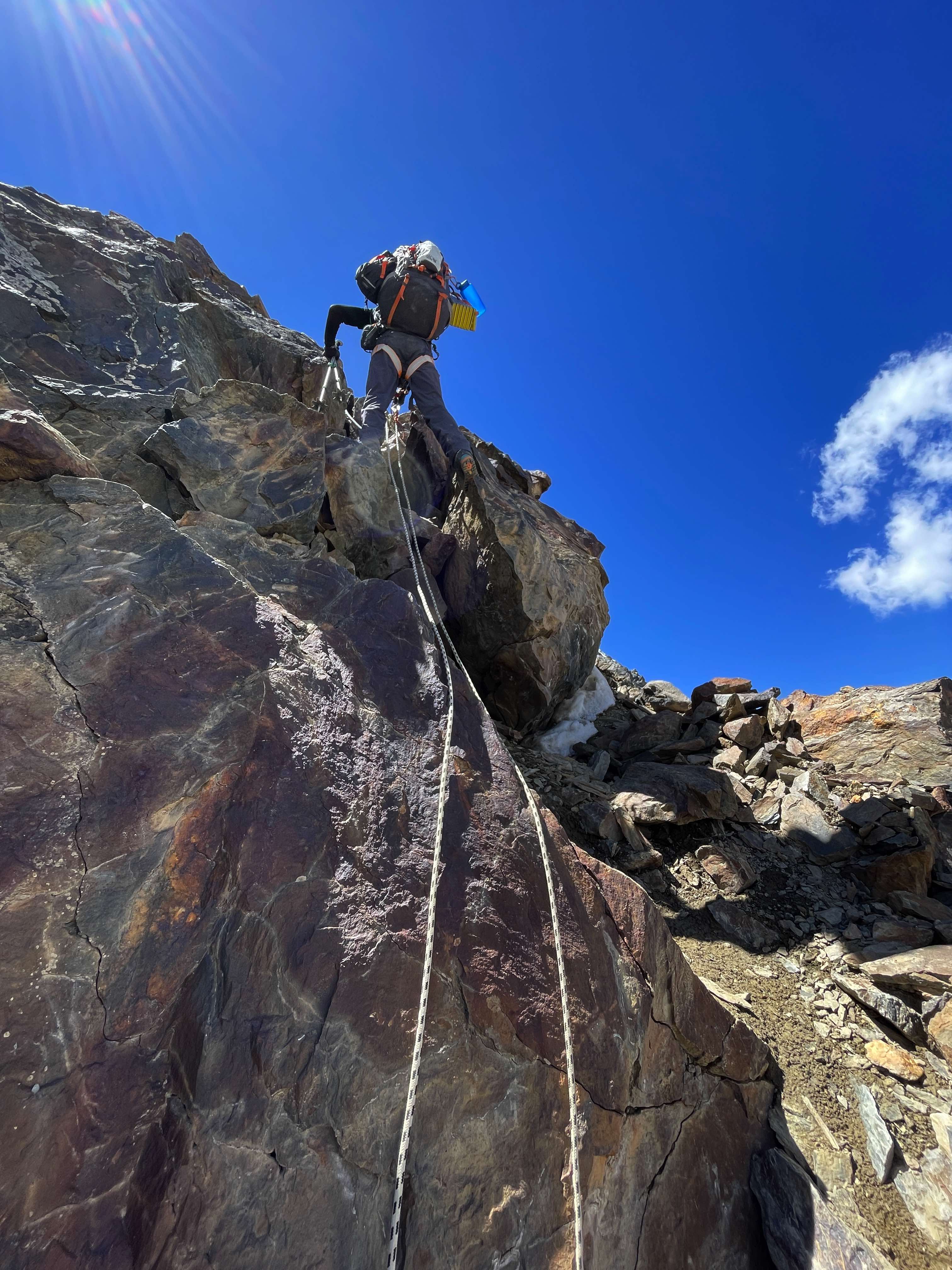
After gaining a few hundred meters up the gently sloped snow ramp, an obvious rock ridge littered with old fixed lines starts up the Borodkin Spur. The rock is pitted and scratched from many decades worth of cramponing; I took my crampons off and was able to actually enjoy the terrain. This was the most interesting part of the entire route, and there is even a cool notch / tunnel which one must climb through. Despite a fair bit of choss the rock ridge mostly offered great scrambling, with exposure and excellent views over the lower glacier. The Rock Camp is found at the top of the ridge between 5100m and 5200m, and has about a dozen good pre-built tent platforms, solid relics from expeditions past.

~5200m Rock Camp to ~5850 Pamir Plateau
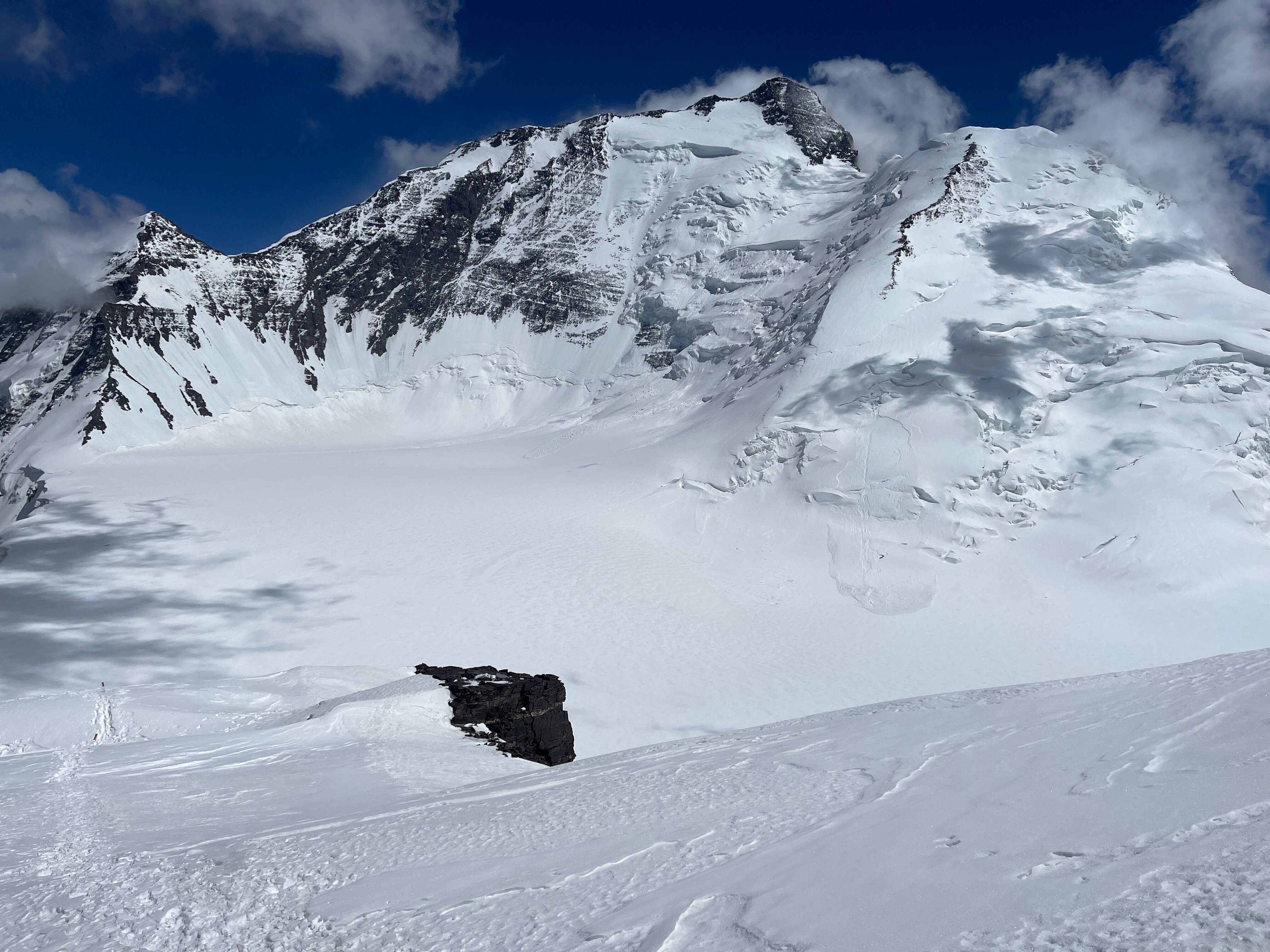
The Borodkin Spur continues on snow past the Rock Camp, up to around ~6250m. Numerous small campsites can be found along the way, mostly underneath cornice formations, but nothing is particularly large and it would be difficult to place more than a few tents. During my ascent I camped the first night at ~5350m, on a level snow shoulder speckled with hairline crevasses. There are several significantly steep sections of climbing, all of which had been fixed by guided parties earlier in the season. Two cornice steps offered difficulty, even fixed, due to slight overhang and exposed ice. On descent several of the fixed ropes had melted out v-thread anchors, and on the way up one section of fixed line was no longer anchored safely. Caution with anchors placed by others, and a spare screw or two, is essential.

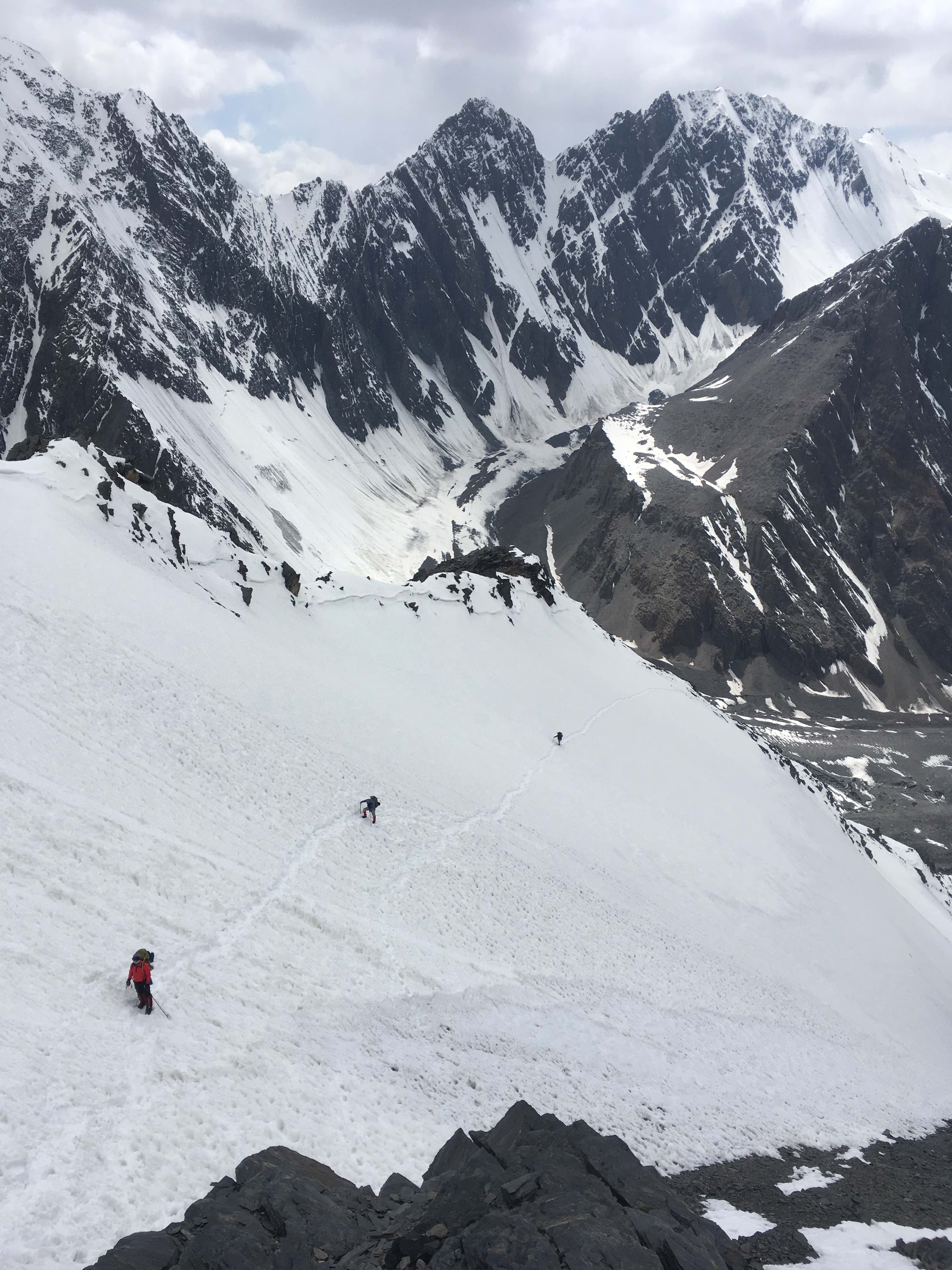
The Borodkin Spur is long and really drags on; cresting the top and getting a first view of the Pamir Plateau below is truly wonderful. The descent from ~6250m down to the Pamir Plateau at ~5850m is mostly quite moderate but did exhibit one significant section of steep and exposed water ice, which we fixed one of our ropes on. Ascending from the plateau some 400m back up the Borodkin Spur after summiting was arduous, and seemingly endless when fatigued.

It is worth nothing that the Moskvina side of the Borodkin was crevassed, with most frozen over or filled but nonetheless present. In the dry conditions which we enjoyed everything was nicely visible, and hazards were very easy to avoid. In deeper snow, or with no boot track, it would be well-advised to consider roping up.

~5850m Pamir Plateau to ~6950m Pik Dushanbe Camp

The Pamir Plateau is enormous and mostly flat; one can camp essentially anywhere. Crossing the plateau isn’t hard at all, and snow conditions were excellent for us. There were no significant crevasses along our line of crossing, nor any nearby it. I can envision significant difficulty if met with deep snow on the plateau, but this would also implicate the entire route, especially the Borodkin Spur.

The ascent of Pik Dushanbe is long and repetitive, a moderate snow slope the entire way. There were no particularly steep sections, and limited terrain variation. A few crevasses lurk along the line of ascent, but were mostly straightforward to see and avoid. A highly visible rocky ridge characterizes the upper half of the slope, and provides a good landmark for navigation. On descent, in whiteout, this rock band easily kept us on route and making good progress. The campsite at ~6950m is located in a nicely sheltered col near the top of Pik Dushanbe, with flat space for quite a few tents. Several much smaller tent platforms exist in the rocks along the ridgeline, with space for one or two tents every two hundred meters or so. Views of Kommunizma’s summit pyramid are grand and imposing from the 6950m camp; the rock wall hangs ominously over Pik Dushanbe and appears much larger close up than from afar.

~6950m Pik Dushanbe Camp to 7495m Summit
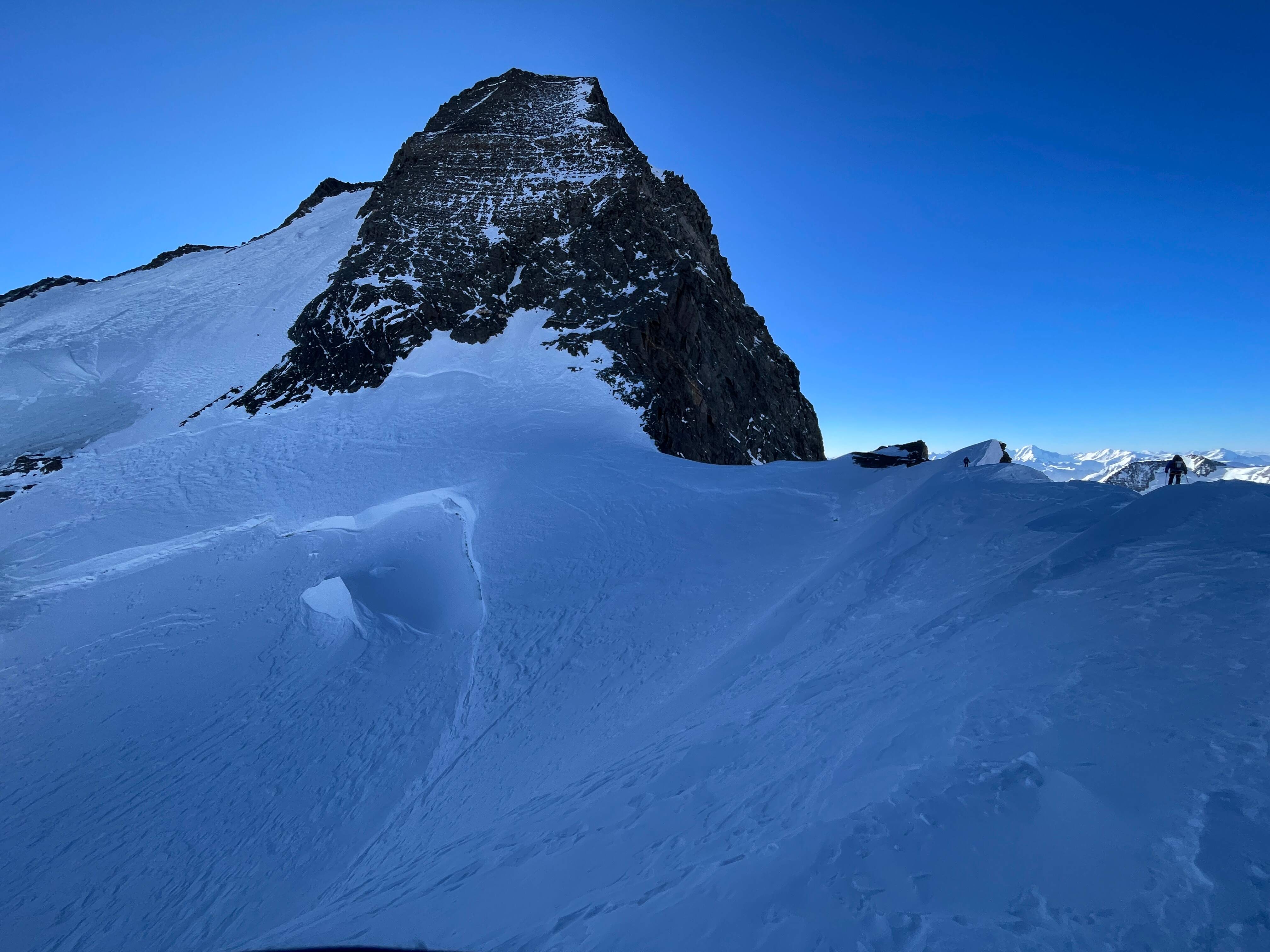
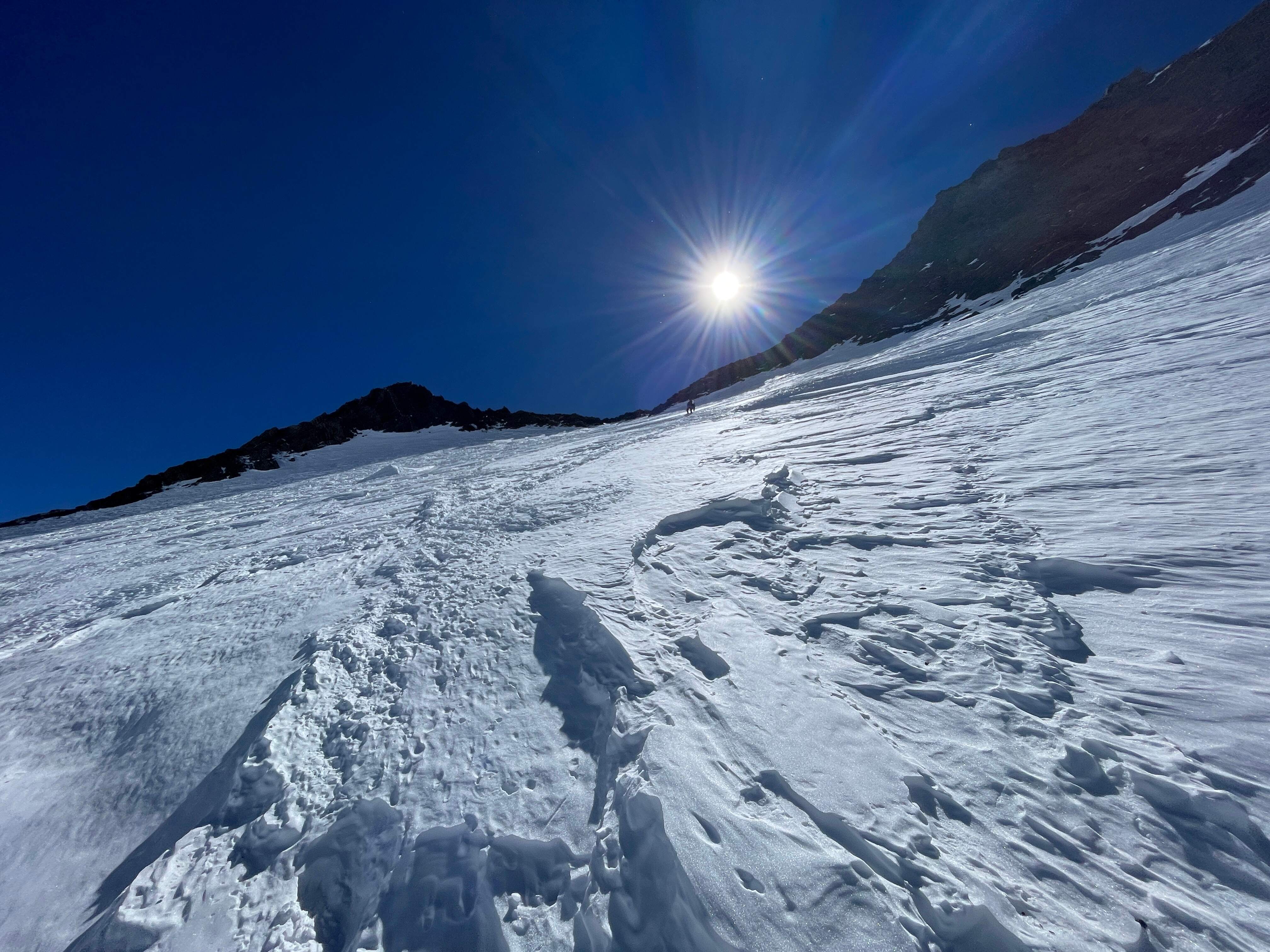
A short descent of some ~100m from camp leads to a rolling ridgeline towards the base of Kommunizma’s summit pyramid. There is a fair bit of ascent / descent throughout this section, more than one would expect when viewing the mountain from a distance, which becomes quite demoralizing when on the way back into camp after summiting. In particular, the final slope back up to 6950m camp is heartbreaking to climb after the summit. The ridge soon reaches the base of the summit pyramid, where a massive snow slope accesses the upper summit ridge. There was a decently switchbacked boot track on our summit day, but no ropes had been fixed by earlier teams. Sections of the face are quite steep, and there were patches of icy terrain where fixed lines or running protection would have been very welcome. A bad fall anywhere on the face would be difficult to arrest, and the subsequent runout is enormous.

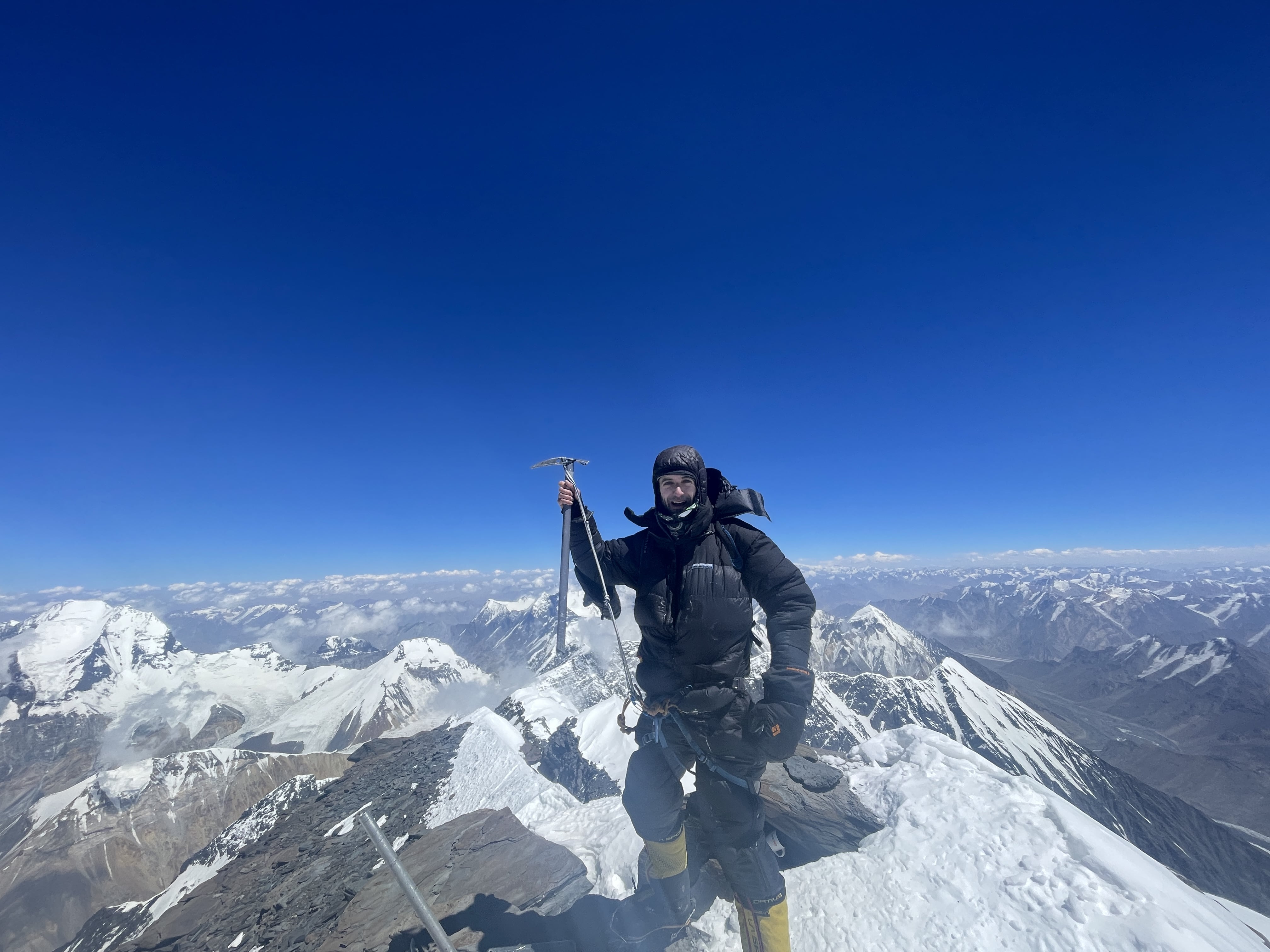
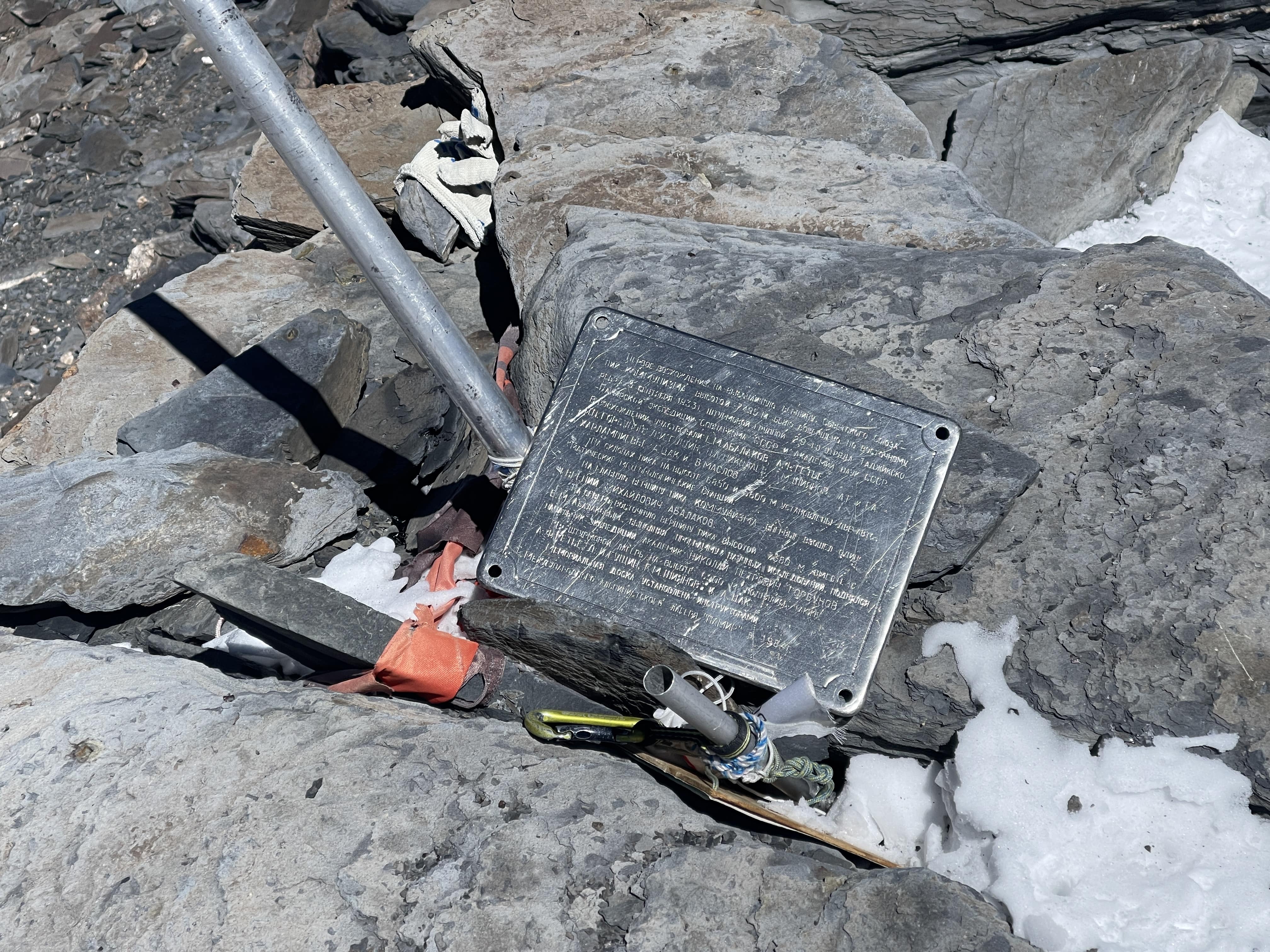
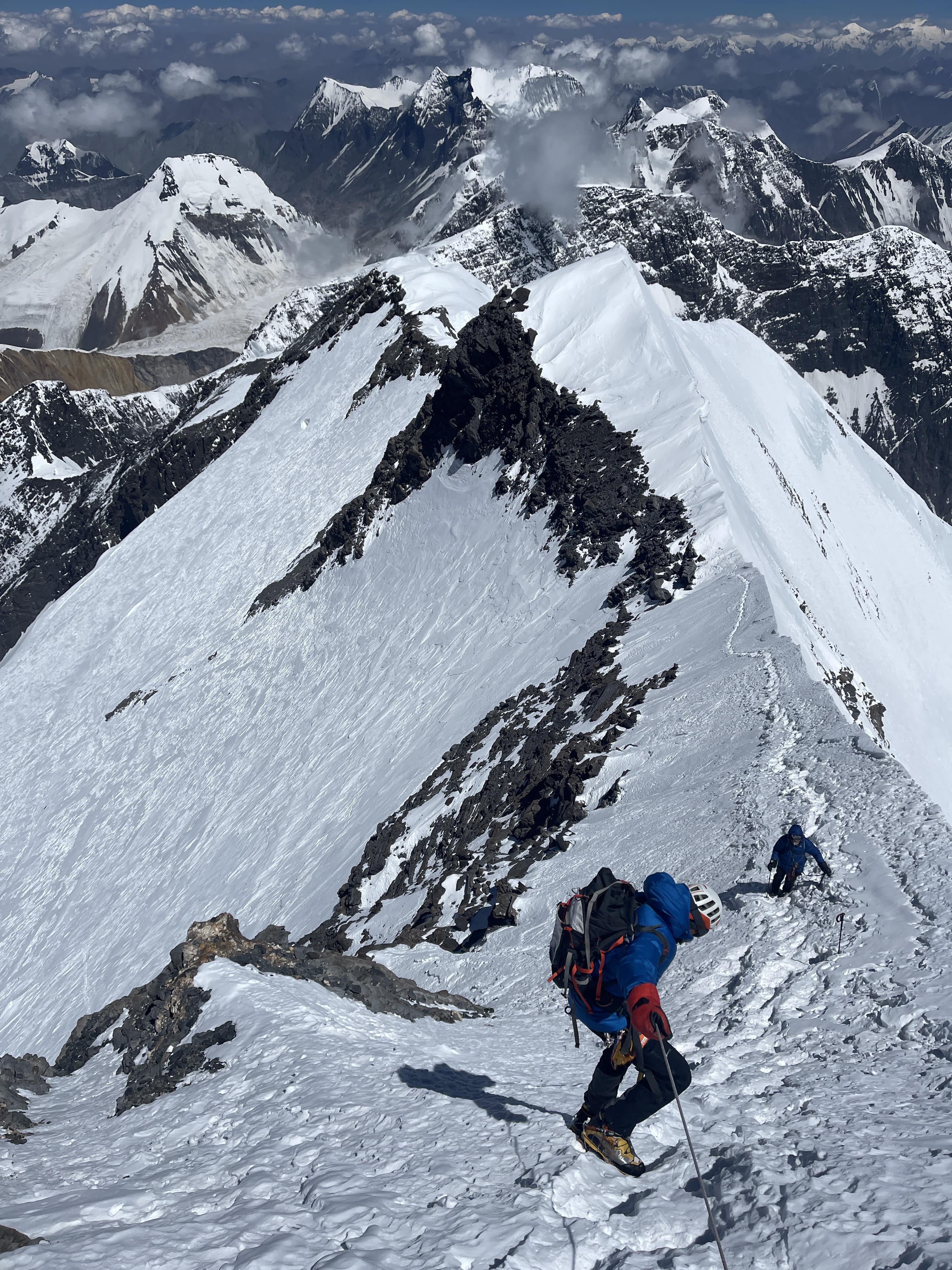
On reaching the upper ridge of the summit pyramid the gradient steepens significantly, and the ridge drops off in a severe cliff. The degree of exposure is startling, as the mountain’s upper aspect provides no clue towards the summit ridge’s sharp edge when viewed from a distance. The sharp ridgeline ascends abruptly, with a slight rolling traverse as one reaches Kommunizma’s summit. A single fixed line was a welcome discovery here, protecting the steepest pitch of the exposed ridge. The summit is small, but flat and unambiguously the peak’s high point. A plaque and some broken poles marked the top, with Pik Korzhenevskaya prominently visible across the valley and the entirety of the Pamirs stretched out far below.

Trip Report and Schedule

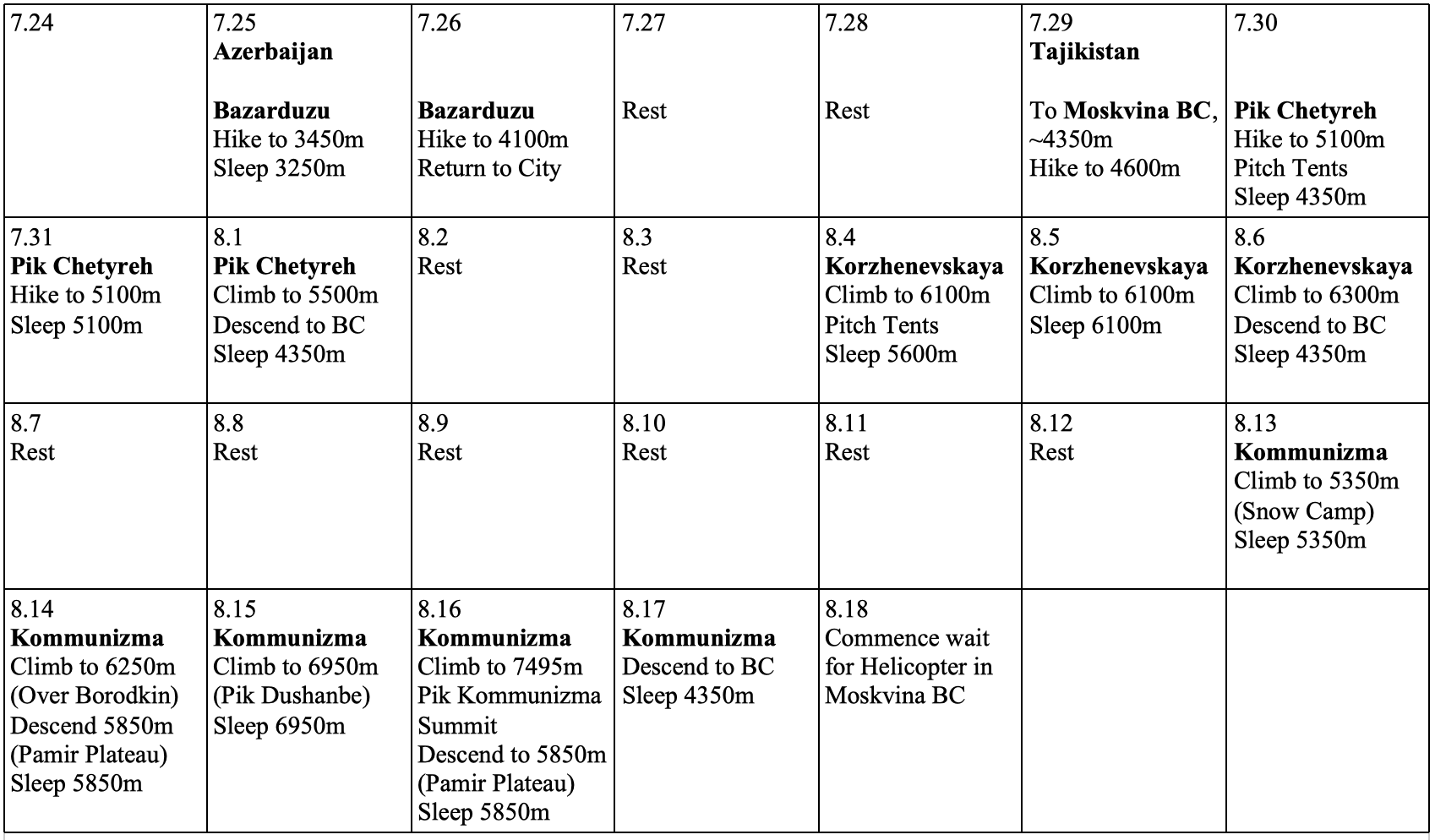
I flew into Moskvina with friends Eric and Andreas, whom I had climbed with in 2019 on Noshaq in Afghanistan.  Prior to Moskvina Glades, Eric, Andreas, and I pre-acclimated by hiking Bazarduzu in Azerbaijan, where I tagged 4100m.  Torrential rain on the only day scheduled for the hike soaked me to the skin, and I turned around well short of the summit.  Once in Moskvina I engaged in two subsequent acclimation intervals on Pik Chetyreh, to 5500m, and on Pik Korzhenevskaya, to 6300m.  Icy conditions prevented our group from attempting a Chetyreh summit, and personally feeling bad on Korzhenevskaya I opted to stop at 6300m and spend a night at 6100m instead of pushing for the summit.  I previously summited both Chetyreh and Korzhenevskaya in 2018.

On this trip Eric, Andreas, and I split the cost for the services of a private meteorologist, Chris Tomer, whose forecasting proved to be remarkably accurate and useful for strategizing.  With a night at 6100m and a high point of 6300m under my belt, I rested for six consecutive days in 4300m Moskvina, waiting for a forecasted weather window with low wind.  This acclimation schedule proved to be more than adequate acclimation for 7495m Pik Kommunizma, likely due to a significant base acclimation period and high quality rest spent at 4300m. 

Following my six day ‘Russian rest’, I started up Kommunizma alongside Paul Schweizer, an experienced friend whom I knew previously from Pik Lenin in 2016, and from Pik Korzhenevskaya in 2018.  On day two I convened with Reuben Kouidri, who alongside Eric and Andreas had opted to make a single lengthy push straight from basecamp, combining what I had split into my own day one and day two schedules.  Reuben and I subsequently shared a tent and stove, and climbed as partners throughout the remainder of my Kommunizma ascent.  We summited together on day four from Pik Dushanbe camp, and descended to the plateau in the same day.

Calendar
Acclimation Graph
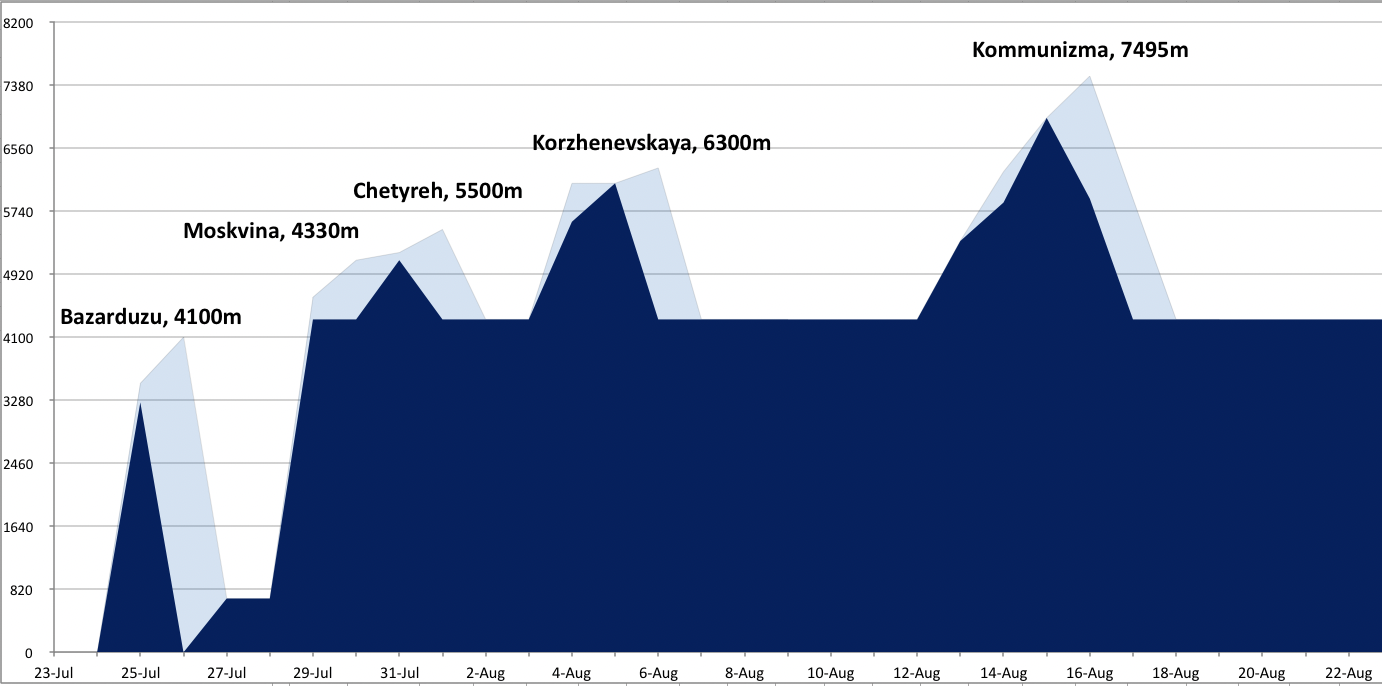
Dark blue depicts sleeping elevation, light blue depicts climbing elevation.

Day-by-Day

Day One: August 13th
~4300m Moskvina Glades to ~5350m Snow Camp
8 Hours, +1050m

Having marinated in Basecamp for about a week, our small band of five unguided climbers – Andreas from Denmark, Eric from the USA, Reuben from the UK, Paul from Scotland, and myself from China/Canada – were all feeling antsy and eager to move. I had been resting very well since coming down from 6300m on Korzhenevskaya, supplementing my Basecamp diet with high-protein food from Dushanbe, maintaining finger strength with simple hangboarding (on my small, one-handed fingerboard) every other day, and doing some light bouldering on (surprisingly decent) nearby blocks when it was warm enough. Our professional weather forecast pointed to low winds and warmer air temperatures on August 16th, and it became increasingly apparent that this would be the best summit day over the coming weeks.

Andreas, Eric, and Reuben planned to wait as late as possible for a firm weather confirmation, and then pull a long first day climbing overnight from Basecamp all the way to the 5850m Pamir Plateau. I had done poorly with the subsequent recovery at altitude following a similarly lengthy 11.5 hour day while acclimating on Korzhenevskaya, and wasn’t keen on straining myself during an ‘approach day’. The long Korzhenevskaya push served as a reminder – after almost four years away from high altitudes – making me cognizant of the ethos which had always worked very well for me on previous climbs; slow and laid back days leading up to a strong summit attempt.

As luck would have it, my fourth friend Paul was both keen to aim for our August 16th summit day and similarly aligned with my aversion to a long first day’s climb. I had initially met Paul on Pik Lenin in 2016, where we climbed together through the lower icefall and to 6000m, and had run into him again at Moskvina in 2018, when I summited Pik Korzhenevskaya. Paul is something of a ‘quiet legend’, enormously experienced and accomplished in the mountains, yet humble and very reserved in downplaying his significant achievements. Paul and I didn’t plan to meet in Moskvina this year, but were happy to run into each other once again. We had always gotten on well, shared a similar enthusiasm, and had a mutual sense of trust in safety standards and competence. Paul had also been up part of the route already, had gas cached on the mountain, and knew conditions well – extremely fortuitous for me! The two of us agreed to climb together, up 1000m from basecamp, to camp at ~5350m on a snow shoulder near the middle of the Borodkin Rib where Paul’s cache was located.

Reuben and I collaborated to pair up after the first day, sharing a tent, stove, and gas supplies. I’d carry the tent up on day one, and Reuben would climb overnight with Eric and Andreas to ‘catch up’ with me, bringing stove and gas, on day two. Reuben and Eric would each carry a radio, for check-in with base camp. Paul graciously offered to share his stove and previously cached gas on day one, saving me significant weight. Paul and I made an early start, taking advantage of the excellent (eggs, and more food than normal!) ‘early alpine breakfast’ offered by the basecamp cook. We set off at a leisurely pace along a well-marked trail, through the moraine up the valley towards Kommunizma. Paul already knew the moraine well, which saved us some trouble in avoiding repeated descents and ascents.

The approach was uneventful, and happily the glacial ramp at the base of the Borodkin was likewise very straightforward and smooth. Two small avalanches did release above us, but were so far off that they didn’t hit, nor even spray, the route of ascent. The ramp is heavily crevassed, but everything was so dry and clearly visible that we didn’t see a need to rope up. The rock ridge past the ramp offered engaging climbing, and I enjoyed the scrambling far above massive glaciers, with awesome views and big exposure on both sides.

Past the rock ridge the snow slopes of Borodkin’s Rib begin at around 5200m, and a dodgy looking fixed rope greeted us, protecting an icy initial section of climbing. Under test strain most of the rope pulled free, some 50m of line. We gingerly ascended up the first section without weighting the remaining lines, rightly nervous of any anchor’s integrity. I finally got high enough to inspect the remaining intermediate anchor, a good v-thread, and confirm that it was safe for us to jumar the line. This process of testing, ripping out, and then inspecting the ropes wasted a fair bit of our time, but it was still only early afternoon and we had a comfortable buffer. We soon found ourselves at Paul’s cache on a flat, but exposed, snow shoulder at around 5350m.

Here we dug a little bit to flatten out tent platforms and then pitched our twin single-walled tents, hairline crevasses conveniently located right at the doorways. I gratefully accepted Paul’s gracious offer to melt snow on his stove and with his cached gas, and managed to eat a huge meal of freeze dried food, cheese, mixed nuts, and snack foods. We settled in for an early rest, and I slept remarkably well throughout the entire evening. The decision to take a slow first day had worked out for me, resulting in a very minor fatigue load, a healthy degree of food consumption, and an excellent night’s sleep at a relatively low elevation.

Day Two: August 14th
~5350m Snow Camp to ~6250m Borodkin Spur
8:30 a.m. – 14:00 p.m.: 5:30 Hours, +900m
~6250m Borodkin Spur to ~5850m Pamir Plateau
14:00 p.m. – 15:00 p.m.: 1 Hour, -400m

Paul and I took our time in the morning, given the relatively short ascent which awaited us. After a good breakfast, again with Paul generously sharing his stove and gas, we packed and were moving by 8:30 a.m. About an hour later we heard voices and saw figures below us; Andreas, Eric, and Reuben had caught up, climbing since around 2 a.m. All three seemed to be in good spirits, and indeed there was plenty to be happy about: a decent boot track continued the rest of the way up the Borodkin, with only a thin dusting of snow over top of it. As we ascended, a large group of Russian climbers descended past us. They were ‘tourists’, on an epic ‘mountain tour’ traverse expedition, and had hiked into Moskvina before summiting both Korzhenevskaya and Kommunizma. Their plan had been to complete a traverse of Kommunizma, descending to some distant village on the side opposite to Moskvina. They had summited Kommunizma some days prior, but one of their members had fallen on descent and been seriously injured; they were headed back to Moskvina for an evacuation. We wished them good luck.

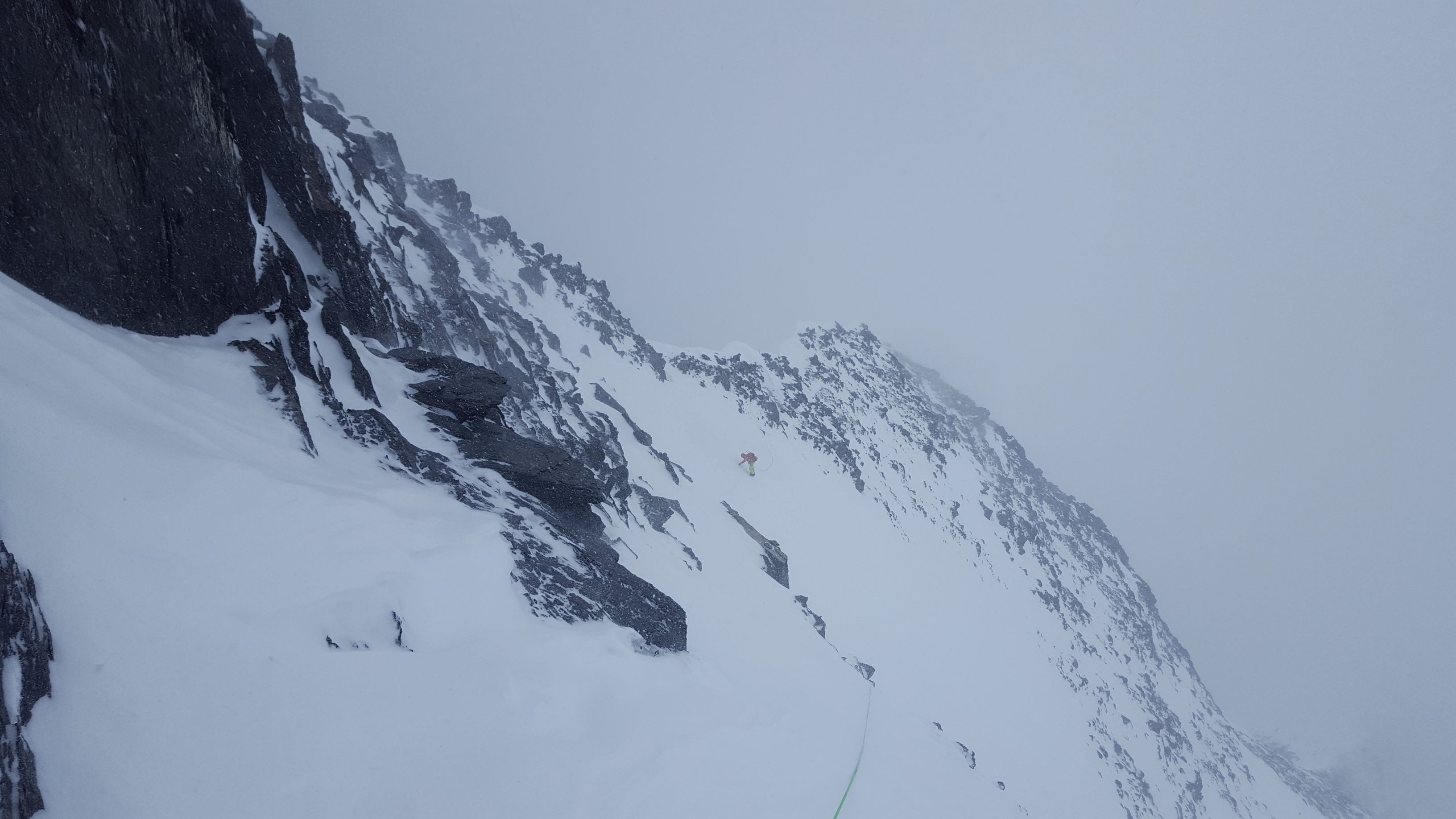
Making steady progress upwards, I reached the top of the Borodkin, around 6250m, at 14:00. The upper Borodkin was viciously cold due to high winds, some of the worst we experienced throughout the five day climb, and it was a relief to find shelter on the far side where the descent begins. The first views of the Pamir Plateau from the top were breathtaking; the plateau is much larger and more impressive than the mountain’s profile would suggest from a distance. The plateau not only stretches out between Borodkin’s Rib and the base of Pik Dushanbe but is also remarkably wide, and falls off starkly to the Moskvina side where it is guarded by severe walls of rock and ice. Pik Dushanbe and Kommunizma preside grandly above the plateau; cresting the Borodkin is akin to having summited a 6000m peak and discovering the lofty base of yet higher mountains behind it.

Descending 400m down the plateau-side of the Borodkin was mostly quite moderately sloped and took one hour, slowed somewhat due to a large patch of exposed water ice which we opted to fix one of our ropes on. Eric proficiently placed two screws, and a treacherous traverse with bad runout became an easy diagonal rappel. On the plateau ahead of us we met Russian guide Pavel and his client Olga, who gave us good advice on the flattest section to set camp. We got our tents up, collected excellent slabs of compact snow for cooking, and settled in for the night.

Day Three: August 15th
~5850m Pamir Plateau to ~6950m Pik Dushanbe
9:50 a.m. – 17:20 p.m.: 7:30 Hours, +1100m

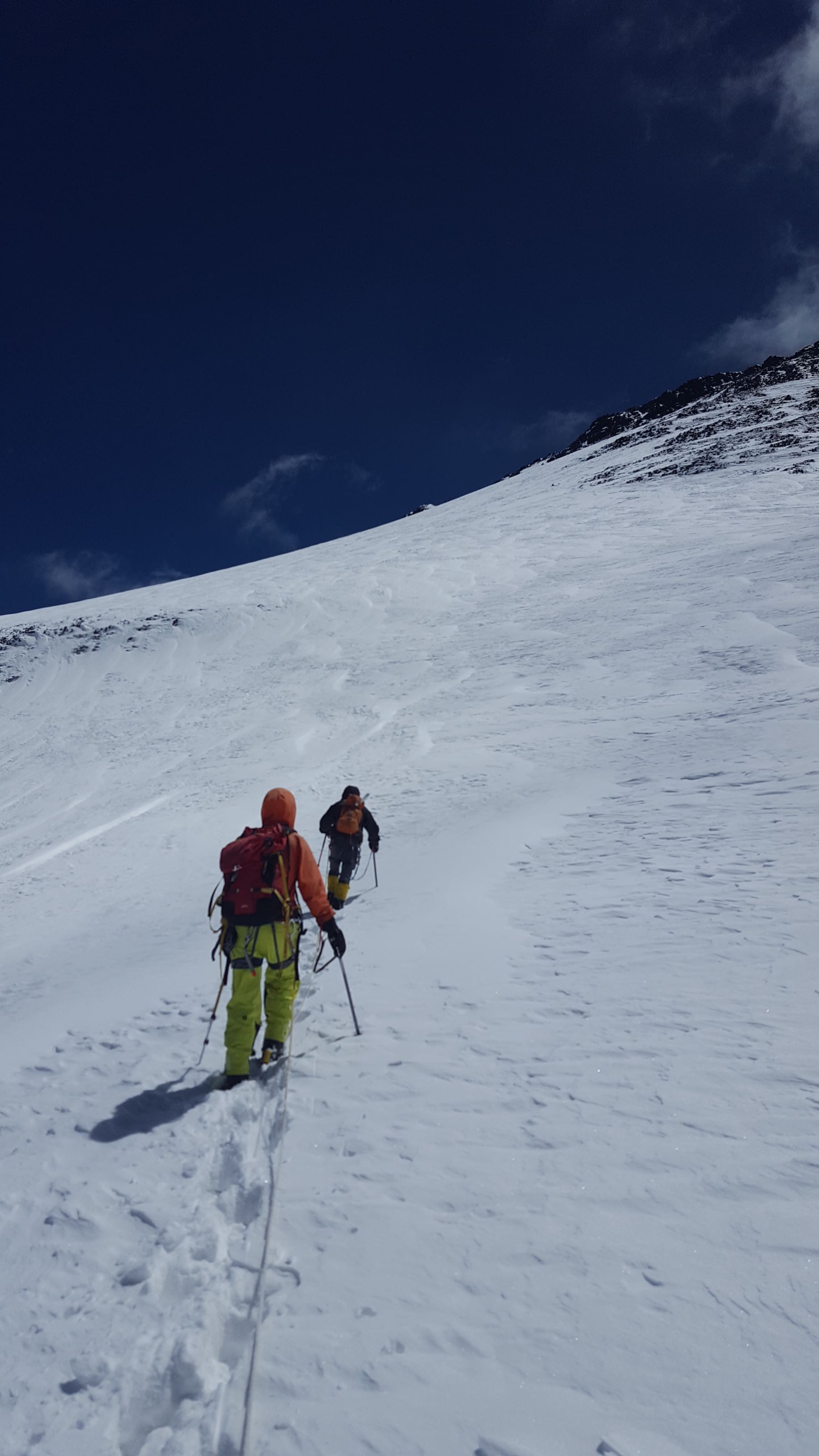
Our group opted for a late start, anticipating a rapid ascent up Pik Dushanbe. We broke camp and were moving by 9:50 a.m. Eric and I opted to rope up and go first on the first section off of the plateau, as visually there seemed to be potential for hidden crevasses. After some 300m of elevation gain it became clear that snow conditions were excellently crisp, everything dry enough for good visibility of any hazards, so we unroped and continued separately.

Ascending Pik Dushanbe was a real slog. The terrain drags on and on with minimal variance in slope or character, an enormous moderate snow slope the entire way, 1100m up. Around halfway up there is a prominent rock band which serves as a clear landmark, with a few small camping platforms dotting the rocks every few hundred meters.

At 16:30 p.m. and around 6700m, Andreas, Reuben and I stopped for a short rest at one such site and briefly discussed the possibility of pitching camp below the 6950m high camp. Eric was already well ahead of us by the time we had stopped, and was out of shouting distance; we couldn’t make out if there were larger sites higher up or not. Andreas committed to high camp, while Reuben and I briefly ran through the pros and cons of stopping where we were. We quickly decided that given we had already somewhat underestimated the timing of our ascent up Pik Dushanbe, we would do poorly to similarly underestimate the summit day by starting too low.

Less than an hour later, at 17:20, Reuben and I reached the 6950m camp. It had been a long day, and a few hours slower than anticipated. In hindsight we probably could have climbed faster or started earlier in the day, but despite it being late the weather was very cooperative; almost no wind. Andreas and Eric had their tent up and were preparing for the night, so Reuben and I likewise focused on getting everything unpacked and organized. Three Russians we had met a week earlier in basecamp – Constantine, Dima, and their guide – were also in their tent, having summited that morning. They had spent several days waiting out bad winds in high camp, but gave us encouraging information on the good condition of the route.

Reuben wasn’t feeling well at all, and complained of blurry vision and stomach issues – he had significant trouble eating, and vomited up most of his food. To make matters worse, when helping him dump a bag of chocolate mousse I accidentally managed to spill most of it onto his outer boot shells!

In the tent, small tasks at this high elevation felt slow and difficult, and I was generally uncoordinated – as evidenced by the chocolate spill. Yet in spite of this I generally felt pretty decent, and was able to eat a fair amount of my cheese, sausage, and snack foods for dinner. I boiled water nonstop, right until sunset, and contentedly drank over a liter of tea, plus a big bowl of sugary hot chocolate mixed with whey protein. Paul arrived late, right at sunset, and I greeted him with a half litre of hot water. We went to sleep early, planning for a 5 a.m. start, and I slept quite well given the elevation.

Day Four: August 16th
~6950m Pik Dushanbe to 7495m Pik Kommunizma Summit
6:45 a.m. – 11:45 a.m.: 5 Hours, +545m
7495m Pik Kommunizma Summit to ~6950m Pik Dushanbe
12:00 p.m. – 14:20 p.m.: 2:20 Hours, -545m
~6950m Pik Dushanbe to ~5850m Pamir Plateau
17:45 p.m. – 19:45 p.m.: 2 Hours, -1100m

I woke up at 4 a.m. and began preparing for a 5 a.m. start to our summit attempt. In lieu of cooked food I ate a bowl of dry muesli, some energy gels, and a large hunk of Tajik cheddar cheese. The stove fired up, but the first of what would soon become many problems reared its head when it became apparent that our gas canister had frozen overnight, despite our storing it inside of the tent. With the gas flowing at a pathetic dribble, just barely hissing into the burner, melting snow was taking an inordinate amount of time. A second problem; Reuben’s only Nalgene water bottle cracked when we filled it, spilling water and rending it useless for a summit bid. The third issue; Reuben’s boot lace snapped, likely due to the mousse that I had spilled on the boots the day prior freezing solid overnight. Fourth; I managed to capsize a full litre of melted water, wasting it, after waiting over an hour to prep it. Fateful bad luck and the consequences of minor carelessness were conspiring against us.

Andreas and Eric managed to depart on time, at 5 a.m., and Paul shared some water before heading out shortly after them. While the various mistakes and setbacks which Reuben and I experienced read as trivial in writing, they posed rather significant challenges at 7000m. We moved slowly, with diminished cognitive alacrity. We swapped an empty soda bottle for the busted Nalgene, carefully tied the boot lace back together, slowly warmed our gas can, and borrowed Andreas’ stove from his tent (we had cached about 1 kg of spare gas on the plateau, and an abundant supply at Pik Dushanbe Camp) so as to run two burners simultaneously. Reuben and I, in reflection well after the fact and in a nice restaurant at sea level, both agreed that we handled these setbacks well; we cooperated, communicated, stayed as focused as we could, and eventually sorted everything out.

Nonetheless, we departed almost two hours later than intended, at 6:45 a.m. This could have been catastrophic for us, but we managed to maintain a healthy pace and make up for lost time. We descended from Pik Dushanbe quickly, following Eric, Andreas, and Paul’s boot tracks across the ridge line. This initial ridge section involved more descent than I had expected, but eventually terminated at a small rock band, the base of Kommunizma’s upper face and summit pyramid.

The upper face presented an endless slog, but happily, mostly on visible boot track. Constantine’s tracks from the morning prior were still in place, and Eric, Andreas, and Paul had further beaten them in. Time dripped and crawled during the climb up the face, my complete focus dialed into each step’s crampon and axe placement. The terrain was fairly steep, with some small sections of water ice, and a fall would have been difficult to arrest well. Ahead, I saw Andreas and Eric traverse left off of the switchbacks that Reuben, Paul, and I were ascending; a voice came over Reuben’s radio, Zaravko the basecamp manager, watching through a telescope and telling us to continue climbing directly. I passed Paul, we wished each other luck, and I continued after Reuben up the switchbacks. Andreas and Eric came into visibility on the ridge above us, moving fast towards the summit. Carefully passing a final 5m section of sketchy water ice, I eventually reached the summit ridge at the rightmost snow notch.

The exposure was incredible, with the face dropping off abruptly and a sharp ridge line extending up to the right. The Pamirs spread out below under a deep blue sky, dozens of 5000m and 6000m peaks, stark contrast between black rock and white snow. Behind us Korzhenevskaya presided with particular prominence, standing alone over the lower glaciers, its long summit ridge and route of ascent perfectly framed against the sky. Reuben was just slightly ahead of me, as the two of us began up the ridge towards the highpoint.

Andreas and Eric met us halfway up the ridge and offered encouragement, telling us that we were almost there. I congratulated them; they had both completed the five Snow Leopard peaks with their ascent of Kommunizma, and just had to descend safely. Fifteen minutes later Reuben and I were both at the summit, a small, flat, unambiguous high point marked with a plaque and some debris. We hugged, shook hands, and started quickly taking photographs. It had taken us almost exactly five hours to summit from Pik Dushanbe, a superb outcome in light of our haphazard start in the morning. The wind was sharp and biting at the top, so we quickly began to descend. We met Paul at the notch, exchanged greetings, and started down the face.

The descent required total concentration. The face is fairly steep, and sections of ice were tricky to navigate with only a trekking pole and a long axe. The ridge back to the base of Pik Dushanbe was miserable, each uphill section taxing my resolve. Pik Dushanbe itself was a hideous slog, and felt like significantly more elevation than it had on the way down. When I finally reached camp Eric and Andreas greeted me with a half litre of hot water. I told them I’d wait for Reuben, and we agreed to meet down in the plateau camp, using our satphones to coordinate if anything happened. Camp was sunny and sheltered from the wind, so as Andreas and Eric finished packing and departed I lay down in the tent to take a nap. Reuben arrived about an hour later, feeling exhausted; we agreed to sleep for one hour and then descend.

My alarm clock woke us up on time, and we began packing up. The weather shifted, and thick cloud socked us in with low visibility. Without wands marking the top of the route up Pik Dushanbe, we wouldn’t even have been able to make out the correct direction of descent. Paul arrived right as we finished packing, and told us that he intended to spend the night at Pik Dushanbe camp and descend in the morning. I asked Paul “Would you go down in this weather?”, to which he replied “No. But, you’ll make it”. Filled with renewed confidence and resolve, Reuben and I hoisted our packs and headed into the swirling mist.

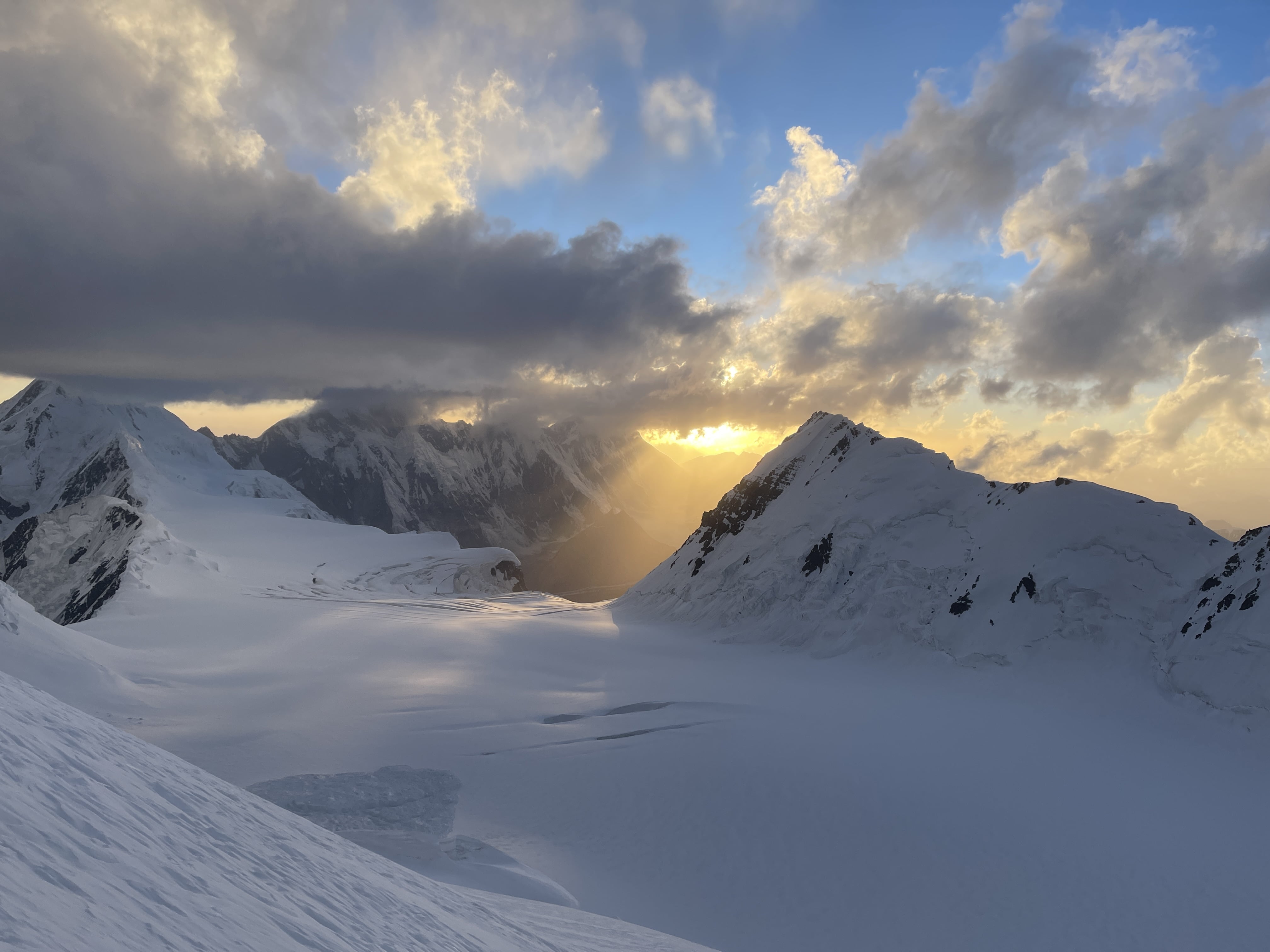
The hike down took forever, the two of us fatigued and struggling somewhat through a few inches of freshly fallen snow. Between whiteout and snowfall, our old boot tracks were almost impossible to make out, but the rocky ridge served as a landmark and compass, keeping us on track along the ridge proper. After a few hours we broke below the clouds and could see the plateau laid out below us, under the glow of a glorious sunset. Andreas and Eric’s tent was clearly visible in the distance, below the Borodkin, but we both felt too worn down to cross the plateau and join them. Reuben glissaded the final few hundred meters of descent, and we pitched our little single-walled tent on the first flat stretch of snow we came across. We felt much better having descended some 1100m, and despite the whiteout hiking down had been the correct decision. We boiled water, ate some light food, and fell asleep.

Day Five: August 17th
~5850m Pamir Plateau to ~4300m Moskvina Glades
10:50 a.m. – 18:30 p.m.: 7:40 Hours, +400m / -1950m

Reuben and I slept in late, and awoke to hot sun and high wind on the plateau. We really dragged our feet, and took our time getting ready. We met Tomas and Martin, two strong Czech brothers who had skied Pik Chetyreh and Pik Korzhenevskaya in the weeks prior, as they crossed the plateau towards Pik Dushanbe. They would go on to summit Kommunizma and ski most of the descent. Reascending the plateau-side of Borodkin’s Spur was awful, our pace miserably slow. Our fixed rope was still in place on the iced-over section, and we stopped to recover my two ice screws, re-anchoring the top of the rope on a v-thread. This would later prove to be a mistake, as a day later Paul would find the rope unusable, the lower section inaccessible.

Cresting the Borodkin, our pace rapidly accelerated once on downhill terrain. We quickly found ourselves at the top of the ramp, fresh with avalanche debris, and we hustled across so as to minimize exposure. At the helipad we changed into approach shoes, an enormous relief for feet accustomed to stiff mountaineering boots. The trek back to basecamp was sloppy, our wobbly legs uncooperative on loose scree, and we both lost our footing more than once. Basecamp eventually came into view, and before we knew it we were crossing grass. Eric and Andreas greeted us, offering congratulations and sharing handshakes. After dropping my bag I immediately cracked the celebratory 1.25L bottle of Coca Cola I’d purchased ahead of time, and headed inside the kitchen hall to try and scrounge up some fresh food.

The climb was truly over, we’d made it safely back. Paul would join us in Moskvina two days later; all five of us succeeded. Eric and Andreas departed a few days later, hitching a ride on the Russian ‘tourist’ evacuation helicopter. They subsequently ascended the Uzbekistan and Turkmenistan highpoints, surveying and establishing a new Uzbek highpoint in the process, and also completing the highpoints of every one of the ‘stan countries. Reuben and I would wait 9 days for the scheduled helicopter to take us back to Djirgital, and then spend an entire day driving back to Dushanbe. The wait, while boring, served the purpose of solidifying and preserving my acclimation for subsequent mountain goals in September.

Images
Thoughts on Pik Kommunizma

Pik Kommunizma presents an enormously long route, about 3600m of altitude gain, and quite a lot of slogging up moderate glacier. After summiting, I strongly felt that I’d never climb the route again. It is too long, has far too much uphill climbing after the summit, is too repetitive, and doesn’t offer much in the way of interesting terrain. Views throughout the route were exceptionally good, especially when contextualized by prior climbs of Korzhenevskaya and Chetyreh. After Kommunizma, I felt a strong desire to climb something ‘more interesting’ (a direct route!) next time. Moskvina now offers enormous value for independent climbers, presenting great access to two 7000m mountains at a very reasonable price. The two independent Czech brothers summited Chetyreh, Korzhenevskaya, and Kommunizma in a single season. Eric, Andreas, and Reuben all managed both Korzhenevskaya and Kommunizma. The basecamp is remarkably comfortable, helicopters actually ran on time this year, and the mountains are very beautiful.

Pik Kommunizma was my first significant mountaineering goal since Covid ‘ended’ in China, reopening the border for two-way travel. I had been away from altitude, and serious mountaineering, for well over three years. Throughout Covid-related travel restrictions in China I had intensely shifted my focus and goal-setting into rock climbing, while trying to maintain basic cardio fitness through lesser mountain goals, hiking, and a little bit of cardio training. I trained quite well leading into Kommunizma, while still maintaining sport climbing activities, through a structured and committed six month endurance-oriented training regime. My good athletic performance on the mountain, and a successful summit, left me with a great sense of confidence and accomplishment; I hadn’t let go of mountaineering throughout Covid travel restrictions, and had proven to myself that I remained capable of good preparation and execution. The entire expedition was long enough for me to get back into the rhythm of my old equipment and food systems, and initial rotations up Pik Chetyreh and Pik Korzhenevskaya gave me both robust acclimation and a chance to make mistakes at lower stakes.

Good luck with conditions played a significant role in our experience on Kommunizma. Fixed ropes placed by a Russian guide two weeks prior to our ascent, and maintained by Ak-Sai, aided many of the steep sections. An incredibly dry season made for a visible glacier, and our ascent involved almost no trail breaking; the descent from Pik Dushanbe under steady snowfall was the worst of it. The climb would have been significantly harder through deep snow or up an unbroken route. The climb would have been harder, or impossible, without the camaraderie and teamwork of Reuben, Paul, Andreas, and Eric. The upgraded basecamp allowed for an excellent recovery environment, and besides a throat infection after summiting I didn’t experience any stomach issues or serious illness. Our weather forecast was invaluable, and secured a low-wind summit day for us.

We organized our climb through ClimberCA, a proxy for Ak-Sai and Tajik Peaks, although one should ostensibly be able to organize directly with either of these two companies. As of late 2023, their websites are:

Ak-Sai: https://ak-sai.com/en/

Tajik Peaks: https://www.tajikpeaks.com/en.html

Noshaq – July 2019

IMG_7046

Noshaq, from basecamp at 4650m.

IMG_7187

Noshaq, from the near the edge of the glacial moraine at the mountain’s base.

Noshaq

Despite being the 52nd highest mountain in the world, standing at 7492m, Noshaq is not well known outside of niche circles.  By most measures Noshaq cannot fairly be described as beautiful or aesthetically pleasing, and is about as far as is possible from being a ‘popular’ mountain to climb, located as it is within the Wakhan Corridor of northeast Afghanistan.  The mountain is nonetheless notable as Afghanistan’s highpoint, the second highest summit of the Hindu Kush range, and the westernmost 7000m mountain in the world.  Notwithstanding its obscurity within the modern climbing world, Noshaq has a storied early history. Noshaq was first ascended by a Japanese team in 1960, and in 1972 saw a summit by the legendary Reinhold Messner.  A year later Noshaq became the first 7000m peak to see a winter ascent when a Polish team reached the top in February of 1973, a feat which as of yet remains unrepeated.

IMG_7182

Noshaq at Sunrise.

From 1979 well into the early 2000s Noshaq fell off the radar of the mountaineering community due to Afghanistan’s ongoing political instability, sectarian violence, and outright war.  The first Afghan ascents of the mountain took place in 2009 when Wakhan locals Malang and Amruddin, two of a team of four Afghan climbers supported by French guides, reached the top.  Both men are still active in the Wakhan, and offer services as fixers and tour operators.  Their accomplishment attracting considerable international attention to Noshaq for the first time in decades.  The valley which leads to Noshaq Basecamp has since been de-mined, relative stability has returned to Afghanistan’s Wakhan Corridor, and each summer season for the past several years has seen a few teams making attempts on the mountain.  In 2018 the first Afghan female gained the summit of Noshaq, climbing with an American NGO team.

The Wakhan corridor is a natural barrier between the Pamir, Karakoram, and Hindu Kush mountain ranges, a narrow fertile valley wedged between high mountain peaks.  The area is remote, difficult to access, and is both culturally and ethnically distinct from the rest of Afghanistan, predominantly populated as it is by the Wakhi people.  The Wakhan has been relatively safe for the past ten years or so, and has never seen an established Taliban presence.

Our 2019 expedition to Noshaq was initiated by my American friend Pat, who began to pull together a variety of interested climbers he’d partnered with in the past, or whom had good vouching.  Over the course of several months the group resolved into a team of seven, representing the USA, Estonia, Denmark, Canada, Spain, and Hong Kong.  Our expedition was successful, and four of our seven summited Noshaq.  I did not summit, on account of a severe lung infection which hit me hard after an initial rope-fixing foray and summit attempt.  I was unable to shake off symptoms of pneumonia or bronchitis, including a debilitatingly productive cough.  With significantly compromised respiration I ultimately ended up struggling just to get off of the mountain.

Getting There

The Wakhan is difficult to access.  Land travel from Kabul, Afghanistan, is extremely unsafe and is absolutely not a viable option.  The border with China is closed, and will likely remain so for the indefinite future.  There are no established airports, and the tiny airstrip in Afghan Ishkashim is limited to special, non-commercial use.

IMG_7017

The beautiful Wakhan Corridor.

Support exists in the Afghan Wakhan as one of the first Afghan Noshaq summiteers, Malang, now operates a small tour company there.  His right-hand man Azim Ziahee is an absolutely incredible fixer and problem solver whose support was invaluable to our expedition.

Further good news is that it is possible to access the Afghan Wakhan via Tajikistan, crossing the Tajik/Afghan border at Ishkashim.  While this sounds daunting at first glance, as a process it is relatively straightforward.  For the sake of accuracy, brevity, and clarity, I have written out a detailed step by step process:

1. Obtain an e-visa for Tajikistan. This can be done at http://www.evisa.tj/index.evisa.html#/ . The process is straightforward enough, but pay attention when submitting payment.  If a mistake is made in entering credit card information, the system can lock the application.  Ensure that you pay the additional fee for a GBAO, Gorno-Badakhsan Autonomous Region, permit.

2. Fly into Dushanbe, or otherwise enter Tajikistan. Dushanbe is a relatively developed city, and has a rather nice supermarket in the main mall. This is absolutely the best place for obtaining supplies anywhere nearby.

3. Buy a SIM card at the ‘Megaphone’ (Tajik’s largest wireless carrier) in the central mall. Tajikistan has a solid 4G network, and prepaid SIM cards are very affordable. The Tajik Megaphone network is accessible from the settled parts of the Afghan Wakhan corridor, or at least from locations with good line of sight.   Getting a Tajik SIM is highly advised, as doing so will make the entire trip significantly smoother.  A Tajik SIM card is the only reliable means of accessing the internet from the Afghan Wakhan.

4. On entry to Tajikistan, immediately apply for a second e-Visa. Set the entry date to some ~10 days in the future; e-visa validity is good for entry on or after the listed date. This second e-visa will be used to re-enter Tajikistan at the end of the expedition.  It is not possible to obtain a Tajik visa at the Afghan land border.  It is not possible to cross the Afghan land border into Tajikistan without a visa.  It is difficult and slow to apply for a Tajik e-Visa from Afghanistan, due to the absence of stable internet infrastructure.  This second e-Visa will likely be approved at some point during the approach hike to Noshaq Basecamp.  As such, it is wise to have it emailed to a trusted friend or family member, who can confirm its receipt via satphone, and then forward it to your Afghan fixer/operator.  It is easy to print documents in Afghan Ishkashim.

5. Drive to Khorugh, in Tajikistan. The drive takes roughly 14-16 hours from Dushanbe, on bad roads. The drive from Dushanbe to Khorugh is significantly more expensive than the drive back, because there isn’t much demand for travel in that direction!  Azim and Malang should be able to assist in arranging transportation.  If a Russian speaker is in the party, it will be possible to arrange transportation once on the ground in Dushanbe.  LAL hostel in Khorugh is a decent place to spend the night.  Bring plenty of food and water for the car ride, as there aren’t many places to stop along the way.  Expect at least one flat tire.

6. Visit the Afghan Consulate in Khorugh to apply for an Afghan tourist visa. I can provide GPS coordinates of the Consulate if desired. The application requires 5 visa photos, the small size which is also used by China.  Inexpensive photos can be taken in Khorugh, but it is much faster if you already have your own.  The visa application is relatively straightforward, but does require a handwritten letter of intent.  The cost in 2019 was $220 USD for Americans, $150 for all other nationalities, and must be paid in cash.  We were told that Japanese, South Korean, and Russian passport holders are presently unable to apply for a visa.  The application took roughly two hours to process, after which time we retrieved our passports with visa stickers inserted.

7. Drive to the border crossing in Tajik Ishkashim. The drive takes about 2-3 hours from Khorugh. The border crossing is on a bridge, in the middle of the large river which separates the Tajik and Afghan Wakhan.  The border crossing is slow, as passports must be processed on both sides.  We experienced no issues crossing the border.  Azim met us with cars on the Afghan side.

8. Drive to Afghan Ishkashim, just a half hour from the border, where one can overnight. We paid $30 USD for bed and board, and while expensive, this appeared to be the standard rate throughout the Afghan Wakhan.

9. Register with the police in Ishkashim and obtain permits for entering the mountains. We needed an additional five photos for this, but took them in Ishkashim at a cost of about $1. The paperwork was easy to sort out with Azim’s assistance.  Qazi-Deh, the village from which the Noshaq approach begins, is roughly one hour’s drive from Ishkashim.

Route Description

Noshaq Map

An outline of camp locations and of our climbing routes to 5500m Camp 1.  The summit is located at the far left of the ridge, behind where it is marked in this image.

I have accurate GPS waypoints for campsites, major landmarks, and for the summit.  Please contact me if you want a copy.

It is worth noting the consistent weather patterns which we experienced on Noshaq.  Every morning was clear, with low winds.  Every day on the mountain, bar two days in the middle of the expedition, we experienced whiteout, snowfall, and significantly increased winds starting between 11 a.m. and 3 p.m., and lasting until after sunset.

Qazi-Deh to Basecamp

Qazi-Deh, a small village at around 2600m, is the starting point for the approach to Noshaq Basecamp.  Qazi-Deh is Malang’s home village, and everyone there knows him; there are comfortable enough guesthouses available.  We paid $30 per night for room and board in 2019.  The full approach from Qazi-Deh to Noshaq Basecamp is typically completed over a 3-4 day timeframe.

The mouth of the valley leading to Noshaq can be found 2km east of Qazi-Deh, and a well-marked path leads due south, away from the houses and fields.  The first few kilometers of the approach cover easy terrain, a rocky path following the valley river.  Abandoned farms line the lower valley, and the area is mostly quite barren.  Further along are small areas of surprisingly dense greenery, rich with trees and moss cultivated by the glacial meltwaters of the river.  This easy, pleasant terrain continues all the way to the standard campsite for the first night, a pastoral grove of trees and grass beside the river at about 3200m.  This location is known to porters, and they will plan to stop here to overnight and graze the donkeys.  Porters warned our party of landmines around this area, and cautioned us not to leave the path or wander towards the nearby hills.   This first night’s campsite is roughly 14.5km from Qazi-Deh, or 12.5km from the mouth of the valley.

As the route ascends the terrain gradually becomes more severe, crossing scree fields and traversing landslide-prone slopes of rock high above the river valley.  One section is notably unstable and lengthy; an enormous scree traverse of considerable difficulty for the donkeys.  Porters know the way well, and will keep the donkeys under close watch here.  Unfortunately this is also where the path becomes steeper and gains a considerable amount of altitude.  Past the traverse is a long swath of glacial moraine and scree fields, churned leftovers of the receding glaciers which flow off of surrounding mountains.

Most parties stop at around 4200m to overnight, breaking the second leg of the approach into two days so as to avoid an overly rapid ascent.  A direct hike from the riverside campsite at 3200m to basecamp at 4650m covers 16.75km.  Basecamp itself is large, with numerous good tent platforms.  There is a water source in the form of a small stream which emerges from the ground – it stops flowing overnight, but swells considerably each afternoon.

Basecamp to 5500m Camp 1

From basecamp a well-cairned boot track follows a ridge of moraine all the way to the snout of a melted out glacier.  This lower glacier should be dry and open, crevasses thin and easily spotted, and can safely be crossed in hiking boots.  There are many ways across, of varying complexity, and we cairned a few different paths.

From the base of the mountain there are two easy to spot and relatively straightforward routes to Camp 1.  The first option, which we had read about prior to our expedition, is ‘the glacier route’, an ascent up Noshaq’s prominent central glacier.  The path of least resistance begins at the base of an obvious ramp, far to climber’s left when facing the mountain from basecamp.  Upon seeing the mountain’s condition in person we decided not to explore this option, and did not scout access to the base of the ramp.  We rationalized that the hassle of roping for each transition up and down, the objective hazard of significant exposure underneath the large seracs which guard the sides of the ramp, and the general risks inherent to heavily crevassed terrain made the glacier a poor choice.

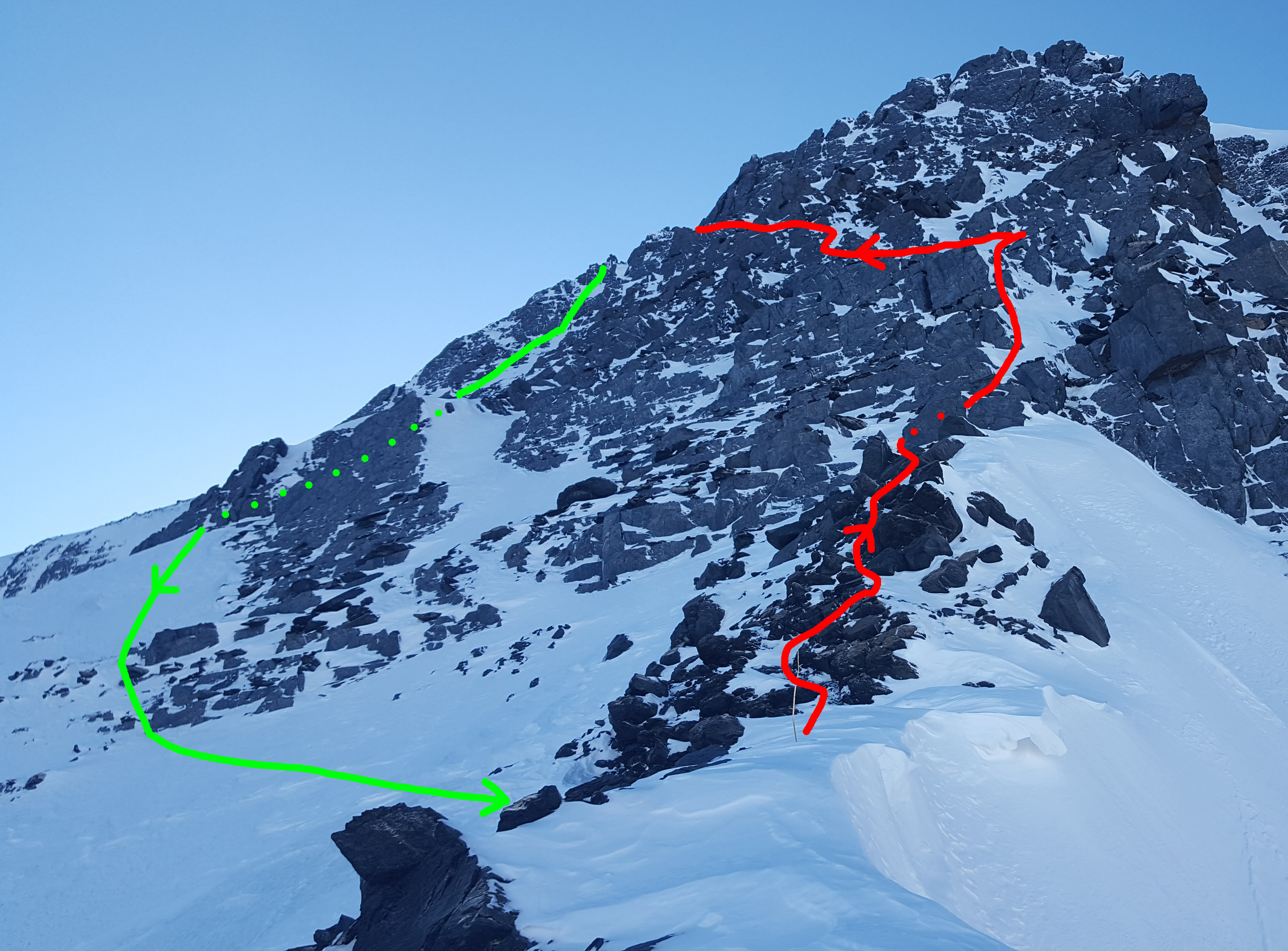
We opted to take the second clear option, and ascend a gully more or less directly in front of a climber observing the mountain from basecamp.  About 100m of loose scree leads into this gully from the edge of the melted out lower glacier, and a large boulder at the bottom served as a convenient cache spot and easily identifiable landmark.  I have marked this gully in the above image of Noshaq, and have an accurate GPS waypoint for the base of the gully.  The weather was warm throughout our climb, and snow conditions on the mountain rapidly deteriorated throughout the expedition.  The route to Camp 1 had fully declined into a slippery, melted-out nightmare of ice, rockfall, and steep scree by the time we made our final descent.  As such, we ended up climbing this section via three different variations, which I have colored red, blue, and green in the above image.

Red indicates our initial line of ascent, made while there was still a snowpack available.  We began by climbing directly up the gully on soft but decent snow, comfortably switchbacking as much as possible.  The upper gully is characterized by a steep ‘snow triangle’ which, as evidenced by debris, had avalanched some time before our arrival.  As the terrain grew steeper we traversed right, ascended a short section of scrambling to the far right side of the snow triangle, and then made an easy traverse back across.  When covered in snow this traverse was straightforward enough for each of us to comfortably solo, and felt quite secure.  Unfortunately, as the mountain melted out a hideous layer of hard ice was revealed, making for unacceptable exposure to an ugly runout.  In such slippery conditions I wouldn’t want to cross without at minimum a running belay on screws, as self arrest would be impossible and a slip would result in a catastrophic fall down the icy upper gully.  From the left-hand side of the snow triangle we ascended alongside a rocky ridge to the area where the red route shown above splits into a blue line.  From here the red line indicates the safest means of ascent, scrambling up and over the rocks directly below Camp 1.  The blue line shows a variation which many of us opted to take when snow conditions were good; a brief traverse onto well consolidated glacier, and back across along the ridge/ramp which finishes the top of the ‘glacier route’.  While a nice ascent option if provided good snow, with poor conditions this variation was not viable.

The green line in the above image indicates an alternative line of ascent and descent.  The rocky ridge to the left of the gully and snow triangle, while composed of steep, loose, hideous scree, is far preferable when the gully and snow triangle traverse are melting out.  Rockfall was a constant hazard on this ridge; wear a helmet and establish a clear communication routine with partners.  Despite the rockfall, this ridge felt much safer and more secure than the icy and exposed snow triangle traverse.

IMG_7189

Climbing to 5500m Camp 1.

Camp 1 itself is a sizeable, flat area atop a rocky ridge.  There is abundant tent space, and plenty of accessible snow for cooking.  Amongst the rocks there were a fair number of propane/butane gas cartridges both unopened and partially used.

5500m Camp 1 to 6200m Camp 2

The route to 6200m Camp 2 is straightforward, and follows the ridge quite directly.  There are some interesting little features below Camp 2; a short but easy ridge traverse and several protruding rock steps which collectively require about a dozen metres of scrambling.  One prominent step just a few hundred metres above Camp 1 can be climbed to the left, over class 4 terrain, or to the right, over easy snow and simple rock scrambling.  We discovered a fixed rope on the left side of this particular rock step, and while it turned out to be of good integrity, other old fixed lines discovered higher up were core shot.  Never weight a fixed line of unknown origin if you haven’t inspected both it and its anchor.  There are several small plateaus along the ridge which would be suitable for camping, but the standard spot for Camp 2 at 6200m is by far the largest and best of them.  While the ridge is not glaciated, and thus is not crevassed, it is imperative that climbers attentively stay on route; the glacier is only some 5-10 metres to climber’s left, and a significant bergschrund/moat separates it from the rock of the ridgeline.  I sustained an unroped, armpit-deep fall into this moat/bergschrund just above Camp 1, with only my enormous backpack and quick ice ax reflex saving me.  Unbeknownst to us, our boot track had been passing dangerously close to this crack throughout the expedition.

IMG_7427

Climbing to 6200m Camp 2. Photo by Pat.

I have not marked this section of ascent on the photo, as it is relatively direct and quite straightforward to navigate.

6200m Camp 2 to 6500-6700m Camp 3

From Camp 2 the route continues directly up the ridge, towards the imposing rock wall which waits above.  The ridge broadens above Camp 2, and in a whiteout it can be difficult to ascertain one’s location relative to camp – we did well by paying careful attention to the size and location of prominent rocky sections, and using them to navigate on descent .  Higher up, the ridge steadily becomes rockier and slightly steeper.  Crossing over the patches of exposed rock is easier than breaking trail through snow, and besides one or two metres of scrambling is mostly just scree slogging.  There are several options for a Camp 3 location, with good tent platforms on rocky plateaus at 6500m and 6700m.

Camp 3 to Summit

I did not achieve Noshaq’s summit, but did make it to 7100m on the summit plateau, to the base of the summit ridge.

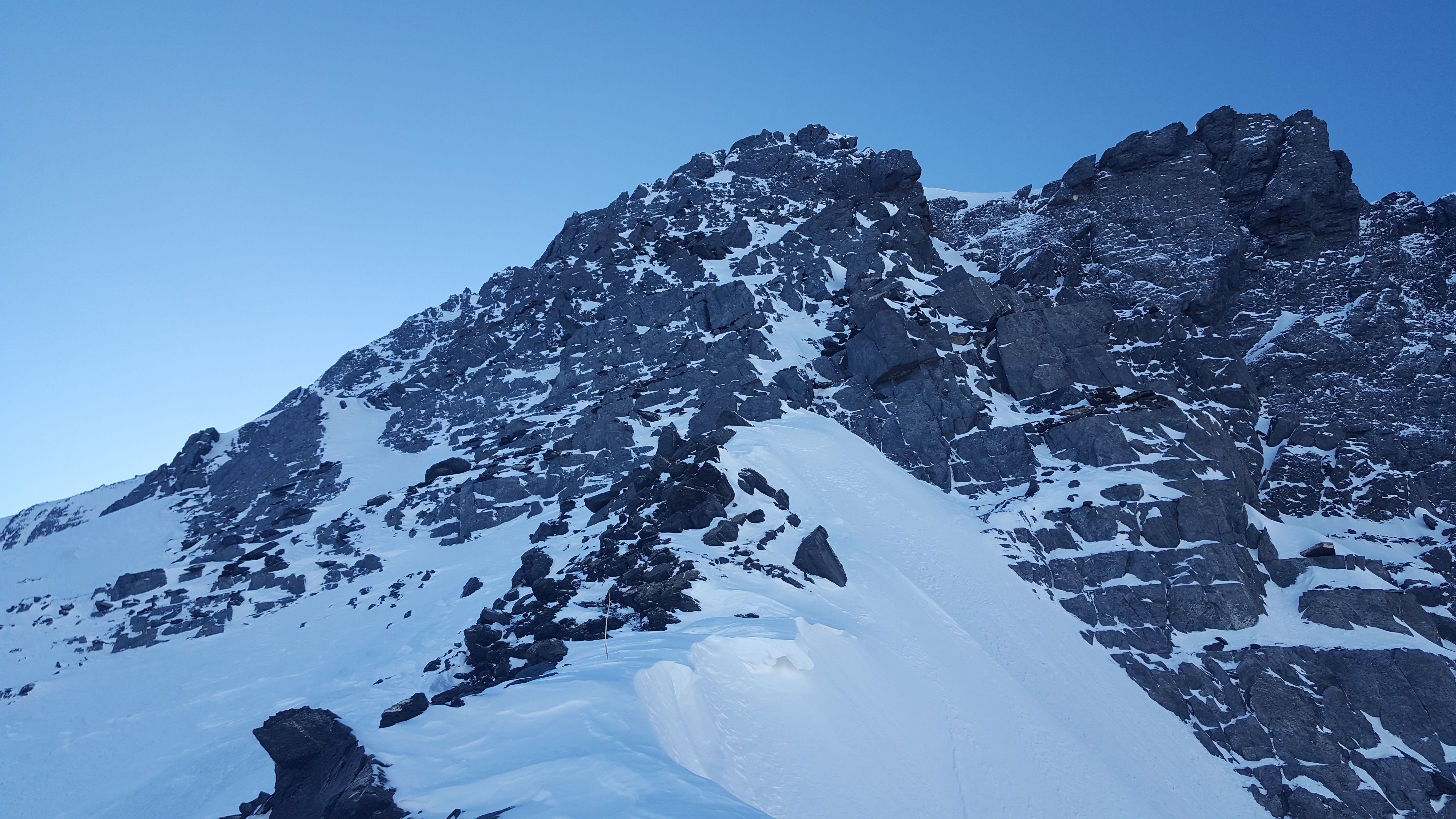
From high camp between 6500-6900m the rock quality improves, but also becomes much steeper.  I would classify several sections in this area as Class 4.  At around 6900m the route terminates in an obvious ridge, slightly corniced.  From this ridge, about 100m of rock stands directly in front of the climber.  To climber’s right the wall is steeper, and drops sharply off into Pakistan. Far to climber’s left lies steep and crevassed glacier.

Rock Step

The rock band at 6900m.  We ascended to the left.  Photo: Eric

ROCK STEP ROUTE.jpg

Our route of ascent in red, rappel in green.  Photo and route: Eric

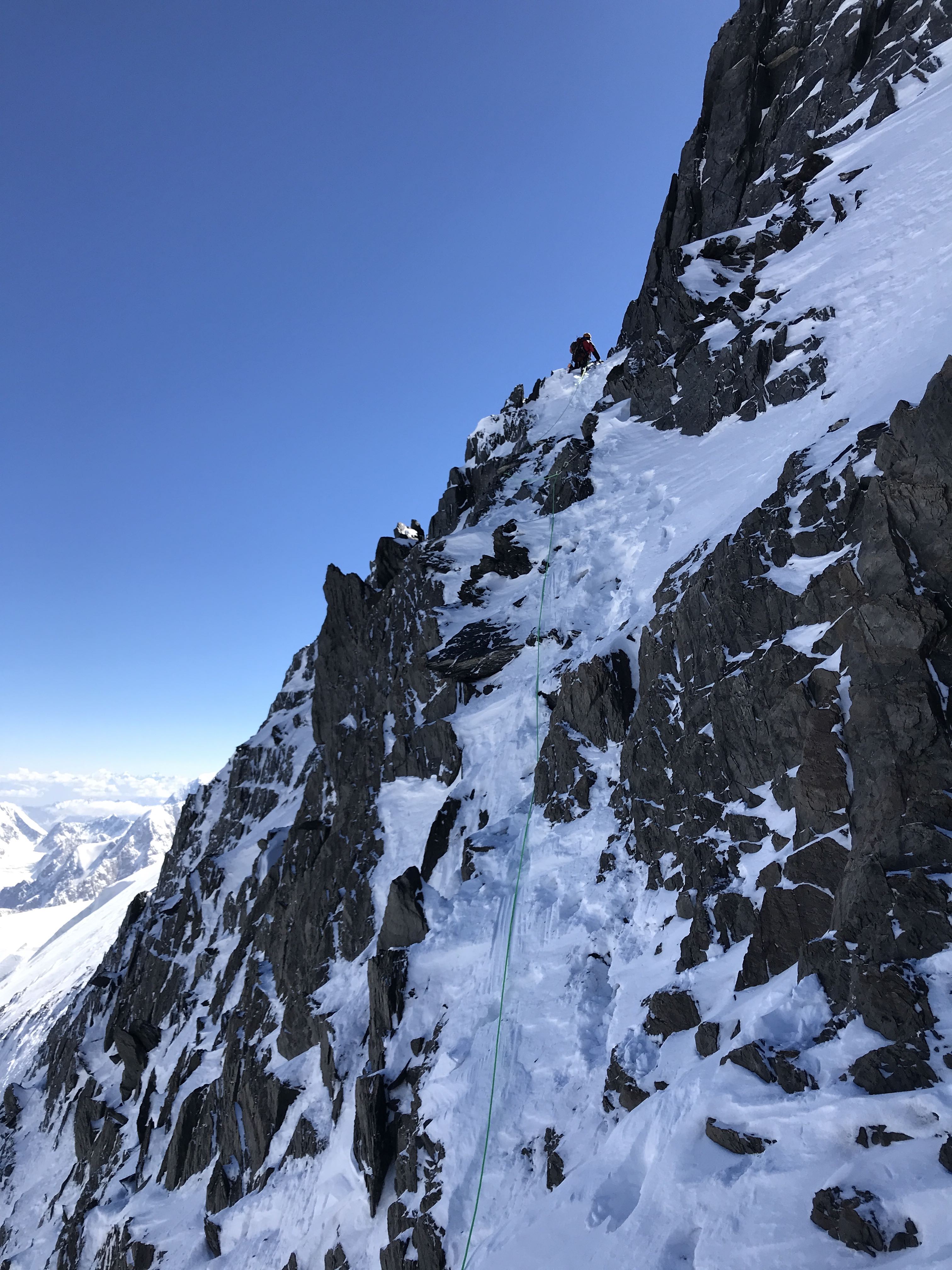
On our first summit attempt we ascended the middle-left of the rock wall, up a fairly obvious weakness in the terrain.  Altogether we climbed three pitches of about 40m each.  Eric, one of two Americans on our team, confidently led all three and was able to place good cams for protection – he used one of each BD small red through BD big red.  In different conditions screws could also be useful here.  With Eric’s help I have marked the route of ascent in red, and the rappel route in green.  The first and second pitches were easy, perhaps 5.6, and fairly secure.  Due to its being a traverse, and on account of deep, loose snow, the third pitch was a somewhat sketchy 5.7 and poorly protected.  We found good pitons at the top of the third pitch.

IMG_7166

Eric leading the third pitch.

IMG_7157

Following the second pitch.

While ascending, we noticed a fixed line further to our left.  This fixed line ascended significantly easier terrain, perhaps Class 4 or ~5.4.  From the top of our three pitch route, we were able to easily access this old fixed rope, to discover that it was thoroughly core-shot.  We re-fixed this rope, and used this easier route for descent.  Later, it was used for jumared ascent during the successful summit bid.  While this route of ascent is considerably easier, accessing it involves a significant traverse along the base of the rock wall.  The snow in this area was deep and unconsolidated in 2019, making it an unintuitive option.   If I return to Noshaq, I will likely endeavor to ascend the rock wall via this variation, budgeting an entire day from high camp to break trail to its base, ascend it, and fix it prior to any serious summit attempt.

Above the rock difficulties is Noshaq’s enormous summit plateau.  The terrain is gently sloped, but most definitely glaciated; climbers should rope up.  In the past, many teams have fixed a high camp on the plateau, as there is abundant space very suitable for tents. The summit itself lies at the far eastern termination of the significant ridge standing atop the plateau.  Crossing the plateau, ascending the ridge, and crossing the ridge to the summit covers roughly 1.6km of distance.  My teammates informed me that they climbed a few meters of Class 3 scrambling in order to gain the ridge itself.

Schedule and Trip Report

Noshaq Climbing Schedule

Noshaq Altitude Schedule

July 8th
Dushanbe to Khorugh

Arrived in Dushanbe at 3:45 a.m., on the same airplane as Maria and Pat.  There were significant delays at customs, as Pat had to sort out a landing visa.  Met Eric and Ludwig at the airport at around 6:30 a.m.  We had many errands to complete – grocery, gas, SIM cards, picking Andreas up from his hostel.  There was limited time for food or rest, and we were all exhausted.  We departed Dushanbe at around 10 a.m. and arrived in Khorugh at 2 a.m. the next day, taking about 14 hours total for the drive.  The drive was hot and unpleasant, on bad roads most of the way.  We were utterly exhausted by the time we reached Khorugh!

After meeting Ray in Khorugh our team was fully assembled.  In total we numbered seven; myself, Pat (USA), Eric (USA), Marie (Estonia), Ludwig (Spain), Andreas (Denmark), and Ray (Hong Kong).  While experience within the team varied, everyone seemed keen.

July 9th
Khorugh to Afghan Ishkashim

We met Ray at LAL hostel, where we slept for a few hours.  Good WiFi, showers, and acceptable food were to be had.  We went to the Consulate General of Afghanistan at 9 a.m., and applied for our tourist visas.  A few hours later we drove to the border, where we crossed into Afghanistan.  Azim, our highly capable fixer, met us with cars and drove us for about 30 minutes to Afghan Ishkashim, where we were finally able to slow down and rest properly.  We had a good meal here, and met Malang, one of the first two Afghan nationals to summit Noshaq.  Malang is an interesting and exceptional man.

We have transited from Dushanbe to Afghan Ishkashim in around 40 hours, a breakneck pace.  Everything has felt rushed, albeit relatively smooth.  If ever repeating this journey I would likely try to pace things in a more relaxed manner, perhaps taking one additional day in Dushanbe and departing for Khorugh at around 6 a.m.

July 10th
Afghan Ishkashim to 3225m Approach Camp

We registered with police in Ishkashim.  With Azim’s help the paperwork involved in this was smooth and easy.  We then drove for about one hour to Qazi-Deh, the village at 2600m where the approach hike to Noshaq basecamp begins.  Here we sorted out porters and donkeys.  In the past, expeditions have had porters carry all gear to basecamp manually.  Happily, for our approach the porters were able to take donkeys all the way to basecamp, which significantly improved their work situation.  Malang told us that this is only the second time donkeys have been able to make the entire approach.

We began the approach hike in the heat of the day at 2:30 p.m.  We covered 14.5km in just over four hours, arriving at our first night’s campsite at 6:45 p.m.  The campsite is at 3225m, and we were already beginning to feel the impact of altitude.  The campsite is very pastoral, in a grassy scattering of trees alongside a branching stream of the main river.  There was easy access to water and good camping spots.  Porters warned us not to venture towards the nearby mountains, on the premise that there may still be landmines in the area.  The first day’s approach was very dry and dusty, and once in camp all of us were complaining of itchy throats and nostrils.

July 11th
3225m Approach Camp to 4650m Noshaq Basecamp

9 a.m. start, 7 p.m. arrival.  We hiked 3225m to 4650m in roughly ten hours.  All of us are very tired, and this was perhaps too much altitude for one day, with over 1400m of gain.  The porters were all doing well, as the donkeys carried everything all the way to basecamp, and were very happy to be paid, ecstatic when we gave each of them a $10 tip.  The basecamp was nice, with a good water source and several rock wind walls for tents.  Eric, Ludwig and I made it to basecamp about an hour ahead of the remainder of the team, and handled checking luggage and paying the porters.  I was experiencing mild AMS on arrival in basecamp, and tried to sleep early.  The dust and grit from the second half of the approach had irritated my throat, and a persistent dry cough made breathing uncomfortable while lying down.

July 12th
Carry to 5000m

I carried a light load to 5000m, at the edge of the dry glacier, and then descended to basecamp to rest.  Still experiencing mild AMS, I didn’t want to push myself too hard.  Tagging 5000m so quickly is not normal for me, and thus far the acclimation schedule has felt extremely rushed.  The remainder of the team went higher for a few hours while I turned back to basecamp.

July 13th
Carry to 5000m

The six others on the team decided to make a carry all the way to 5500m Camp 1 today.  I decided not to go, as I absolutely did not feel ready to clear 5000m.  The team departed at 9 a.m., while I rested all morning.  I departed basecamp at 12:35 p.m., and moved my cache at 5000m to the boulder at the base of the gully, also at around 5000m.  I met with Eric and Andreas as they descended, but hiked back to basecamp by myself.

Thus far the rushed pace and accelerated acclimation schedule has been pushed forward mostly by Ludwig’s tight timeframe – he has a strict departure flight – and by Eric’s intention to try and climb the Uzbekistan highpoint after Noshaq.  If I return to Noshaq, I will likely slow down the initial acclimation schedule by spreading the approach hike over three days, and spending an extra rest day in basecamp.

July 14th
Rest day at 4650m Noshaq Basecamp

July 15th
4650m Noshaq Basecamp to 5500m Camp 1

We agreed that we would move to Camp 1 today – fast, but somewhat reasonable given that I felt well and had twice tagged 5000m.  As I had already moved most of my equipment up to the cache boulder at 5000m, lightening the load from basecamp, I felt good about making the move in a single carry.  I departed basecamp at 9:05 a.m., collected my cache at 10:15 a.m., and reached 5500m Camp 1 at 3:30 p.m.  My single carry bag was very heavy, and I felt slow ascending the gully.  Indeed, I took up the rear of the team the entire way, the others all moving faster quite far ahead of me.

There were a few class 3 moves across rotten rock on the way up, and a little bit of exposure on steep terrain.  It was an enormous relief to reach 5500m Camp 1 and take my bag off.  I quickly pitched my tent on the rocks.  The cough which I had been nursing since basecamp persisted, still from the throat rather than the lungs.  My throat felt dry and irritated, and I figured that if the dusty two day approach had caused the cough, then the dry air at altitude was developing it.

July 16th
Hike to 6000m

We departed camp at 11:30 a.m. with the intention of making an acclimation hike, and reached 6000m at 3:15 p.m.  The route along this section of ridge above 5500m Camp 1 passes several rock steps, one of which had an old fixed rope placed on it – I didn’t climb the rope, and opted for a more secure scrambling option.  On descent I inspected the rope’s anchor, rapped it carefully, and hacked it out of the ice – it turned out that the scramble circumnavigating the rope was faster for the remainder of the expedition, but finding and recovering this fixed line still felt promising.  Eric led the way up the ridge, breaking trail and finding the most efficient lines past the rock steps.  I once again took up the rear for most of the hike, trying to pace myself, and thus climbing slowly.  At 6000m we realized that Camp 2 was higher up, but decided to turn around due to deteriorating weather.

July 17th
Rest day at 5500m Camp 1

July 18th
5500m Camp 1 to 6200m Camp 2

We decided to move higher today.  We departed at 9:20 a.m., and arrived at 6200m Camp 2 at 3:10 p.m.  I once again made a single carry and ascended with an atrociously heavy bag.  I felt lightheaded on arrival, and had abnormal difficulty trying to focus on setting up my tent; mild AMS.  Eric, Andreas, and I arrived at camp first, followed by Marie.  Eric once again broke trail most of the way from 5500m Camp 1.  Pat, Ray, and Ludwig opted to stop lower down and complete the move up on the following day.  In hindsight, this was a wise decision for acclimation.

July 19th
Hike to 6700m

Feeling much better after a full night’s sleep, Eric, Andreas and I decided to make an acclimation hike and try to scout the rock feature below the summit plateau.  We departed camp at 11:15 a.m., and reached 6700m at 2:15 p.m.  I broke trail for about half an hour right out of basecamp, Andreas for over an hour, and Eric broke trail for the remainder of the way.  This had become a recurrent theme; throughout the trip Eric was the best acclimated of us all, was likely the strongest, and always moved the fastest.  At points he outpaced Andreas and I while trail breaking deep snow.

As we ascended the weather began to deteriorate.  At around 6600m we were moving through intermittent whiteout, and climbing increasingly steep terrain.  A hundred metres later at 6700m, feeling the altitude, I decided to head back to camp rather than continue pushing higher in terrible visibility.  Andreas and Eric continued into the whiteout as I descended alone.  Snow had already filled our boot track, and my descent involved plenty of postholing.  Despite poor conditions, I was back at camp in just 30 minutes, arriving at 2:45 p.m.

July 20th
Rest day at 6200m Camp 2

The remainder of the team all arrived at Camp 2.

July 21st
Summit attempt to 7100m

Eric, Andreas, and I decided to make a summit attempt on this day.  At the last minute Ray opted to join us, and Ludwig decided he would try to get as high as he could despite his poor acclimation.  Pat and Maria chose to wait.

We departed 6200m Camp 2 under a bright moon at 2:10 a.m.  The hike to 6700m was mostly uneventful, although Ray lagged far behind Eric, Andreas and I.  We were unaware that Ray had lost his mitts in the wind until much later, when he caught up to us at about 6900m.  From 6700m to 6900m the terrain became much steeper, slowing us down as we broke trail through deep snow.  Eric led most of the way, with Andreas and I taking over only for short sections.

At 6900m we reached the base of the rock section.  It was here that Ray caught up with us.  As he was without his mitts, we persuaded him that he needed to descend.  Eric led three pitches through the rock band as Andreas and I belayed and cleaned.  Protection was pretty O.K. for most of it, and Eric was able to place good cams.  Only the third pitch was difficult or sketchy, due to a traversing section on loose, deep snow with marginal protection.  We found good pitons at the top of the third pitch, and a piton or two along the way, indicating to us that the route we took had been climbed in the past.  Our three pitch route roughly ascended to climber’s left, and finished in a prominent notch in the rock.  Although I cannot visually identify our route in any of our photographs of the rock band (see the route description, above), the notch is visible to the left, along the ridgeline.

The top of pitch 3 found us at the base of the summit plateau, albeit on a 40 degree slope.  From here I could spot the top of the fixed line we had seen on ascent; I made a GPS waypoint, so that we could easily return to it for our descent.  The decision to descend via a different route was made due to perceived difficulty in setting fixed ropes on the traversing pitches we had just ascended. Rather than messing about with rapping the route we had climbed, we figured that it would be faster and safer to re-anchor and secure the more direct fixed rope that we had spotted.  In hindsight, this was probably a very good decision.

From our last anchor I led a short ~10m section of steep snow to a flatter area, where I belayed Eric and Andreas up on a picket and my ax.  We roped up to continue a bit higher, away from the edge, and cached our rock gear.

IMG_7339

Crossing the summit plateau.  Photo by Eric.

We stayed roped up for the entire summit plateau crossing, quite certain that it was glaciated.  Eric and I took the ends of the rope team, placing Andreas in the middle, and I volunteered to break the first trail.  The snow was ankle to knee deep, but the terrain was gently sloped.  We had begun to really feel the altitude, and moved at a painfully slow pace despite our good condition.  It was here that the weather abruptly began to worsen – intermittent whiteout and increasingly heavy snowfall.  As the weather got progressively worse, and given our snail’s pace, I suggested that we bail.  Andreas seemed undecided, but Eric was adamant that we continue pushing.  We all still felt great, albeit tired, so I agreed that we continue.  I broke trail for about an hour to the base of the summit ridge, where Eric took over.

From here we climbed for another hour, or so, into worsening whiteout conditions.  Wind was picking up, and it was getting colder.  Visibility was down to 20-30m.  I once again broached the topic of descent, and this time Andreas agreed.  We rationalized that we were pacing such that we might summit by 5-6 p.m., but would then be left descending in the dark, or bivvying on the summit plateau.  We still had to fix ropes, or at the very least rappel our route of ascent.  We had a stove and gas with us, had extra water and extra layers, and bivvying was on the table as an option until we decided that to do so would be to invite frostbite.  As a team we agreed to turn back.  It was 12:30 p.m., and our elevation was a bit over 7100m.

Back at the edge of the summit plateau I took charge of rope-fixing.  I tried to work quickly, but by this point was tired and hypoxic.  Easy knots took a few tries to dress correctly, and I was constantly having to double, triple check everything I did.  Skills which I practice every weekend on rock had become clumsy and molasses-slow due to cold and fatigue.  I was able to salvage most of the anchor gear left with the old fixed line, and back it up nicely with fresh runners.  The old rope was core shot, so I cut the bad section out and replaced it with some of the static line that we had carried up with us.  I made sure to keep the old rope attached and accessible, as I wanted to follow its line of descent.  Anchors and rope all sorted, I rapped while hacking the old rope out of the snow and ice.  I was thus was able to follow it down and find a solid cordelette anchor, which had been left on a big boulder.

I backed the cord up with a piton and a sewn runner.  From here the ridge that we had ascended from was visible, below and to skier’s left.  Eric and Andreas arrived at the boulder, and we agreed that it would be easiest if I tried to fix a second line to the ridge.  I took the first rap again, traversing and breaking through knee to waist deep snow along the base of the rock wall, placing a single intermediate anchor part way.  It took almost 80m of rope to reach to ridge, costing us Andreas’ 60m climbing rope and most of the remaining static line which we had carried up.  I securely tied the system off onto a large boulder.

IMG_7341

Andreas rapping the second fixed line.  I am visible on the ridge. Photo by Eric.

The fixed lines completed, I found myself shivering uncontrollably in the wind and deep snow.  The weather was truly heinous by now, with moderate winds, total whiteout, and steady snowfall.  As Andreas and Eric rapped across to me, I put on my down pants and storm mitts.  My throat was bothering me, and I was wracked with fits of coughing.

Descending back to 6200m Camp 2 was a nightmarish slog through deep snow, the whiteout limiting visibility to some 20m.  I was exhausted by this point, coughing and staggering, and found myself moving far slower than I had just two days earlier on the same terrain.  Several times I postholed waist deep and had to sit, breathing for a minute, before pulling myself out.  We returned to camp at 7:10 p.m., a 17 hour day.

July 22nd
6200m Camp 2 to 4650m Noshaq Basecamp

I woke up feeling terrible.  I was coughing uncontrollably, and the cough had developed into a wet, productive one.  I had no symptoms of AMS and felt strong aside from the cough; I quickly ruled out HAPE.  In regards to climbing, there was much disagreement and discussion as to the best course of action to take next.  Andreas also had a cough, although only from his throat, and like myself felt that he needed to descend and rest before another attempt.  Ludwig had made it to 6800m on the 21st, and then descended all the way to basecamp; he had to leave to catch his airplane.  Eric wanted to move up immediately in preparation for a second summit bid.  Pat and Marie were undecided, but tempted to move up and take a shot at the summit.  The deciding factor ended up being food.  I only had two days supply remaining, Andreas had nothing, and Eric was running low.

Eventually Eric, Andreas, and I decided to return to basecamp to rest and recover.  Pat, Marie, and Ray would descend to Camp 1, where they had a food cache.  On descent we met three Polish climbers who had arrived while we were on the upper mountain – they were the only other team to attempt Noshaq this season.  Much of the route was melted out on descent, and turned to either scree or ice.  We departed 6200m Camp 2 at 12:00 noon, reached 5500m Camp 1 at 12:45 p.m., and reached Basecamp at 2:20 p.m.  We cooked pasta with sausage when we arrived, and while it looked like dog’s breakfast, it tasted delicious.  Some three hours after Eric, Andreas and I arrived in basecamp, we saw Marie approaching across the moraine.  We feared bad news, and were relieved to learn that she, Pat, and Ray had descended only because their food cache had been raided and eaten by the ravens which inhabit the valley.

It so happened that 7.22 and 7.23 were the only two days of the entire expedition when weather remained clear of afternoon whiteout and snowfall.  Unfortunately this wasn’t of much benefit to us, given we used these as rest days.

July 23rd
Rest day at 4650m Noshaq Basecamp

I slept poorly, waking up several times throughout the night due to uncontrollable coughing, able to sleep only once my lungs were cleared.  I was continually coughing up thick chunks of yellowish phlegm, in startling quantity.  I was unable to breathe deeply without my lungs bubbling, which triggered coughing fits.  Shallow breathing felt fine, and I otherwise felt strong and healthy, with a good appetite.  Marie let me use her asthma puffer, which helped suppress the cough for an hour or so after use, but didn’t alleviate my difficulty breathing.

July 24th
4650m Noshaq Basecamp to 6200m Camp 2

The team wanted to move back up to make a summit bid.  My cough was only marginally better after a full day’s rest, but accompanying the others was my only chance – in my condition I knew that holding back in basecamp and making a solo attempt later wouldn’t be possible.

We departed basecamp at 9:40 a.m., reached 5500m Camp 1 at 2:40 p.m., and 6200m Camp 2 at 6:40 p.m. – 9 hours in total, covering more than 1500m of elevation gain at a very slow pace.  I moved slowly due to terrible conditions in the gully and relentless productive coughing.  Much of the route had melted out into dangerously icy conditions, and the traverse across the ‘snow triangle’ (see route description above) was insecure and dangerous – we probably should have taken the time to place a running belay, or even pitch it out.  Ray took a ~5m fall on ice, but luckily was completely unhurt and able to continue.  Ray later stopped at 5500m Camp 1, too tired to continue to 6200m Camp 2.  The route to 6200m Camp 2 felt endless, rest stepping forever in the punishing sun, and later in whiteout and snow.

I was physically very tired when arriving at 6200m Camp 2, and trying to manage my cough.  I focused on getting food and water prepared, along with hot water bottles to sleep with.

July 25th
6200m Camp 2 to 6500m Camp 3

I slept poorly, unable to rest properly due to my cough and difficulty breathing.  The plan was to ascend to 6700m today, in order to place a high camp in anticipation of making a summit bid on the 26th.  Eric and Andreas left on time, while the rest of us took our time getting ready.

We departed camp at 11:00 a.m., and reached 6500m at 2:00 p.m., 300m in a slow two hours.  I was still tired from the big ascent the day prior, and significantly impacted by my cough and breathing troubles.  Given the nice tent platforms at 6500m, I decided that I should stop for the night.  Pat and Marie, seeing that I was in poor shape, decided to camp with me rather than continue to 6700m, where Andreas and Eric waited.  We agreed to depart for a summit bid at 2 a.m. the next day.

July 26th
6500m Camp 3 to 4650m Noshaq Basecamp

Ready to leave at 2 a.m., I waited another hour for Pat and Marie to get ready before starting upwards at 3 a.m.  Eric and Andreas’ headlights were visible above us; they had started at midnight.  By 4 a.m. I realized that I was moving too slowly, couldn’t breathe properly, and was coughing too much to continue.  I turned around at around 6650-6700m, and was back in my tent by 4:30 a.m., where I immediately went back to sleep.  I slept until 9 a.m., and realized that Ray had also descended.  His headlight had broken, and ill equipped for managing the fixed lines he had turned back.

Ray and I packed up our equipment and started down together at 10:15 a.m.  We reached 6200m Camp 2 at 10:45 a.m., 5500m Camp 1 at 12:45 p.m., and basecamp at 4:45 p.m.

The descent was quite difficult for me, and validated my decision to abort the summit bid.  I struggled to breathe properly due to the amount of fluid in my lungs, and had to stop every 40-60 minutes in order to aggressively cough and clear them.  I was coughing up roughly 3 popcorn kernel sized chunks of phlegm each time, yet more kept accumulating.  Despite this, I still exhibited no symptoms of AMS – this was a lung infection, not HAPE.

About 100m above 5500m Camp 1, just a few meters to the side of our old boot track, I punched through into a crevasse, a hidden moat where the glacier meets the rock of the ridge.  I fell armpit-deep into the crack.  My enormous descent backpack lodged against the crevasse edge, and I was also able to plant my ax pick in time to help stop the fall.  Looking down I could see that the ice slot went some fifteen to twenty meters deep, and my legs dangled over a dark void.  I reacted quickly, and spread my weight onto my arms and ax, back in the direction I had been coming from.  I shouted at Ray in Chinese – that I was in a crack and for him to stay where he was.  Using my trekking pole and ax, fueled by adrenaline, I was able to physically haul myself out and back onto the snow slope.  My heart rate through the roof, breathing heavily from the burst of heavy exertion, I collapsed in a fit of uncontrollable coughing.  This was by far the worst unroped crevasse encounter I had ever had, and a full fall could have been catastrophic.  We had moved unroped over this area throughout the expedition, feeling secure in the knowledge that we were on a ridge.  In hindsight, it is possible that the entirety of the  saddle area above 5500m Camp 1 is in fact glaciated; if returning to Noshaq, I would make a point of roping up on this section.

From 5500m Camp 1 the descent became significantly worse.  The route was severely melted out, and crossing the snow triangle was no longer a safe option; it was a bulletproof sheet of ice.  We opted to descend the rocky ridge to climber’s left of our ascent gully.  This option was significantly safer than the ice of the gully, but did expose us to unpleasantly unstable scree prone to rockfall.  We gingerly made our way down, taking almost three hours to get to the cache boulder at the base of the gully.

From the cache boulder it took another hour to reach basecamp, where I collapsed into my tent, utterly annihilated and struggling to breathe well.  Andreas and Eric arrived several hours later, before sunset, having successfully summited before noon.  They were in good spirits, despite Andreas visibly suffering from his throat issue.  Pat and Marie got in contact with us via satphone; they had summited and were safely back in their tents at 6500m.

July 27th
Rest day at 4650m Noshaq Basecamp

Pat and Marie made it back to basecamp in the afternoon.  A small earthquake hit in the morning, dislodging enormous boulders onto the path between basecamp and the dry glacier.

July 28th
4650m Noshaq Basecamp to Qazi-Deh

The porters arrived in basecamp with donkeys, in the middle of a snowstorm.  Throughout the expedition weather had followed the pattern of afternoon whiteout on the upper mountain, some days earlier and some days later.  This, however, was the first and only day we experienced snow in basecamp itself, and it came down hard and heavy.  One of the Polish team assisted us in weighing everything, and helped negotiate a firm rate with the porters.

IMG_7205

Donkeys waiting in basecamp.

We loaded up the donkeys with bags, with one porter carrying an additional bag that didn’t fit, and began to head down.  Within fifteen minutes of departing basecamp we broke through the cloud ceiling, and were greeted with a view of blue sky and open valleys.  Between the earthquake and the storm in basecamp, it was if the mountain had been angered by the summits, and wanted us gone.

IMG_7209

Descending below the clouds, and into open valley.

We made the entire descent hike in a single day, taking some eleven hours to cover the 2000m of descent and 31km of distance.  It felt like a death march for me, my clogged lungs and productive cough still adversely impacting my breathing and endurance.

Back in Qazi-Deh we sorted out payment for the porters, tipped each of them $20 for making the descent in a single day, and feasted on chicken and naan bread.

July 29th
Qazi-Deh to Khorugh

We departed Qazi-Deh for the Tajik border, and crossed back into Tajikistan.  Pat and Andreas had visa problems, in that neither of them had successfully acquired their second e-visa, and were denied entry.  Process the e-visa payment with care, to avoid having the application soft-locked.  They made it across the next day, but only after making some phone calls to the American embassy.  A car arranged by Azim met us on the Tajik side of the river, and those of us who had crossed over headed to LAL in Khorugh, where we would spend the night.  Eric and Ray departed for Dushanbe the next day, while Marie and I waited for Pat and Andreas – the four of us would later make an interesting land journey all the way across Tajikistan, to Bishkek in Kyrgyzstan.

Thoughts on Noshaq

Four of our seven summited the mountain, making the expedition a success.  I contributed meaningfully to the trip, especially by taking responsibility for the work required to fix all of the ropes and help open the route up for the others.  I performed well throughout the expedition, at least until I was hit hard by the respiratory infection, after the first unsuccessful summit attempt.  Our four were the only summits of the year, as the three Polish climbers who arrived after us were hit by a streak of relentless bad weather which forced them to turn around from a highpoint of around 7300m.

I was disappointed that I didn’t summit, especially given that I’d climbed strong up until I became sick.  Well after the expedition’s conclusion, in hindsight my non-summit continues to bother me.  I feel that I should have made it.  Looking at my journal from the climb, I can rationally see that there was no chance of success once I became ill.  There was no way I could have ‘pushed harder’ or ‘been tougher’ and somehow made the summit – certainly not responsibly, without putting myself, and by extension the others in the team, in danger.  Alluding that my coughing fits and difficulty breathing were dramatization of a mild chest infection is disingenuous – the photos I took showing how much phlegm my lungs were producing, the sheer quantity of what I was coughing up, and my journal writing from the moment should serve to dispel my irrational ‘what if’ hindsight thinking.  I have never before been so sick in the mountains, as on this trip.  In spite of this, I still think about it.  What if I had waited a day longer before the first attempt?  What if we had moved camp that day instead?  What if we had pushed on that day, and bivvied somewhere secure after summiting?  What could I have done differently, to avoid getting so debilitatingly sick?

Our coordination and teamwork could have been stronger on Noshaq.  In our group I had only previously climbed with two people, Pat and Marie.  Of the six others on the team I only had prior technical climbing involving ropework, communication on terrain, and gear placement with Pat.  Our coordination as a group on the mountain wasn’t always predicated on good communication, clearly defined expectations, or scheduling.  This was in part due to a lack of familiarity across each person’s habits, style, and routines. We had no radios on the mountain, and relying on satphones for communication made for significant message delays and numerous small miscommunications throughout the trip, some involving minor variations in route finding, others resulting in misallocated equipment.

Throughout the expedition Eric had ended up with a disproportionate amount of the more physically demanding work, in that he thanklessly undertook the majority of trail breaking, with Andreas and to a lesser extent myself filling in the gaps.  Eric also handled all of the significant lead climbing.  This issue likely could have been resolved with clearer communication of expectations at the beginning of the expedition, and a fairer arrangement for breaking the route – on carry days our pacing was entirely irrelevant to intended outcomes, and it wouldn’t have mattered if someone slower had lead.

Likewise, the expedition felt rushed as a result of what were arguably unrealistic time expectations; Ludwig was climbing on a very slim time budget, and Eric was motivated to finish as soon as possible so as to attempt a second mountain.  Our acclimation schedule was the fastest that I have ever followed.  While I exercised my better judgement at the beginning of the climb – in hindsight the choice to delay my first trip to 5500m Camp 1 was a great decision – I eventually felt compelled to ‘keep up’.  The severity of the respiratory infection that I experienced was definitely exacerbated by rushed acclimation, and arguably would not have hit me at all had I not pushed myself as hard and as fast as I did.

These issues could likely have been eased had we worked together on a warm up climb or practice route of lower intensity and significance, before starting on Noshaq.  Radios would have made a huge difference towards smooth and responsive communication, and would have alleviated most, if not all, of the minor miscommunications which occurred.  Nightly planning meetings, even for just a few minutes at a time, routinely and formally arranged, would have helped keep expectations in check and given everyone an opportunity to voice opinions on pacing and strategy.  Our group was large enough that hiring a private meteorologist to provide weather forecasting would have been economical, and could have made a significant impact on our terrible luck with weather – whiteout and snowfall every single day that we were moving above 5500m, the only two bluebird days spent resting in basecamp!

Noshaq is remote, big, short on looks, and chiefly composed of loathsome choss.  When I try to tell people what I was climbing on all summer, they first ask me where on earth it’s even located, then raise an eyebrow and ask me why I’d ever consider going there.  That said, for better or for worse, I know that I need to return to Noshaq.

Pik Chetyreh – July 2018

IMG_4344

Pik Chetyreh, from nearby Moskvina basecamp.

Pik Chetyreh

I visited Tajikistan in the summer of 2018, with the intention of making an attempt on 7105m Pik Korzhenevskaya.  The basecamp for Korzhenevskaya, Moskvina Glades, sits at around ~4300m, and is accessed by helicopter.  Moskvina is remote, far from civilization, and nestled deep within Central Asia’s Pamirs it is surrounded by impressive 6000m mountains.

6230m Pik Chetyreh is impossible to ignore once in Moskvina basecamp, as its prominant, aesthetic pyramid rises on the northeast skyline with remarkable independence; no other summits are nearby to distract one’s perspective of it.  As the vast majority of climbers who make their way to Moskvina do so in order to attempt the pair of mighty 7000m giants, Pik Korzhenevskaya and Pik Kommunizma, Pik Chetyreh sees little traffic.  Nonetheless, the mountain has been climbed many, many times as acclimation prior to beginning on the higher, more committing 7000ers.  It is not hard to imagine the decision making which many before me went through in choosing to attempt it; the mountain is beautiful, and its shape alone is alluring enough to justify a climb.  Besides, a 6000m peak is always a worthy challenge, even if only for acclimation!

On setting my eyes upon Chetyreh for the first time, I knew that I would take a shot at it.  It looked close to basecamp, and appeared relatively simple.  When I found two similarly minded others, a duo composed of an extraordinarily experienced Welshman, Chris, and a friendly Lithuanian, Dave, the plan quickly came together.  We’d head up packed light, just for three days, and have an easy acclimation climb above 6200m.

IMG_4346

Pik Chetyreh, from roughly halfway through the approach hike.

Climbing Route

In the above photographs, our route of ascent can be described as switch-backing up the right-hand skyline ridge – which is quite wide and very gentle lower down – all the way to the upper section of exposed rocks.  At the upper rocks we then traversed a few dozen meters left, out on to the face, and up to the closest of three summits along the inside of two rock bands. We did not traverse so far left as to cross the ridge which cuts down the middle of the mountain in the above photo, and almost ascended the skyline ridge in its entirety. From the lowest exposed sections of rock and upwards the climbing became fairly steep, and I was very happy to have two tools with me, especially when down climbing on descent.  Two 60m ropes would make descent much safer, as two 60m rappels would cover all of the steepest terrain.

Approach

The approach from Moskvina basecamp took us around 7 hours, packed relatively light.  The approach was much slower than anticipated, as while totaling only ~5km, it was made slow by the endless scree and unstable moraine which had to be crossed.  Past the lower moraine we encountered quite a bit of rockfall, and were well advised by experienced Russian climbers when they warned us to avoid moving below any slopes during the warmth of afternoon.  Past the moraine, the three of us roped up to cross the broken glacier which lay ahead of us.  A small bergshrund had to be crossed, easily climbed on stable snow, and immediately  followed by a ~150m traverse above large, otherwise impassable crevasses.  The final section of approach crossed a long, wide glacial plateau, covered in ankle deep snow and riddled with small crevasses.  I led the full glaciated section of our approach hike, and punched through twice on the plateau – not an issue with two partners behind me.  We made our basecamp at around 5100m, one of the few sections free of crevasses, and right near the base of the wide, skyline ridge described above.

Climb

Our climb did not end up being as clean as we had thought it would.  We left our tents at around 5 a.m., as the sun was just beginning to crack the horizon and dispel the chill of a brisk Pamir night.  The ascent to the first rocky section was smooth and fast, with Chris maintaining a measured pace and making even switchbacks on excellent morning snow conditions.  Above the rocks Chris continued to lead, and quite commendably ended up taking point all the way to the summit.  At the first section of exposed rock the climbing began to get steeper, but remained easy to moderate.  Further above, we eventually reached the upper sections of exposed rocks, and could no longer ascend directly up the ridgeline.  We crossed out onto the face, and began moving up through some easy mixed terrain on loose snow and chossy rock.

It was in this short mixed section – easy enough climbing, but not so easy to downclimb – that I began to seriously question the wisdom of my continuing.  How were we to get down?  I knew that I would not be confident downclimbing more than a few of the moves we had been making, and was cognizant of the fact that with just one 30m rope and limited pro – just two of Chris’s ice screws and my one picket – rapping wasn’t much of an option for us. After heated discussion, in a bad location, we agreed that we would be able to try descending via another gully, and continued to ascend.  In hindsight, the decision to continue upwards was the correct choice, and much safer than trying to descend the mixed moves which we had climbed.  The terrain soon cooled off, welcoming us back onto straightforward snow, and we found ourselves on the summit ridge.  Hypoxic and tired, we had climbed for 9 hours and 15 minutes, reaching the top at around 2:15 p.m.

The summit views were spectacular, and offered us full perspective of both Korzhenevskaya and Kommunizma, along with views of innumerable 6000m peaks to the north and east, remote and wild.  Behind our high point were two additional summits, and we were uncertain whether they were on par with the point we stood upon, slightly higher, or slightly lower.  Looking carefully at images from the top, and photos I later took from Korzhenevskaya, it is possible that perspective is deceptive and that they are a part of a different mountain entirely.  The Russian guides in basecamp had told us that the true summit was the one closest to basecamp, which described the prominent ridge we stood upon, and we decided that it was acceptable to call it good.  We didn’t stay at the top long, and quickly began to descend.

We were in over our heads descending the upper mountain.  Without gear to rappel, we had no choice but to down climb the steep snow of a fresh gully, adjacent to our path of ascent.  Chris fell just below the summit, but arrested himself well, and between this and my arrest backing him up didn’t slide very far. After his slip I led the remainder of the descent, carefully placing my tools and gingerly kicking good steps, aware that nothing was protecting a fall but caution and stable, steady movement.  Dave fell three times on the down climb and traverse across the face, with Chris and I catching each of the falls with quick self arrest, fueled by adrenaline.  It was an unpleasant, dangerous finish to the climb, the likes of which I hope to never repeat.  I should have brought a second 30m rope, to rappel on alongside the 30m line which we used to tie in.  We should have had more screws than the two which Chris had the good foresight to have packed.  We all should have had two tools.  Ideally, we should have had two 60m ropes and several spare pickets.  We made it back to the lowest exposed rocks safely, and from there we trudged down the rest of the mountain, me breaking trail through now-soft, knee deep slush.  The sun works wonders in the Pamirs, even at high elevations, and everything melts out in the afternoon!

The day after our summit we descended, and returned to Moskvina basecamp in around 4.5 hours.  Rockfall in the moraine was more severe on our descent day.  The bergshrund crossing was getting periodically showered with golf ball sized rocks – particularly unnerving when I wanted to place a picket before crossing.  Back in basecamp Pik Chetyreh remained as charismatic as before, albeit far more satisfying to look upon having visited its summit.


Pik Lenin – August 2017

I summited 7134m Pik Lenin on August 2nd, 2017. I climbed solo above 5300m Camp 2, using a basecamp support package for 3500m Basecamp and 4400m Advanced Basecamp (“Camp 1”) from Central Asian Travel. I roped with other independent climbers while crossing the heavily crevassed lower glacier between 4400m Advanced Base Camp and 5300m Camp 2. Images and details from my unsuccessful 2016 Pik Lenin expedition can be found here.
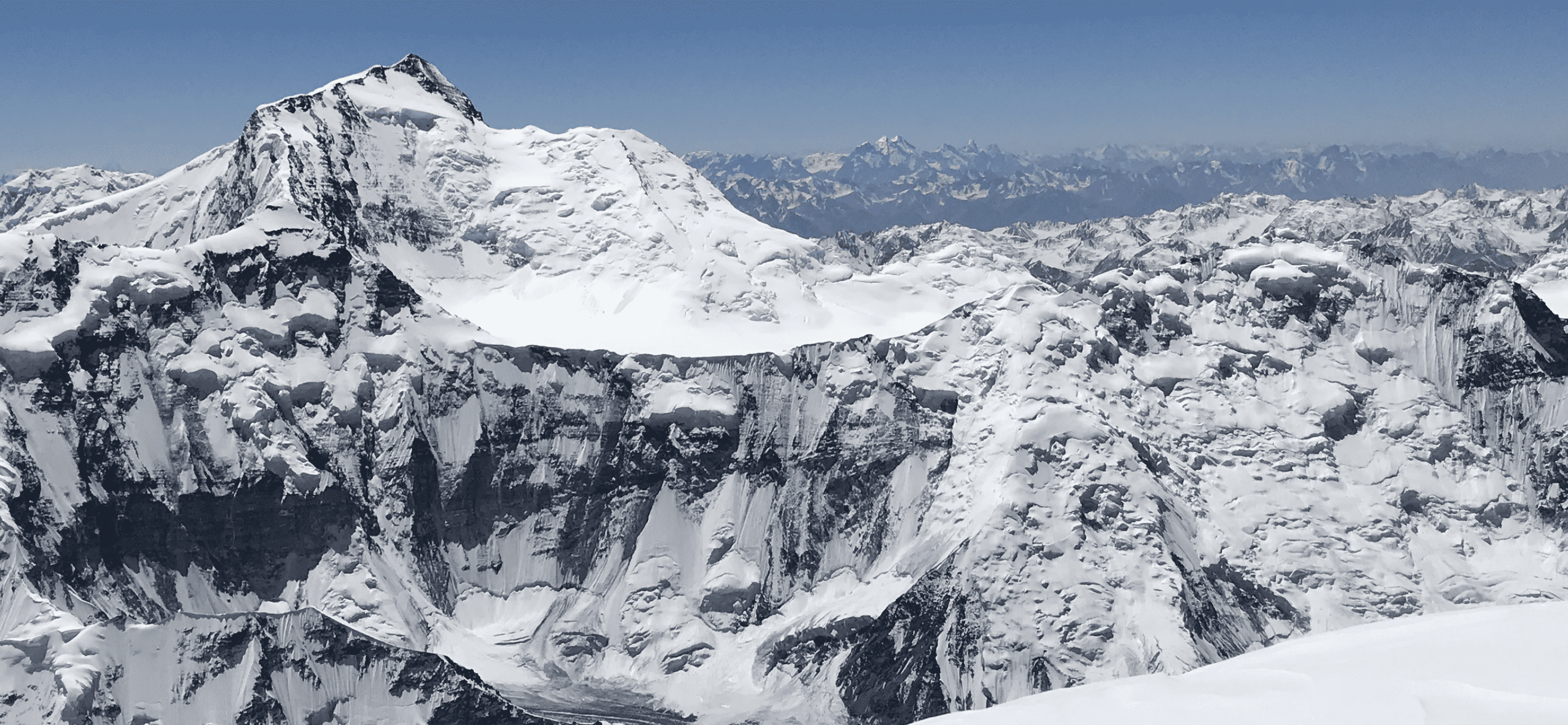
IMG_0925

Pik Lenin, from 3500m Basecamp.

In July of 2016 I made an unsuccessful attempt on Pik Lenin.  Afterwards, the mountain and my non-summit had persistently lingered on my mind.  I thought about the climb almost daily, dwelling upon my feelings of disappointment and considering what had gone wrong.

In February of 2017 I made a rather unpleasant, and ultimately unsuccessful attempt on a solo of 6893m Ojos del Salado from the Argentine side, via an approach across the vast and barren high altitude Atacama Desert.  While unsuccessful, reaching only ~6350m due to thigh deep snow, extreme winds, and an incoming storm, I was surprised afterwards by my feelings of acceptance.  The solo approach from an unacclimated start had been so gruelling that I was glad just to have made it to the base of Ojos, and the snow/weather conditions so poor that progress beyond my high point would indeed have been impossible for me; the non-summit had been entirely out of my control.

I didn’t feel the same way about Pik Lenin.  I felt that I had made a mistake, that I should have continued and forged on instead of turning around, that I had given up too easily and let myself down.  I decided to return and try again.

IMG_0859

Pik Lenin.

Below are images from the expedition, a calendar/schedule of my 2017 climb, and a day-by-day trip report.

Pik Lenin 2017 Photographs

Pik Lenin 2017 Trip Report

2017 Lenin Calendar

My 2017 Expedition Schedule.

July 20th

A 7.5 hour drive from Osh to Pik Lenin basecamp, arriving at 6:00 p.m.  I ate dinner and immediately went to sleep, still jetlagged due to the transition from North America.

July 21st

A relaxed hike took me to 3950m on nearby Pik Petrovski.  Having climbed to the summit the year prior, I opted to stop after an hour of hiking and relax instead of pushing myself to move higher.  A rapid descent down a scree slope took me back to basecamp.

July 22nd

One of my bags had not made it to Bishkek, missing the London/Moscow transfer.  Within were all of my climbing clothes.  I opted to take a full rest day in basecamp, and as luck would have it, the bag arrived just after midnight on a truck from Osh.  Central Asian Travel’s Osh manager had sorted the delayed luggage’s transit from Bishkek to Osh, and delivered it on the next basecamp supply truck.  Very impressive.

July 23rd

Loaded horses with 32kg of equipment and food, taking a ~12kg bag for myself.  Hiked to Advanced Basecamp 4400m, 9:45 a.m. to 2:45 p.m. or 5 hours at a leisurely pace.  I hiked accompanied by a Ukrainian soloist whom I had happened to meet several years prior on Aconcagua.  It rained steadily throughout the day, transitioning into wet snow as we reached Advanced Basecamp.

July 24th

After lunch I took a leisurely hike to 4760m up a nearby scree ridge.  Stopped hiking after an hour, rested in the sun for about an hour, and then made a quick descent back to Advanced Basecamp.

July 25th

I roped up with the Ukrainian soloist who had hiked to Advanced Basecamp with me, and we made an acclimation climb up to 5000m on the route to Camp 2.  We began at 4:15 a.m. and reached 5000m at 9:00 a.m., a time of 4:45.  At 5000m we took a break for about half an hour and then headed back down.  We began early in order to avoid poor snow conditions and ensure that snowbridges would be in good shape.

The route was in decent condition, albeit with many more crevasses than I had encountered the year prior.  A large avalanche had hit the route to Camp 2 about a week earlier, along the flat traverse below a heavily corniced section of the North Face immediately prior to Camp 2, and an early start in cold, stable conditions would also help to mitigate our exposure to another event.

July 26th

I roped up with my Ukrainian friend once again for a carry to 5300m Camp 2 – fairly essential practice given the volume and state of the crevasses on route.  I opted to take up all the supplies I would need for 8 days on the mountain in one foul shot on this carry, and thus make it the only truly heavy load of the entire climb.  Rather than bring a second heavy load with me during my summit bid, which would burn energy and time when I would need it most, I had decided ahead of time that getting the carrying over with all at once was both manageable and reasonable given the technically easy nature of the route to Camp 2.

We departed 4400m Advanced Basecamp at 4:20 a.m., and arrived at 5300m Camp 2 at 11:40 a.m., a very slow time of 7:20.  We took a slow, easy pace with our heavy bags, slowing further when the morning sun turned the route into a horrible furnace of soft snow and glare.  On arrival I immediately pitched and anchored out my tent, cooked lunch, and took a nap.

July 27th

After breakfast I packed a light bag and climbed to 6100m Camp 3, 9:15 a.m. to 12:15 p.m., or three hours.  The route out of Camp 2 follows a ~35-40 degree slope before traversing across gentle terrain to the base of Pik Razdelnaya.  A final slope of increasing steepness, to around 40-45 degrees, leads to Camp 3 at 6100m-6150m on the summit of Pik Razdelnaya.  I rested for half an hour at 6100m and then descended to 5300m Camp 2, taking one hour.  I had a headache on return to Camp 2, and to my dismay discovered that I had packed an empty Ibuprofen blisterpack.  I took a nap, spent the afternoon reading, and struggled to eat a full dinner.

July 28th

I had initially planned to make a second acclimation hike to 6100m today, but woke up feeling lethargic and uncomfortable.  I had a minor headache and no appetite; mild AMS.  I began my acclimation hike, but stopped at around 5500m and decided that I should take a full rest day instead.  While I didn’t feel terrible enough to warrant descending, I had a fairly unpleasant rest day roasting in the heat of my tent.

July 29th

I packed a light bag and descended from 5300m Camp 2 to 4400m Advanced Basecamp, leaving my tent and supplies well anchored.  I departed at 7:00 a.m., and reached ABC at 8:50 a.m.  I descended alone, unable to find another independent climber to rope with, gingerly making my way across the crevasses.  In ABC I spent the remainder of the day resting, checking the weather forecast for a possible summit window.

July 30th

The forecast showed a few days of favourable weather, followed by an abrupt spike in wind speeds.  I took a full rest day, and prepared to begin my summit bid on the 31st.

July 31st

With an extremely lightweight bag, I departed for 5300m Camp 2 roped up with an independent Czech climber.  We began climbing at 4:15 a.m. and arrived in Camp 2 at 9:00 a.m., taking 4:45.  The weather was perfect, clear and windless, and the climb much easier than my load carry several days before.

August 1st

I packed all of my equipment and supplies and climbed from 5300m Camp 2 to 5800m, near the base of the final slope below 6100m Camp 3.  I departed Camp 2 at 10:30 a.m., and arrived at my 5800m “Camp 2.5” at 1:00 p.m., taking 2:30 while moving at a leisurely pace.  Here I stopped and pitched my tent.

I had decided in advance that I would forego sleeping at 6100m Camp 3, and instead use this spot at 5800m as the high camp from which I would launch my summit bid.  I had made this decision for several reasons.  First, Camp 3 is filthy. Human waste and dirty snow is everywhere, making it very difficult to prepare clean water.  This had likely contributed to the stomach issues I had experienced in 2016.  Second, Camp 3 is fairly high, making it difficult to eat and sleep well.  I knew from prior experience that camping 300m lower would have a significant positive influence on my appetite and sleep.  Third, Camp 3 is very exposed, and I knew from my three nights there in 2016 that in high wind or storm it would be a particularly unpleasant place to be based.

While I was nervous that the additional 300m of altitude gain on summit day would be quite significant when undertaken prior to the already very long summit ridge (almost 6km above 6000m), I also felt strong, and confident in my endurance.  Given that the ridge to the summit descends ~100m immediately past Camp 3, I was setting myself up for a 1400m summit day.  I had decided that the tradeoffs of using a lower high camp were worth it, and indeed I enjoyed a quiet, pleasant afternoon of rest and abundant eating.  I checked the weather forecast on my satellite phone before going to sleep; it called for 25km/h winds and light snowfall.

August 2nd

Awake around 3 a.m., I managed to eat a light meal and drink some water.  I packed two litres of water with electrolyte mix (one heavily caffeinated), some snacks, my down pants, and my storm gloves into a summit pack.  I left my tent at 4:20 a.m., intentionally late compared to the standard departure times used by most who climb Lenin. I left late because I knew the route to be of very moderate difficulty, and because I wanted to minimize the time spent climbing in darkness and the cold of night.

I crossed the ridge towards the slope to Razdelnaya and Camp 3 and began to ascend, reaching Camp 3 at 5:40 a.m. as the sun began to rise, taking 1:20 from my tent.  Without stopping in Camp 3 I descended ~100m to the saddle between Razdelnaya and Lenin’s summit ridge, where I continued upwards on moderate snow slopes.  The sun began to cast a glow over the mountain, warming things up and providing superb views of the surrounding mountains and the massive glacier far below.

I began to pass other climbers, a few having turned around.  I soon reached the base of ‘The Knife’, a short ~50-55 degree snow slope sporting a fixed rope of dubious anchorage, and front pointed up it with my 70cm straight shaft ice ax and trekking pole.  From the top of the knife the route continued along gentle slopes for what felt like an eternity.  The entire summit ridge from Camp 3 to the high point is well above 6000m and is almost 6km long.

At around 11:45 I met a friendly French Canadian climber whom I had spoken with in Camp 2 days earlier; he was descending from the summit, was encouraging, and told me that I was getting close to the top.  I enjoyed the bright sunshine and blue skies, and made steady pace with a focused, controlled rest stepping rhythm.  Around half an hour later the weather abruptly and somewhat violently worsened.  A strong wind picked up, clouds rolled over the mountain, and snow began to fall.  I double checked my phone battery, confirmed that my GPS was tracking correctly, and continued on.

I soon found myself ascending across the upper summit ridge in deteriorating visibility.  At around 12:30 p.m. I reached the upper plateau of rolling hills and false summits, where I encountered a group of climbers debating their course of action.  Another climber descending from the summit was telling them that the summit was still about an hour away, and further that he felt the worsening conditions made the upper slopes too dangerous to proceed.  Confident in my GPS navigation, holding a litre of water, still feeling strong, well prepared with abundant backup layers in the form of my down pants and storm mittens, and still feeling quite comfortably warm in my extremities, I continued past them.  Ten minutes later the summit came into view, one climber descending from it and a third figure standing atop.

I reached the summit at 12:45 p.m., 8:25 from my tent at 5800m and 7:05 from Camp 3 at 6100m.  I spent about 3 minutes quickly taking a few dozen photographs of the summit and of myself.  The climber who was on top when I arrived was Russian, alone and preparing to descend.  While he did not speak English, nor I Russian, I introduced myself and offered to accompany him down with my GPS, to which he happily agreed.  We began down through an absolute whiteout.

The descent was long and psychologically arduous.  Moving in atrocious visibility and high winds, which felt as if gusts were reaching into the ~70km/h range, my GPS track was the only thing keeping me headed in the right direction and off of the slopes leading down to Lenin’s north face.  Below the slope of ‘The Knife’ visibility improved somewhat, but progress remained slow.  As we reached the saddle between Razdelnaya and Lenin’s summit ridge we met three friendly Ukrainians whom I had run into twice previously on the mountain.

Only about 100m of distance and 80m of vertical away from Camp 3, the GPS nonetheless remained absolutely essential for navigation in the poor visibility.  As we broke trail through now-knee-deep snow, electric shocks buzzed our hair; thunder boomed in the distance.  Rather than risk being struck by lightning, we removed all of our metal equipment, tossed it in a heap several meters away from us, and grounded ourselves for roughly half an hour until the thunder ceased.  I reached Camp 3 at 7:20 p.m., and continued down to my 5800m high camp, getting back into my tent at 8:00 p.m., making for a fifteen and a half hour day.

August 3rd

The storm continued all night, dumping a good 20-30 cm of fresh snow.  High winds continued in the early morning, and I resigned myself to the fact that I might have to wait a day before descending.  Around 9:00 a.m. the wind began to calm somewhat, and I quickly began packing my equipment for descent.  I departed my camp at 10:20 a.m., and started the slog back down to Camp 2.

Along the way I met a pair of friendly and experienced Czech climbers who agreed to rope up for the final descent from 5300m Camp 2 to Advanced Basecamp.  I was delighted to have a group of three on my rope for the lower glacier, as while conditions were wet enough for crevasses to be easily visible, the route was made somewhat riskier for now being snow covered.  We reached Advanced Basecamp at 3:00 p.m., an unpleasant and slow descent on loose, wet snow while hauling heavy bags.

August 4th – 5th

I descended from Advanced Basecamp to Basecamp, using horses to haul some ~30kg of equipment down.  The day after arriving in Basecamp I drove back to Osh.

Pik Lenin – July 2016

7134m Pik Lenin is well known for predominantly two reasons; as one of the “easiest” 7000m climbs in the world, and as the site of the worst mountaineering accident, by fatality count, to ever occur. The mountain’s designation as “easy” strikes me as an inside joke of sorts. The climb is very much a non-technical glacier slog, and Lenin is frequently summited by relatively inexperienced climbers. However, the high altitude, long distances, expedition nature of climbing from an unacclimated start, and the fierce weather of the area make Lenin a considerably more involving climb than its mild technical grade may initially suggest.  Images and a detailed trip report from my successful 2017 Pik Lenin expedition can be found here.
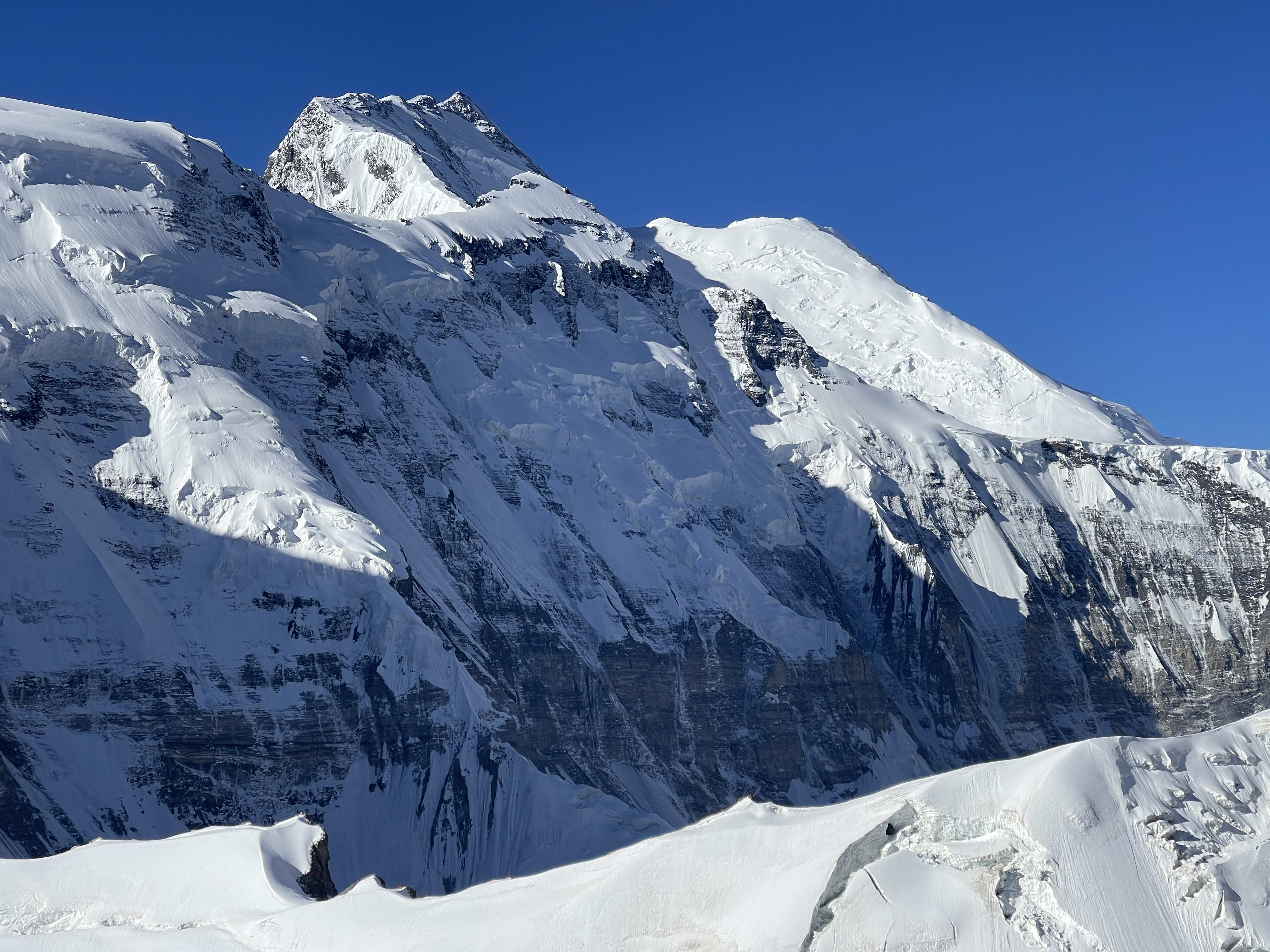
P1040118

View of Pik Lenin from near the summit of Pik Petrovski.

In deciding to attempt Pik Lenin I felt that I would be following a very logical approach to making my first 7000m summit. A non-technical 7000m mountain seemed a good progression from walk-up and moderately technical 6000m climbs. The nature of the climb also seemed conducive to undertaking the expedition independently above basecamp, and perhaps even entirely solo – as much as one can ‘solo’ a mountain as popular as Lenin. After a fairly moderate five month training cycle I sorted out service for access and basecamp logistics, hiring Kyrgyz operator Ak-Sai Travel for this, planned out a balanced supply of food for my high camps, put together an acclimation plan, and booked airfare for Bishkek, Kyrgyzstan.

Ultimately, my attempt on Pik Lenin was unsuccessful. My acclimation routine, rotations up the mountain, and high camp move all went very, very well. However, during my summit bid I experienced an upset stomach and unstable bowels, and this paired with 40-50km/h morning winds caused my decision to turn myself around and descend from only ~6400m. Flight timeframes and energy were not conducive to a second summit attempt, and so I left Kyrgyzstan without a summit, a profound sense of disappointment weighing upon me.

Below is a calendar/schedule of my acclimation and climb, as well as a collection of images from my 2016 Pik Lenin expedition.

Pik Lenin Calendar

My 2016 Expedition Schedule.