Here is a schedule and trip report for my unsuccessful July 2024 attempt on 7134m Pik Lenin.
Atrocious weather – high winds and heavy snowfall throughout my time on the mountain – prevented me from climbing any higher than ~6100m on this attempt. Despite no summit, my main objective in this climb of Pik Lenin was thorough pre-acclimatization for 7010m Khan Tengri, where I was very well prepared and ultimately successful. Although I failed to summit Pik Lenin this time (and didn’t even enjoy myself much!), the time spent was still highly worthwhile; I was so well acclimated afterwards that a rapid ascent of Khan Tengri was possible for me. Take a look at my far more detailed Khan Tengri trip report for a broader discussion of the pre-acclimation strategies which I have now successfully employed multiple times.
Rather than its own goal-oriented expedition, this 2024 attempt on Lenin felt more like an warm up mission, and a very boring one at that. The foul weather kept me camp-bound, and there was loads of downtime with very little to do. Happily, Ak-Sai’s services are top notch, and I was comfortable throughout the endless waiting, waiting for good weather which never came. The following trip report, rather than a more interesting narrative, is essentially just a rough edit of the point-form journal which I kept while in the camps. I hope that it will be useful in some capacity.
Images and details from my successful 2017 Pik Lenin expedition can be found here.
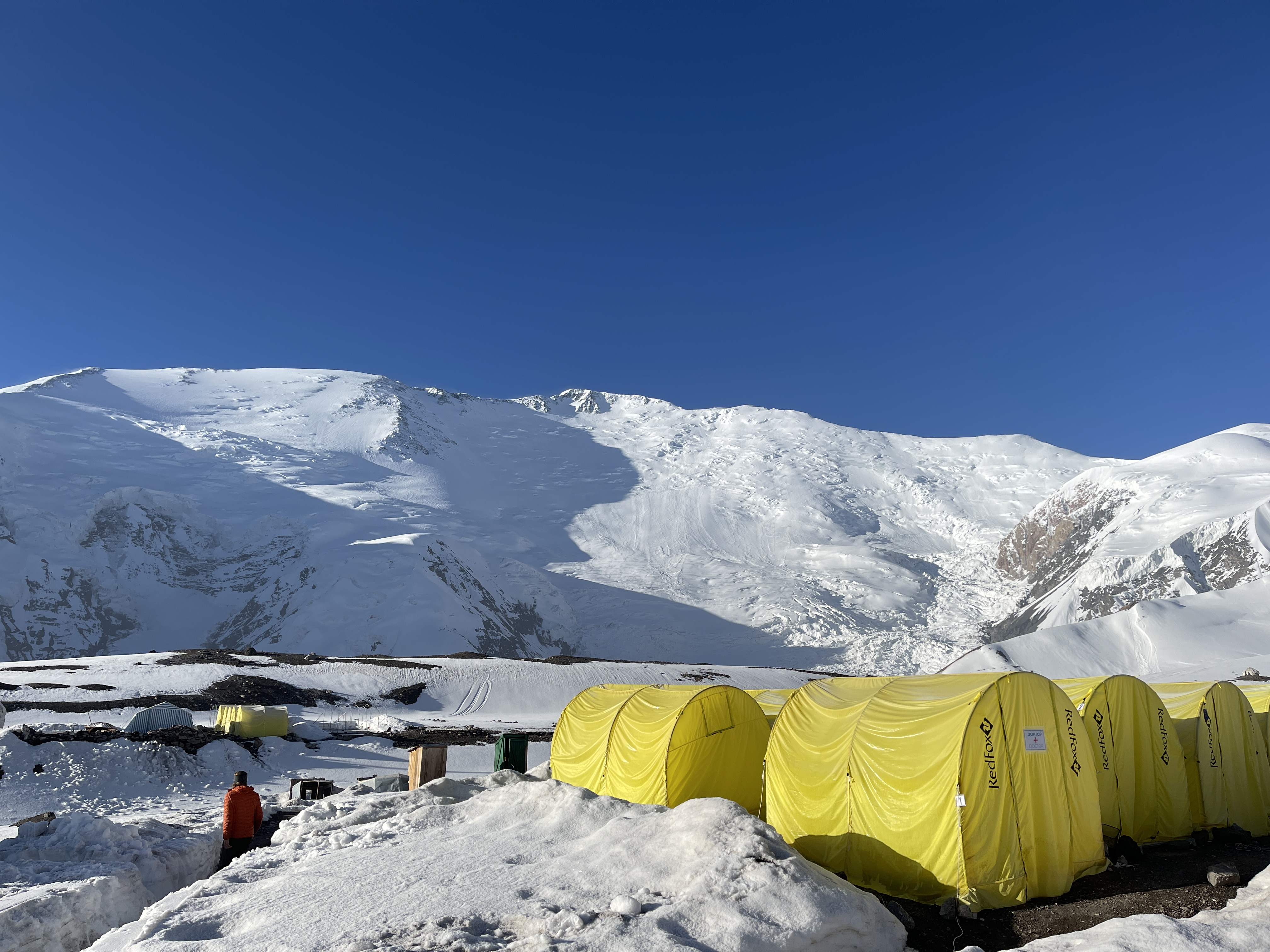
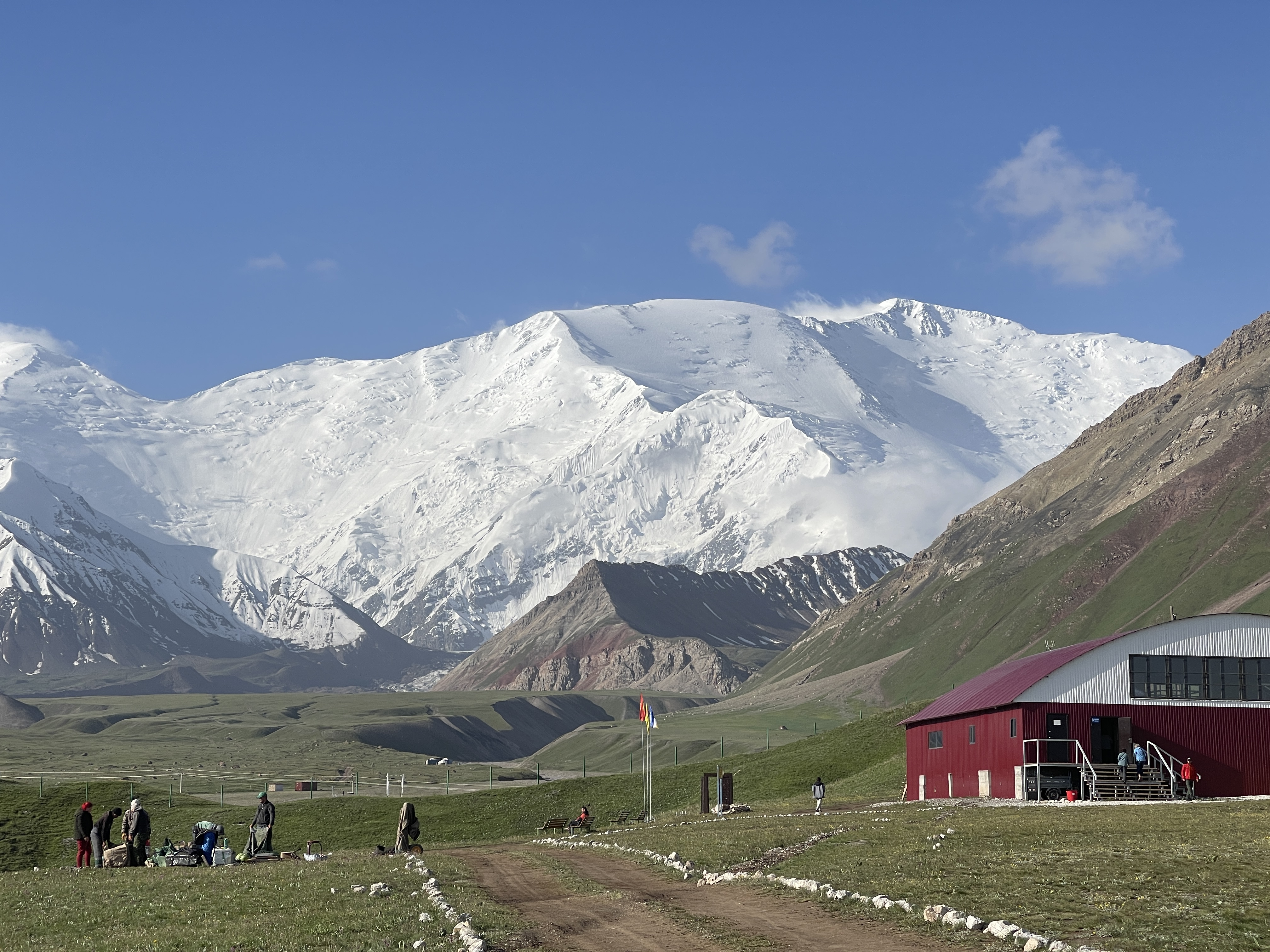
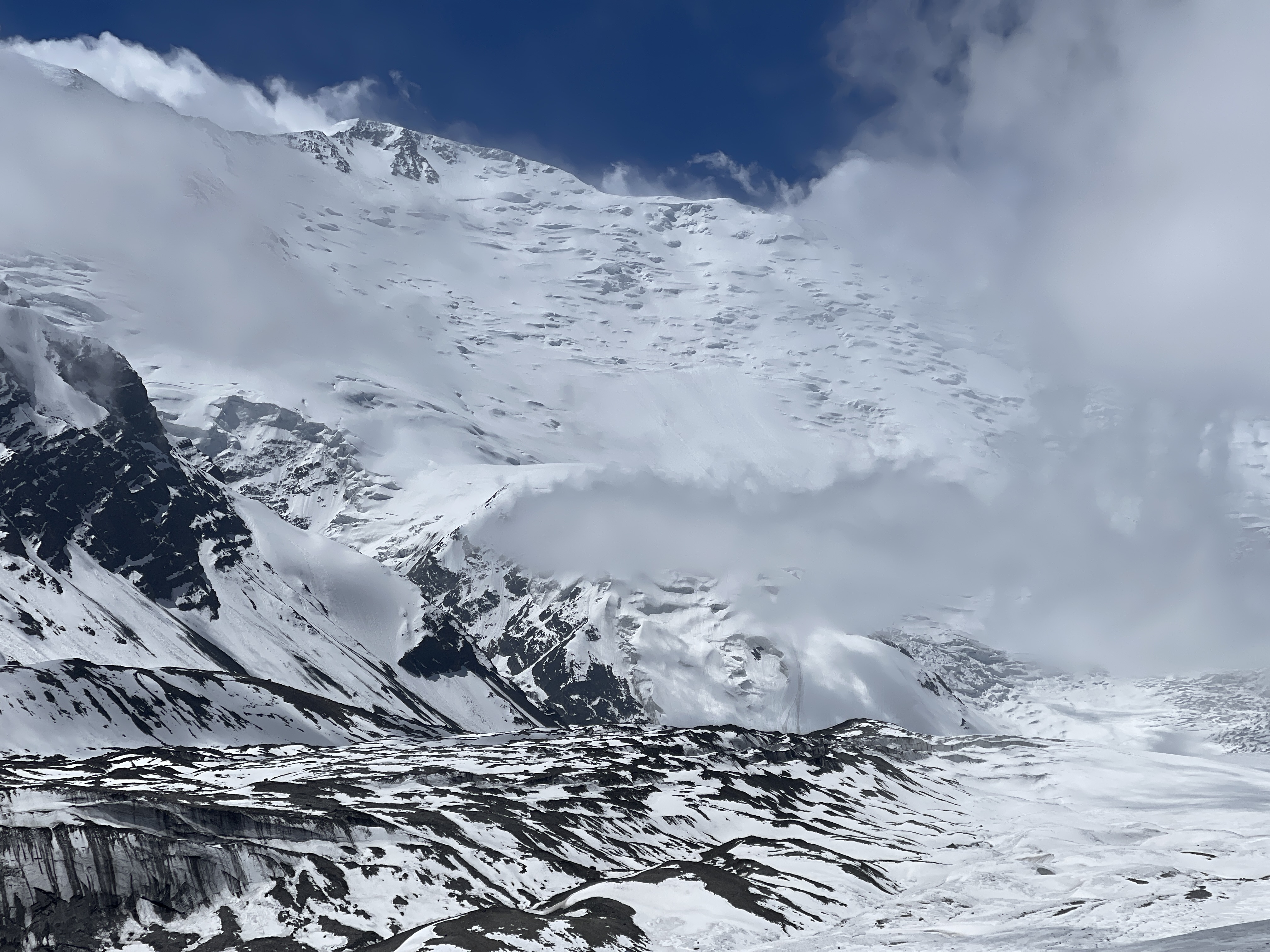
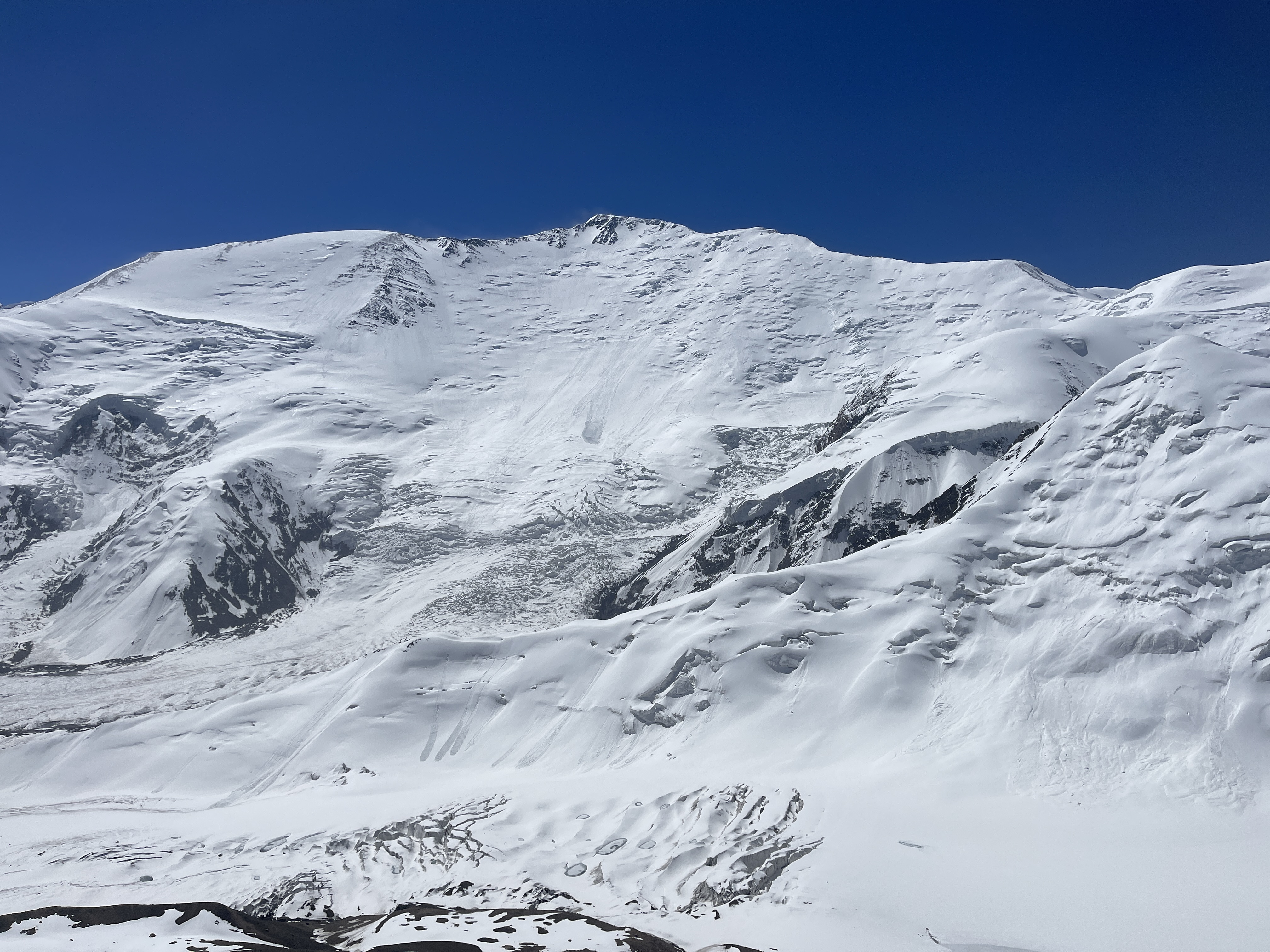
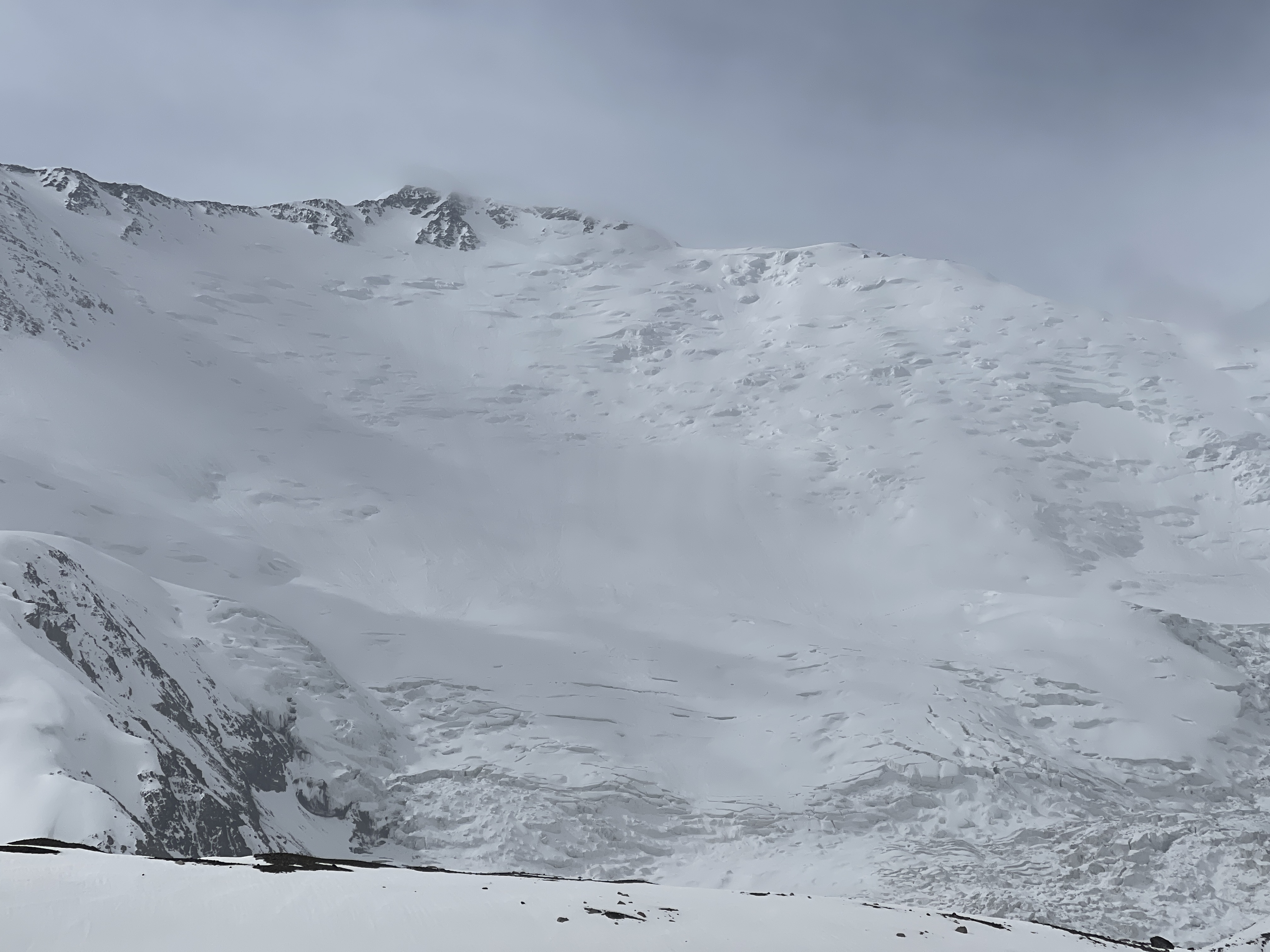
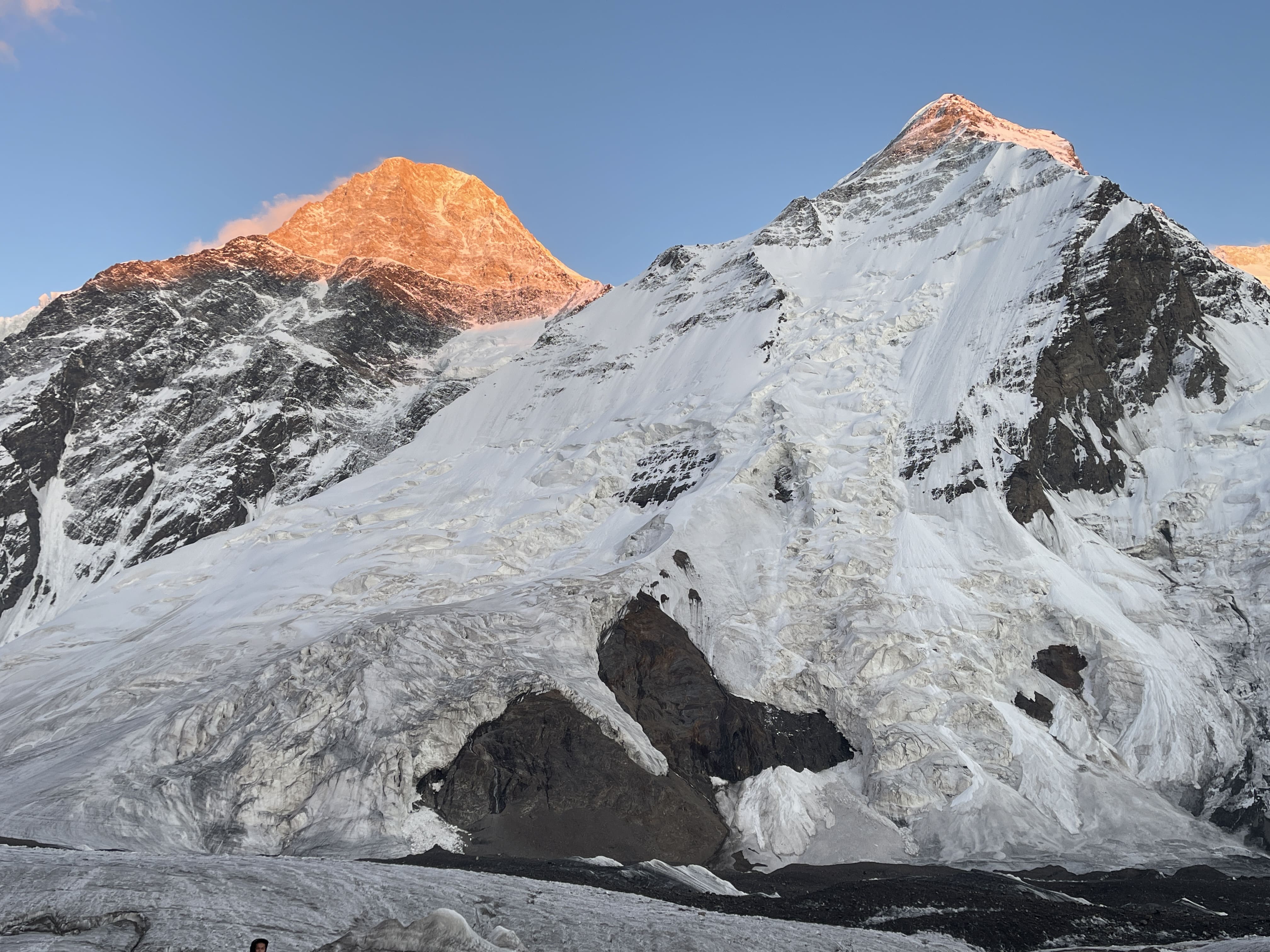
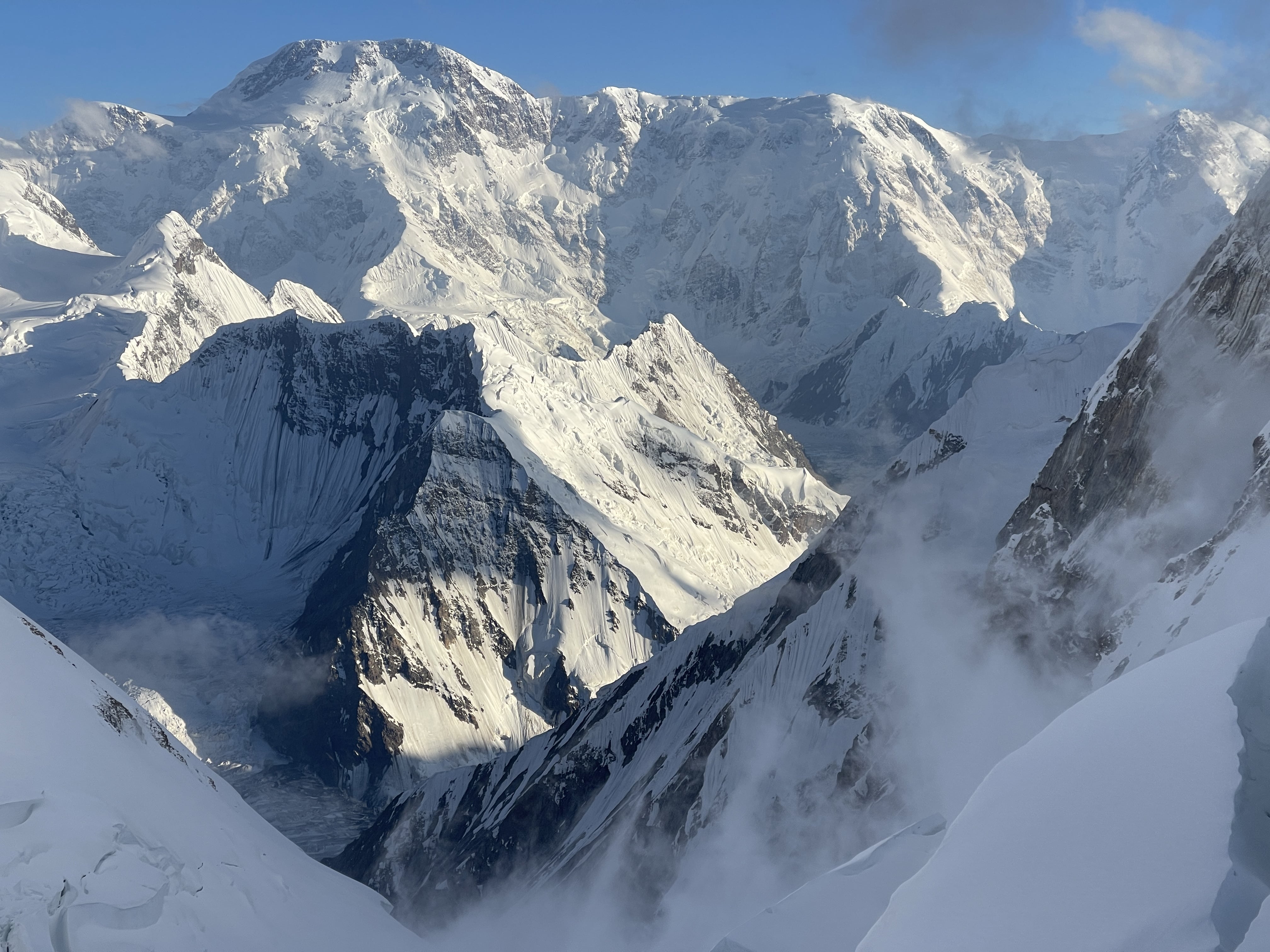
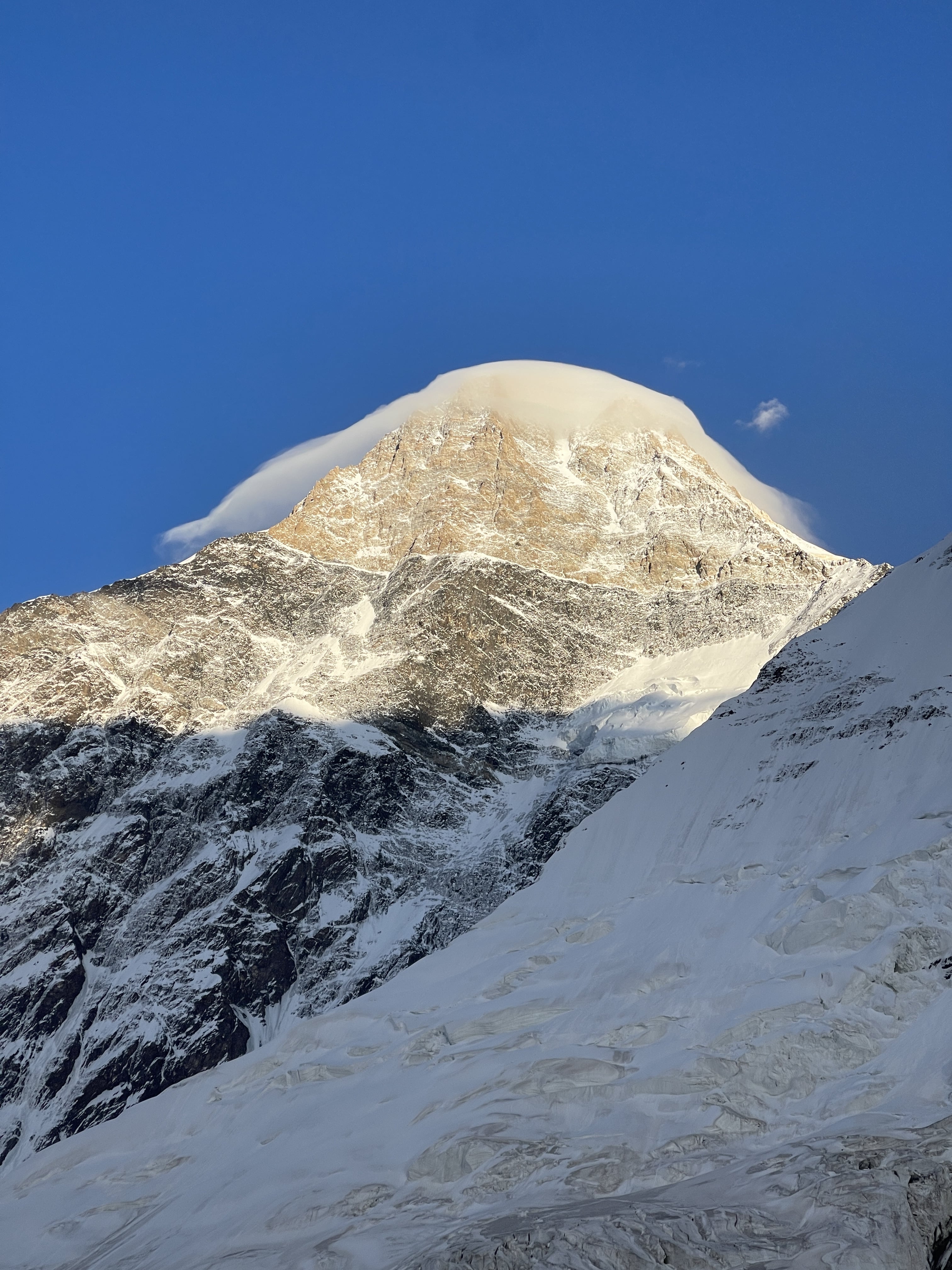
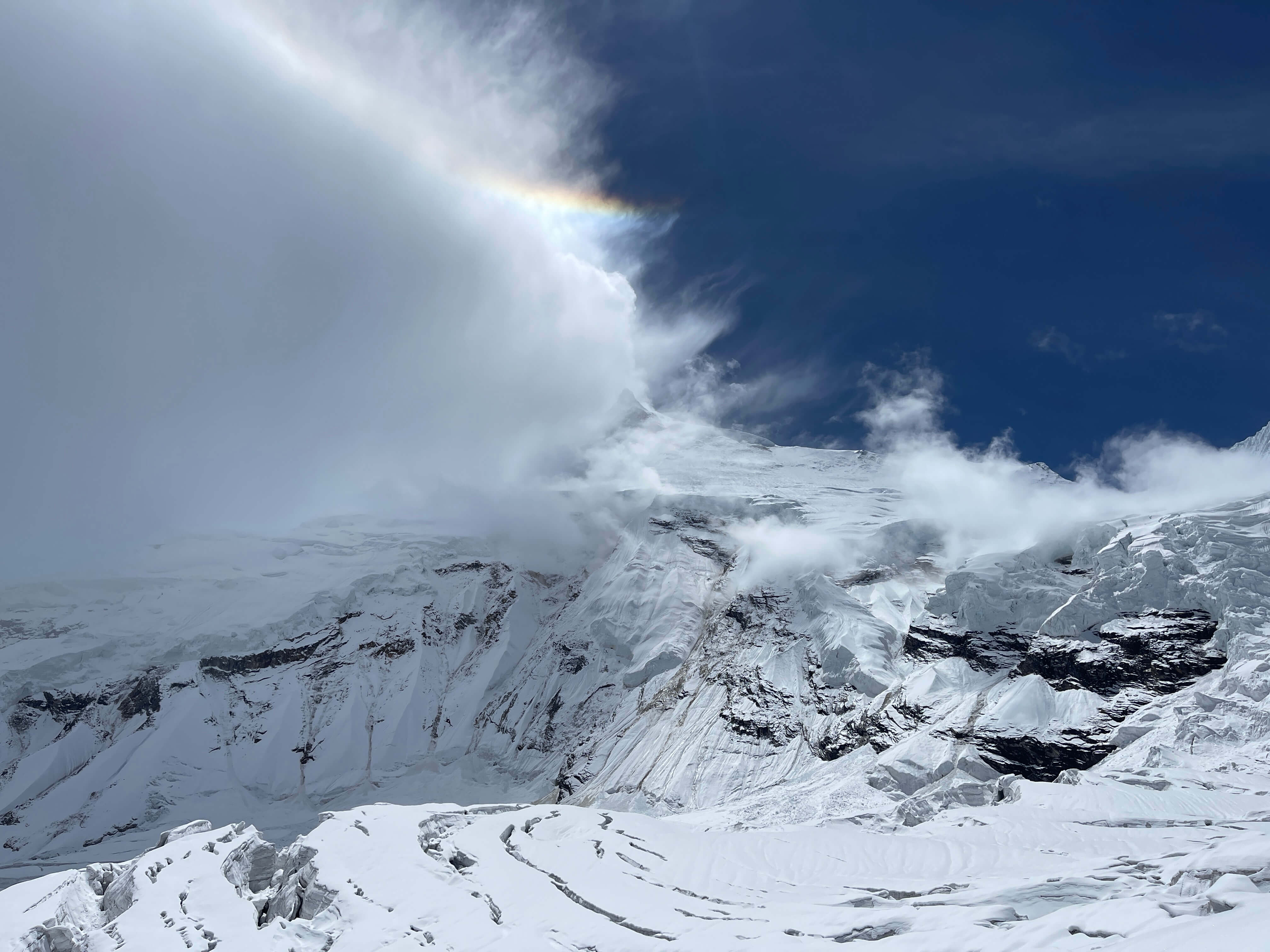
Pik Lenin, from 4400m camp.
Schedule and Calendar
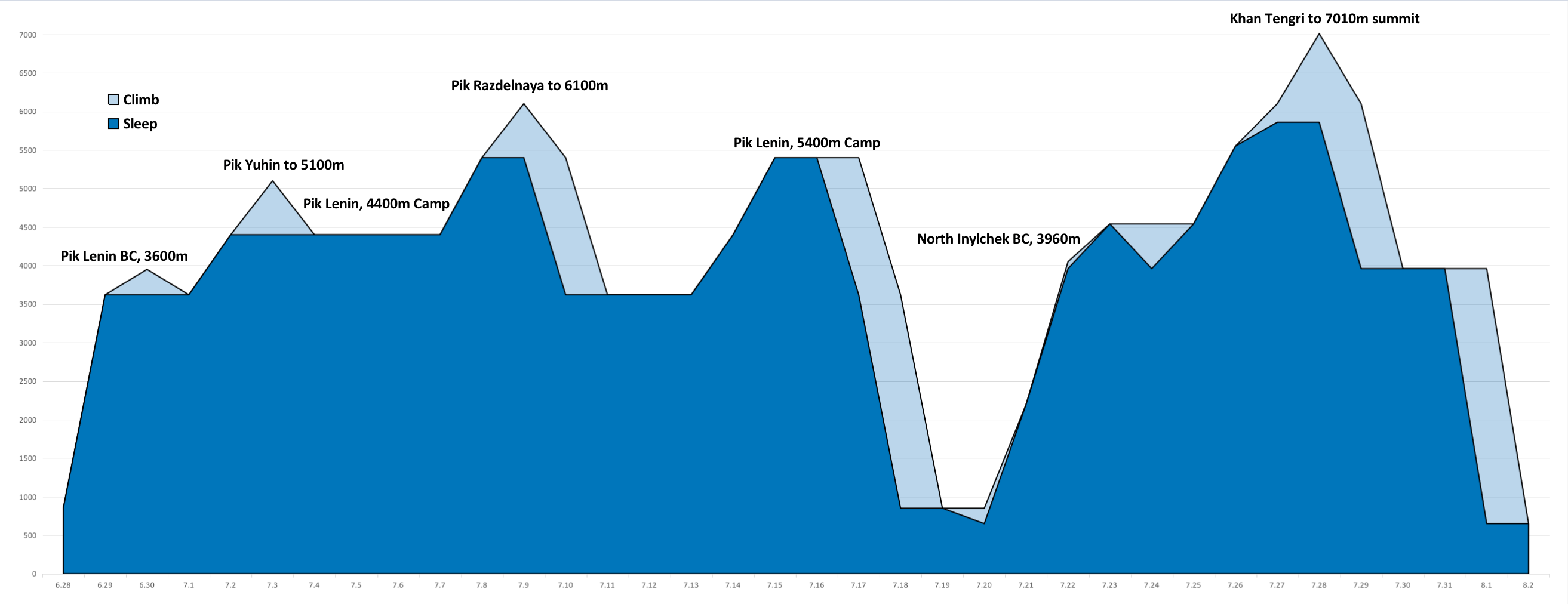
Here is a calendar outlining my acclimation routine and climbing activity throughout my 2024 Pik Lenin climb. I have also charted out the elevations used for my acclimation rotation – with the subsequent Khan Tengri expedtion added on. This attempt on Pik Lenin was predominantly an exercise in acclimation, and despite no rotation above 6100m, the routine I followed was sufficient for a solid acclimatization suitable for ascending into the low 7000m range.
3 am arrive Bishkek, and direct to a Bishkek hotel.
Massively jet lagged! I slept all day long.
6.28
Flight to Osh was delayed. Slept all day and went grocery shopping at night; happily the day prior I had seen that everything stays open until 10 pm, likely due to the summer heat?
6.29
Osh 850m to BC 3620m
Awake at 2am. 8am flight to Osh, 40 minutes.
Drive to Lenin BC, hot in the car!
Much faster than other experiences. About 5 hours from Osh, arrived at 4pm.
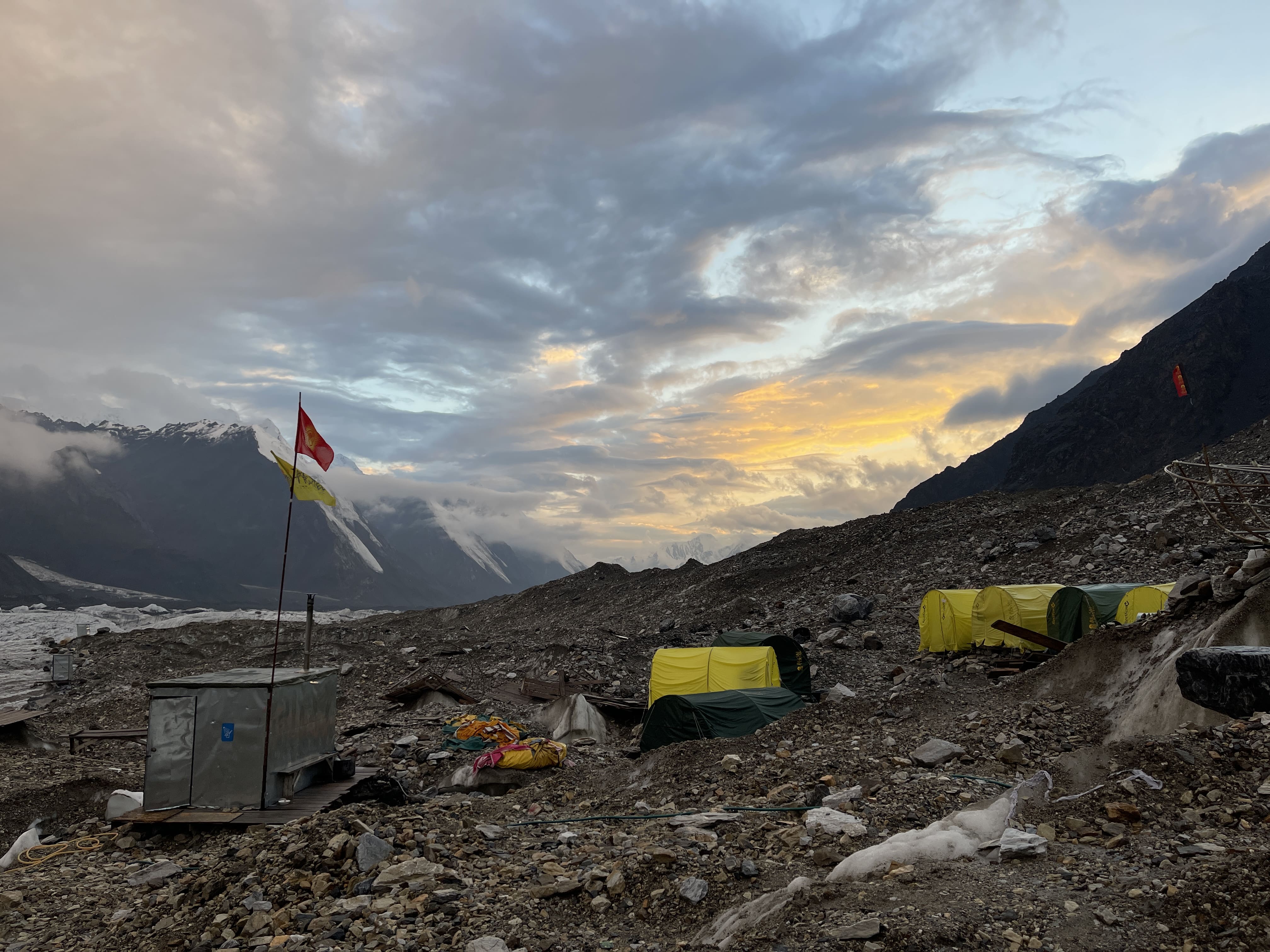
BC is luxurious; awesome food spread, comfortable mess hall, hot showers available 24/7, and now has fast internet with a local SIM card. I used the carrier ‘Mega’ and had full bars, an extremely fast connection in my tent. Unrecognizable to the BC infrastructure of 7 years ago, when I ate in a yurt or in a group tent.
Ak Sai has stepped up their service offering. I was deeply impressed by the quality of the new Ak Sai operated Moskvina Basecamp in Tajikistan during my 2023 Pik Kommunizma expedition, and I was equally impressed by their improved 3600m Basecamp facilities on Pik Lenin.
6.30
Short acclimation hike to 3950m, on the Pik Petrovsky ridge. Going to 4000m is not really worth it for the additional distance involved.
7.1
Rest Day in 3600m Basecamp.
7.2
8:50 am depart 3600m BC.
12:25 pm arrive 4400m camp. Time of 3:35.
Steady rain and wind in the early morning had me nervous about making the hike up, but the weather cleared completely after breakfast. This was a major relief; hiking to 4400m camp in heavy rain would be truly miserable.
I gave the horses 27kg of equipment and food, and carried about 10kg myself.
I departed 3600m BC at 8:50, and arrived at 4400m Camp at 12:25, a time of 3:35. I was surprised to be an hour faster than my 2017 time, as I didn’t feel that I was rushing. Indeed, I stopped twice to take quite significant tea breaks.
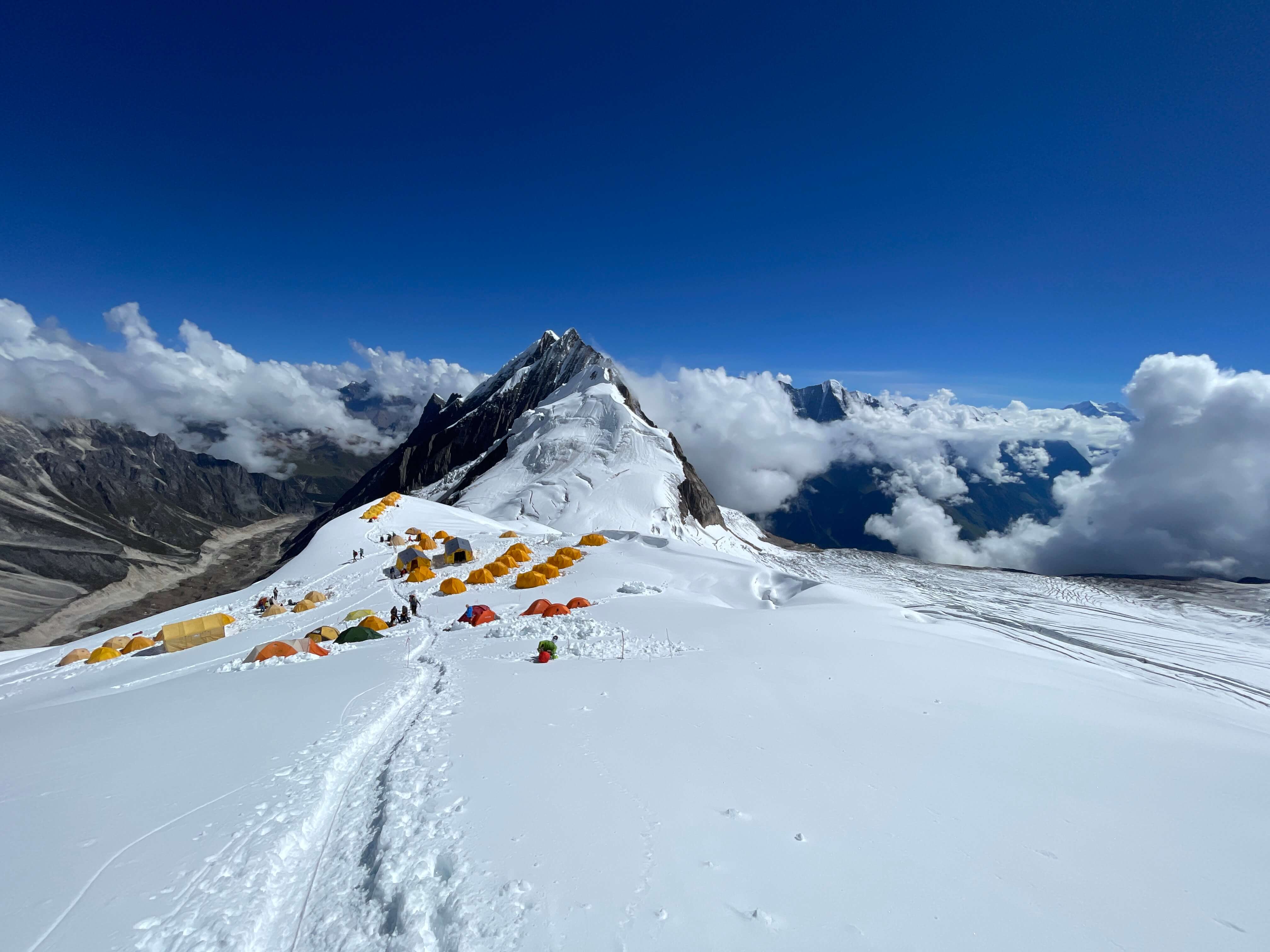
Lunch at 4400m camp was an all-you-can-eat buffet, available right after I arrived. I was astonished and delighted by the quality and variety of fruit on offer! While 4400m camp offers the same infrastructure as I experienced in 2016 and 2017, the food has improved significantly – especially as it is now buffet style.
7.3
Short acclimation hike. I departed 4400m camp at 9am, arrived 5100m Pik Yuhin at 11am, time of exactly 2 hours.
11:50 start to descend and 12:35 arrive, in time for lunch. 45m descent time. I took a nap in the sun at the top of Pik Yuhin, good for acclimatization.
7.4
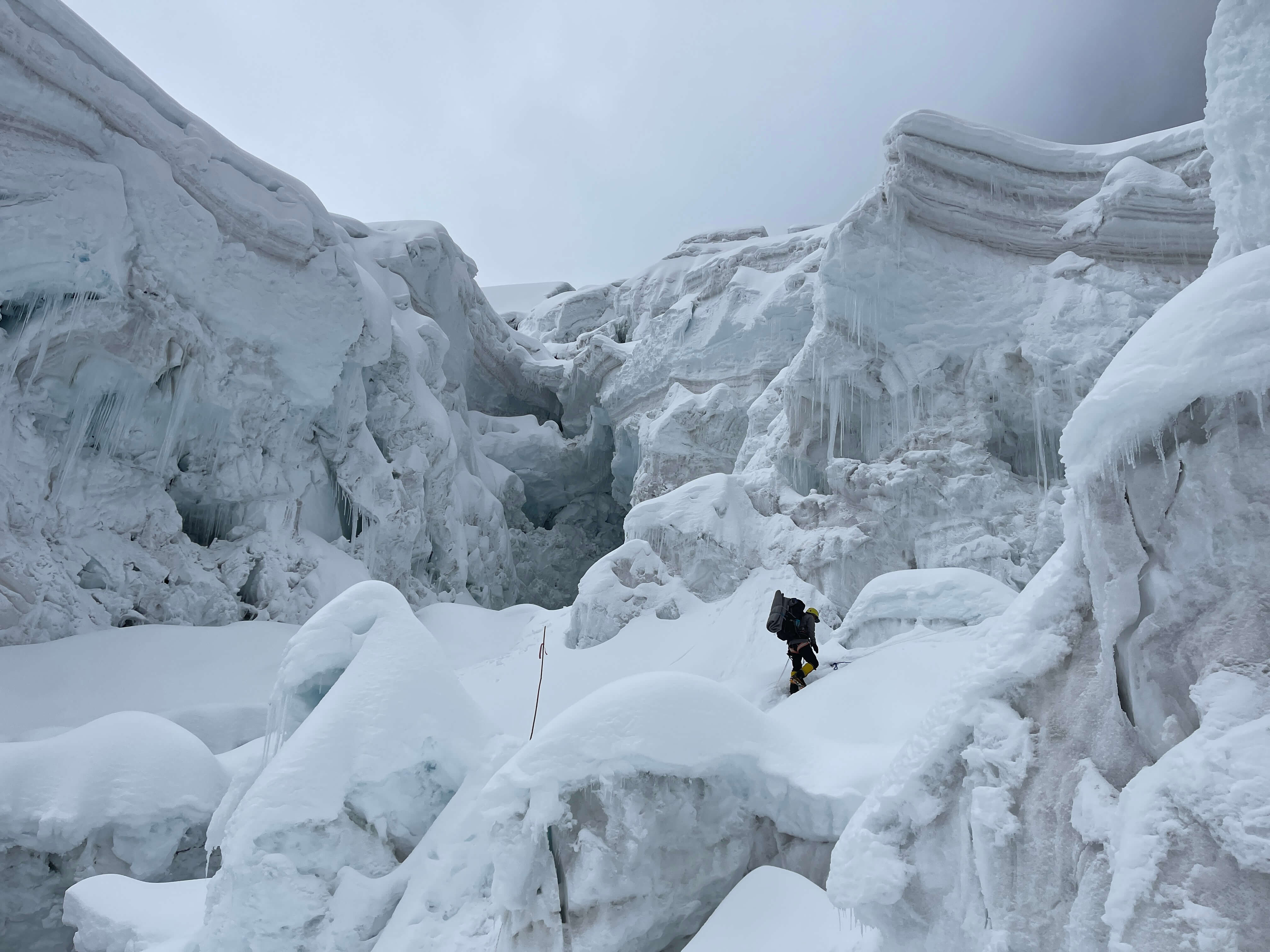
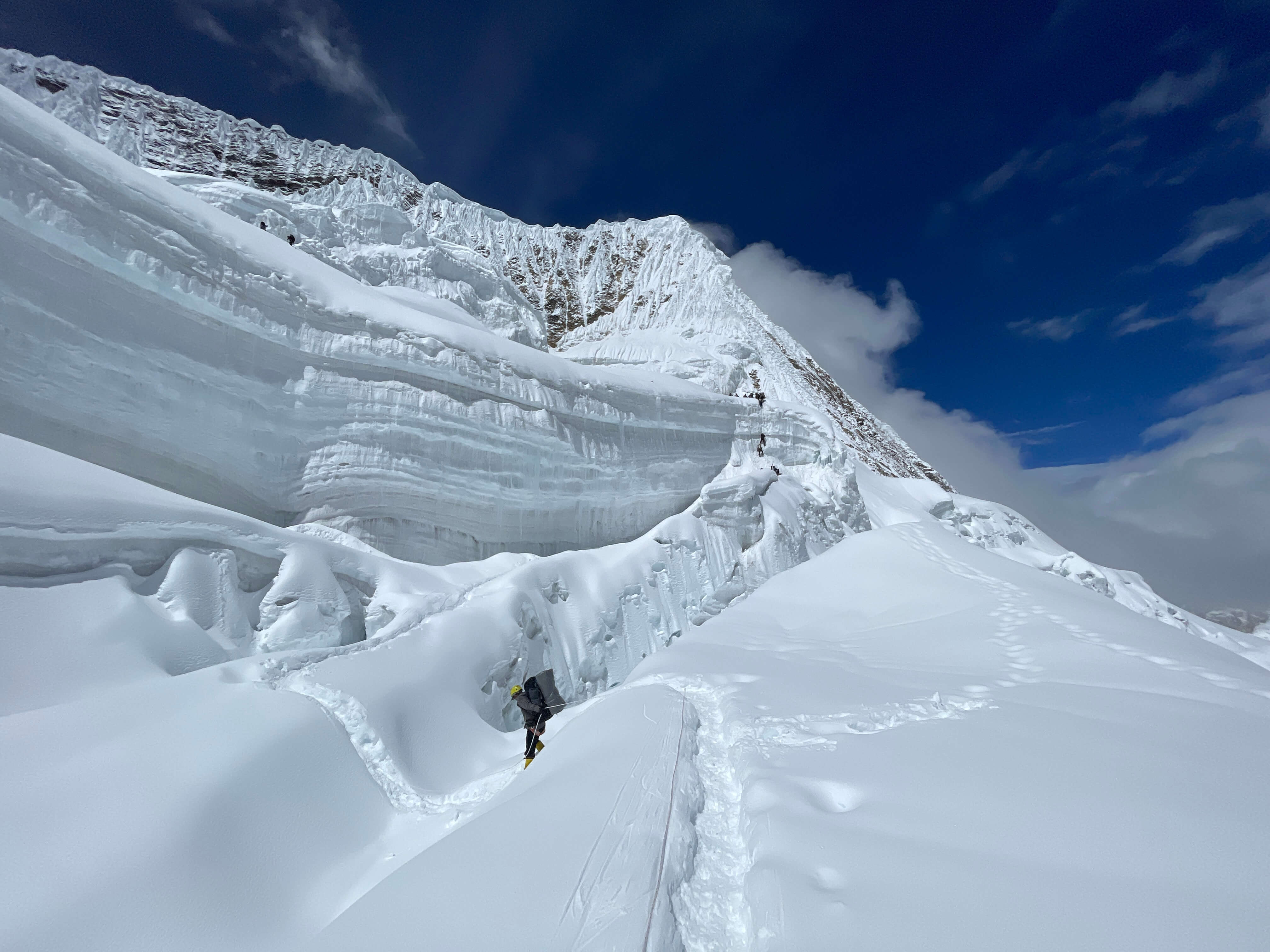
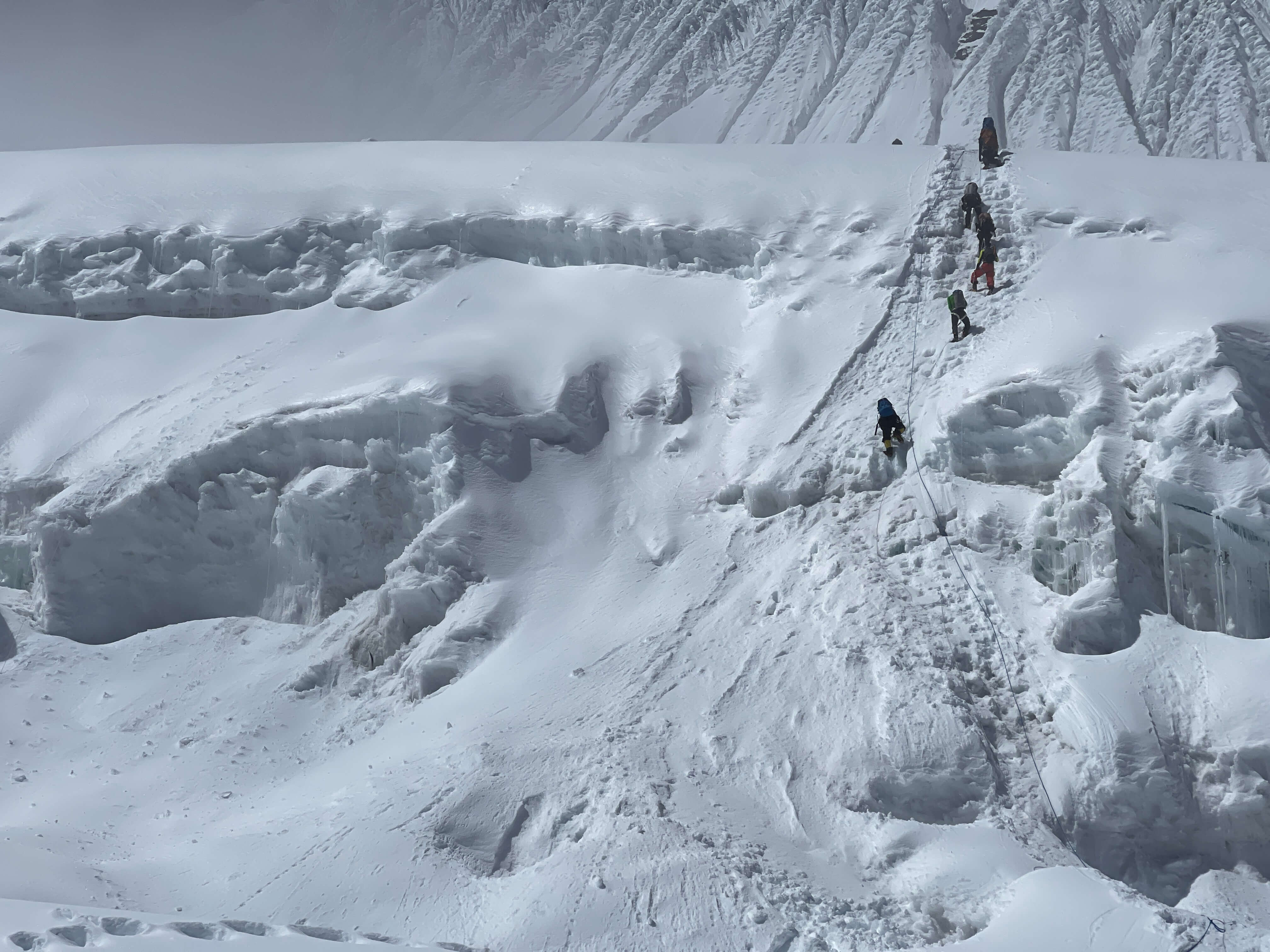
Easy walk to the base of the route up the glacier. Forecast called for heavy snowfall, and as such I felt undecided on next steps. I also felt some urgency in my need to find someone to rope up with for the icefall!
7.5
Rest day.
Heavy snowfall, as forecasted. I had been tempted to ascend today, but upon seeing the weather at 2:30 am I decided to bail, and immediately went back to sleep.
7.6
Rest day.
A departing Swiss and Dutch couple gave me their remaining electrolyte tabs, wet wipes, and hand sanitizer. Their generosity put me into an excellent mood!
Deep snow makes for an unsafe route on the glacier; nobody goes up, nobody comes down. I felt happy to be in 4400m camp, and not trapped higher on the mountain.
7.7
Rest day.
Many groups decided to abandon their expeditions today, due to the poor forecast and the boredom of incessant waiting. I opted to wait patiently; I’d budgeted significant time for my summer mountain goals, and while very bored in 4400m camp, I felt that I could tough it out for a few more days. Ak Sai now has fast WiFi for $5 $USD per hour, and I made a point of using it once every other day to help kill time.
7.8
3:25 am depart 4400m camp.
10:45 am arrive 5400m camp. Time of 7:40.
With a favorable weather forecast, I finally committed to moving up to 5400m camp. I teamed up with a pair of fit Belgians so as to have three on the rope for the icefall – a best practice given the number and magnitude of crevasses on route.
I followed my normal strategy for acclimatization rotations, and packed an absolutely enormous load to carry up. I hoped to bring everything I needed to 5400m camp in one shot, thus enabling me to carry only a tiny, light daypack up when it came time for my summit attempt. My backpack was painfully heavy.
We departed Ak Sai’s 4400m camp at 3:25am, and arrived at Central Asia’s 4400m camp at 4:05. We arrived at 5400m camp at 10:45am, a time of 7:20 from Ak Sai’s camp or 6:40 from Central Asia’s. In 2017, with a similarly loaded pack, the climb to 5400m camp took me 7:40 from Central Asia’s camp – not a bad improvement!
On arrival in 5400m camp I was lucky and grateful to find a perfect tent platform waiting for me. Exhausted, my shoulders, back, and legs thrashed from my heavy backpack, I pitched my tent and immediately took a nap without unpacking anything else. After 90 minutes of sleep in the mid-day heat I spent an hour properly anchoring my tent, unpacking, and brewing a whey protein hot chocolate. I had no headache, nor any other symptoms of AMS; so many days waiting in 4400m camp had definitely provided me with a good base of acclimatization. For dinner I tried a freeze dried meal, but it was so revolting that I was only able to eat half of it. Luckily I had plenty of cheese, sausage, nuts, and chocolate to eat.
7.9
9:35 am depart 5400m camp.
12:55 pm arrive 6110m. Time of 3:20.
Depart 6110m at 1:35 pm.
2:30 pm return to tent at 5400m camp, time of 55m.
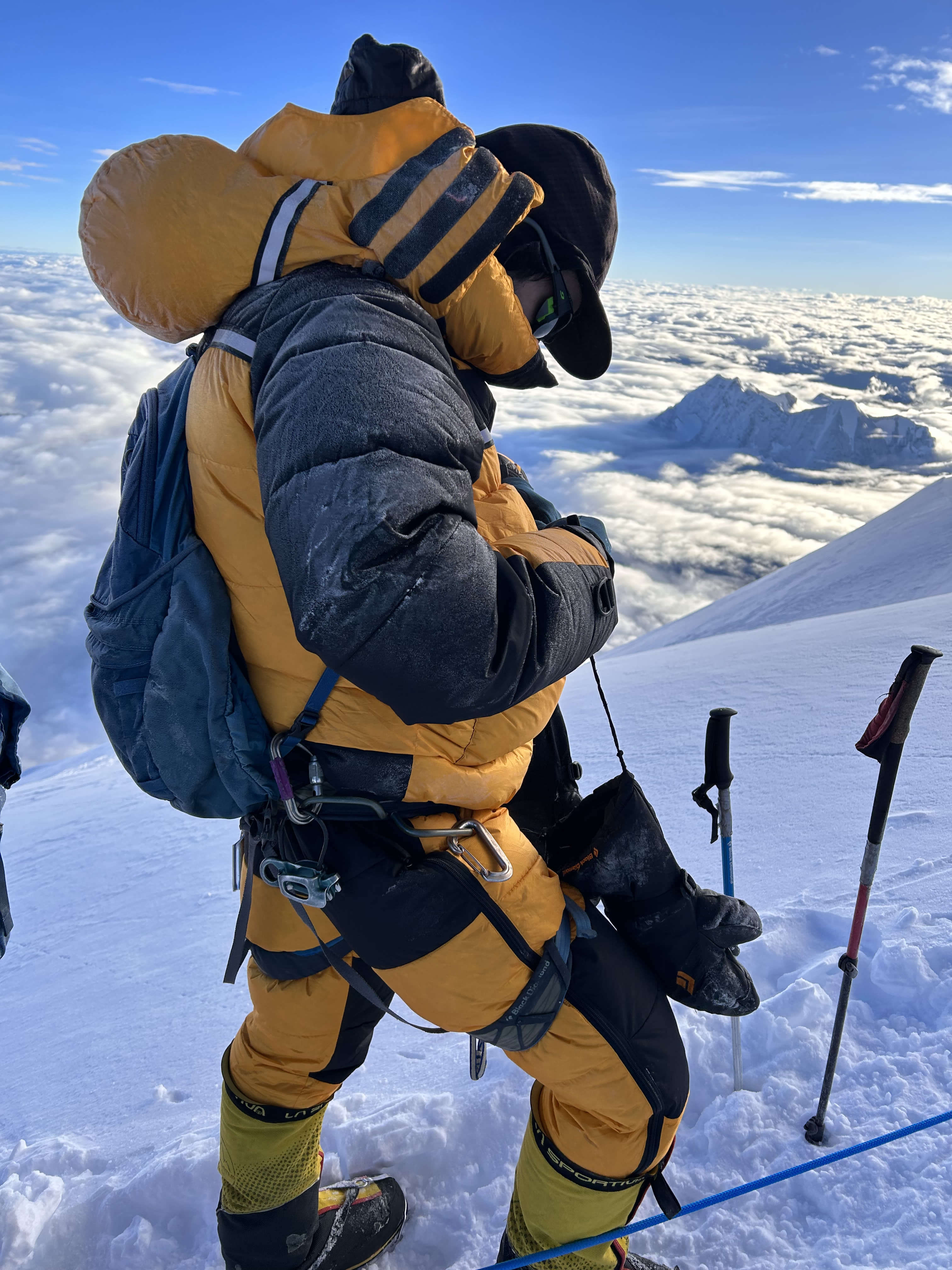
I went up on an acclimation rotation, hoping to tag at least 6000m. On my prior Pik Lenin expeditions, this single rotation to 6000m had been sufficient acclimatization preparation for a summit attempt.
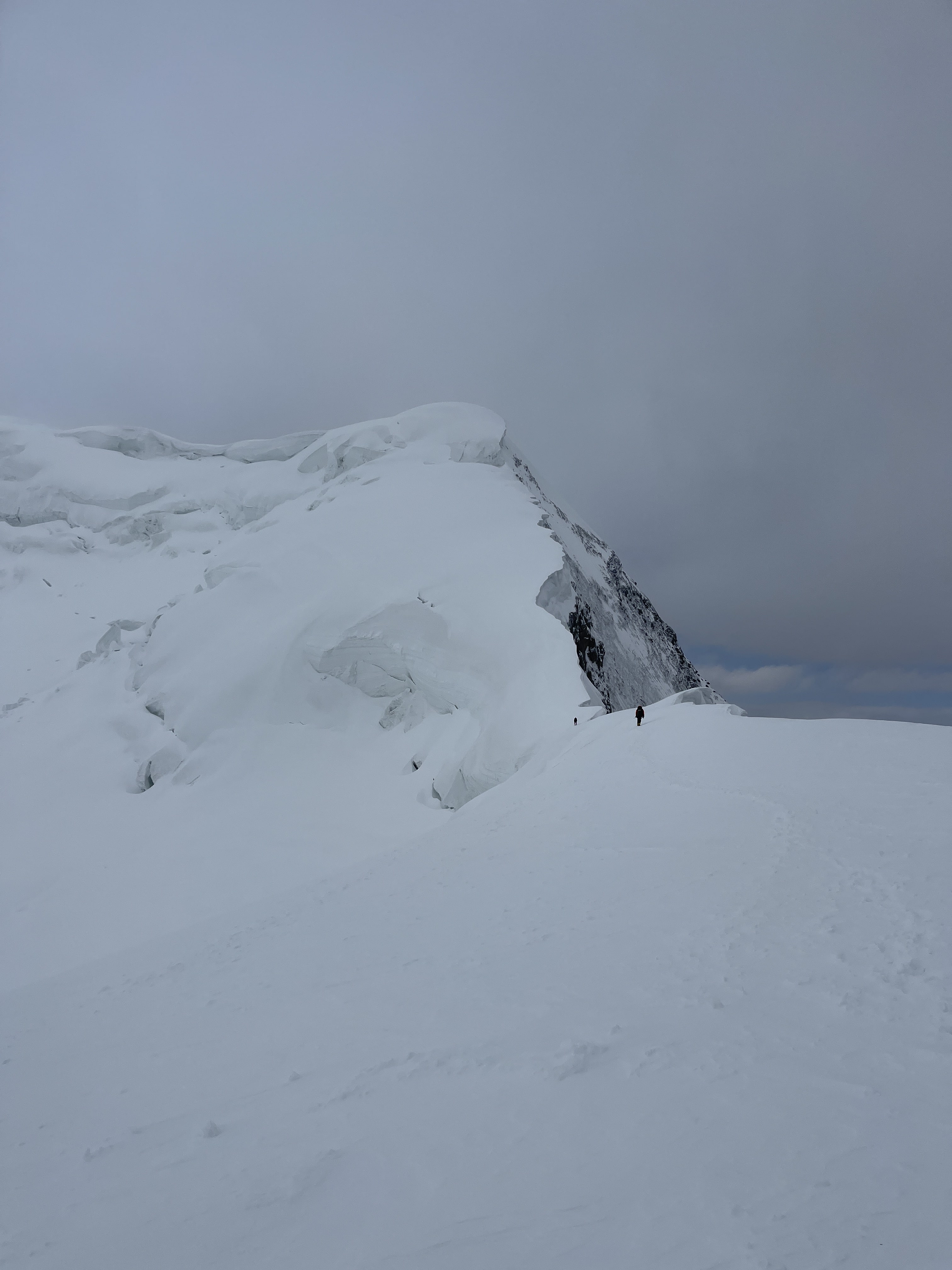
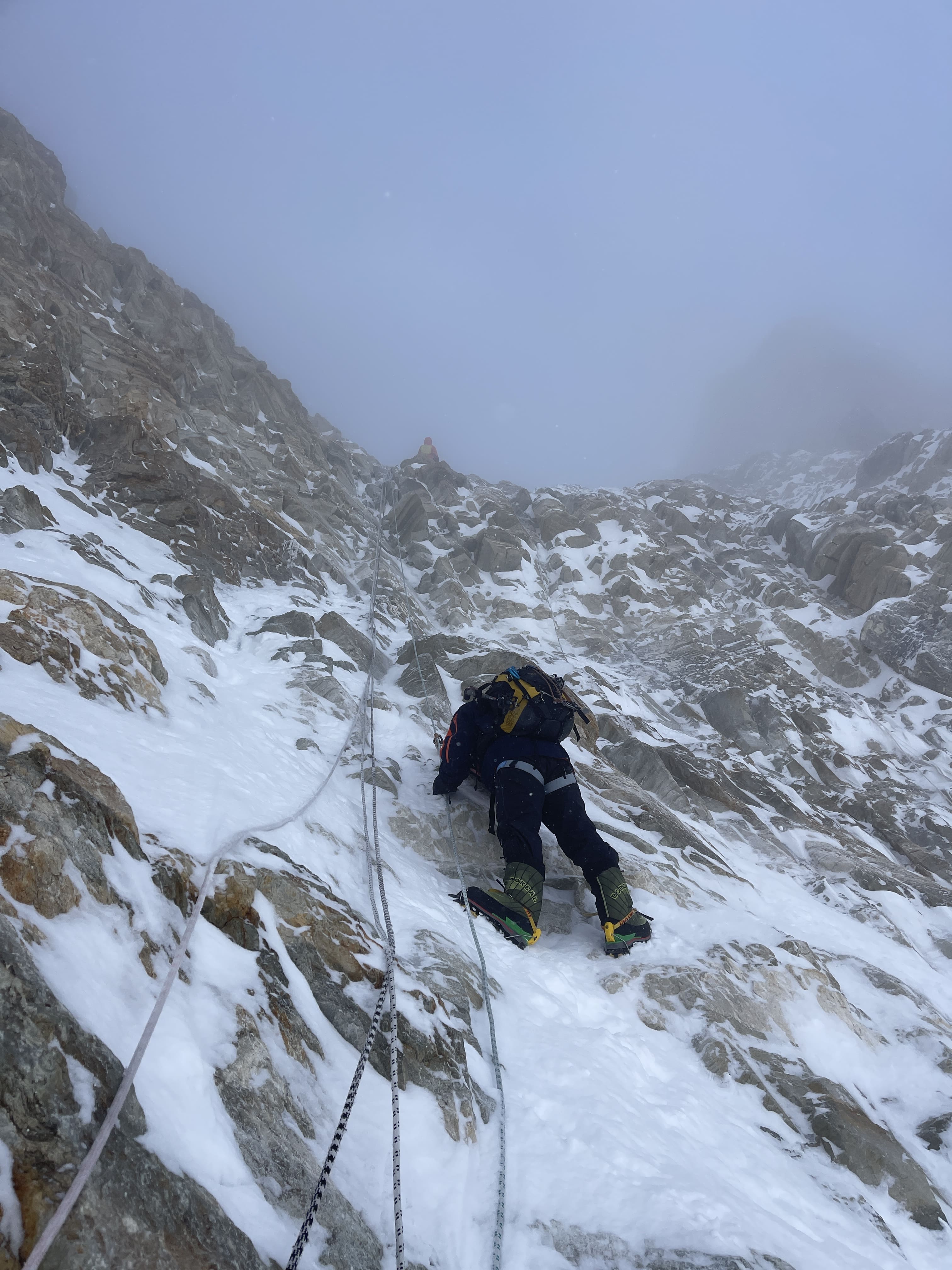
High wind and deep snow near the summit of Pik Razdelnaya made for slow going. I opted to stop at 6110m rather than climb into the fierce wind and go all the way to the summit. I felt well enough at 6k, but would have preferred calmer weather. Back at 5400m some green tea, sausage, and cheddar cheese served as my recovery meal. I had a headache in the evening, which was resolved with an ibuprofen.
7.10
8:40 am depart 5400m camp.
11:55 am arrive Ak Sai 4400m camp. Time of 3:15.
2:05 pm depart 4400m camp.
4:45 pm arrive 3600m BC. Time of 2:40.
I woke up feeling quite well, and prepared a breakfast of whey protein hot chocolate, sausage, and mixed nuts. As I’ve undertaken more expeditions, I’ve come to rely less and less upon cooked food while at high camps. Cheese and sausage are reliably easy to eat, although not available in every country. Mixed nuts also offer remarkably high calorie/weight value, and are usually palatable when sick from altitude. Freeze dried food is majorly hit or miss for me, and can feel utterly inedible. It’s also expensive, heavy to deal with if uneaten once prepared, and time consuming to cook.
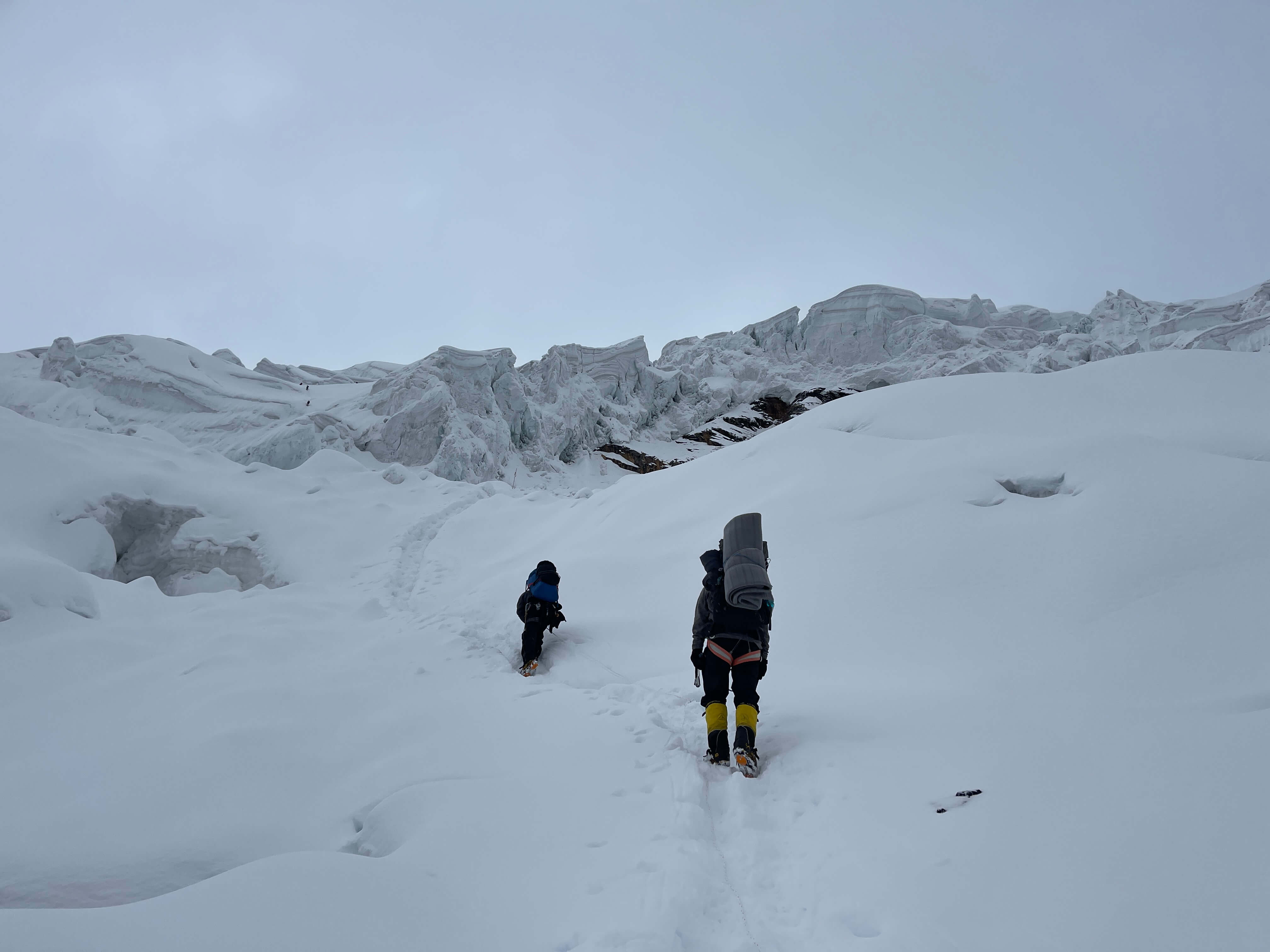
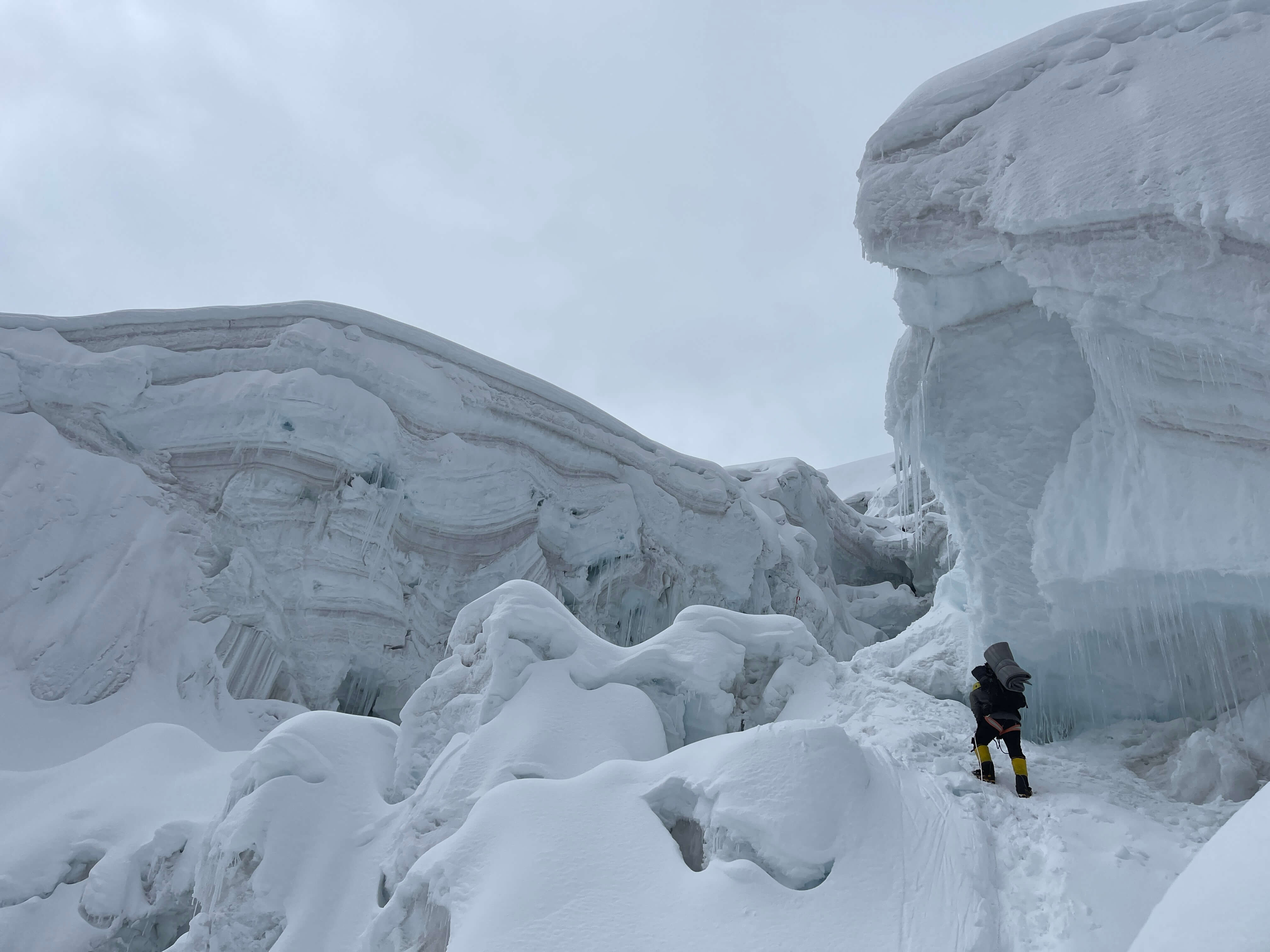
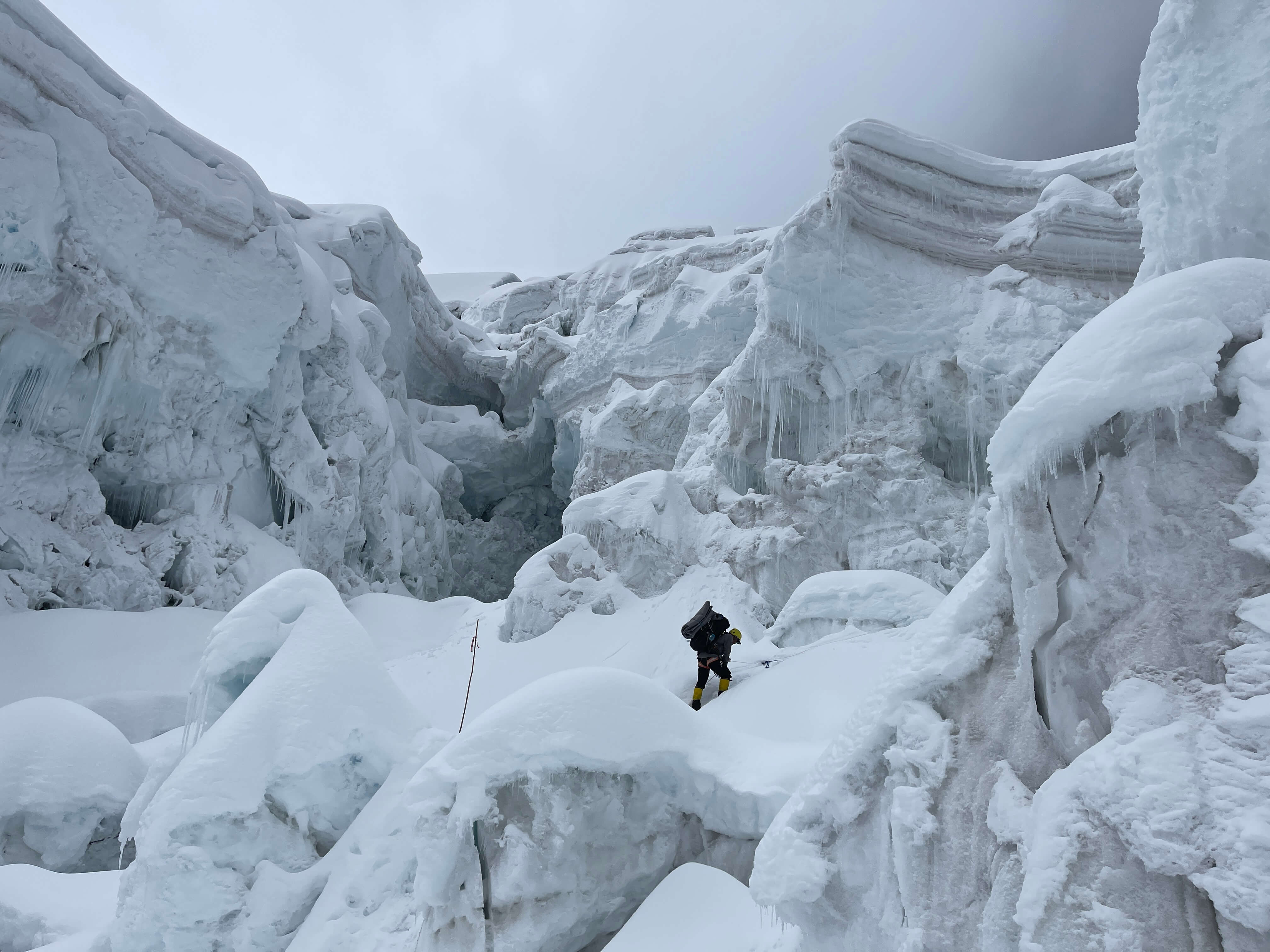
Our descent from 5400m camp was much slower than I had managed in 2017; three on the rope and one section made more comfortable with a rappel slowed us down. Ak Sai’s camp is also almost an hour past Central Asia’s on the moraine, and the final stretch of chossy rock is quite annoying in late morning heat.
I met the living legend Carlos Soria in 4400m camp; he had apparently just arrived with a Spanish team. I shook his hand and wished him good luck! Lunch in 4400m camp was an otherwise very pleasant reprieve from my high-altitude food.
Hike down to 3600m BC was uneventful, but for a heavy hailstorm which lasted about 30 minutes. BC was luxurious compared to camping higher, and the hot shower was especially welcome.
7.11 – 7.13
Rest days in 3600m BC.
I spent three days resting in 3600m BC, waiting for the deep snow higher up to melt and for the weather forecast to improve.
7.14
8:55 am depart 3600m BC. 12:10 pm arrive 4400m camp. Time of 3:15.
I took my time getting ready after breakfast, until my Belgian friends began urgently calling me, telling me that the Ak Sai truck was waiting for me. I was only partially ready, and still needed to drop my luggage in storage, brush my teeth, prepare water. I tried to hurry, but still took at least ten minutes… When I got to the truck a large crowd was waiting only for me; very unexpected and embarrassing!
The truck departed at 8:55 am, and drove us to the cliffs where the hike begins to steepen. I hadn’t taken the truck the last hike from 3600m to 4400m – indeed I had departed at 8:50 am and arrived at the cliffs *before* the truck! I paced only 15m faster with the ride. Despite a similar timing to my first hike up, I felt incredibly fresh and energized this second time. Three days of rest in BC had supported great recovery and robust acclimation.
7.15
3:25 am depart 4400m camp. 9:25 am arrive 5400m camp. Time of 6:00.
Awake early, we were treated to a cloudless sky bright with stars and a visible Milky Way. We made it to 5400m camp in approximately 6 hours from Ak Sai’s camp, or roughly 5:15 from Central Asia’s.
High wind as we entered the ‘frying pan’ was extremely cold, and balance was tricky at times. Likely sustained at around 40km/h. This tapered off as we reached camp, tired.
I found my tent in superb shape, undisturbed, perfectly anchored, and nicely set into about 10 cm of snow. It was warm and cozy inside, very well insulated from the wind.
My hard Kyrgyz cheese from Bishkek was amazing, totally fresh and unspoiled. I carried 1.5 kg of it up, and was able to eat large quantities right away. Major thanks to the Ak Sai Basecamp manager who helped me refrigerate it while I was rotating and resting in BC.
I felt myself developing symptoms of a cold: a very sore throat and runny nose. I was hopeful that it would resolve overnight, or at least not get worse.
7.16
I spent the entire day in tent, eating, reading, and resting. Wind was so severe that there was absolutely no way to move higher, and the prospect of descending also seemed risky. My cold symptoms were more or less the same; I decided to see how I felt the next day, and hopefully ascend.
7.17
10:20 a.m. depart 5400m camp. 1:40 p.m. arrive 4400m camp. Time of 3:20.
My sore throat had developed into a full-on head cold. I decided to descend, rather than risk the throat infection getting into my lungs. I’d been similarly sick several times prior at altitude, and knew that a lung infection could set me back multiple days.
Weather was also absolutely awful, with high wind and yet more heavy snowfall scheduled.
We departed 5400m camp at a late 10:20 am, slow getting ready and digging up the tent while not feeling well. Arrived at 4400m camp at 1:40pm, a time of 3:20.
Depart 4400m at 3:20, arrive 3600m 6:40. Many, many breaks on the way down, moving at a leisurely and relaxed pace.
7.18
5:20 pm depart 3600m BC and return to Osh.
7.19
Day spent in 850m Osh.
7.20
Flight to 650m Bishkek.
Images
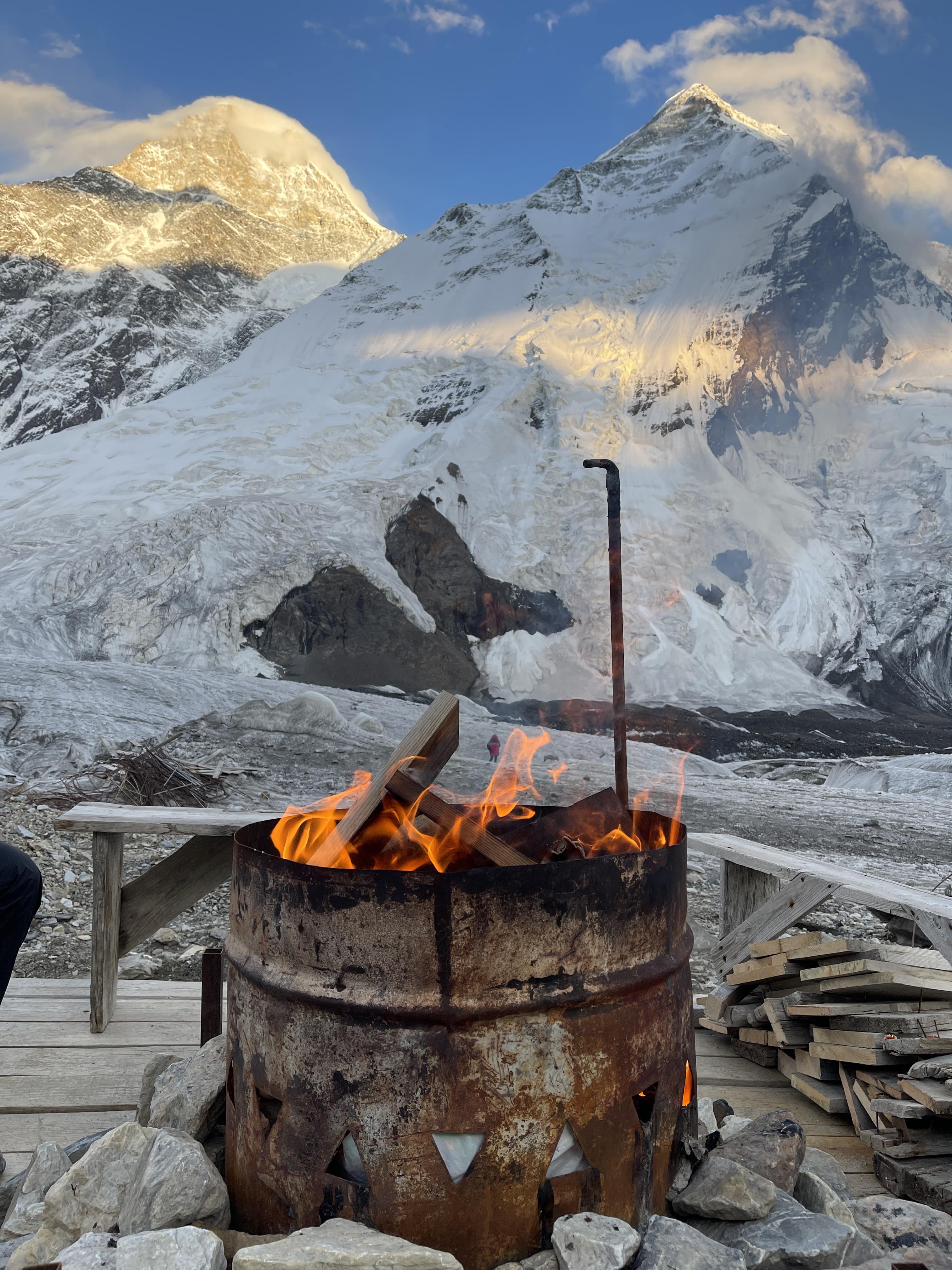
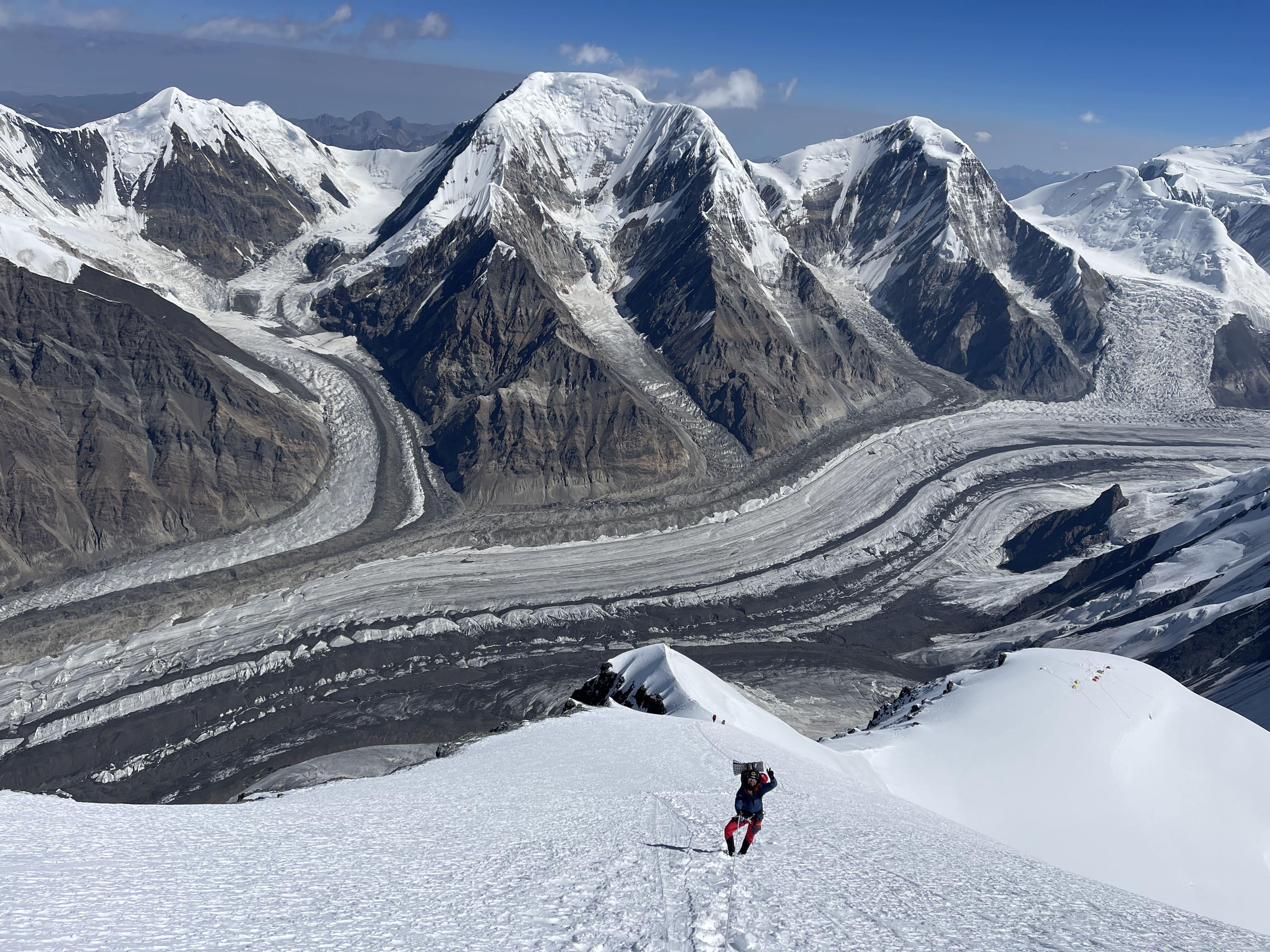
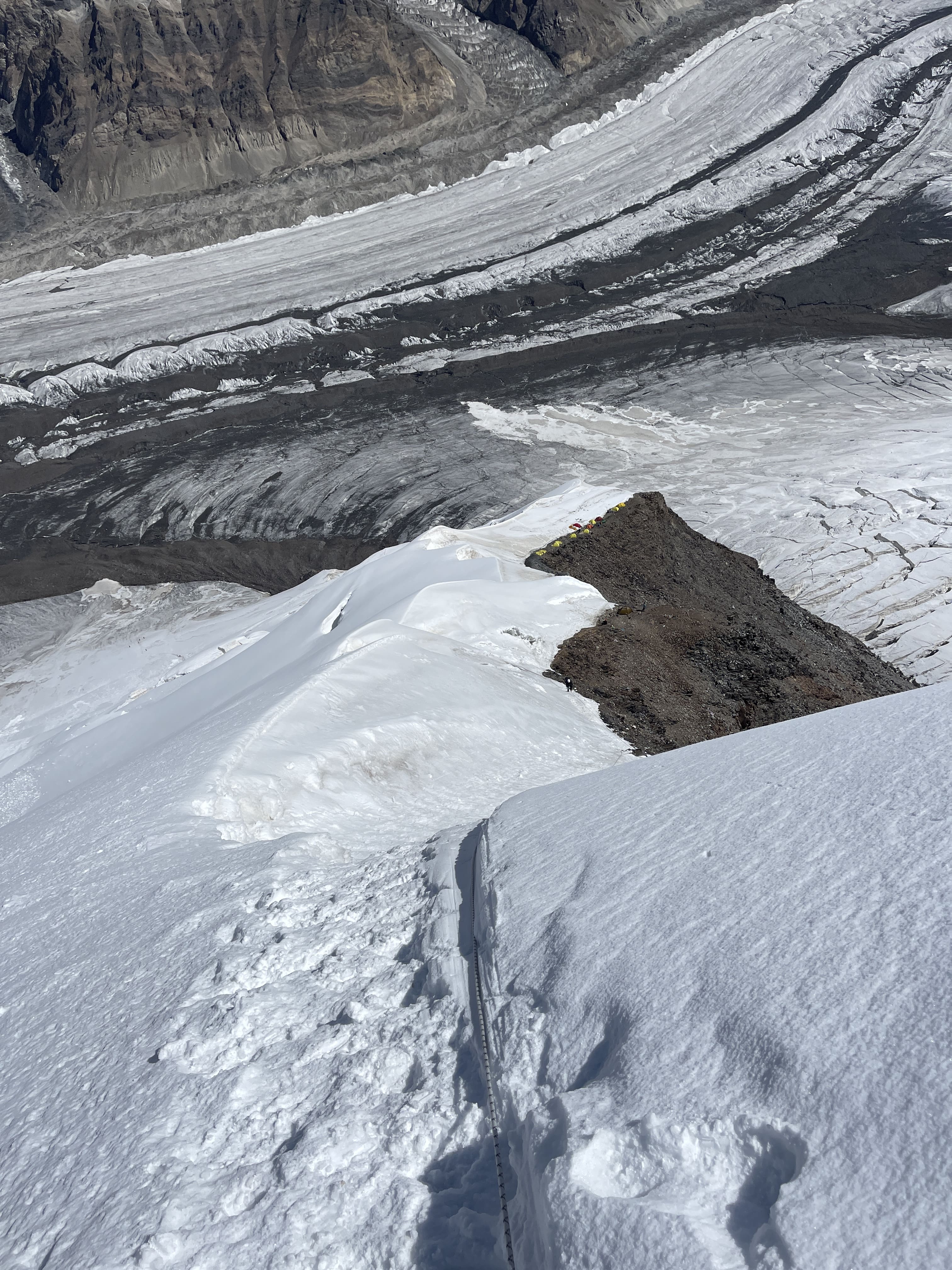
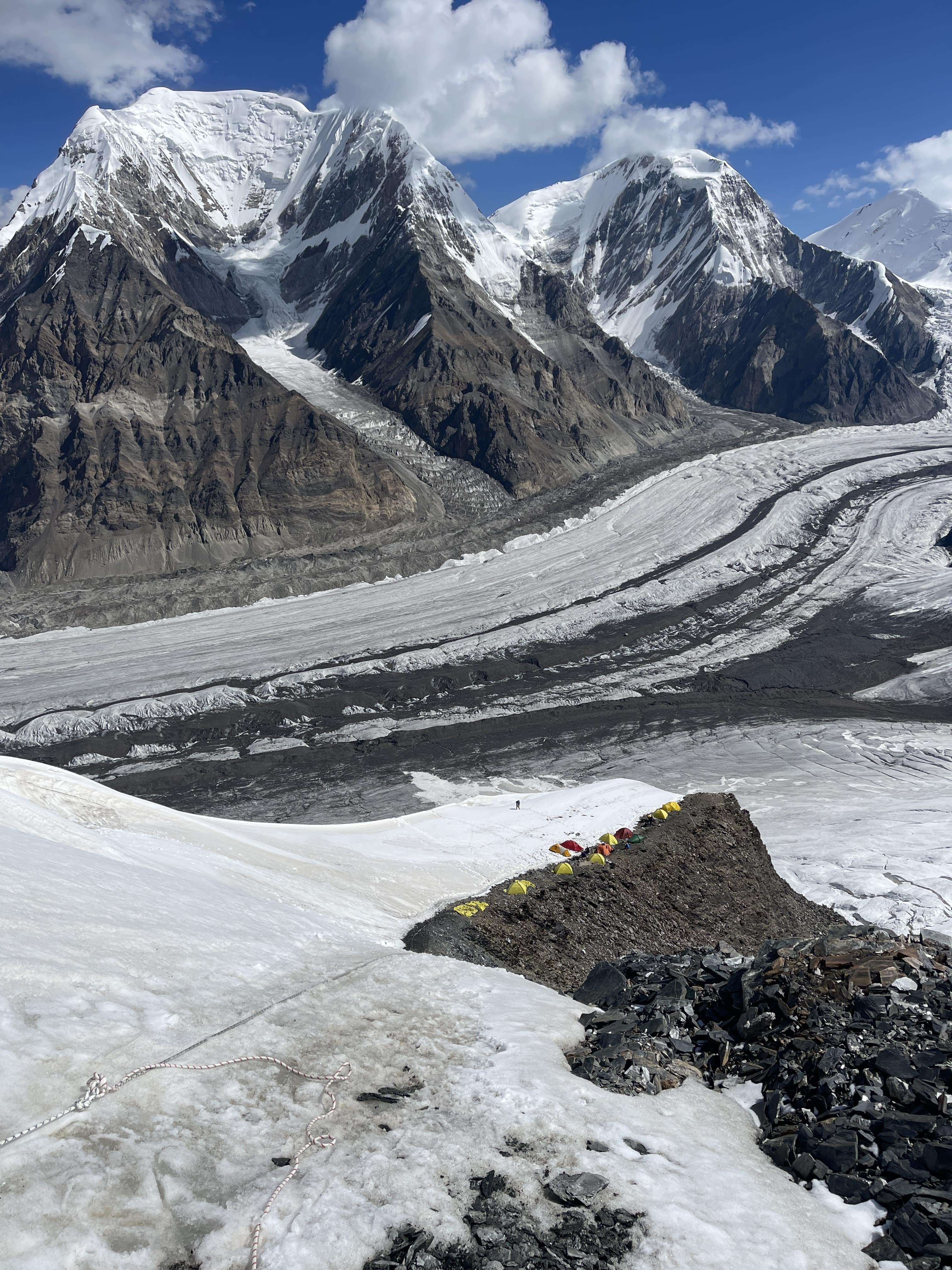
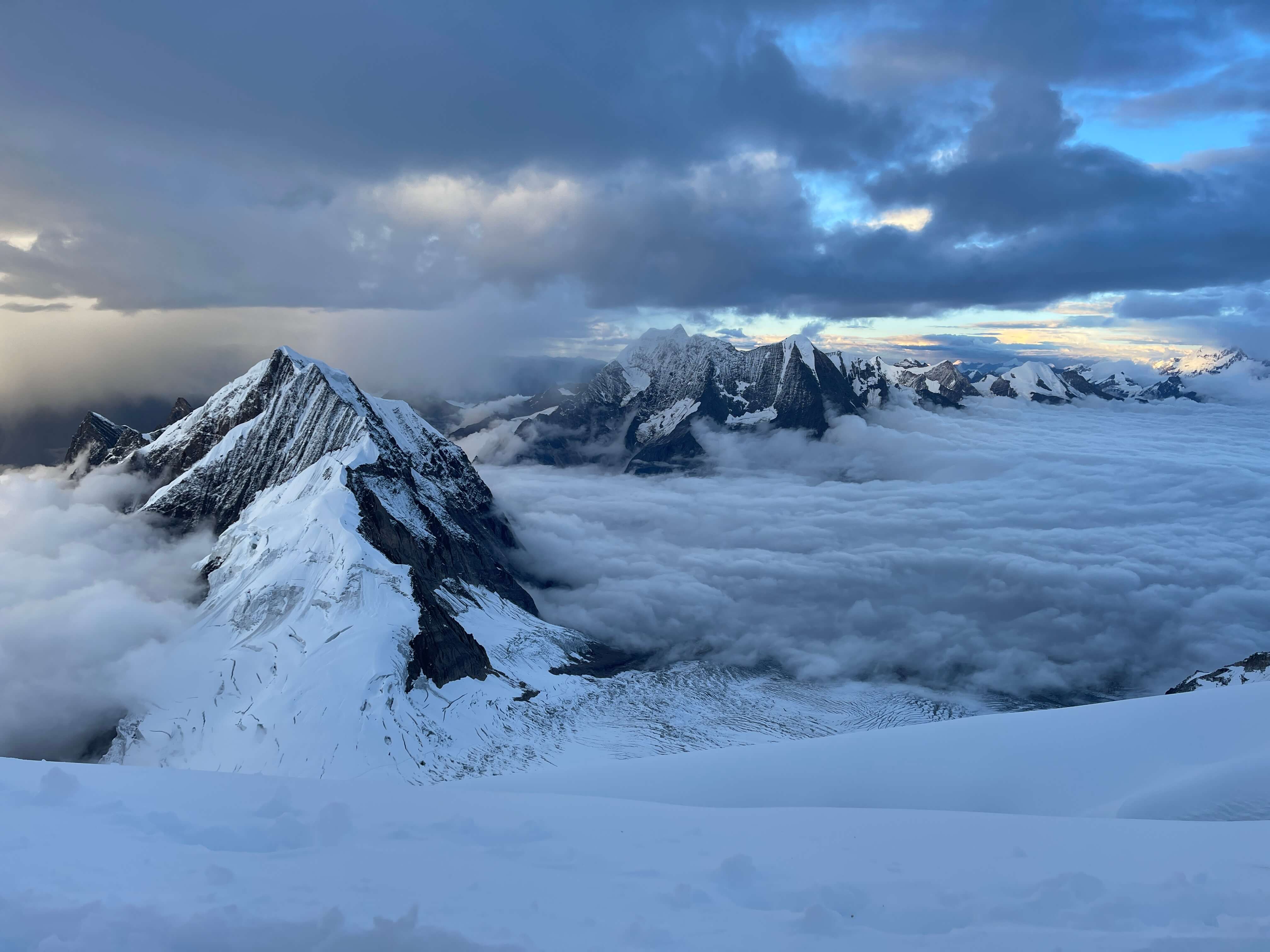
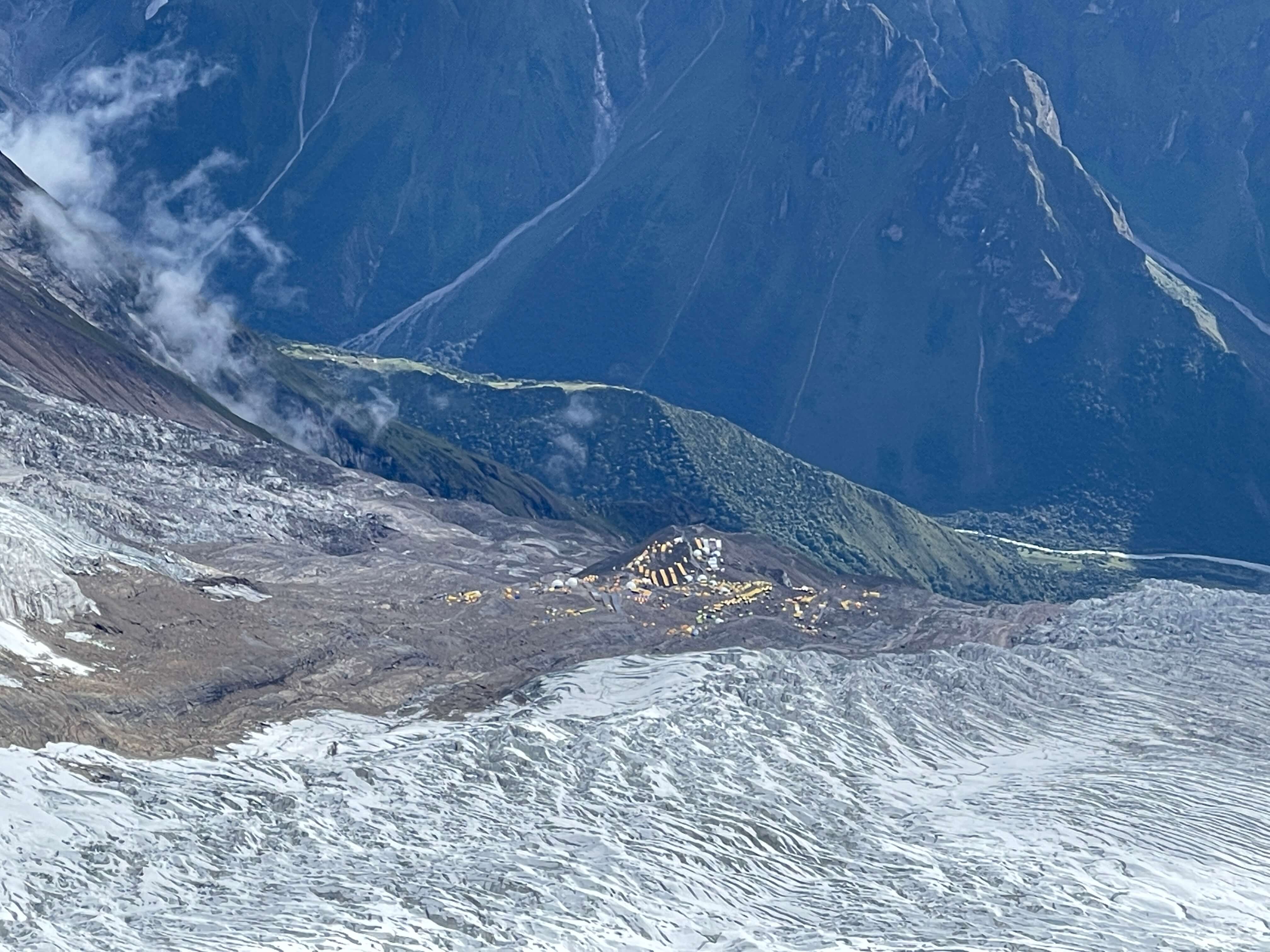
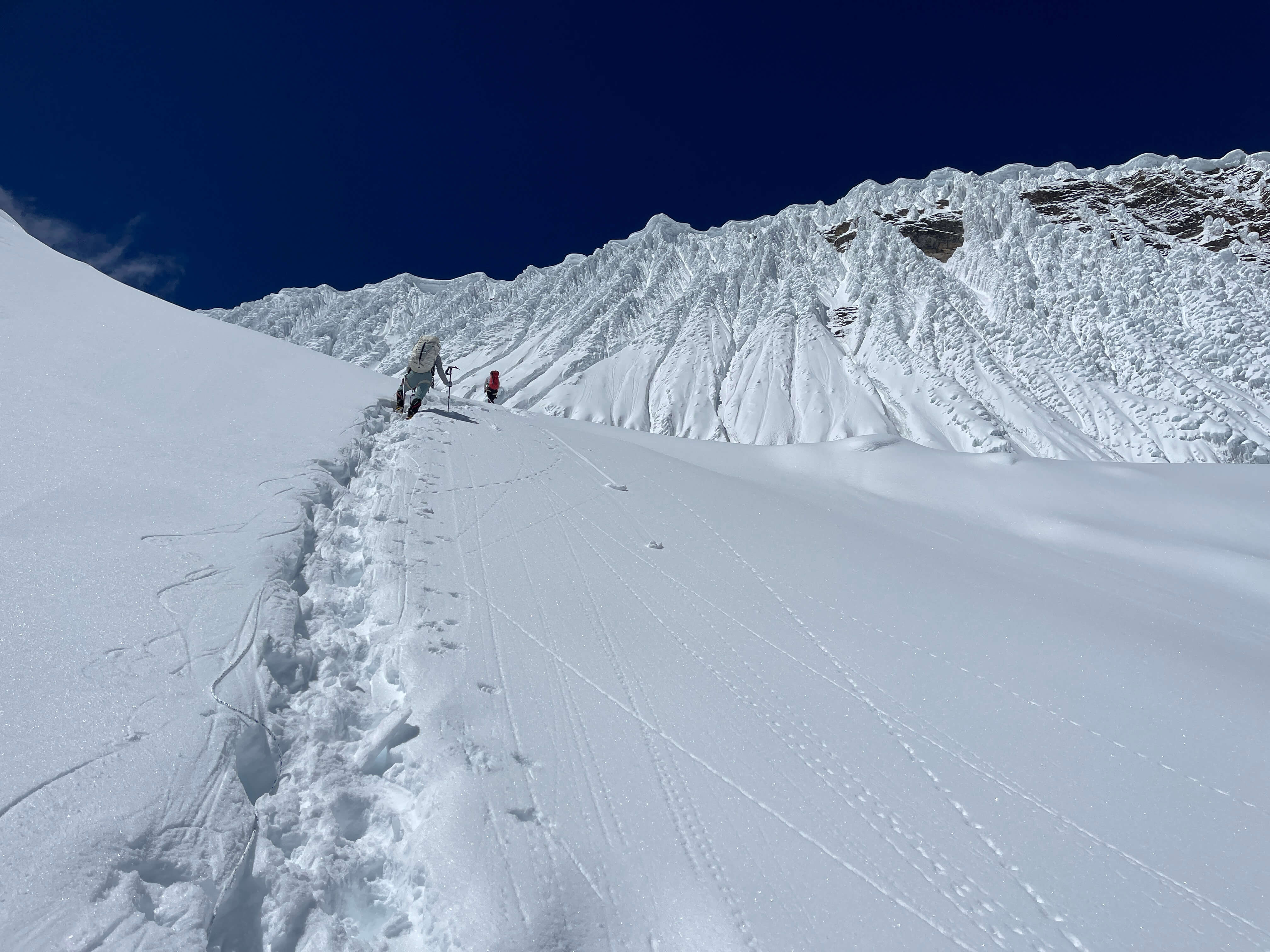
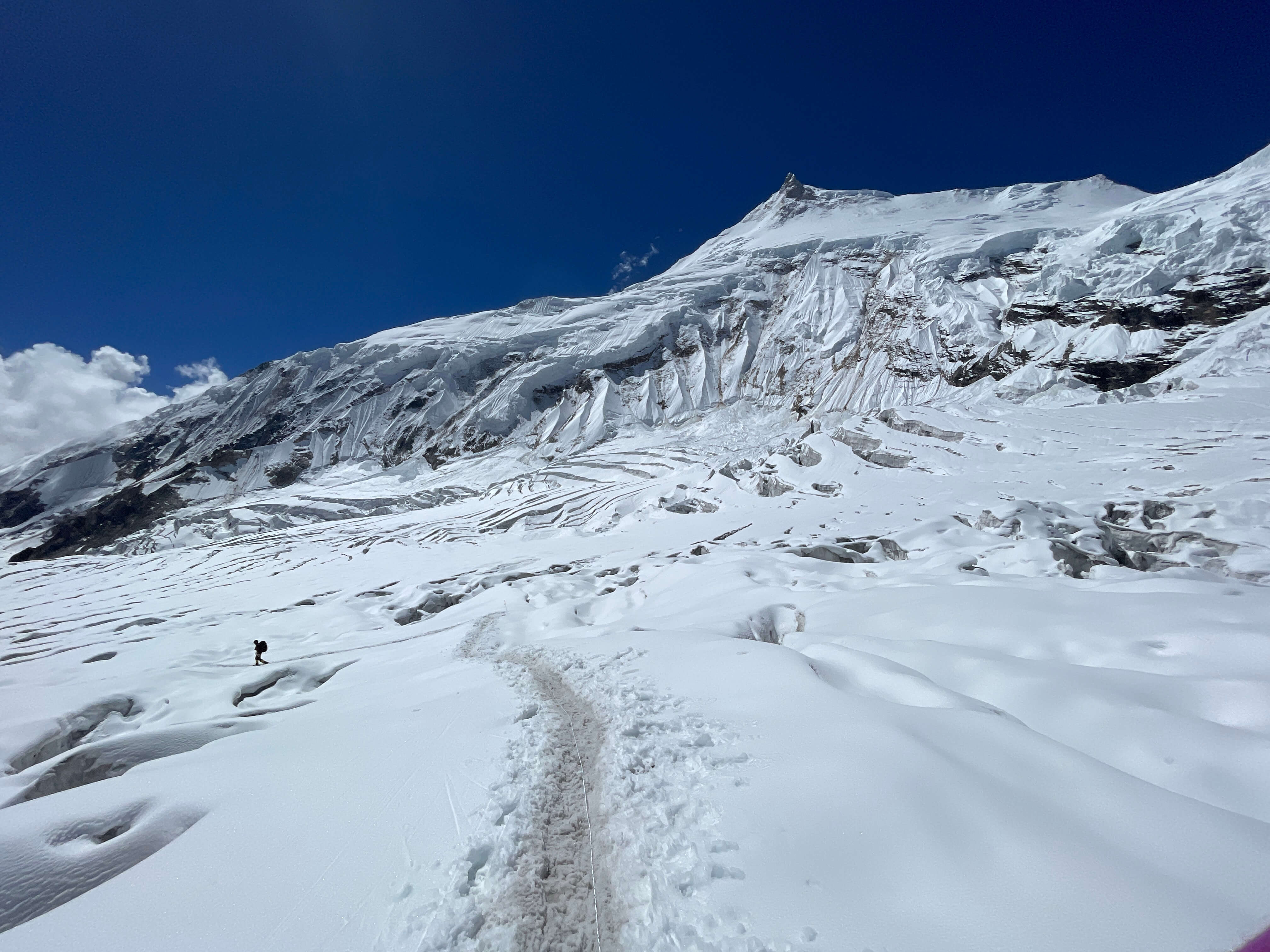
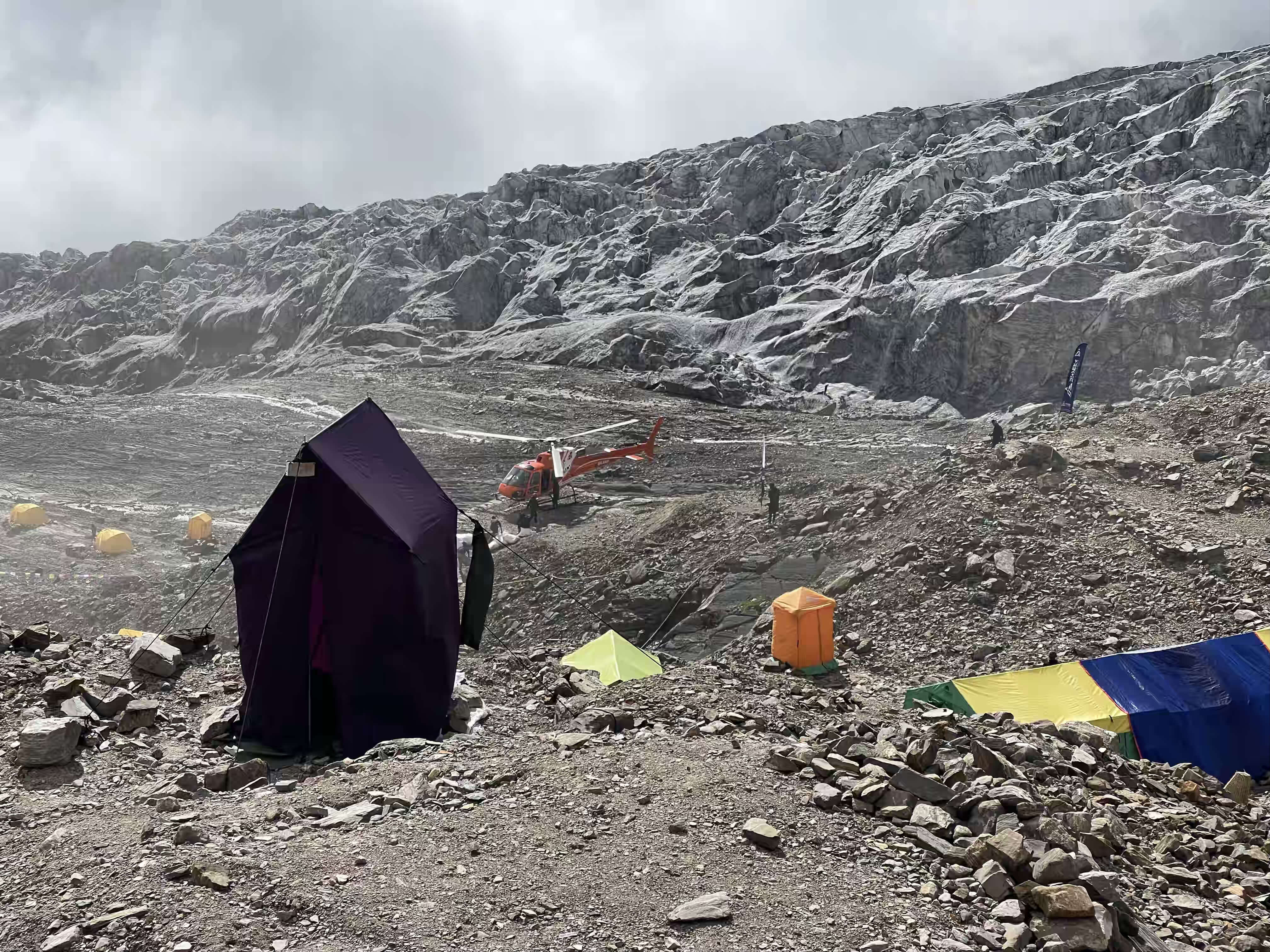
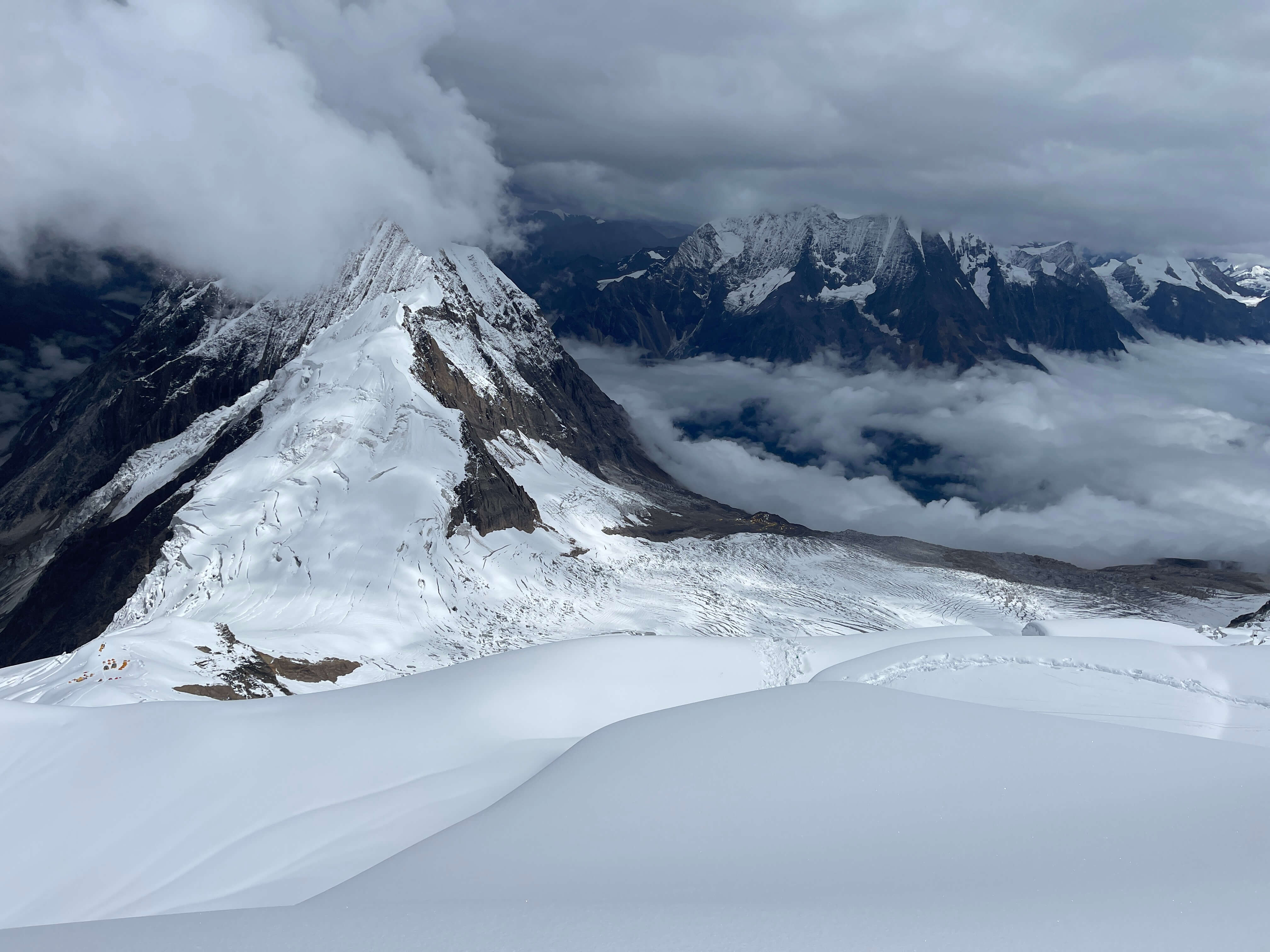
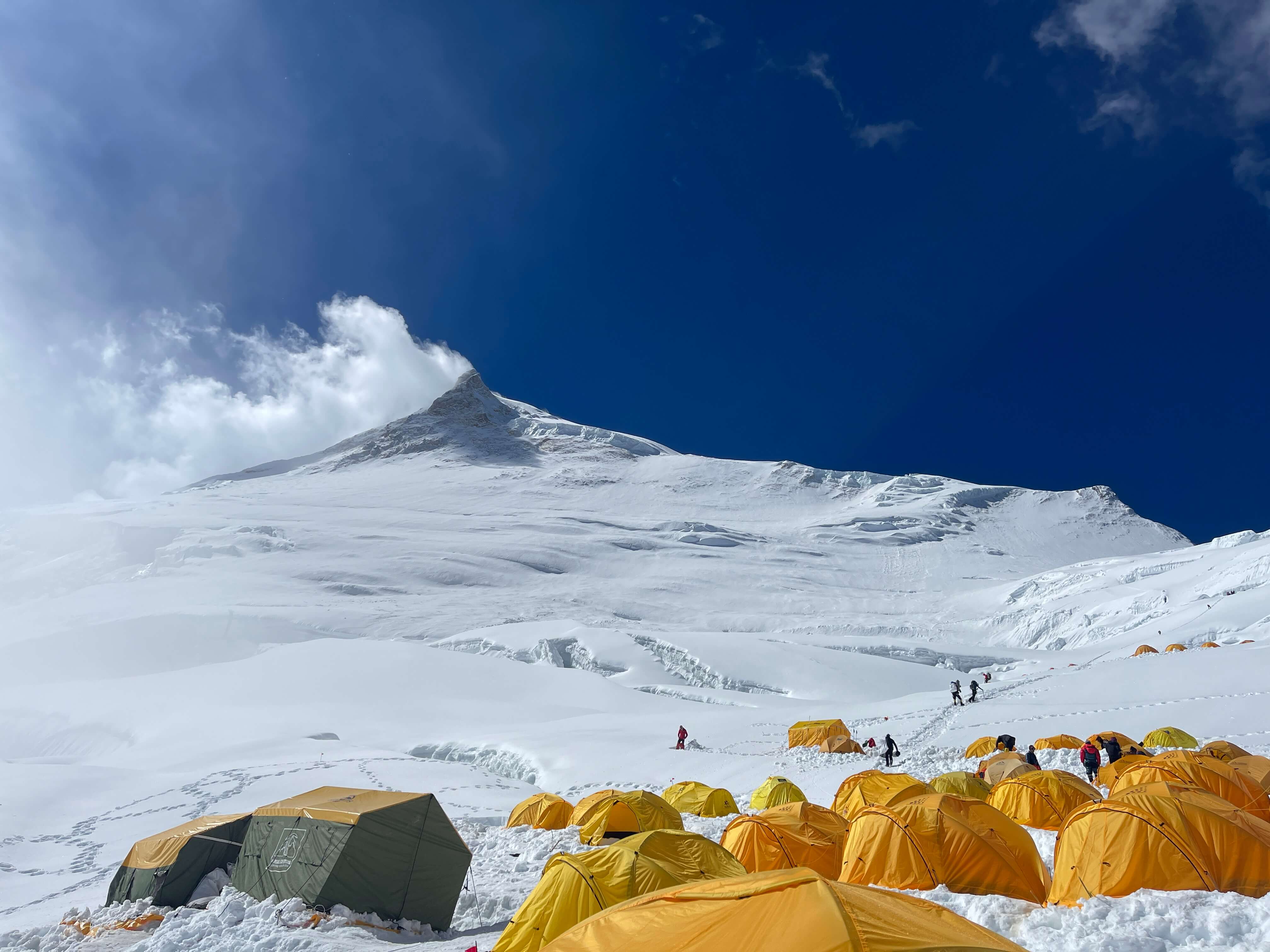
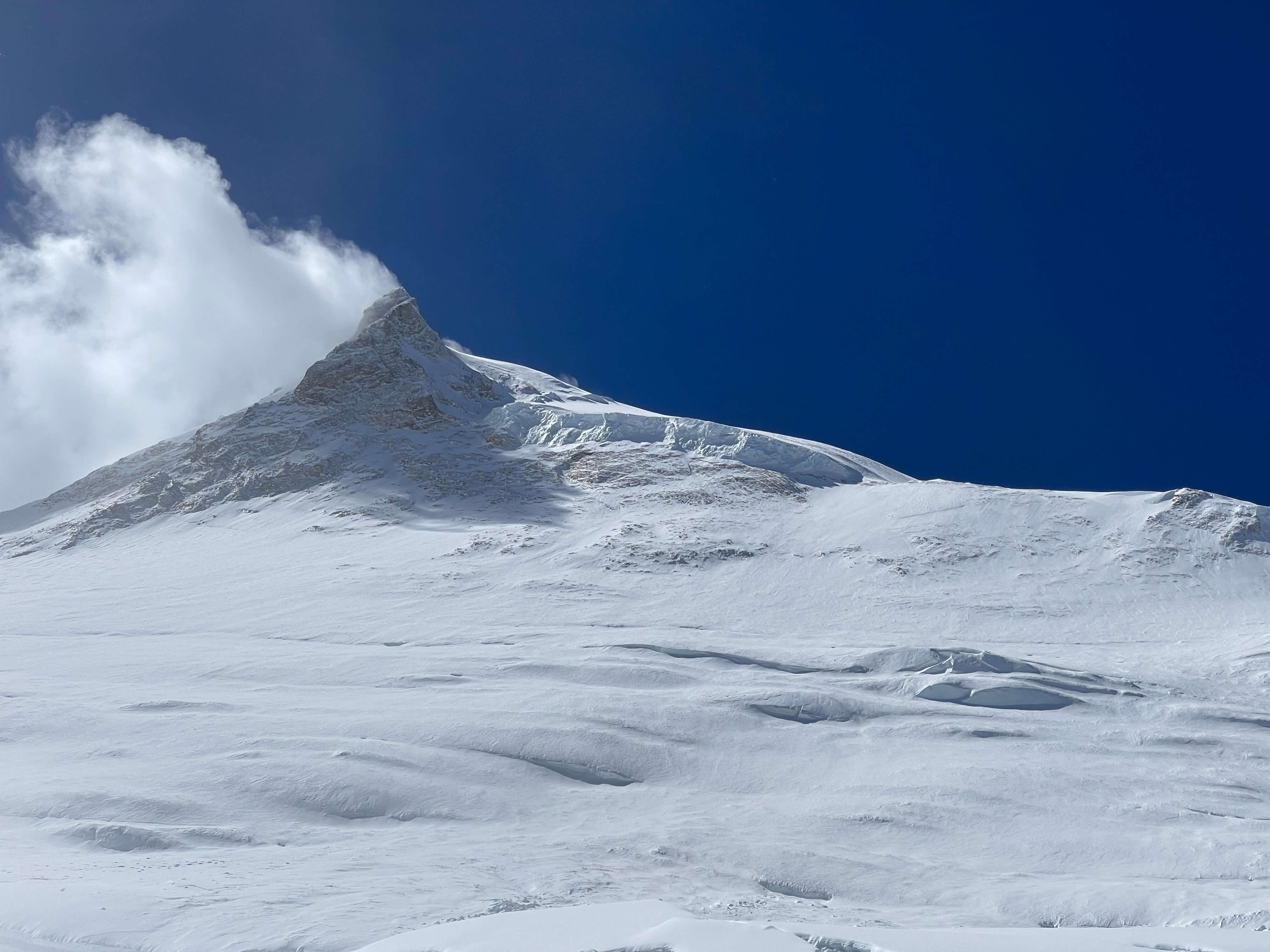
Pik Lenin from 3600m BCPik LeninPik Lenin from 4400m campPik Lenin4400m campPik LeninThe base of the route at dawn5400m camp5400m camp
Thoughts on Pik Lenin
This was my third time climbing on Pik Lenin, and the earliest in the season I’d ever been on the mountain. My main goal for the 2024 summer season was 7010m Khan Tengri, and my time on Pik Lenin was predominantly intended as acclimatization. That said, I did want to summit Pik Lenin a second time, tried my best to do so, and was shut down completely by weather conditions.
As acclimatization, my time on Pik Lenin served me very well, and I was able to make a rapid ascent of Khan Tengri – standing on the summit just over a week after departing the Pik Lenin basecamp. I feel that extensive rest intervals at 4400m camp, plus a three day stint in 3600m camp, produced a thorough ‘foundation’ of very good acclimatization. The quality of the facilities also likely helped, especially the hot showers in 3600m camp, and the abundant all-you-can-eat food provided in both 3600m and 4400m camps.
I would definitely return to Pik Lenin for another acclimation round in the future. If seriously keen to summit I’d definitely avoid starting any earlier than the last week of July. Weather was truly awful throughout my time on the mountain in 2024, characterized by high winds and enormous snow dumps. If I hadn’t summited Lenin previously, I would have been enormously disappointed and discouraged by the experience; conditions were simply not conducive to summiting.
No 7000m mountain is ‘easy’, and in poor conditions even the most moderate 7000er can become all but impossible.
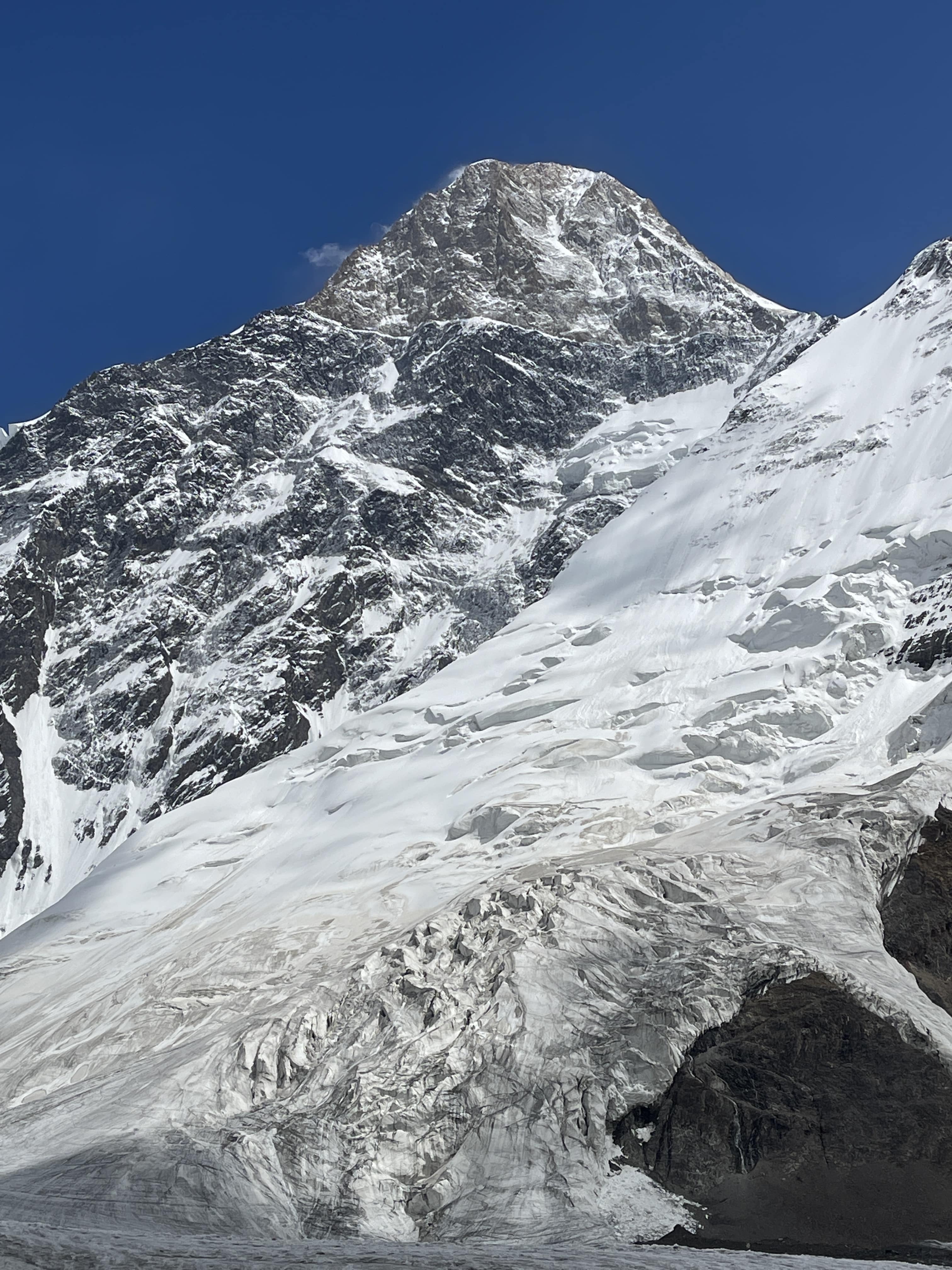
Khan Tengri from North Inylchek GlacierKhan Tengri at sunsetKhan Tengri from North Inylchek BasecampKhan Tengri from Chapaev Shoulder
Khan Tengri is the high point of Kazakhstan, the second highest peak of the Tian Shan range, and one of the five 7000m snow leopard peaks. At 7010m Khan Tengri is also the world’s northernmost 7000m peak, although there is some contention as to whether its altitude should be considered 6995m on account of a significant ice cap adding to the peak’s geological elevation. Its northern latitude means that weather on Khan Tengri is unstable and often severe, and that climbers encounter a thinner atmosphere than is found at comparable elevations further south.
Khan Tengri is an exceptionally beautiful mountain on account of its prominence, its pyramidal shape, and its remarkable geological composition – the upper peak from ~6000m is a marble pyramid steep enough on its north face to remain mostly free of snow. Viewed from the north on a clear day, at sunset this pale yellow-gold marble catches the light of the setting sun and glows in a fiery, blood red hue. When viewed from the south Khan Tengri presents a perfect snow pyramid reminiscent of K2 in Pakistan or Alpamayo in Peru. The first time I experienced Khan Tengri’s sunset alpenglow I could only gape in awe – it is one of the most glorious, impressive peaks I have ever laid eyes upon.
The Goal: An Independent 7000m Snow Leopard Summit
I had been keen to make an attempt on Khan Tengri for many years prior to my 2024 expedition. Khan Tengri is a mountain which, early on in my mountaineering progression, seemed utterly out of reach for me. I first laid eyes on images of the route in 2015 when Edgar Parra, a friend and mountain guide from Ecuador, had shown me photos from his ascent. For many years, Khan Tengri stood in my mind as a mountain which I thought I’d never be skilled or strong enough to climb, let alone independently (which I define here simply as ‘unguided’). With time and experience it began to seem more realistic, and possible for me to safely take a shot at. A variety of climbers I’d met over the years, including several friends, had recommended the northern route to me, emphasizing its viability for an independent or ‘solo’ (if such can be considered possible, given the fixed ropes) climb, its relatively good protection via seasonally maintained fixed lines, and its challenging, rewarding character. I had similarly been warned that the south route was unacceptably risky, due to significant serac and avalanche exposure.
After successful and highly rewarding experiences on Pik Kommunizma and Manaslu in the summer through autumn of 2023, I knew that I would be keen for another big mountain goal in 2024. While I shifted my focus entirely to rock climbing after Manaslu, and kept it there for the following six months, beginning in the early spring of 2024 I also committed time and energy to a training regime for mountaineering.
With no partners available on an aligned timeframe the expense, extreme physical toll, and guide support of a second 8000m expedition undertaken without friends did not seem particularly viable to me. At the same time, Pik Kommunizma had renewed my enthusiasm for the 7000m snow leopard peaks, and based on the advice of friends I felt confident that Khan Tengri could be doable if going alone. At this point I had summited three of the 7000m snow leopards, had climbed on those three peaks five times in total, and had done so independently – whether with friends or all alone – each time. I committed to an early start at the very beginning of the season, paid my deposit to Ak-Sai Travel, who now operate both the north and south basecamps on the Inylchek glacier, and prepared to return to Central Asia. I would warm up and pre-acclimatize on Pik Lenin, before shifting to Khan Tengri via the North Inylchek basecamp.
I pre-acclimated for Khan Tengri by making an attempt on 7134m Pik Lenin, the basecamp of which is also accessed from within Kyrgyzstan. I had previously summited Lenin in the summer of 2017, and in 2016 had also made an unsuccessful attempt; this was my third time on the mountain. I had a very rough time of things on Lenin on account of sustained inclement weather – enormous snow dumps and high winds – and never made it higher than ~6100m. Nonetheless, my time spent moving up and down Lenin, and resting at elevation, served as adequate acclimation for a rapid ascent of Khan Tengri. I summited Khan Tengri on my 7th day in North Inylchek. I did not feel as thoroughly acclimated as I wanted to be, largely due to my ‘low’ highpoint on Lenin, but my acclimation was definitely sufficient and served my goal wonderfully. Had I made it to the summit of Lenin during pre-acclimation, I believe that my subsequent time on Khan Tengri would have felt much easier than it did.
Pre-acclimation via expedition enchainment is a majorly effective strategy for tackling big mountains. It requires a significant time investment, which is a deterrent for many, but significantly improves odds of success and quality of experience (minimizing AMS and discomfort) at altitude. Climbing a ~7000m peak before a lower but technically demanding peak in the ~6000m range effectively mitigates altitude as a factor for the second climb. Climbing a 7500m peak and spending weeks in basecamp before an 8000m peak prepares the body with a thorough acclimation ‘foundation’, making a no-o2 ascent more realistic. At the time of writing I have successfully enchained four major expeditions above 7000m:
7134m Pik Lenin as preparation for an ‘overnight’ solo ascent of 5642m Mt. Elbrus, with no acclimation rotation on Elbrus.
7134m Pik Lenin leading into a rapid 5-day ascent of 5947m Alpamayo, where we skipped high camp and gained the summit on day 4.
7495m Pik Kommunizma as pre-acclimation for an ascent of 8163m Manaslu, where a single rotation to ~6650m was sufficient for my summiting without the use of supplementary oxygen.
7134m Pik Lenin prior to 7010m Khan Tengri, where I was able to summit on my 7th day without any rotations above ~4500m.
Pik Lenin is uniquely ideal for this purpose. It is inexpensive, quite high, highly accessible, very comfortable due to a developed basecamp, geographically close to me (I live in China), and relatively straightforward to rotate up and down on. When climbing Lenin it is notably easy to gain 5000m on nearby Pik Yuhin; this may be one of the most efficient and comfortable places to tag 5000m anywhere in the world. Lenin is a slog most of the way, but in spite of that I’d totally go back and spend time on Lenin (yet again!) in preparation for other peaks.
Schedule and Calendar
Here I have put together a calendar outlining my acclimation routine and climbing activity throughout my 2024 Pik Lenin and Khan Tengri climbs. I have likewise charted out the elevations used for acclimation rotations, culminating in an ascent.
Long, full-day drive to Karkara at 2200m. Many stops made the ride far lengthier than expected.
7.22
Helicopter ride for ~40 minutes through the valleys and into the mountains, to North Inylchek basecamp at 3960m, with first views of the Tian Shan range.
After lunch I went for a hike to crampon point at 4050m. Time of 45 minutes to get there, crossing moraine and dry glacier. A large river crossing was bridged with a wooden platform, which must be found via a specific ice valley. The river is fierce and powerful, quite dangerous, and must be crossed with caution.
North Inylchek Basecamp is small, rugged, spartan. Situated upon moving glacier, there are no permanent structures – indeed, the tents shift and slowly flow over time. My sleeping tent developed a distinctive slant and a troubling instability throughout my short stay in it. Food was consistently excellent, and Basecamp staff were friendly and professional. Yet, the camp feels cold and desolate when compared to Moskvina or to Lenin’s BC and ABC. There is no greenery, little life, much shadow and ice.
Khan Tengri presides above camp, majestic in its geometry. On clear evenings it glows orange and red at sunset, magnificent and ominous. Surrounding peaks are sharp and severe, numerous 5000m teeth rising alongside Khan Tengri, steep and pronounced. The Tian Shan are serious business, and very few of the visible mountains would be easily ascended. The proximity of the Inylchek glacier is startling; it is always underfoot, and its exposed ice lies a few short meters from camp. Climbers in camp visit it frequently for the washroom facility. Puddles of meltwater form, freeze, and drain throughout the day. Rivers of pure glacial water materialize at noon. The glacier is the highway which leads to the base of the route upward, and the foundation upon which camp is temporarily constructed.
7.23
2:20 pm depart BC. 3:35 pm arrive crampon point. Time of 75 minutes. 6:30 pm arrive Camp 1, 4540m. Time of 4:10 from BC.
I packed 6 days worth of supplies and all of my equipment for higher up. I had decided to go heavy and get the carrying over with in one shot – a strategy which has worked well for me in the past. I hoped to potentially even make my way into position for a summit attempt off of this heavy carry.
Soft snow made the heavy pack quite grueling to manage throughout steeper sections of the easy climb to Camp 1. I wished that I’d left earlier in the day; soft snow bridges were more than a bit dodgy. I used my jumar twice on fixed lines, making the slush easier to manage.
Camp 1 is small, but I had no problem finding a rock platform for my low-profile one-person tent. One benefit of a small tent is the ease of pitching in tight spaces!
7.24
9:20 am depart 4540m Camp 1 10:05 arrive Crampon Point. 11:05 arrive BC. Time of 1:45.
I woke up to steady, wet snowfall, and very poor visibility. I decided to bail rather than waste gas and food waiting around in Camp 1. Conditions were very damp. Ascending in such conditions would be miserable, and it would be hard to dry off properly once back in my tent.
I descended fairly quickly, although fresh snow slowed me down as I pulled ropes out and looked for the optimal path down. The moraine was lovely in the snow, and the flags which mark the way to the wooden bridge across the glacial river were much easier to see.
It was quite hot; I sweated inside of my water resistant layers and was thoroughly soaked once I got back to BC.
I was pleased to make a heavy carry to Camp 1, as I would never have to make that section of the route with a huge pack again. At the same time, I was disappointed not to get my equipment and supplies up to Camp 2, as doing so would have set me up nicely for a fast-paced summit attempt later.
7.25
Depart BC at 10:10 am. Arrive Camp 1 at 13:10 pm. Time of 3:00.
After spending all of 7.24 in Basecamp, during sustained wet snowfall and poor conditions, the forecast shifted for the better. I agreed to move up on a similar time schedule as two other independent climbers, Lucas from Germany and James from the UK, and meet them in camp 2 on the 26th. We would then share a tent and stove in Camp 3 on the 27th.
I ascended in a light breeze and full sun, making a good pace whilst subjectively ‘taking it easy’. Conditions were much better than my first climb to Camp 1, as I left much earlier in the day. Having a lighter backpack was also quite enjoyable!
I observed two enormous serac collapses off of Khan Tengri’s shoulder, to the climber’s left of the north face. These did not threaten the route or its approach. It was very pleasant to arrive at Camp 1 with my tent pitched and food ready to eat. Conditions were flawless in camp, sunny and warm with a light breeze. I was easily able to dry my boots in the sun, and take a comfortable nap.
I ate well all afternoon and evening, and slept for over 9 hours. Light snow fell overnight, exactly as forecasted.
7.26
9:30 am depart Camp 1 4540m. 16:05 pm arrive Camp 2 5550m. Time of 6:35.
The route from Camp 1 to Camp 2 covers steep terrain, with several ice and rock steps. The rock steps and an exposed rock traverse were fun, and not strenuous for me, but the steep ice was brutal to front point while hauling my heavy backpack. I felt great with breathing and altitude, just absolutely slammed by the weight of my enormous pack. There were almost no places suitable for stopping to rest, due to the sustained steepness of the terrain. I had trained well for this expedition, but mostly via running rather than load hauling. This definitely contributed to my intense discomfort in managing my heavy pack while on steep terrain. Unfortunately, the remainder of the climb was like this; steep, and difficult with a big bag.
The weather was sunny and warm for most of the way, shifting into cloud and wind as I approached Camp 2. The entire route is fixed each season, and I kept my ascender on the lines for the majority of the climbing. With the ascender on, the route felt secure and reasonably well protected, but remains relentlessly steep. Without fixed ropes, the route between Camp 1 and Camp 2 would be an order of magnitude more strenuous, and I would not have felt at all comfortable soloing the vast majority of it. This would be a theme for the remainder of the route from Camp 2 to Camp 3 and then to the summit; if not already fixed this would be a very challenging and involved mixed route with what appeared to me to be fairly mediocre protection. Make no mistake, the majority of climbers – myself included – are only ascending Khan Tengri from the north due to the presence of the fixed lines.
Lucas and James met me at Camp 2 as planned. They arrived well before me, coming directly from Basecamp with light packs given that they had already deposited their tents, equipment, and supplies in Camp 2. I pitched my tent between theirs, and would leave my tent and some spare supplies here when the three of us moved up to Camp 3 together with a shared tent.
7.27
8:30 am depart Camp 2. Arrive 6100m Chapaev Shoulder at 12:45. 13:25 pm arrive Camp 3 5860m. Time of 4:55.
More steep, sustained climbing from Camp 2 to Camp 3. Many rock and ice steps, but the fixed ropes made for secure climbing with the jumar on as a backup. The route up and over Chapaev shoulder is quite demoralizing, as it seems to go on forever – climbing still higher even while Camp 3 is clearly visible below! This aspect of the north route, paired with relentlessly sustained steepness, contributes to its (deserved) reputation for being difficult. Chapaev’s shoulder represents an additional ~250m of ascent and descent which must be covered – both on the way up and on the way down.
Views from the top of Chapaev shoulder were superb, and we spent fifteen minutes taking photos and looking at Khan Tengri’s west ridge under clear skies. The descent down to Camp 3 was very quick on firm snow. Camp 3 is a tiny snow ridge dropping off into large cornices to the north, and a steep face to the south, but we quickly found a flat space for our shared tent.
The forecast for 7.28 was promising, calling for 35 km/h wind with light snowfall in the morning and heavier snowfall in the evening. Lucas, James, and I decided to commit to a summit attempt.
7.28
Awake at 12:30 am. 2:45 am start. 12:20 pm Summit. Time of 9:35. 3:50 pm return to camp. Time of 13:05 round trip.
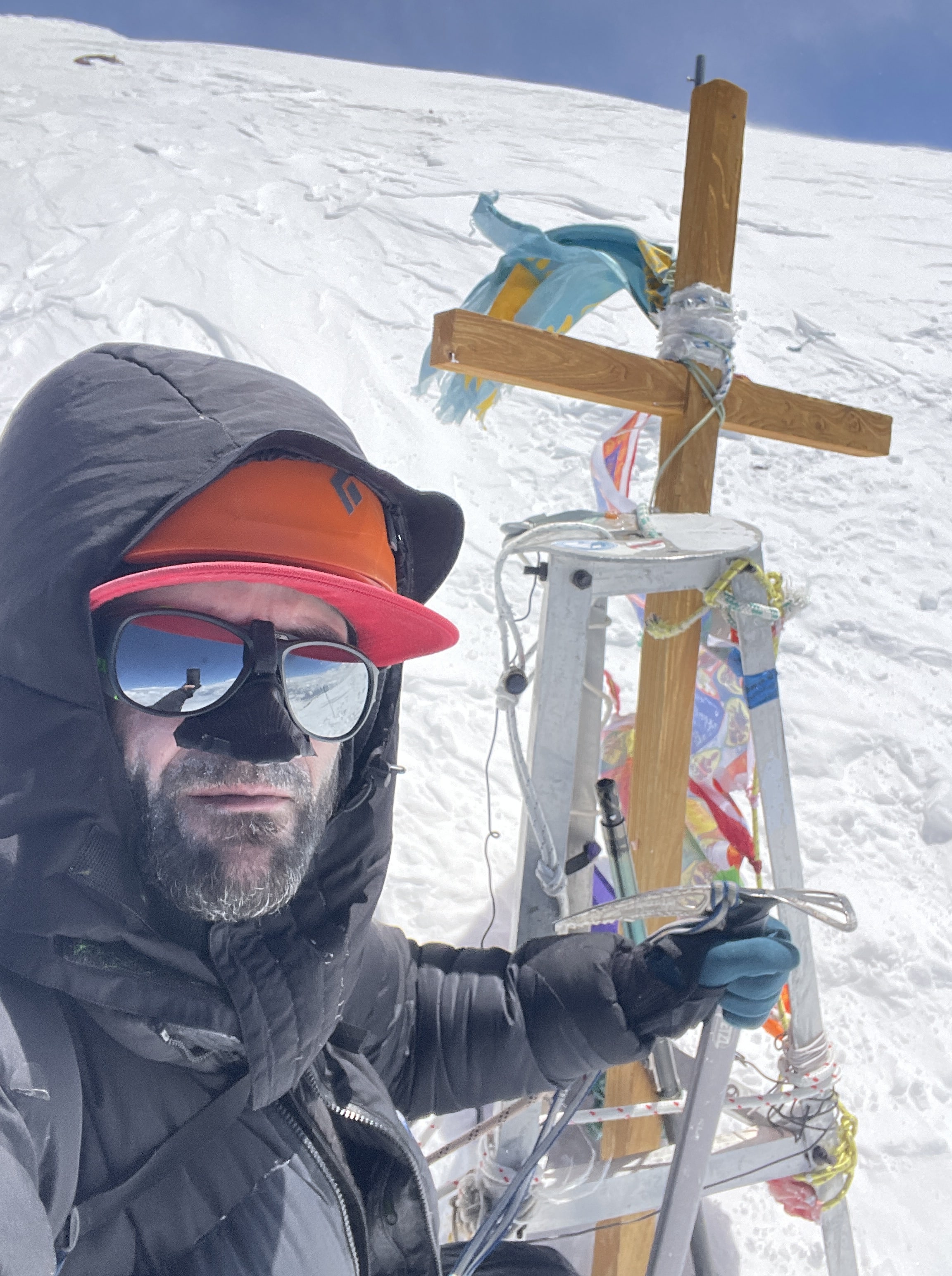
Khan Tengri’s summit, and summit cross.
The route to the summit begins with a low-angled snow climb, but rapidly steepens. The majority of the route to the summit is relentlessly steep. There is almost nowhere to stop without anchoring off, and only a handful of small, level ledges. Two of these are sometimes used as high camps, and both were occupied by very tightly-pitched 2-person tents. James left our tent first, and Lucas struck out ahead of me. Lucas climbed impressively fast, and I wouldn’t see him again until ~100m below the summit. I caught up to James where the route steepened, and climbed more or less on pace with him until the couloir, where I moved on ahead of him.
The weather for our summit day was very much sub-optimal, with intermittent high winds and sustained snowfall throughout the ascent. Around 4 am I began to fear that the forecast was entirely incorrect, and that the projected evening snowfall had shifted forward to early morning. Beginning at around 8am there were two hours of vicious wind and driving snow wherein I seriously thought about bailing. I pushed through in the hopes of the weather shifting, and although high wind continued, the snow eased off.
I climbed in my down pants, down storm parka, and all of my base and mid layers. My base and mid layer system for the upper body was: 150g merino t-shirt, 150g merino long sleeve, 200g merino long sleeve, Patagonia R1, Patagonia Nanopuff. For my legs, my system was: 200g merino underwear, 150g merino leggings, 200g merino leggings (yes, two pairs of merino leggings, layered), Patagonia softshell guide pants. I use a Feathered Friends Volant storm parka, and Feathered Friends Volant down pants for 7000m peaks. I wear a single heavyweight merino sock. Gloves were an issue for me on summit day; due to constant manipulation of my jumar and personal anchor I was not able to wear my 8000m storm mitts during the climb. I wore a Polartec liner glove inside of the storm mitt mid-glove, a ‘crab claw’ with bifurcated index finger. If I were to return to Khan Tengri I’d purchase the warmest, heaviest five-finger glove I could find and leave my mittens behind.
Without my storm parka’s hood closure, a thick Polartec buff face mask and my goggles, my face would have become too cold to continue – I had to minimize any skin exposure to the air. I quite frankly would have majorly benefited from wearing my full down suit in the frigid, windy conditions we experienced – but carrying it up to Camp 3 in the nice weather lower down would have been miserable! Khan Tengri was a bloody cold climb; I had more gear than I thought I’d need, used all of it, was still cold, and am glad that I was especially cognizant of protecting my hands and feet while moving. The ‘wiggle step’ is an important technique to master; wiggling the toes and fingers in line with every single rhythmic rest-step higher.
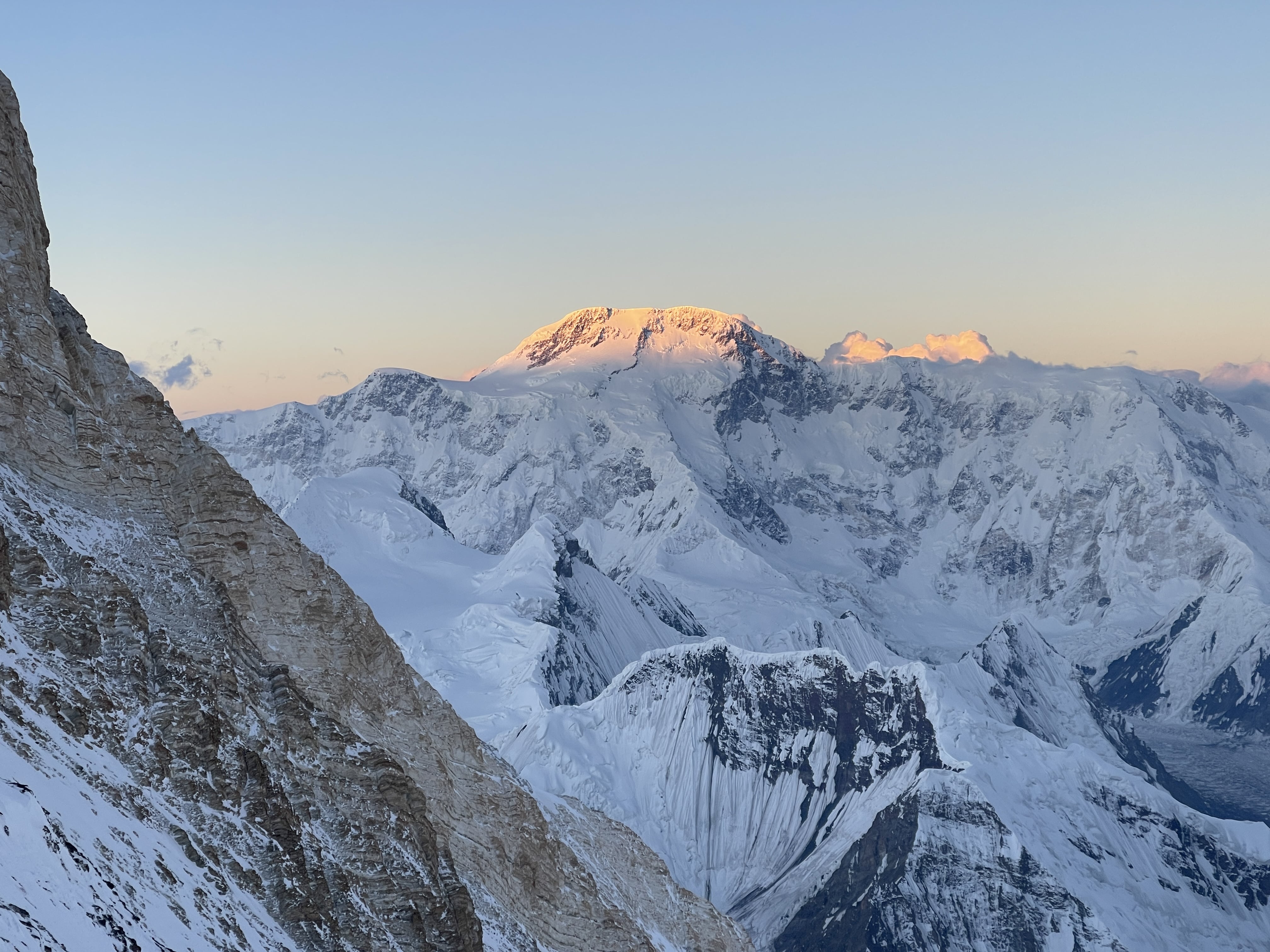
Dawn eventually cracked the frozen night sky open, revealing Pik Pobeda in the distance. Pobeda’s summit glowed warmly, while its enormous massif spanned across the horizon below. A fearsome mountain, Pik Pobeda is the hardest and most dangerous of the snow leopards, the ‘gatekeeper’ to finishing the five. Sunrise did not, unfortunately, bring warmth. Khan Tengri’s normal summit route follows the west ridge, which does not catch morning sun, and the wind was too intense for daylight to make much of a difference.
At around ~6800m, I roughly approximate the elevation here, I reached the couloir where the ridge traverses north onto the mountain’s upper slopes. There was a significant bottleneck here, as the handful of climbers ahead of me worked their way past the sketchy pair of core-shot fixed ropes. Unanchored in the middle, the ropes protected the traverse from a deadly fall, but did not serve to keep a climber comfortably on route. They were very loose, difficult to jumar in a controlled manner, and majorly slowed down the people ahead of me. I reckon that I waited for almost 45 minutes for my shot at this short ~15m of the route; when it was my finally turn to climb I used my axe for balance and delicately cramponed across the traverse with the ropes held as taut as possible. On the way down, rappelling this section was also annoying, and one of the slowest sections to navigate.
Above the couloir I finally gained Khan Tengri’s upper slopes, and was greeted by the glory and life-bringing warmth of the sun. The sunshine revitalized me, filling me with hope and renewed motivation. Immediately overheated, I anchored myself to slather sunscreen onto my face and remove my down pants. Taking the pants off would prove to be a mistake, as I needed to put them on again when intense wind resumed less than an hour later. Above the couloir is a fun rock step on beautiful marble. Fresh fixed lines made for perfect protection here, and I racked my axe so that I could free climb. I made use of a hand jam, stemmed, and pulled some easy rock moves with my jumar as backup. This section of rock was by far the highlight of the route for me – class 5 climbing and a hand jam above 6800m!
The final slopes to the summit are moderately angled, but were arduous in their own way due to intense wind and cold. Snow quality was acceptably firm and the route up was easy, but weather made for significant discomfort. I met Lucas here, on his way down from the summit, and we exchanged words of encouragement. Near the summit are several large boulders, and enough small, flat areas for a few tents. Some ambitious teams do apparently camp up there, although the prospect of hauling gear up makes me shudder.
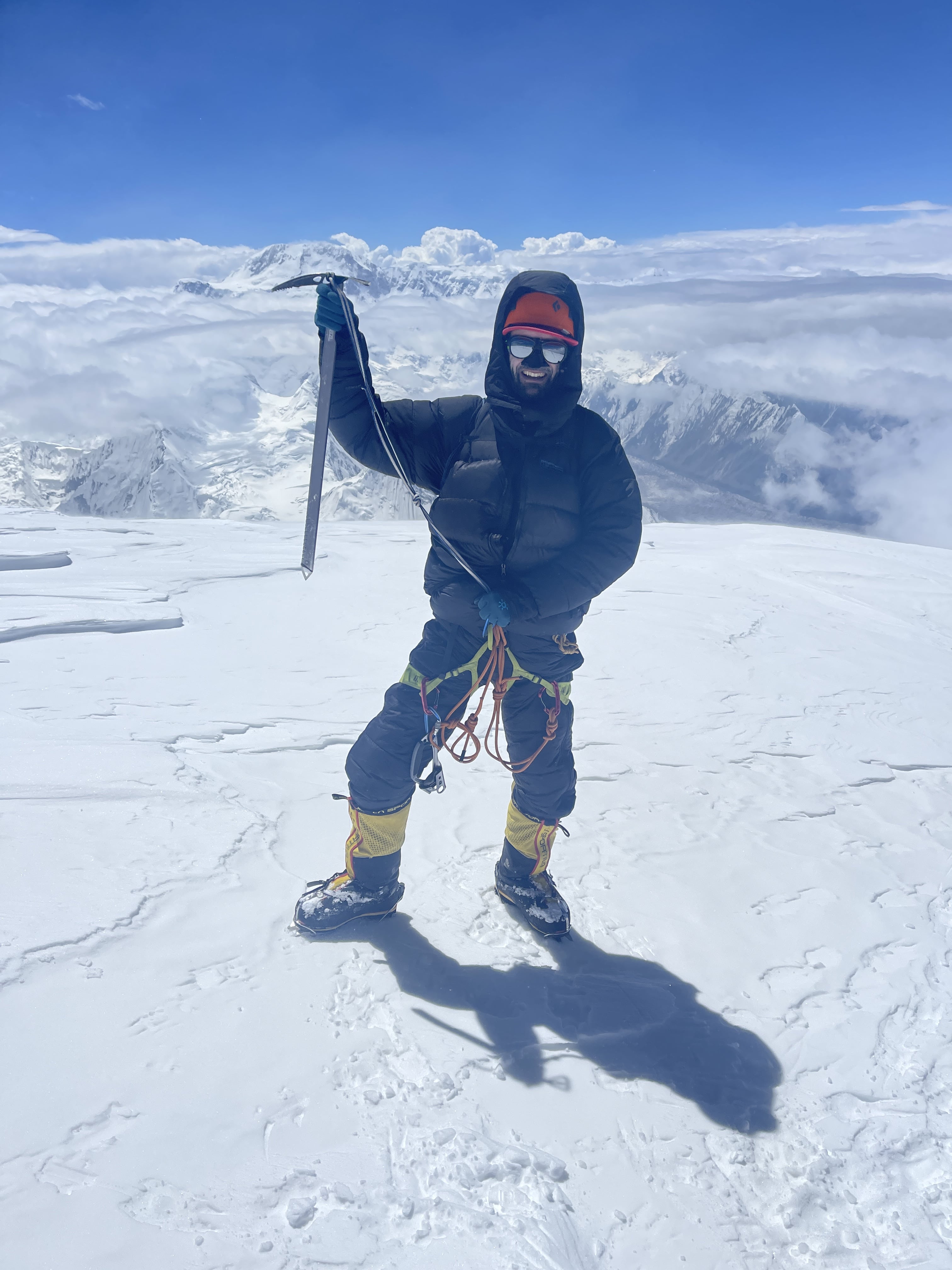
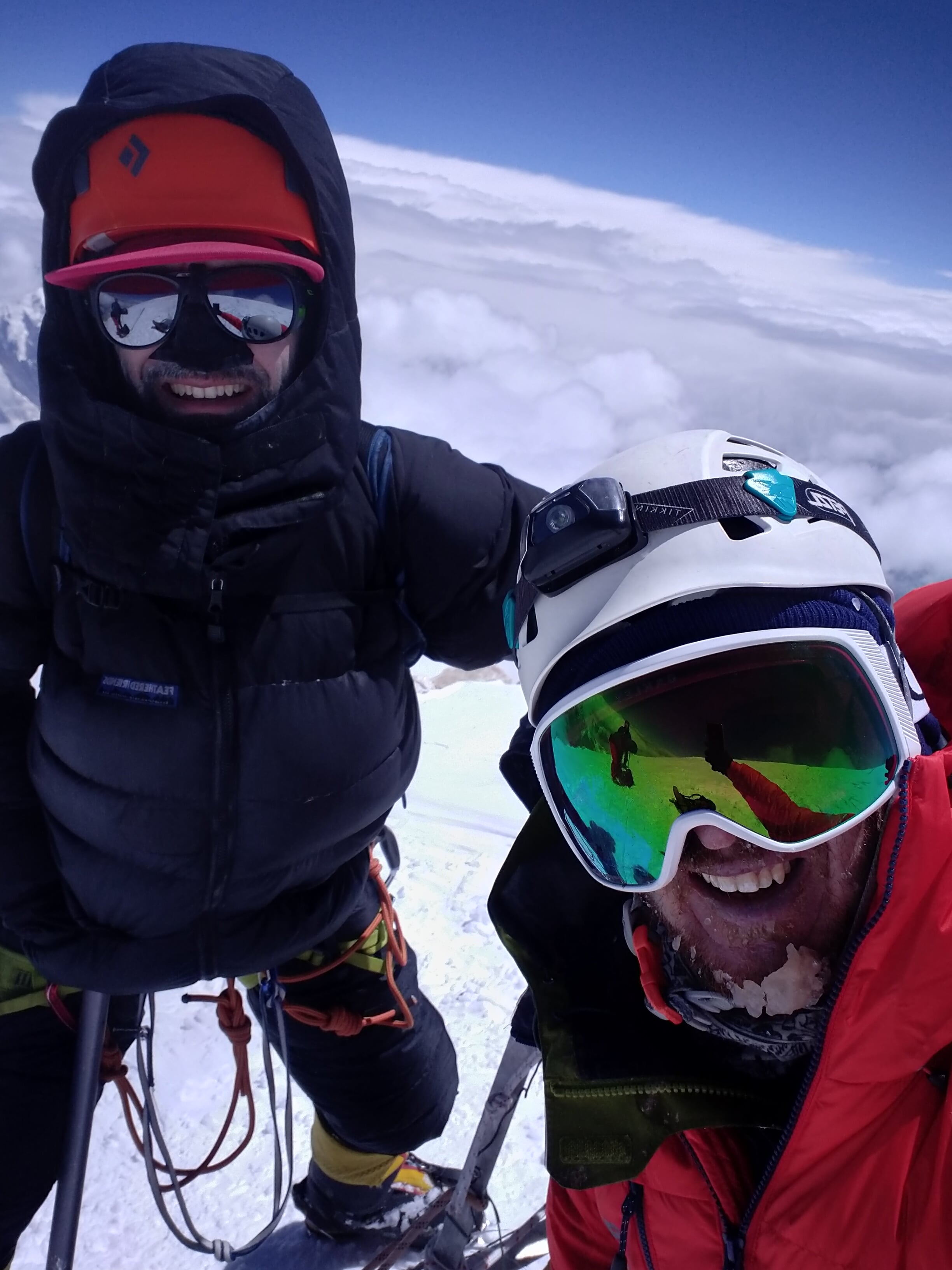
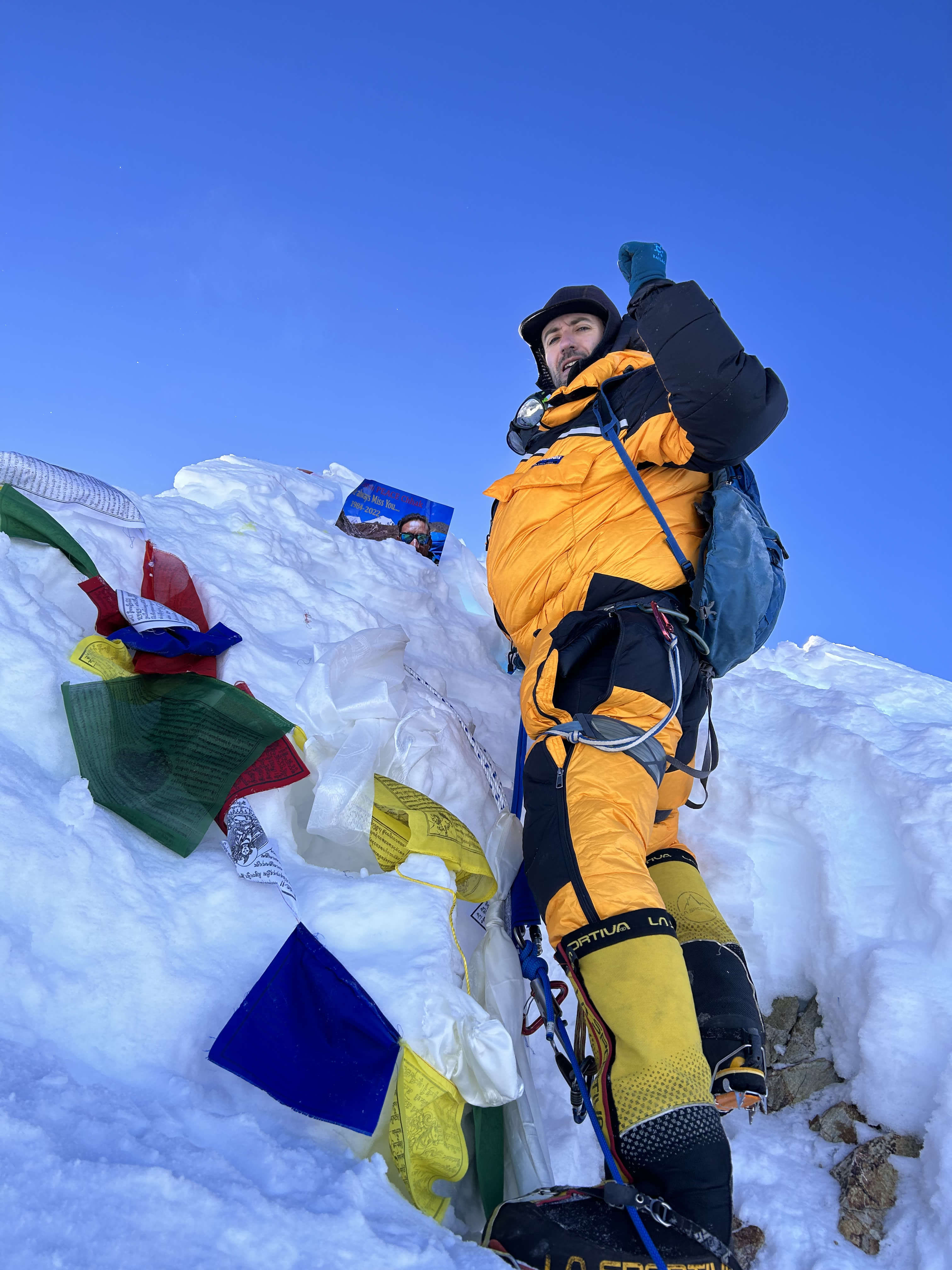
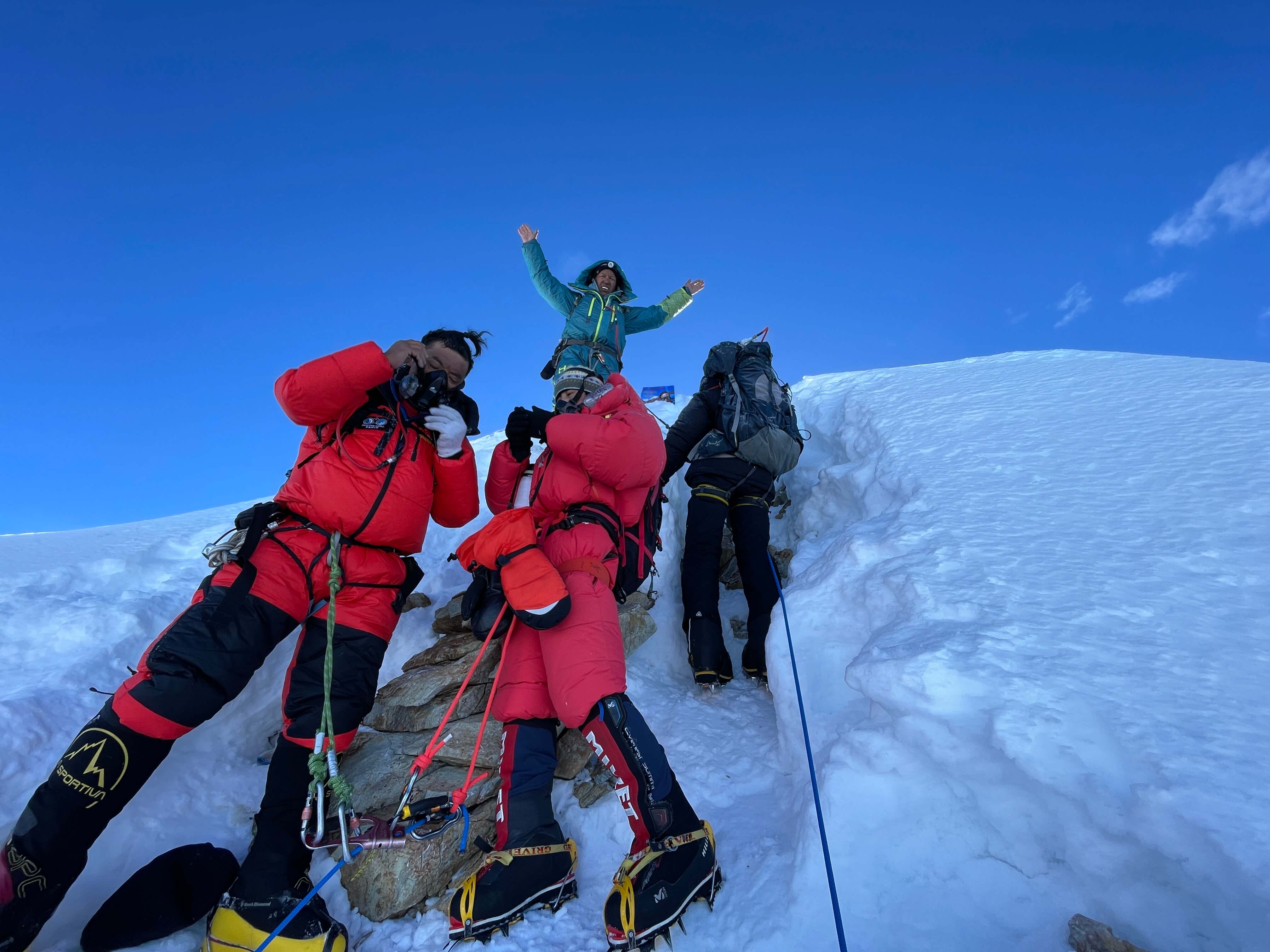
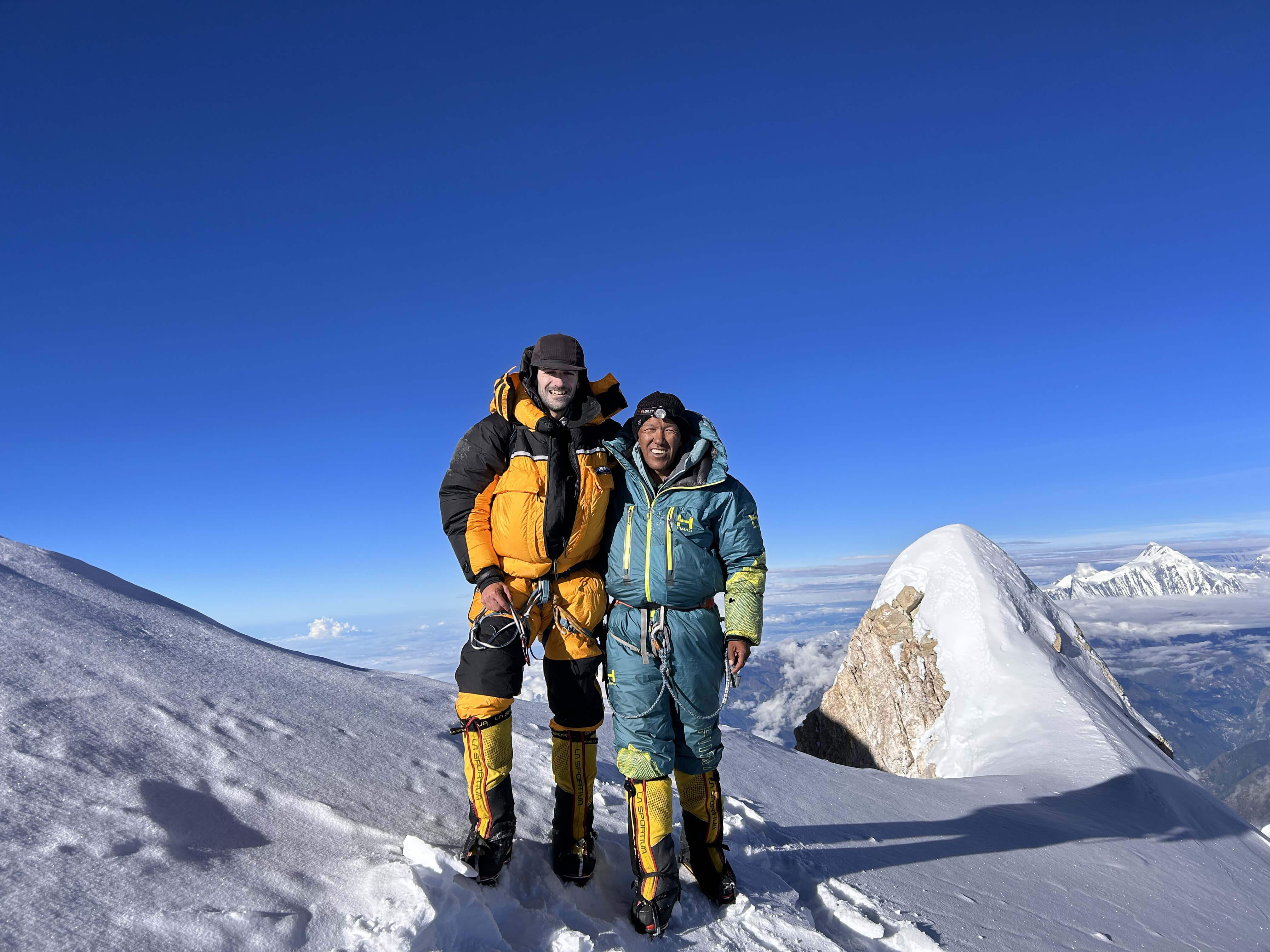
When I reached the top, I let out a shout of triumph. It had been a long push, in poor conditions, and I was delighted and relieved to have made it. Each meter was fought for and hard earned. The summit day was physically and mentally difficult. A lot of this can be attributed to the impact of weather conditions, especially wind. The summit plateau was excruciatingly cold, due to intense and sustained winds. I was only able to stay for a few minutes and hastily take photographs of Pik Pobeda, Khan Tengri’s summit cross, and the surrounding terrain. A friendly Ukrainian climber who was already on the summit when I arrived generously removed his gloves in order to take my photo for me. I climbed the final ~10m up the ice cap, to the true high point of the mountain, the controversial final meters which designate Khan Tengri as a 7000m peak. James arrived as I was headed down, and we quickly took a selfie together.
The descent to our high camp tent felt endless; rappel after rappel after rappel, mostly on iced and knotted fixed lines. I made a concerted effort to remain focused and intentional in my actions, double check my systems, lock my carabiners, and generally be as careful as possible. I was fatigued, mentally and physically, and knew that mistakes would come easily should I allow them.
Back at the tent, I clocked my round-trip time at 13:05, not very fast at all. I believe that inclement weather slowed me down significantly. I also lost between 30-60 minutes due to the small bottleneck at the couloir traverse fixed lines. I also could definitely have trained with better specificity; my calves persistently felt like an athletic bottleneck on Khan Tengri. I was not fully prepared for the amount of front-pointing and sustained steep terrain, and had been especially worn down by the struggle of managing my enormous backpack during the steep load carries.
7.29
10:55 am depart Camp 3. 1.5 hour rest in Camp 1. 18:00 pm arrive Crampon Point. ~3 hour rest at Crampon Point. 21:50 pm arrive BC.
James, Lucas and I slept in, and took our time eating breakfast, drinking coffee, and packing up. A massive avalanche woke Lucas and I in the early morning – it swept the southern route below Camp 3. A serac collapse off of Pik Chapaev had triggered the slide, a common occurrence given Chapaev’s topography above the southern route’s approach gulley. Lucas and I turned our radio on to listen for any distress calls from the south: nothing. On return to basecamp we would learn that one man had died in this avalanche, and that two others had been seriously injured.
The climb from Camp 3 back up Chapaev’s shoulder was slow and annoying – yet more jugging on the jumar. Happily this ~250m climb would be the final use of my ascender on the route.
Endless rappelling on the way down. Chapaev’s shoulder is around 6100m high, and the base of the route sits at roughly 4000m. Accounting for some sections of smoother terrain and short sections of walking, I figure that I easily rappelled 1800m in total. Many fixed ropes were icy, pulled too tight by snowfall or glacial shift, or were knotted in awkward places mid-rap. Diagonal rappels and raps on loose scree or deep snow began to add their toll both physically and mentally.
In Camp 1 we stopped to pack our tents and spare supplies, and take a much needed break from rappelling. We stopped again for several hours to regroup as a trio at Crampon Point, drying our boots and socks in the sun and gazing at Khan Tengri’s splendor.
We were all exhausted, and the final easy dry glacier crossing to basecamp felt like a bit of a death march. On return to basecamp – manna from heaven! A hot meal, a cold Coca Cola, and the Sauna facility were all ready and waiting for us! Never before have I slept so well after drinking a full liter of cola.
7.30
Rest day in Basecamp. I felt quite alright this day, not particularly worn down, albeit with a very healthy appetite. The weather began to deteriorate, and we were grateful that we had summited when we did.
7.31
Helicopter scheduled for today, but cancelled due to foul weather. High wind and steady rain all day long.
8.1
Helicopter at 11 am back to Karkara camp. Long drive back to Bishkek, total time of ~6.5 hours with minimal gas station stops.
Images
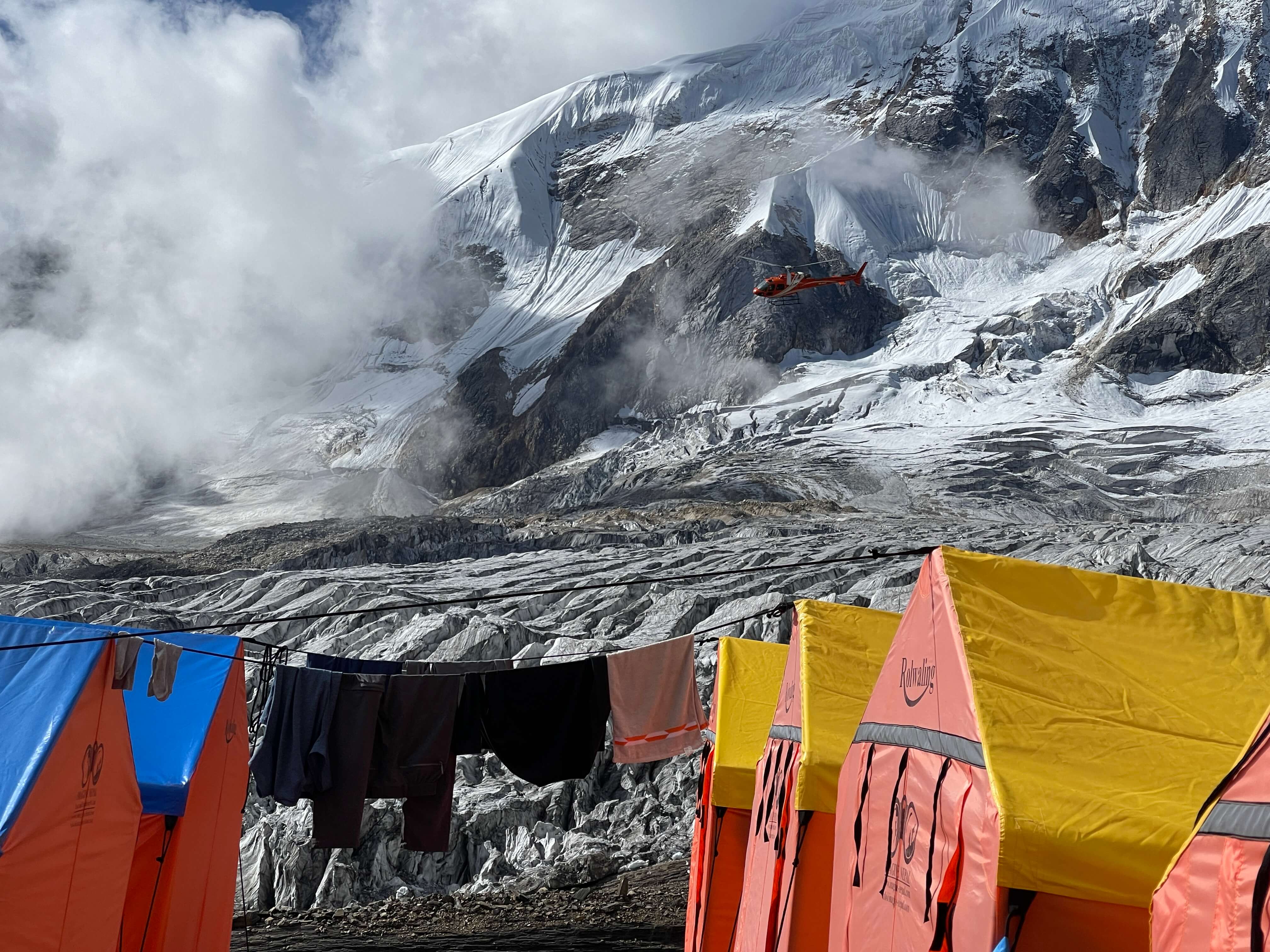
James and I on the summitDeparture helicopterNorth Inylchek basecampIce bath in basecampApproach to crampon pointAscending Chapaev Shoulder, from C3The summit ridgeJames, reaching the summitPik Pobeda, from Khan Tengri summitKhan Tengri’s summit crossSummit daySummit dayPik PobedaSummit daySummit dayPik PobedaPik PobedaPik PobedaCamp 3, Coca Cola in handSummit ridge from Chapaev ShoulderSummit ridge from Chapaev ShoulderApproaching Camp 3Approaching Camp 3Khan Tengri at sunsetAbove Camp 1Above Camp 1Above Camp 1Khan Tengri at sunsetClouds over Khan TengriThe Tian ShanThe Tian ShanThe Helicopter
Thoughts on Khan Tengri
Khan Tengri via North Inylchek was a difficult climb. The terrain and demands of the ascent, even with fixed lines in place, represent a totally different scope of ascent than Pik Lenin or Pik Korzhenevskaya, the other two ‘lower’ 7000m snow leopard peaks. Weather was challenging, and extremely cold on summit day. Load carries on relentlessly steep terrain posed a real challenge, and are something which I will endeavor to train for with better specificity in the future. I was delighted to summit Khan Tengri in an independent style, and in good time due to pre-acclimation. Pik Lenin had been a total wash, a boring grind of a climb with days upon days spent waiting out foul weather, and having that ascent pay off with success on Khan Tengri was a joy. North Inylchek is a spartan base camp, but food was both sufficient and good, the sauna was delightful, and the staff were highly capable. Ak Sai runs a solid operation, and I have been very impressed by their basecamps on Moskvina, Pik Lenin, and the Inylchek glacier. Ak Sai’s pricing is of quite good value, in my opinion, if just paying for basecamp.
Khan Tengri is one of the most beautiful mountains I have ever climbed, or even seen! This is a special peak, one of the world’s most remarkable, unique in its character. The marble cap of the upper mountain is unlike anything I have ever seen elsewhere – I’d love to hear a geologist go into greater depth as to its formation and nature. Witnessing the blood red glow of Khan Tengri at sunset is indelible, a powerful mountain experience which will never leave me.
Editing this journal as I am, in late September of 2024, it is interesting to compare my physical state after Khan Tengri, with that of my condition after Manaslu – Khan Tengri was subjectively a ‘harder’ climb than Manaslu, yet Manaslu was much ‘harder’ on my body and mind. After Khan Tengri I felt pretty good, had an appetite and energy, had lost about 4kg of body mass, was able to rapidly begin regaining lost weight. After Manaslu I was physically ruined, suffered from short term cognitive fatigue or impairment, had no appetite for about a full day, and had lost about 7kg of body mass. My rock climbing performance took roughly three months, around 12 weeks, to fully recover from Manaslu. As I write, I subjectively feel that my rock climbing performance has taken only about 6-7 weeks to recover from Khan Tengri.
I am of the firm belief that the southern route to Khan Tengri’s west ridge (the northern and southern routes share the same summit ridge) is unacceptably hazardous, exposed to severe and unavoidable objective risk in the form of serac-induced avalanche off of Pik Chapaev. We saw or heard numerous slides on the southern side of the route, and multiple fatalities and grievous injuries occurred in 2024. I am compelled to put this to writing, phrased in strong language: If planning to climb Khan Tengri, you should prepare for and train for the northern route. Do not play dice with your life on the southern side of the mountain.
I climbed to the true summit and absolute highpoint of 8163m Manaslu on September 21st, 2023 with a commercial expedition organized by Imagine Nepal, and 1:1 guided by Pasang Dawa ‘Pa Dawa’ Sherpa. I did not use supplemental oxygen at any time during my ascent or descent.
This is a written trip report for my climb. For photographs, take a look at this post.
Manaslu’s East Pinnacle, from 4900m BasecampManaslu’s East Pinnacle, from 6650m Camp 3Manaslu’s East Pinnacle, from 4900m Basecamp
The Goal: 8000m Without Supplementary o2
An 8000m summit without the use of supplementary oxygen had been a major personal goal of mine for a long time. The economic expense, training rigor, time commitment, and uncertainty surrounding my ability to physically handle 8000m had deterred me from making any attempt pre-Covid, with the rationale that I could continue to build more 7000m experience first. Uncertainty, especially, was in hindsight a major factor for me; how would I handle the elevation without o2, and how could I know or fully prepare without just committing? The high-friction environment created by Covid policies in China, where I live, suddenly put a hard stop to any possibility of my getting onto an 8000er, or even mountaineering at all, for three and a half years. Near the end of Covid I arranged to take a one year sabbatical from work, thus satisfying the time commitment involved, and commenced a structured training regime.
With no stable partners keen to make early plans, and absolutely not confident in targeting my first 8000er alone, I resolved to accept the cost of climbing guided with a commercial operator. Manaslu, whilst still very expensive, was the cheapest 8000m peak one could climb guided, and its normal route was very straightforward for me to research and get a sense of – especially so given excellent content published by Explorersweb. I chose to climb with Imagine Nepal for a number of reasons. Imagine Nepal stood out to me as a local Nepali operator, as the operator responsible for rope fixing, and due to their solid track record in climbing to Manaslu’s elusive true summit – and not a ‘false’ foresummit – during the two seasons prior to my attempt. The choice worked out for me, and Imagine Nepal was as fine an operator as any on the mountain; basecamp provided excellent rest and recovery, Pa Dawa was an absolute unit of a guide and partner, and all logistics and transfers were smooth and professional.
Acclimatization Strategy: Expedition Enchainment
Enchaining expeditions, climbing multiple high elevation peaks in a row with the goal of robust long-term acclimatization, is a tactic which I have made productive use of several times. In the past I have enchained Pik Lenin with Mount Elbrus, and Pik Lenin with Alpamayo, for excellent outcomes. The primary difference between a lengthy singular expedition within one region, and a link up for acclimation carry-over, is in the loss of exposure to elevation midway due to travel and transitions. I am not aware of any well-established science to the persistence of acclimatization, nor its rate of degradation once removed from a hypoxic environment. However, I know from prior experience that I am fine for roughly a week at sea level without any significant loss of acclimation, and I also believe that – if smoothly executed – transitions at low elevation can function as good recovery intervals for the body.
Prior to Manaslu I undertook a significant expedition to the Pamir in Tajikistan, where I successfully ascended 7495m Pik Kommunizma, another long-term goal of mine. This climb, unguided and with friends, was deeply significant for my subsequent success on Manaslu. I had plenty of time in Tajikistan to refresh myself on my mountaineering systems and habits, get back into the rhythm and challenge of high altitude climbing, and most importantly was able to rigorously acclimate before setting foot in Nepal. Thorough acclimation was absolutely critical to ascending Manaslu without bottled oxygen, and I am certain that without Pik Kommunizma, plus significant time resting in Tajikistan’s 4330m Moskvina basecamp after that ascent, I would have needed at least one additional acclimatization rotation on Manaslu. The schedule followed by climbers making use of bottled oxygen is absolutely not suitable for a no-o2 ascent, as it involves a quite limited scope of acclimation.
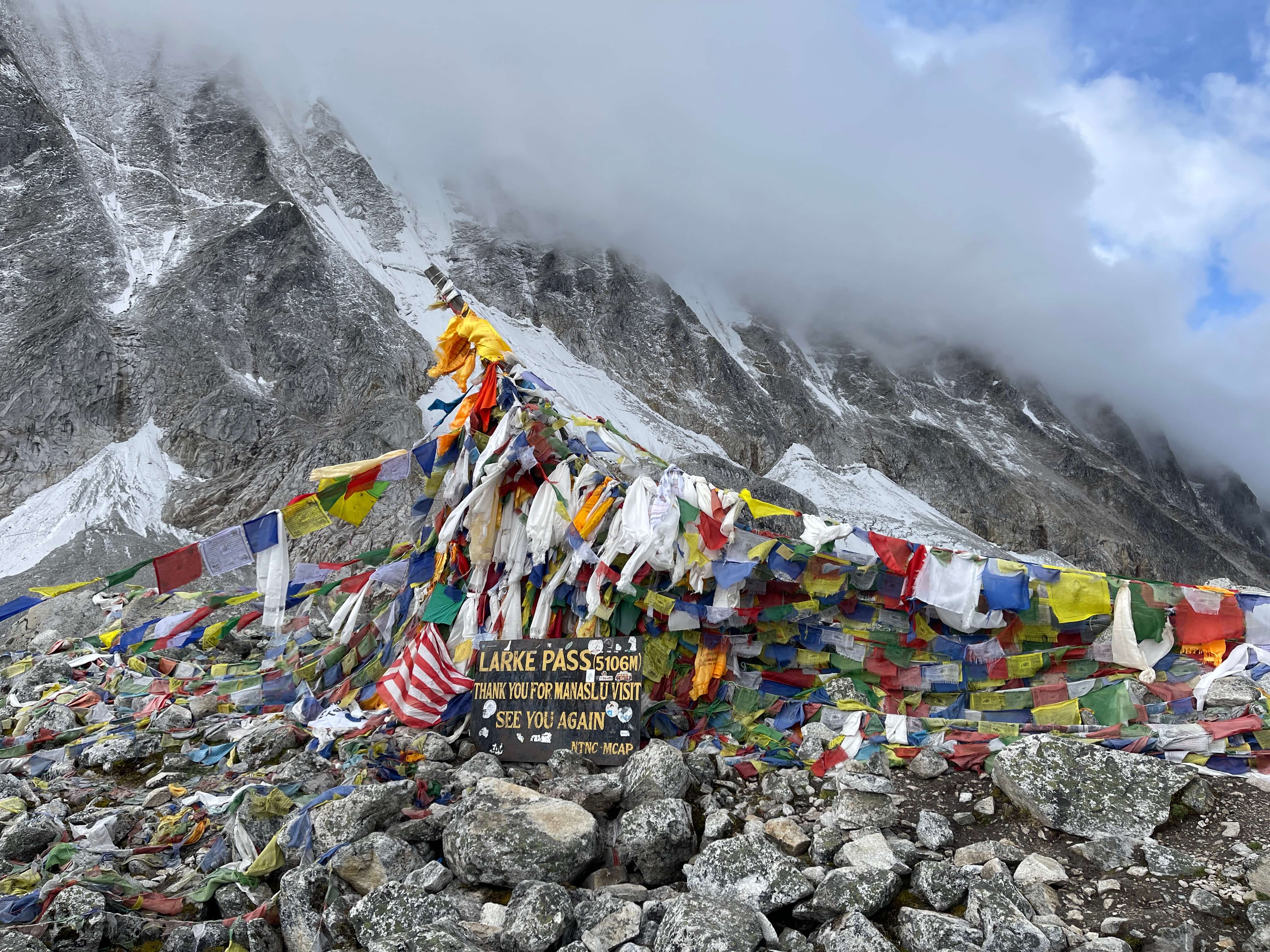
I had spent an unpleasant night at 6950m camp on Kommunizma before ascending to 7495m, which provided serious stimulus for my body to adapt for even higher. The risk I faced was in losing this deep acclimation by spending too much time at sea level; I thus opted to remain in Moskvina Glades Basecamp for over a week after Kommunizma, and tried to get back to altitude as quickly as was possible upon reaching Nepal. As part of this strategy, I opted to save money by trekking into Manaslu basecamp, clearing 5150m Larke Pass and spending several additional nights above 4000m. The approach trek had me back to elevation much faster than a helicopter would have (helicopters fly in somewhat last minute, only when basecamp is fully constructed), and I also felt that the trek served to reinforce my base acclimation from living at 4330m Moskvina Glades. Nutrition and rest during most (I’ve heard horror stories about the Makalu approach!) approach treks in Nepal are a non-issue, due to well established tea house infrastructure, and an approach trek on a popular route (as in the Khumbu region) serves as a very low intensity acclimation interval. I felt quite strong from the get-go on Manaslu, with no issue sleeping at 6650m C3 on my first and only rotation, and no issue sleeping or eating at 7430m C4 during my summit push. The ability to rest and eat properly at these elevations set me up with a superb foundation of energy and motivation for my summit attempt.
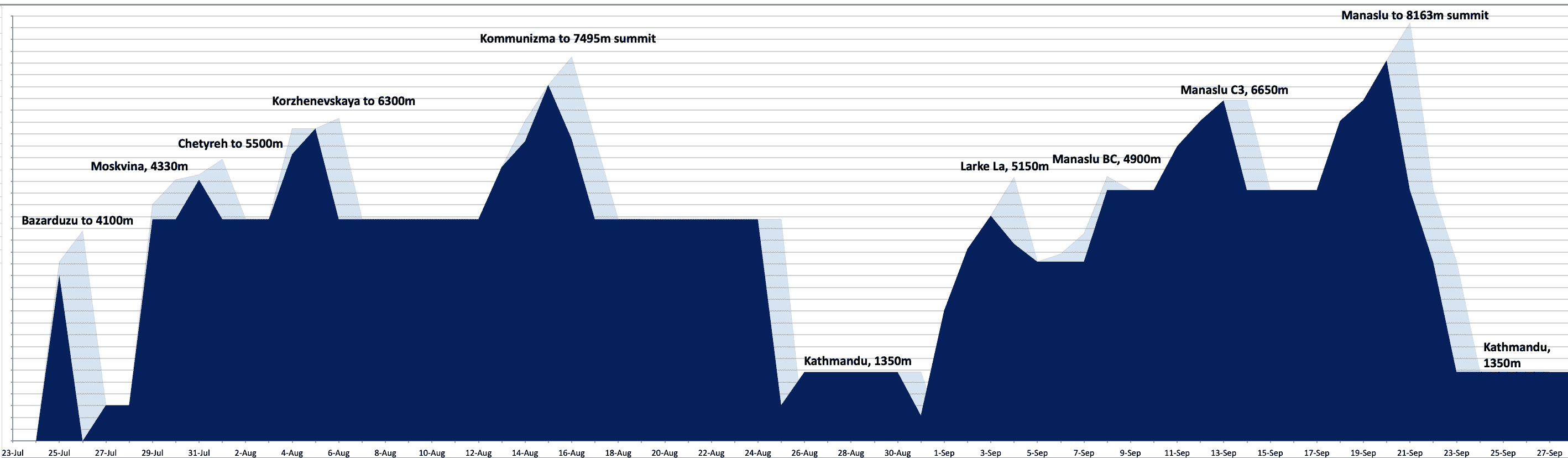
My complete acclimation schedule, including Manaslu’s summit, is visualized below. Dark blue shows sleeping elevation, and light blue indicates the daily high point:
Day-by-Day Climbing Schedule and Route
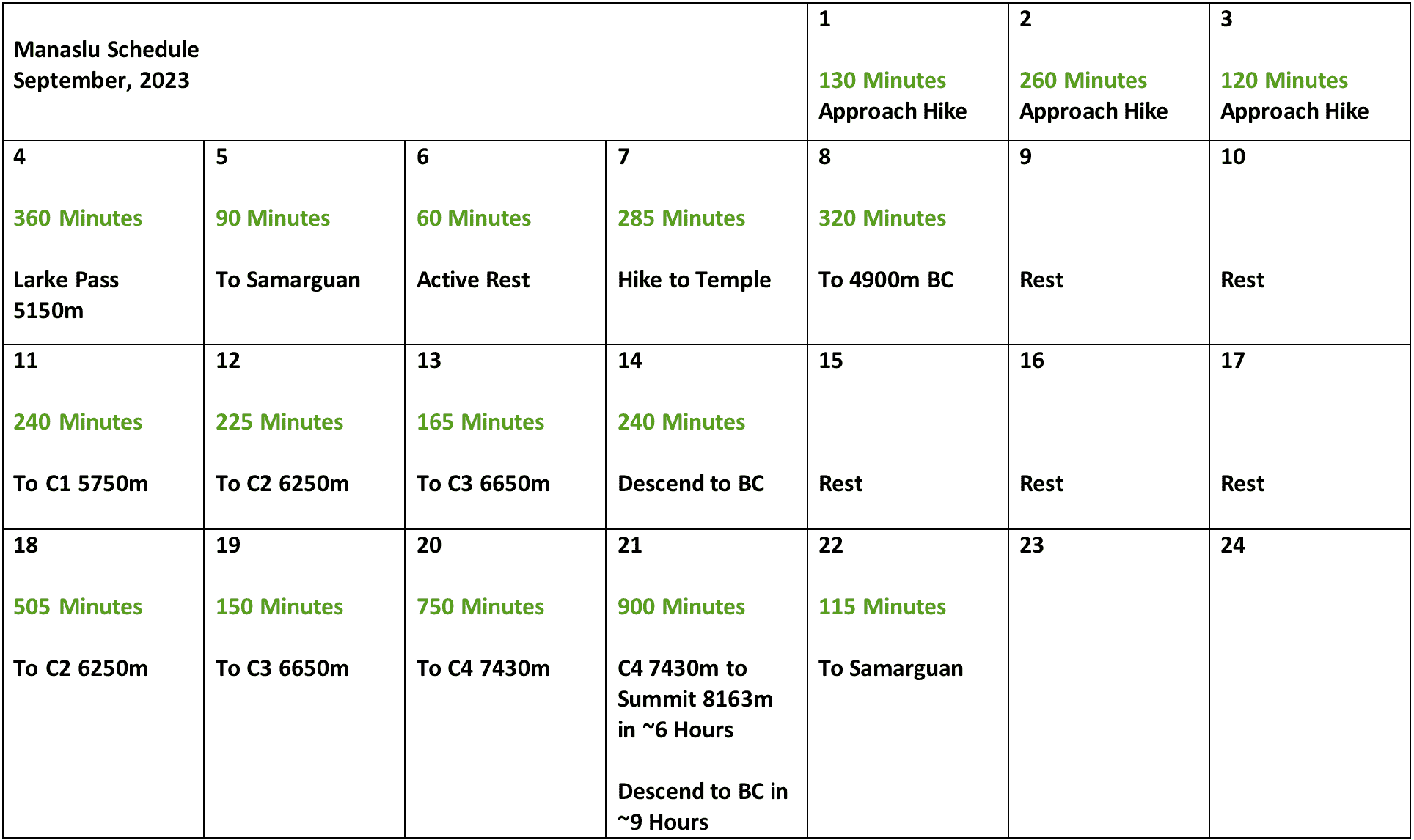
Here is a calendar outlining my schedule throughout the approach hike and climb. I tracked output as minutes spent moving, whether ascending or descending.
September 1st – 5th
Approach trek.
The approach began with a long drive split over two days, from Kathmandu to the trailhead for the Manaslu circuit trek. I saved a significant amount of money by undertaking the 5 day approach trek instead of helicoptering into basecamp. This also served to reinforce acclimation nicely; on September 4th I cleared 5150m Larke Pass, and I spent two nights sleeping above 4000m during the approach.
Weather was quite unstable and rather poor throughout the approach. There was intermittent rain, high humidity, and one full day of torrential rain where we decided to hunker down in a tea house and just wait. The approach trek was otherwise pleasant enough, with very well broken trails and comfortable tea houses the entire way. The approach hike ended in Samarguan, a small village with guesthouses catering to both hikers and climbers.
A donkey train took my equipment separately, and Pa Dawa and I only carried day packs throughout the approach hike. The donkey with my bags was delayed, and my equipment made it to Samarguan just the day before we hiked up to basecamp! Luckily I had packed a thorough day bag, with everything that I needed (except an umbrella!).
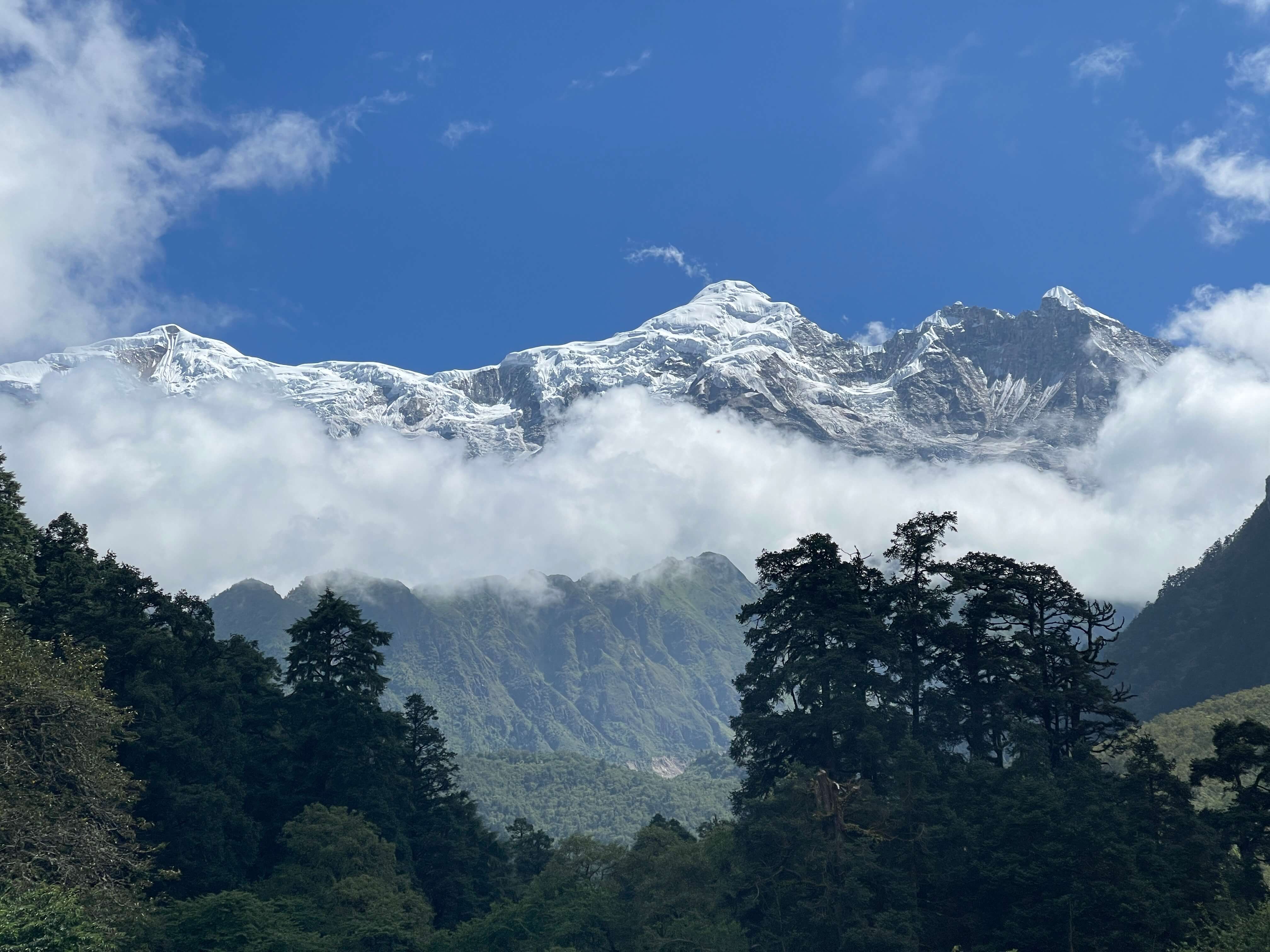
The terrain throughout the approach hike was lovely higher up, especially the mountains surrounding Larke Pass and the high alpine lakes outside of Samarguan. In nice weather the Manaslu circuit would be a worthwhile hike unto itself, although the nearby peaks are less stunningly pronounced than those in the Khumbu region. Unfortunately, Manaslu did not reveal itself to me throughout the approach hike, and remained wreathed in clouds on days where I would have had good views in clear weather. I would not set eyes upon the mountain’s profile until the day of my first rotation to elevation.
September 6th – 8th
Active rest days in Samarguan, followed by a move to 4900m Basecamp.
I went for an afternoon hike up to an alpine lake on one day, and a much longer hike up to a high temple on another. The hike up to 4900m basecamp was slow but easy, on a well beaten trail. The route to basecamp was crowded with porters, hauling equipment up both for climbers and for basecamp infrastructure. We stopped for local milk tea halfway up, and took our time hiking at a relaxed pace. The weather was truly atrocious, rainy and very wet, and gave me cause for concern as to the conditions we would face higher on the mountain.
Manaslu is a very wet mountain, apparently due to the topography of the nearby valleys. On arrival basecamp was wreathed with mist and fog, there was incessant drizzle, and an umbrella became a truly critical piece of equipment. If attempting Manaslu, bring an umbrella for use on the lower mountain! We immediately went to the meal tent of our basecamp, where hot drinks and a space heater insulated us from the wet. My personal tent was spacious, and with double walls was insulated from condensation.
In reflection, the mood was somewhat grim those first days in basecamp, with very wet weather and heavy precipitation casting a shadow over our perceived chances for a smooth climb on the upper mountain. Moving between rest tents and meal tents was tenuous, exposure to the rain and cold making it difficult to stay dry and comfortable. The initially foul weather did eventually stabilize into one of the best seasons Manaslu has ever seen, with an enormous multi-week weather window of low winds and zero precipitation.
September 9th – 10th
Rest days in 4900m Basecamp.
I got to know the other climbers climbing with Imagine Nepal, meet more of the local support staff, and get a sense of the basecamp environment. I made daily forays higher, up to ‘crampon point’ at the edge of the glacier, in an effort to push my acclimation a little bit. Satellite internet service was available, and I was able to keep in touch with family and friends.
Weather was awful, constant drizzle and high humidity. It was difficult to stay dry, even inside the vestibule of my tent. I found myself wearing my down pants every day in basecamp, to deal with the penetrating humid cold.
September 11th
4900m Basecamp to 5750m Camp 1.
Manaslu revealed itself to me for the first time today, as the clouds parted and the mountain appeared from the mist. A rainbow appeared in the humidity over the peak, crowning the pinnacle – a false foresummit summit visible from basecamp – with colour.
My first day on the upper mountain, gaining the glacier and Camp 1 at 5750m. The lower icefall above basecamp is broken and heavily crevassed, and the route to Camp 1 was winding and somewhat indirect. The climbing was extremely easy, on very gentle slopes throughout, just with quite a bit of crevasse navigation via fixed ropes. There were numerous sections which would have been incredibly dangerous to cross without the fixed lines in place.
September 12th
5750m Camp 1 to 6250m Camp 2.
This section presented the ‘lower crux’ of the route, with a complex icefall navigation and several steep ice steps to ascend. The entire route was fixed, so the 80 degree to overhanging ice cliffs within the icefall required only easy jumaring. Regardless, each ice step was crowded with climbers, and they presented bottlenecks to movement. Porters carrying oxygen and heavy loads of equipment to the upper camps had to ascend slowly, and some climbers appeared very uncomfortable managing the steep terrain.
Camp 2 was still being established when we arrived, and there weren’t many tents up yet. Our group placed our tents, and enjoyed the rare clear view over nearby peaks. I felt quite good on this first foray above 6000m, although my pace from Camp 1 wasn’t particularly quick. I had a healthy appetite, and rested well through the afternoon and overnight. Many climbers planning to utilize o2 stopped at 6250m Camp 2 and descended to basecamp the next day – this would be their only acclimation rotation, and they would use oxygen from the low 6000s onwards for their summit attempt. I had heard that this was the standard tactic for oxygen-supported attempts, but was nonetheless surprised to see it employed at scale; an ascent of a 7000m peak typically requires more acclimation than this!
September 13th
6250m Camp 2 to 6650m Camp 3.
Camp 2 to Camp 3 is a very short route, quite direct and steeper than the terrain from basecamp through to Camp 2. I was able to make the ascent in just over two hours, pacing slowly and carefully so as to avoid heavy breathing and overexertion. Camp 3 is situated on a natural plateau below a gorgeous ridge of ice cliffs, well protected from the slopes above. Due to high precipitation Manaslu is notoriously avalanche prone; the upper camps below the large plateau at ~7400m have historically been hit with slides, and this season’s Camp 3 placement was intended to help mitigate that. It was a gorgeous location, with incredible views both down and up the mountain.
Our small group – three other Imagine Nepal clients, two Sherpa guides and myself – were the first climbers besides the rope fixing team to reach Camp 3 this season, and the route higher had not been opened or fixed yet. We placed our tents, and spent the afternoon looking at the route to Camp 4 above us. This would be the highpoint of my first, and only, acclimation rotation. There was no means of reasonably ascending higher, as the way to Camp 4 was bogged in deep snow. A rope fixing team of half a dozen strong Sherpa guides were to open the route and fix it in its entirety, in a few days once that snow consolidated.
I rested very well at Camp 3, with a healthy appetite and no difficulty sleeping. This elevation was a solid ~300m lower than the high camp on Pik Kommunizma, where I had spent an unpleasant night almost a month earlier. I was uncertain how much acclimation I had retained from my time on Kommunizma and in the 4330m Moskvina Basecamp, and was quite relieved to respond well to the elevation at Camp 3.
September 14th
6650m Camp 3 to 4900m Basecamp.
A big descent day. The large ice steps were all smooth enough to rappel, on account of well-fixed ropes. Descending was a slog, but relatively fast; only 4 hours from Camp 3 to basecamp. There was no rush, given an entire day budgeted for descending.
September 15th – 17th
Rest days in 4900m Basecamp.
I focused on good nutrition, lots of sleep, and calm mental focus throughout these three days. I was feeling very uncertain as to whether or not my acclimation would be sufficient for a no o2 ascent, and consulted online with several friends and partners who between them had a wealth of 8000m experience. I also received helpful perspective from Pakisani mountaineering legend Sirbaz Khan, who was climbing under Imagine Nepal’s logistics, and from Imagine Nepal’s leader Mingma G. Their combined advice and experience put me somewhat at ease; I decided that I should be well enough acclimated to make a solid attempt.
September 18th
4900m Basecamp to 6250m Camp 2.
The first day of my summit push was one of the longer ones, as I opted to skip Camp 1 and climb directly to Camp 2 from basecamp. The intention was that this first big output day would be offset by a shorter day two, ascending only from Camp 2 to Camp 3, a more reliable (shorter term) weather forecast for the proposed summit day, and a better two night rest interval in the mid ~6000m range. Slower climbers departed a day earlier, and included Camp 1 in their push. This tactic seems to be quite standard on Manaslu, as it gives guides better flexibility with their clients. One strong climber I’m aware of departed basecamp a day after I did, and climbed directly to Camp 3.
On Pik Kommunizma I had taken the opposite side of this strategy, and opted to add a day so as to make for two shorter and easier first days rather than a huge single day’s push. By my reckoning, this decision is really contingent first upon weather reliability and second upon confidence in one’s physical fitness.
September 19th
6250m Camp 2 to 6650m Camp 3.
A short, easy day ascending 400m to Camp 3. We took our time on this day, and tried to move at a low intensity pace.
September 20th
6650m Camp 3 to 7430m Camp 4.
More than the summit day, Camp 3 to Camp 4 felt like the crux of the route. We departed Camp 3 very early in the morning, making most of this ascent in the dark. Many climbers began to use oxygen on this move, and some continued to the summit in a single push on account of superb weather. My understanding is that most climbers who start on o2 from their Camp 3 departure continue to use it, at a low flow rate, overnight at Camp 4. The route from Camp 3 to Camp 4 is long and very sustained, relatively steep the entire way, and mentally feels endless due to the visual illusion of false tops throughout. Due to foreshortening of the mountain ahead, each rolling crest of the route looks like it might be the last – but isn’t!
This was a long and arduous day, and the first day that I used my down suit for an entire day. At almost 800m of elevation gain, Camp 3 to Camp 4 is comparable to summit days on many other peaks, and easily as taxing. The route is much, much steeper and more strenuous than Camp 4 to Manaslu’s summit. In total, this ascent took me an incredible 12.5 hours of output. We began very early in the day, so as to maximize rest time in Camp 4 before the summit attempt. This worked out very well for me, as due to my good acclimation I was able to both eat and sleep comfortably at 7430m Camp 4.
September 21st
7430m Camp 4 to 8163m Summit.
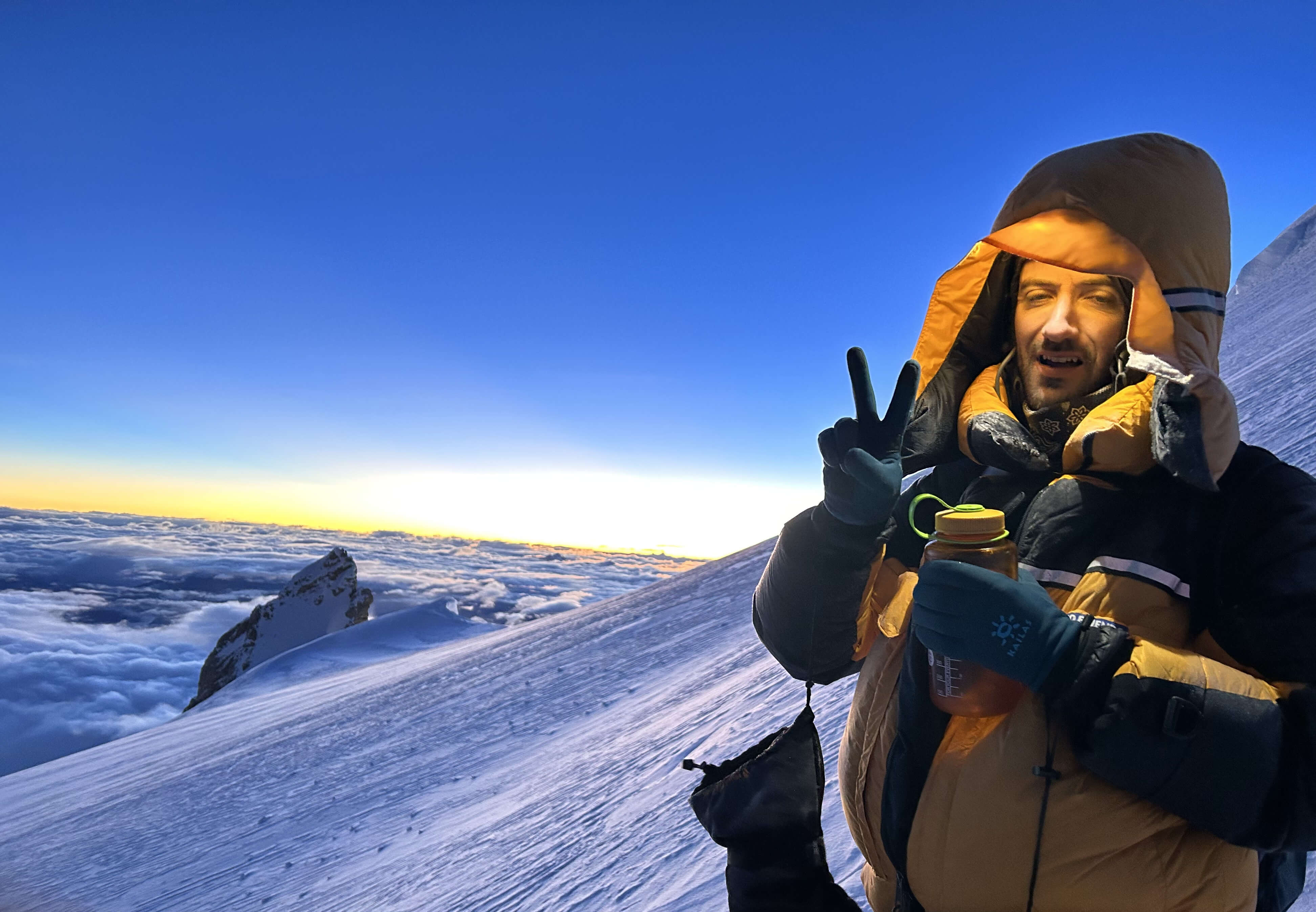
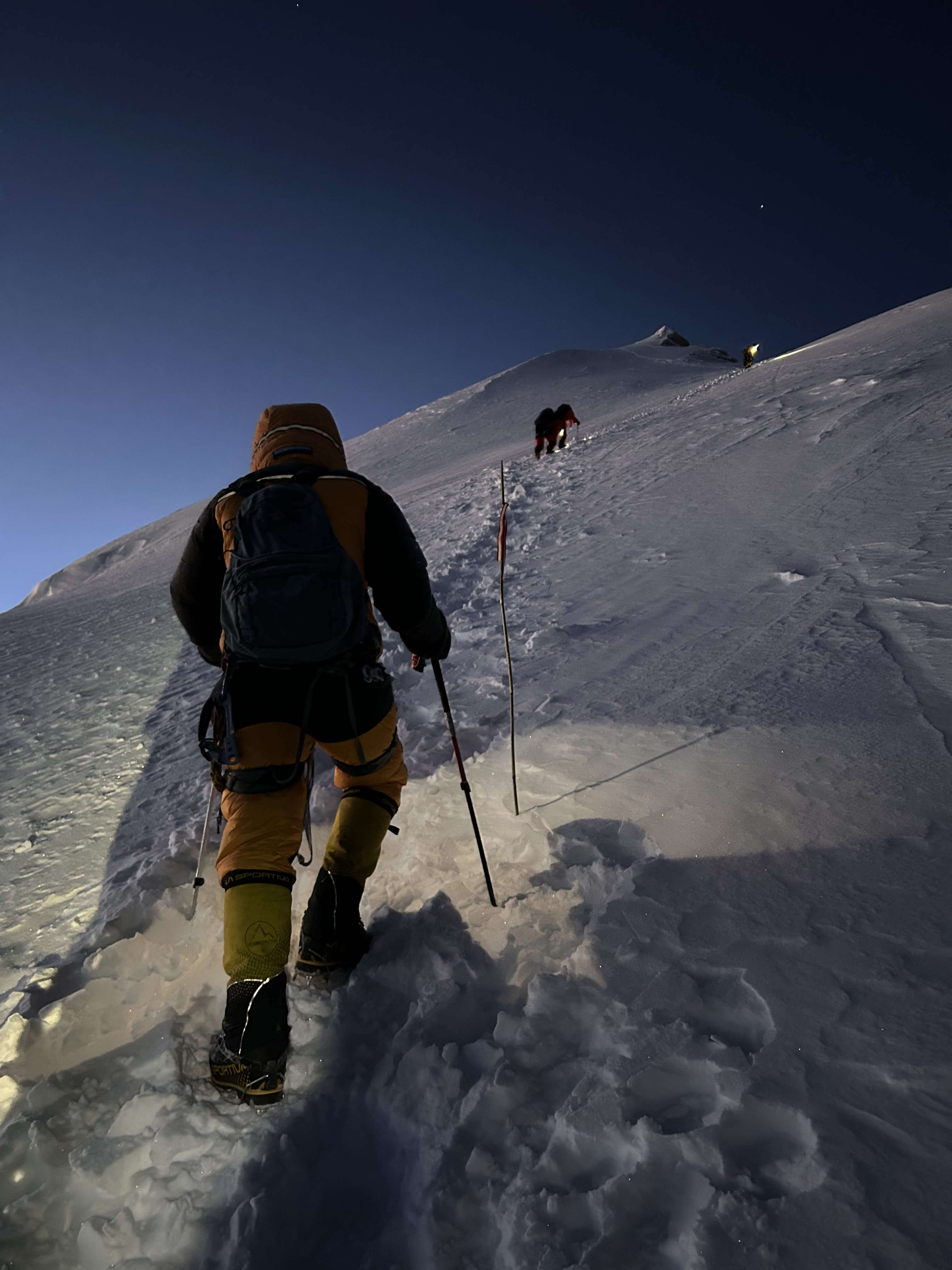
Awake at midnight, Pa Dawa and I began moving at approximately 1 a.m. I had trouble getting one of my crampons on, as the bulky chest and stomach of my down suit made it difficult to see my feet in the dark. Pa Dawa helped me, and I couldn’t help but think of all the anecdotes of ‘commercial climbers who can’t even put their own crampons on’! I kept my down suit hood up as we climbed up into darkness, my headlight inside illuminating only a small bubble of light on the snow in front of me. We greeted other Imagine Nepal climbers on their way out of camp 4, but with supplemental oxygen they quickly outpaced me. The down suit is a remarkable piece of equipment, highly versatile for venting and layering. I had a perfect micro-climate inside of the suit, and few issues with cold. My toes did become quite cold in the hours before sunrise, but I was able to manage by applying a focused ‘wiggle step’ technique – adding a full toe wiggle into my rest step rhythm at the conclusion of each step up.
The terrain immediately out of camp 4 was gently sloped. The majority of the route to the summit was similar, with the exception of one ~100m section of steeper terrain without fixed ropes. Most of the climbing to the summit only involved sustained rest stepping without use of a jumar, periodically switching the wire gate on my leash across fixed rope anchors. I left my ice axe in camp 4, and climbed to the final plateau below the true summit using two trekking poles. I climbed to the summit itself with only a jumar, empty handed.
A few hours into the summit push Pa Dawa, who climbed using o2 from 7430m C4, told me “You’re moving too slowly. I will run out of o2 if you continue at this pace. You must either go faster, or use o2”. This sparked a fierce intensity in me, and prompted me to push myself quite hard; I had resolved to either summit without o2 or to retreat, but not to use oxygen for ascent. I placed my full mental focus into my breathing and my rest step output, stopped only to drink or apply sunscreen, and made each stepping movement as efficient and as precise as possible. The elevation was enormously challenging for me, and I struggled with my breath and output rhythm every step of the way.
Sunrise brought a burst of energy and enormous stoke. We were already at or close to 8000m when the sun hit, and the morning light brought both warmth and a clear view of the route to the top. Other Imagine Nepal clients, new friends whom I had shared many meals with in basecamp, were descending from the summit, and we met at dawn below the final fixed ropes. They offered encouragement, and were proud to see me climbing without o2.
Sunrise, ManasluSunrise, ManasluSunrise, ManasluSunrise, ManasluEarly morning, below the summit
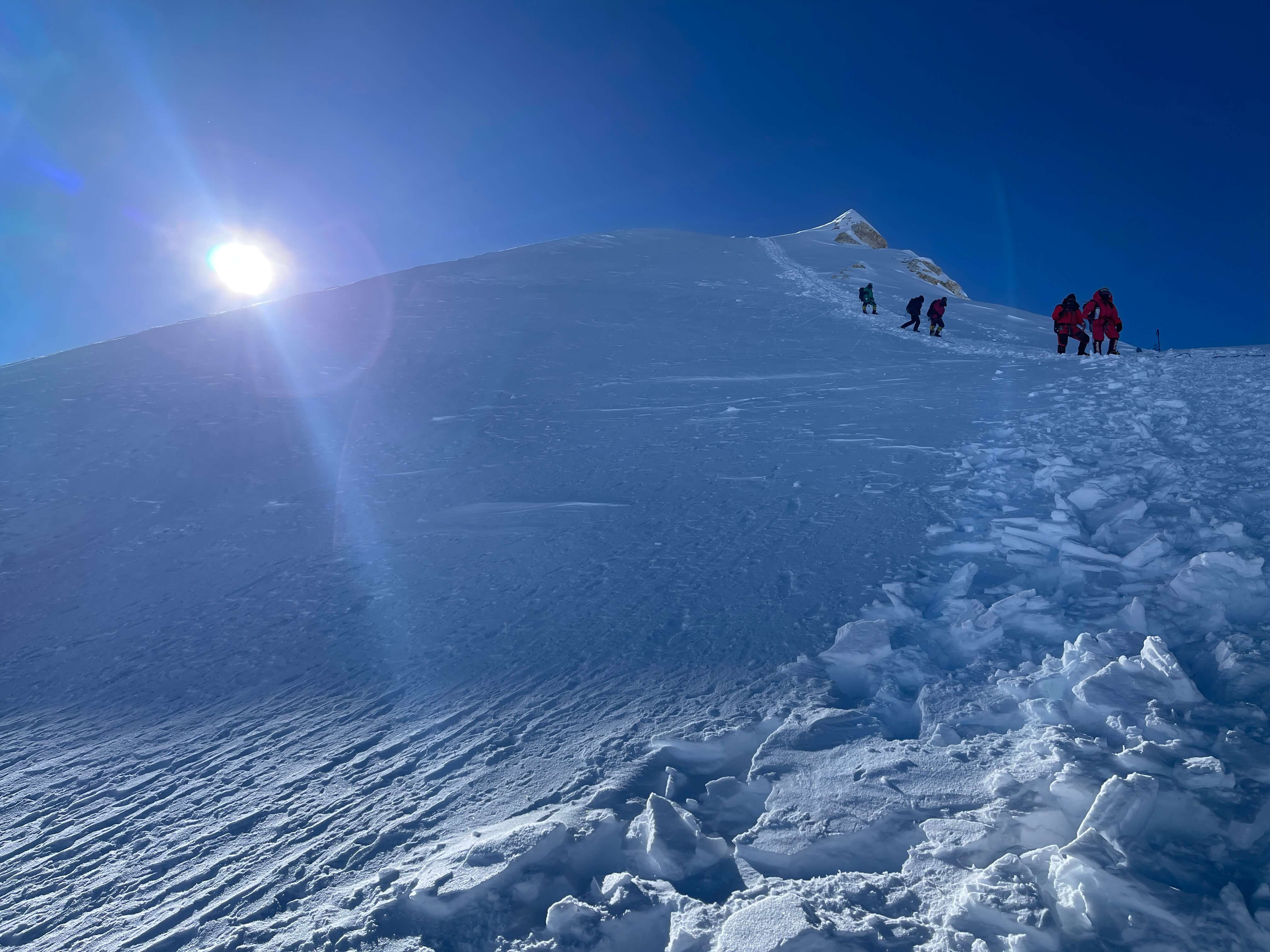
The final section of the route to the true summit was nowhere near as severe as I had expected it to be. A great boot track had been broken in, traversing past the false summits and then ascending steeply on fixed ropes to the true high point. While the anchors, a loose piton and some pickets, were a little bit dodgy, jumaring up to the high point was neither difficult nor particularly exposed. The view from the top was unambiguous; there was no more mountain, nor any higher pinnacle, to ascend. The weather had been flawless from camp 4, with almost no wind and clear skies, and the summit area was no exception. I was even comfortable removing my gloves. On the summit I waited a few minutes to take my turn standing at the top, chest and hands above the final snow cornice, but was very keen to begin descending immediately. Pa Dawa persuaded me to wait while he prepared two magnificent videos: one of the view from the true summit, and one of me on the top. I took several photos, but most were poorly framed – Pa Dawa’s photo and video at the summit were welcome images of the environment, of my state at the top, and of the view.
On the way down from the summit I sat down to rest at around 7600m and vomited until my stomach was knotted empty. Between C4, the summit, and my return to basecamp I consumed nothing but Coca Cola, Honey Stinger energy gels, a cup of juice generously provided by Nims Dai’s team at Camp 1, and a litre of water mixed with Cyclic Dextrin carbohydrate powder – a gift from my partner Reuben on Pik Kommunizma. Feeling far from spent after summiting, Pa Dawa and I decided to descend all the way to 4900m basecamp in one push. We knew that the food, sleep, and general environment of basecamp would be far preferable to another night at a high camp, and worth the exertion of a big descent. We ended up completing the ~3200m descent in approximately 9 hours. The descent was long and arduous, but we moved with high spirits.
In basecamp we received a warm welcome. One of the basecamp team met us at the edge of the lower glacier with Coca Cola and water, and in basecamp I enjoyed a hot tea before lying down. I had no appetite, difficulty sleeping, and fairly severe cognitive fog that evening, but knew that I’d ‘made it’ the entire way, up and down, and would easily be able to descend even further the next day.
Manaslu SummitPa Dawa, Manaslu SummitPa Dawa and I, Manaslu Summit
Thoughts on Manaslu
Manaslu was not a difficult climb in any technical sense; the vast majority of the climbing route was fully fixed and broken in by local Nepali guides and porters, and the (severe if not fixed) ice steps throughout the icefall and middle mountain required only simple jumar and rappel techniques. Manaslu was not a difficult climb in any logistical sense; all tents were hauled and placed by Imagine Nepal’s team, I carried nothing besides my personal gear throughout the climb, I cooked no food and prepared no water, I did not route find, I did not dig tent platforms, and all decisions regarding timing and weather were made for me. Manaslu was not a difficult climb in regards to risk; objective hazards were almost entirely mitigated by the fixed route, I climbed with Pa Dawa at my back whenever on the mountain, and on summit day Pa Dawa had a spare bottle of oxygen in his pack – ‘psychological oxygen’ – for use in case of emergency. The Imagine Nepal basecamp was absolutely luxurious by my standards, which bolstered the quality of my rest intervals and likewise kept me well nourished physically and relaxed mentally. In many respects, Manaslu was significantly ‘easier’ than any 7000m peak I have ever attempted.
The worthy challenge of Manaslu was in its elevation. Output above ~7700m was brutally difficult for me to maintain, and I felt that there was an invisible wall after which it required extreme focus to manage my breath rhythm and pacing. I moved much slower than the majority of climbers who were making use of o2, but still set a decent time of almost exactly 6 hours from camp 4 to summit. Subjectively this felt like much longer, struggling to continue moving, to rest step as efficiently as possible, and to minimize my breaks to water consumption or sunscreen reapplication. Both physically and mentally, Manaslu was a very challenging mountain to climb.
I lost roughly 11% of my body weight throughout my Pik Kommunizma and Manaslu expeditions, despite concerted efforts at weight gain: the Turkish restaurant and lots of baklava in Dushanbe after Pik Kommunizma, loads of ice cream and lamb noodles in Kathmandu before Manslu. I was particularly weak on return to Manaslu basecamp, significantly worse off than on Kommunizma. The afternoon, evening, and morning after summiting I experienced significant cognitive fog, was uncoordinated and clumsy, and had no appetite. I developed a productive cough on return to basecamp, which almost immediately resolved when I reached Kathmandu at low elevation. I was quite thoroughly slammed by the summit and descent, and if I had been unsuccessful I likely would not have had reserves for a second attempt. I had intended to attempt a climb of Ama Dablam after Manaslu, but was so worn down that I opted to change plans and go to South East Asia for sport climbing beside the ocean instead.
I was delighted to succeed on Manaslu. Despite the climb’s ‘accessible’ nature, due entirely to the degree of infrastructure and support present on the mountain, 8000m without o2 was the real deal, a true challenge and a worthy goal. Climbing guided was expensive, but after the fact I feel that I derived significant value from the expense. Pa Dawa was an enormously supportive, experienced, and reliable partner, and was pivotal in making my climb happen smoothly. He was a talented cook, knew everyone on the mountain and was thus able to secure a three person tent for the two of us to share at every camp, accompanied me from Kathmandu throughout the approach trek and entire climb, managed to capture excellent images at the summit, and quietly ‘had my back’ throughout the difficult C3-C4 and summit days. I was lucky to climb with him, and must not only express gratitude for his support, but also emphasize the role which his presence played in my successful summit.
I would attempt another ‘low’ 8000m peak, one of the nine below ~8400m, but next time would feel comfortable doing so unguided with an independent team. I would not consider changing my attitude towards the use of o2 in the future – I would only use supplementary o2 for the purpose of an emergency descent – and now realize that this decision quite possibly precludes me from ever making an attempt on Everest, K2, Kangchenjunga, Makalu, or Lhotse.
I ascended the true summit and absolute highpoint of 8163m Manaslu on September 21st, 2023 with a commercial expedition organized by Imagine Nepal, and 1:1 guided by Pasang Dawa ‘Pa Dawa’ Sherpa. I did not use supplemental oxygen at any time during my ascent or descent.
Below are photographs from my climb, organized by date. For a detailed written trip report, take a look here.
Manaslu
Manaslu’s East Pinnacle, from Basecamp.Manaslu’s East Pinnacle, from 6650m Camp 3.Manaslu, cloaked in rainbow and cloud.
September 2nd – 7th: Approach Hike
Distant mountains, Manaslu TrekSunset, Manaslu TrekLarke Pass, ~5100mA herd of deer at ~3000mStupa, Manaslu TrekGlacial Lakes nearby SamagaunSunrise, Manaslu Trek
September 8th – 18th: Basecamp, Acclimation Rotation to 6650m Camp 3
Glacial Lake, Basecamp Approach from SamagaunFirst views of ManasluManaslu, above BasecampManaslu’s East PinnacleRainbow and cloud over ManasluIcefall above Camp 1Icefall above Camp 1Icefall above Camp 1Icefall above Camp 1Ice Step below Camp 2Ice Step below Camp 2Ice Step below Camp 2View from Camp 2Basecamp, far belowApproaching Camp 3East Pinnacle from Camp 3Camp 3Camp 3Pa Dawa at Camp 3View from Camp 3View from Camp 3View from Camp 3Camp 3View from Camp 3Camp 1Manaslu from above BasecampManaslu from above BasecampHelicopter Rescue, BasecampHelicopter Rescue, BasecampBasecampLooking down at Camp 1 and Basecamp
Sunrise, ~7300mApproaching Camp 4Summit Crown from Camp 4Summit Crown from 7430m Camp 4
September 21st: 7430m Camp 4 to 8163m Summit
Summit DayPacked light for the summitMe, on Manaslu’s true summitSummit DayFinishing my Coca Cola at ~8000mPa Dawa and I, on Manaslu’s true summitPa Dawa and IPa Dawa on the true summitSummit crown, from ~7900mPa Dawa descendingClimbers descendingClouds moving in, as we descendSummit Day, ~8000m






































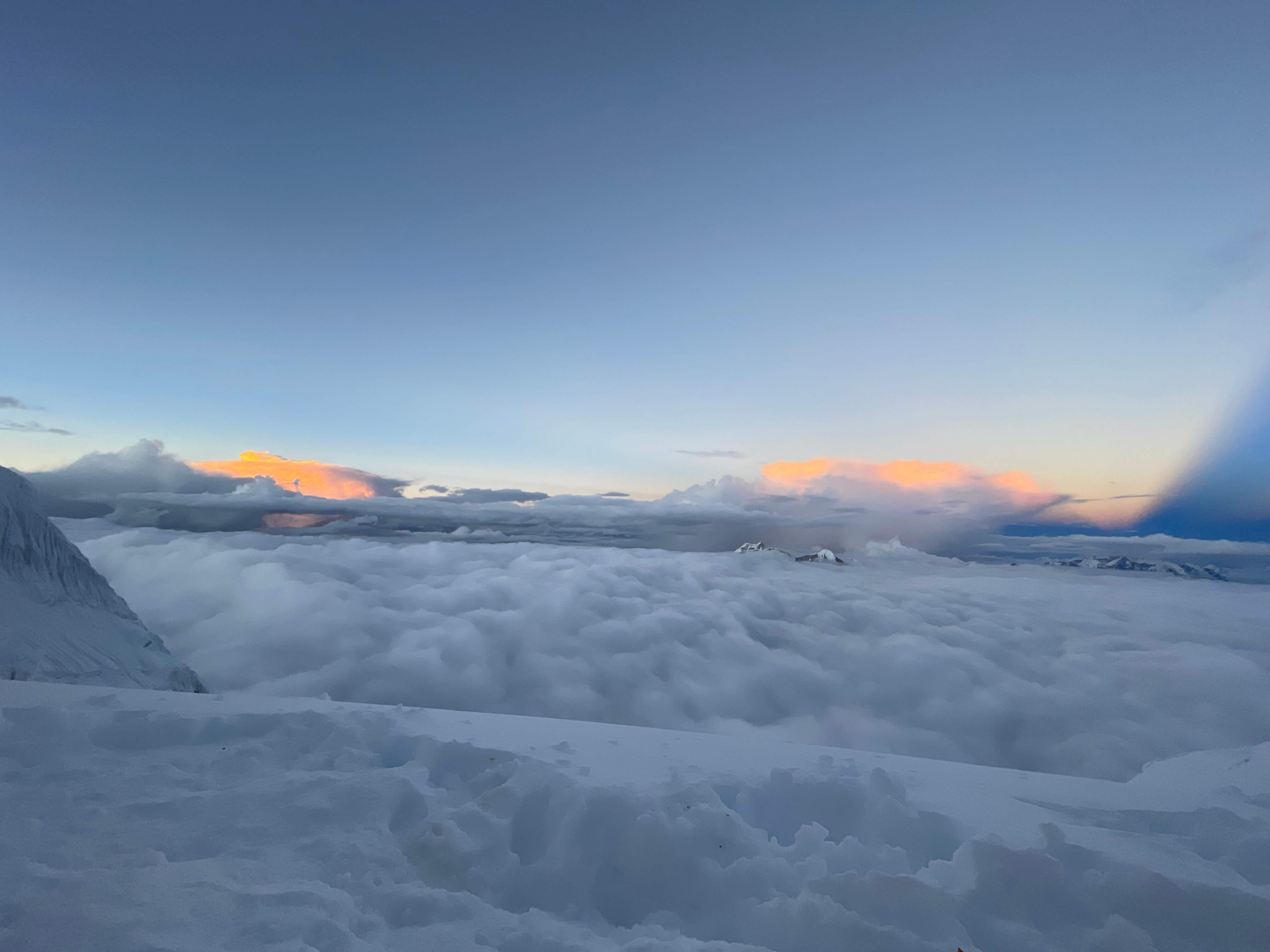
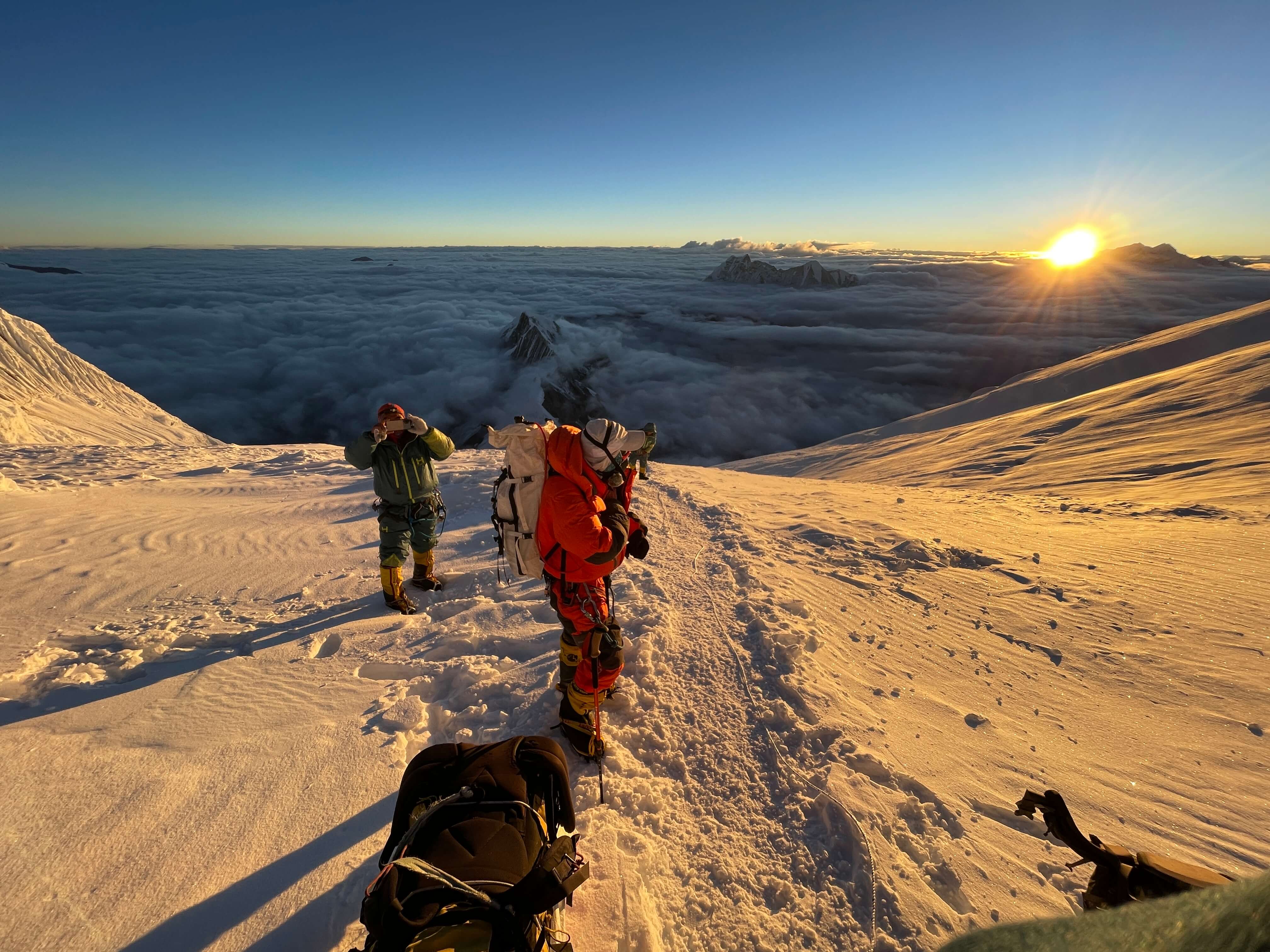

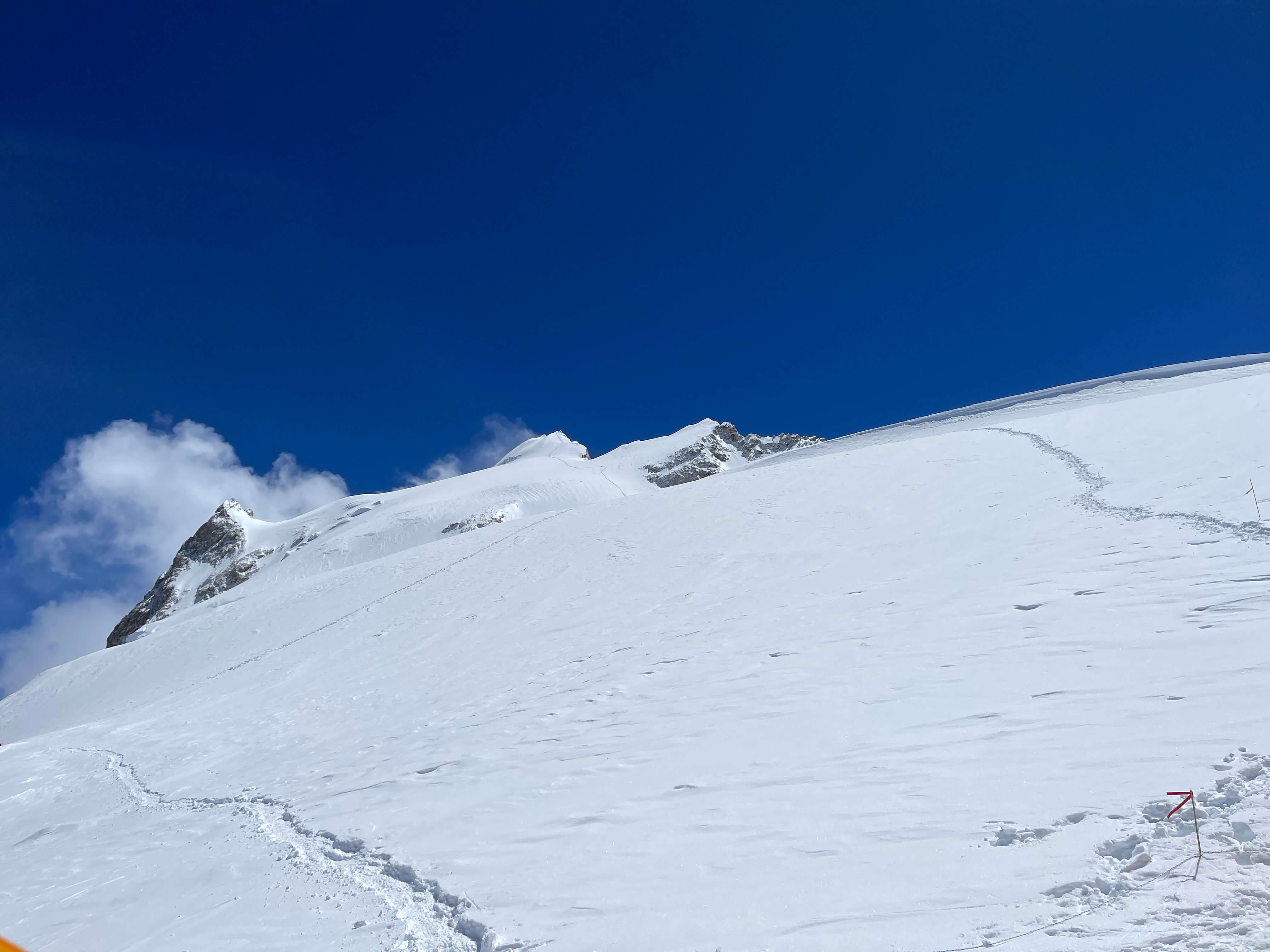

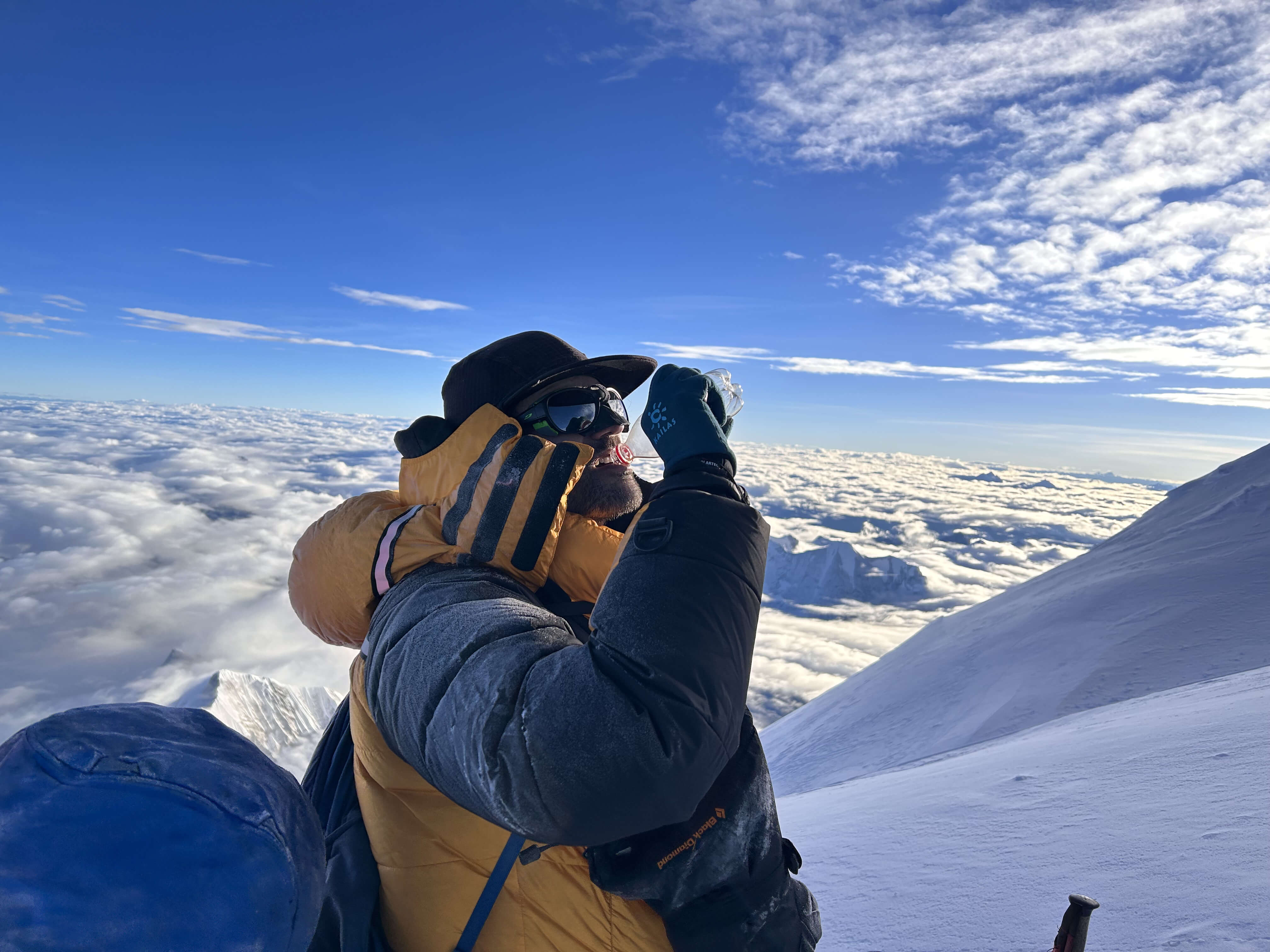

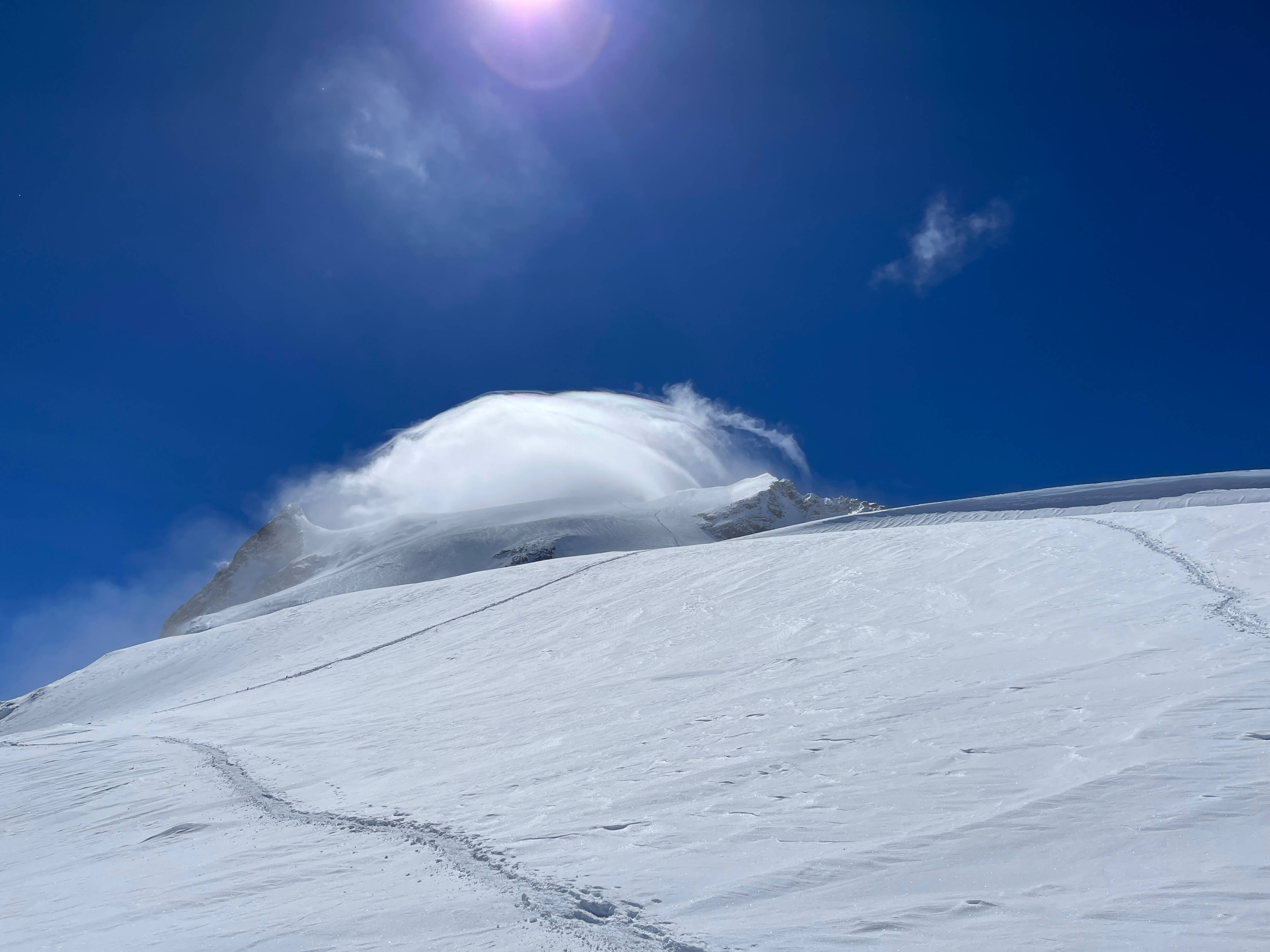
 The Cloud Ocean