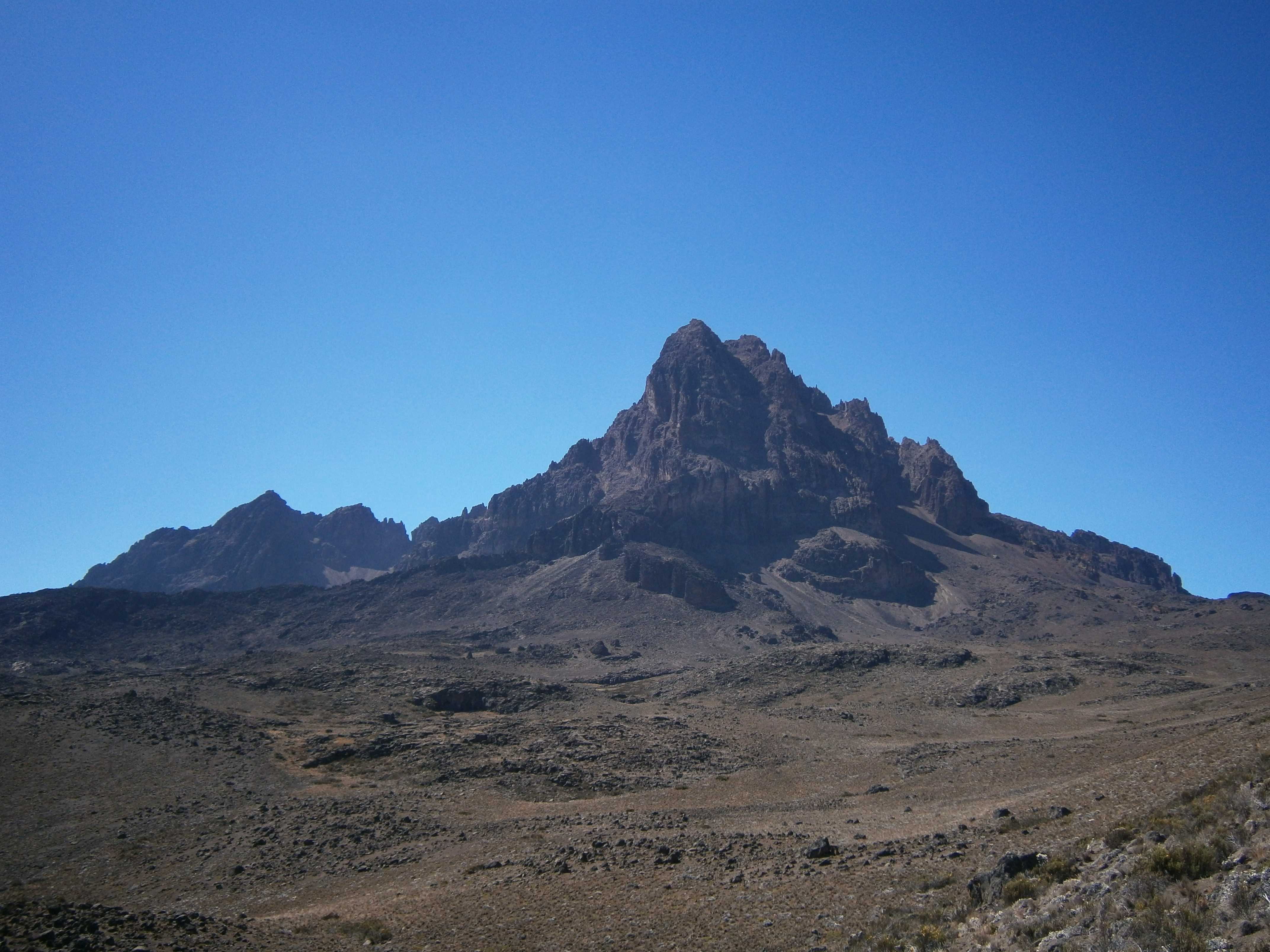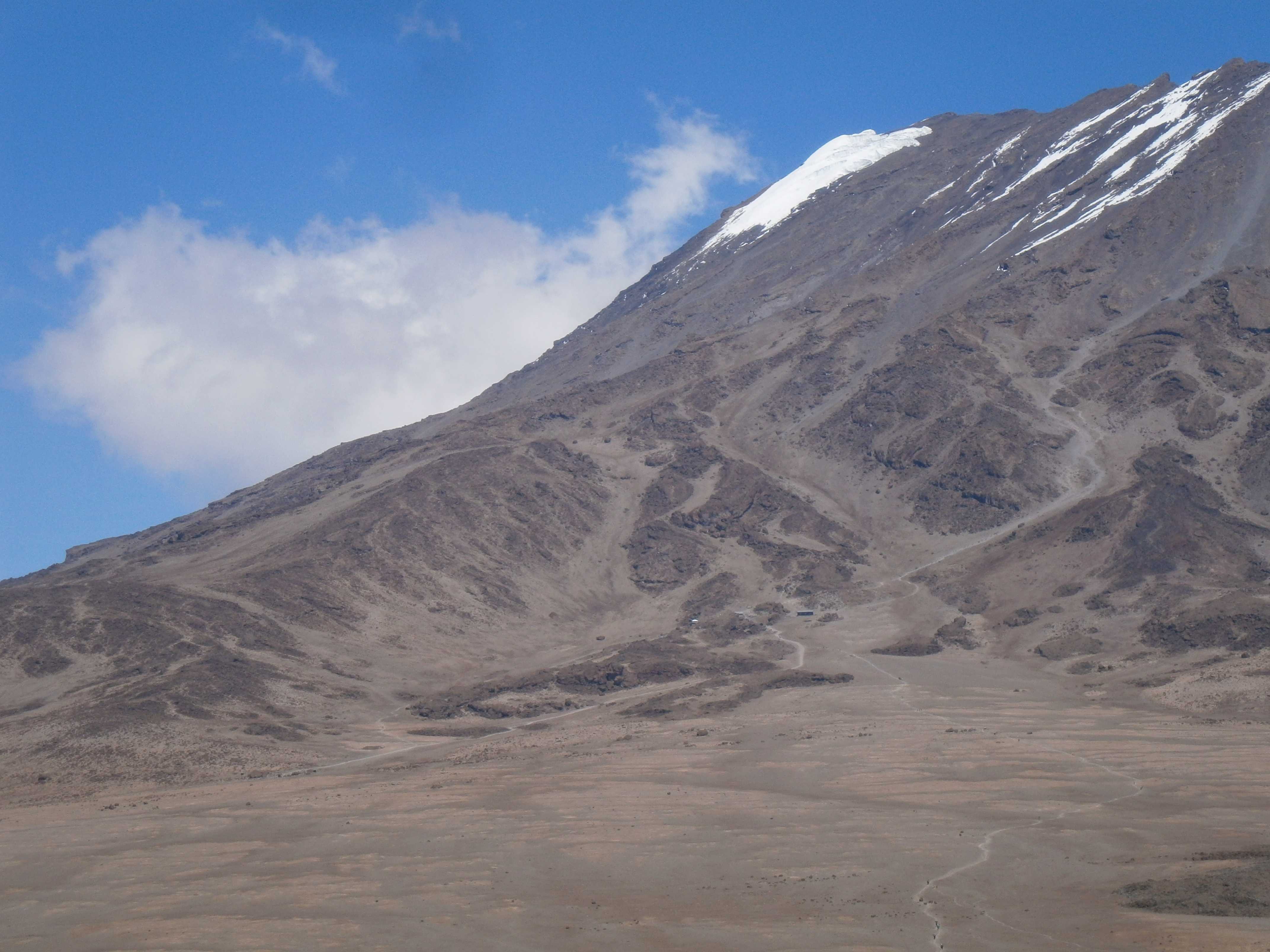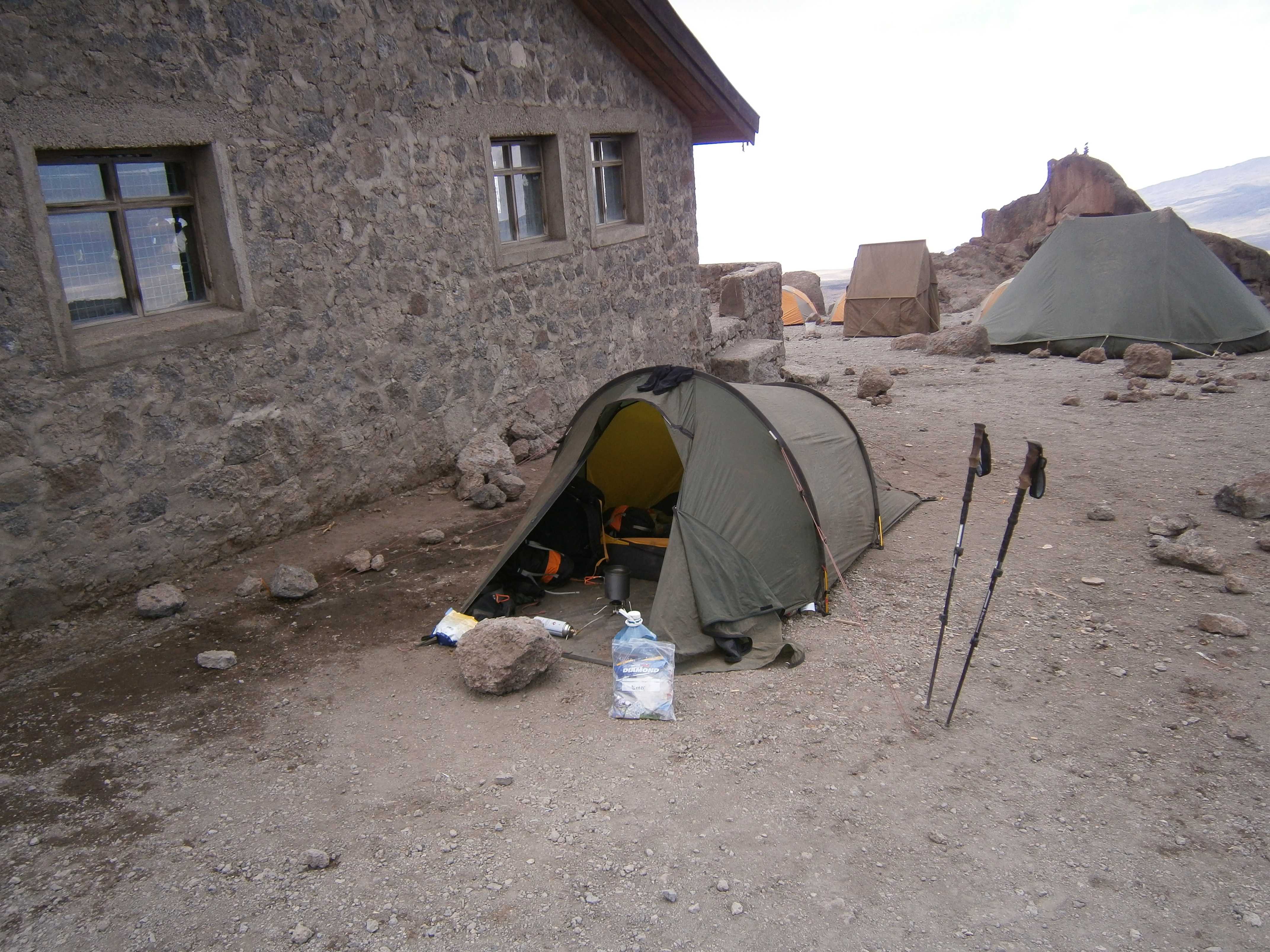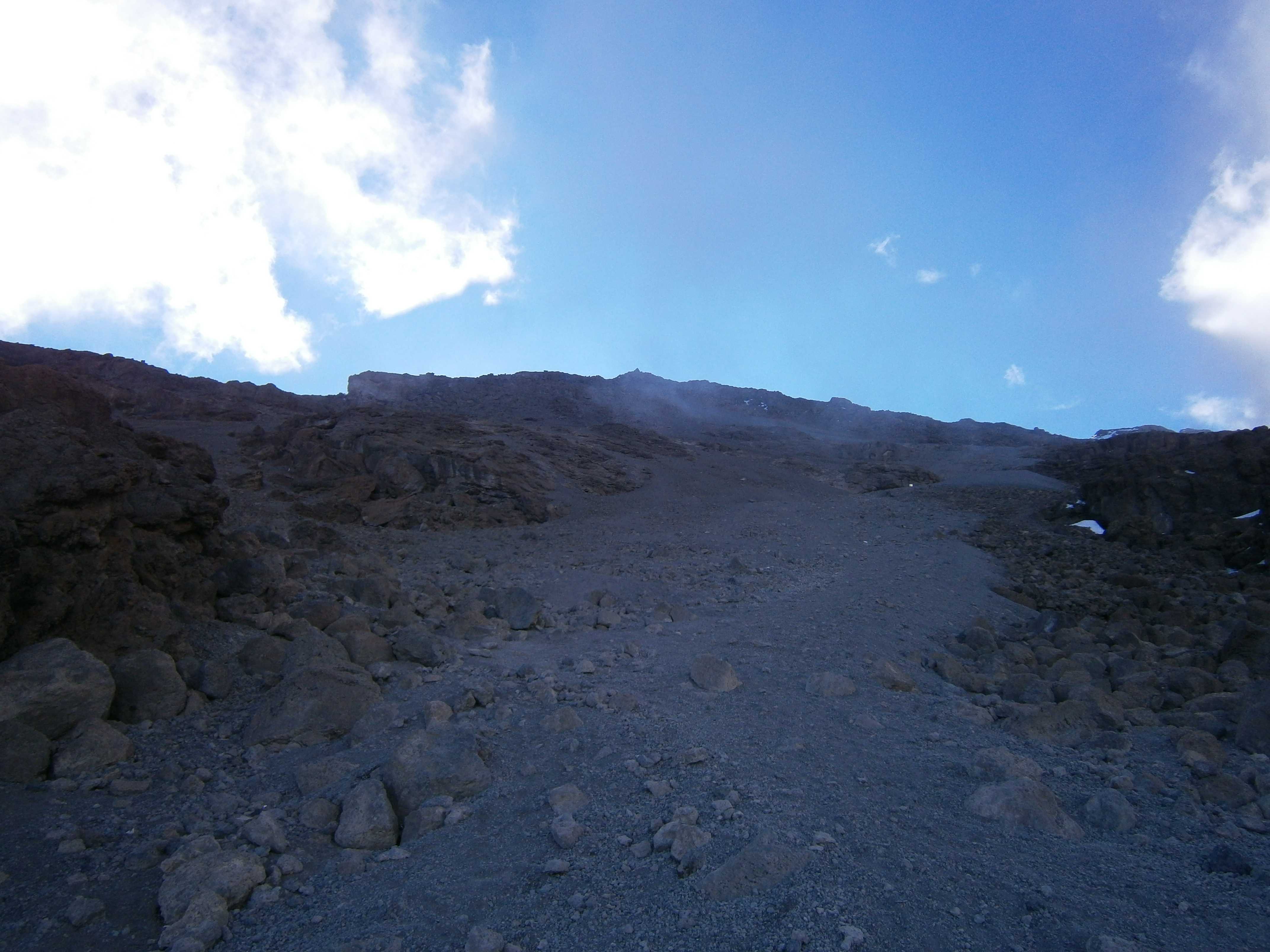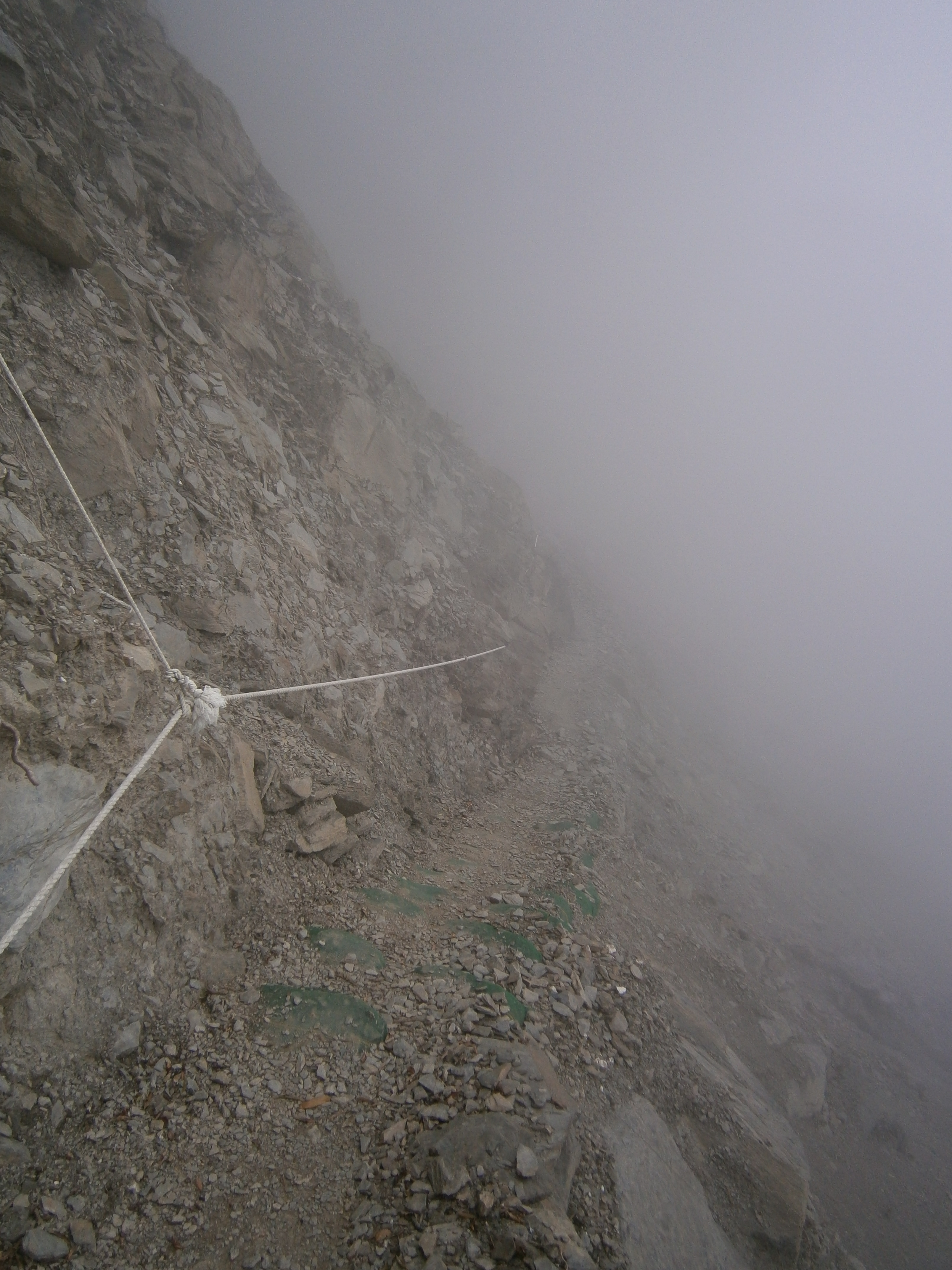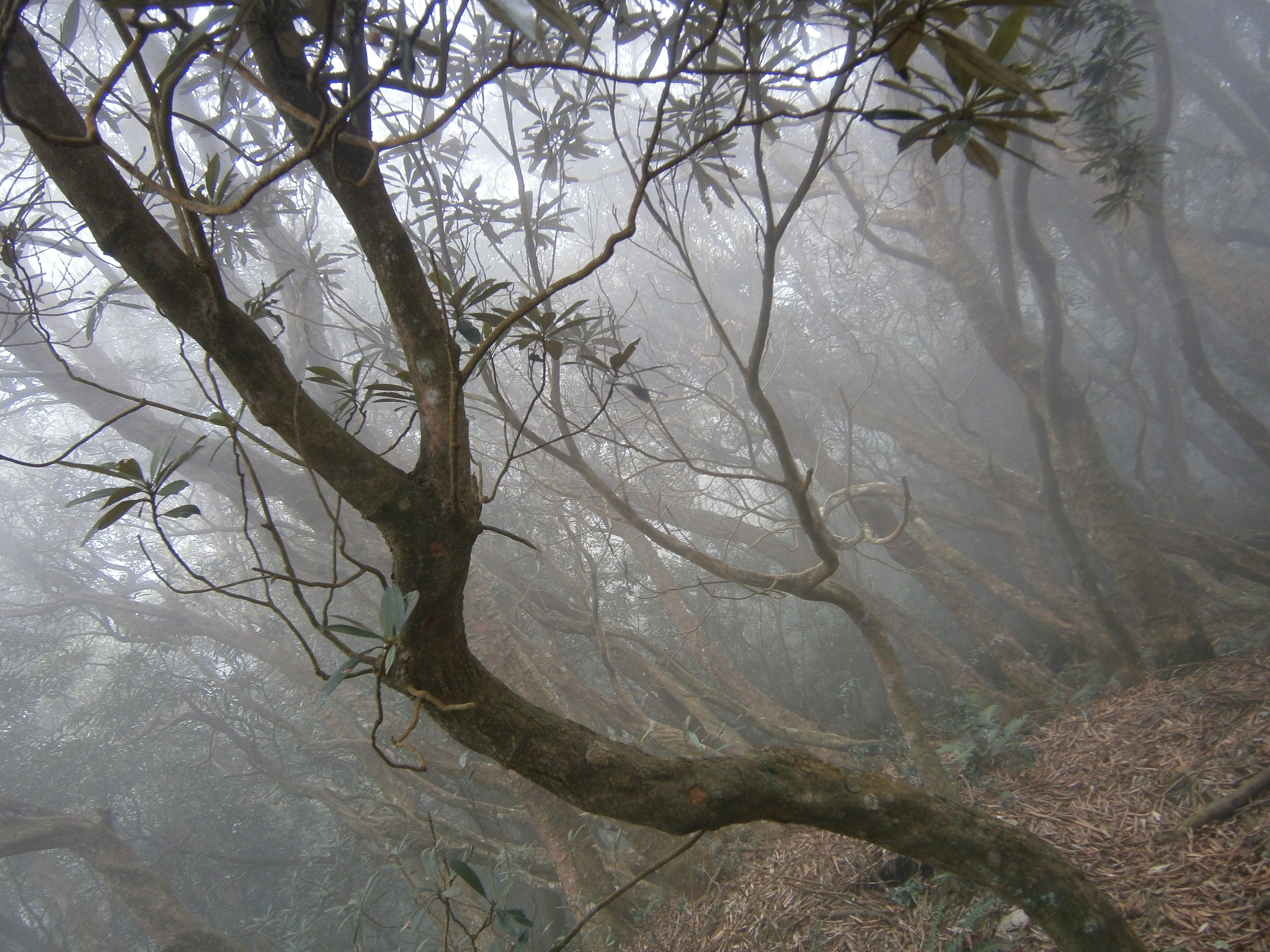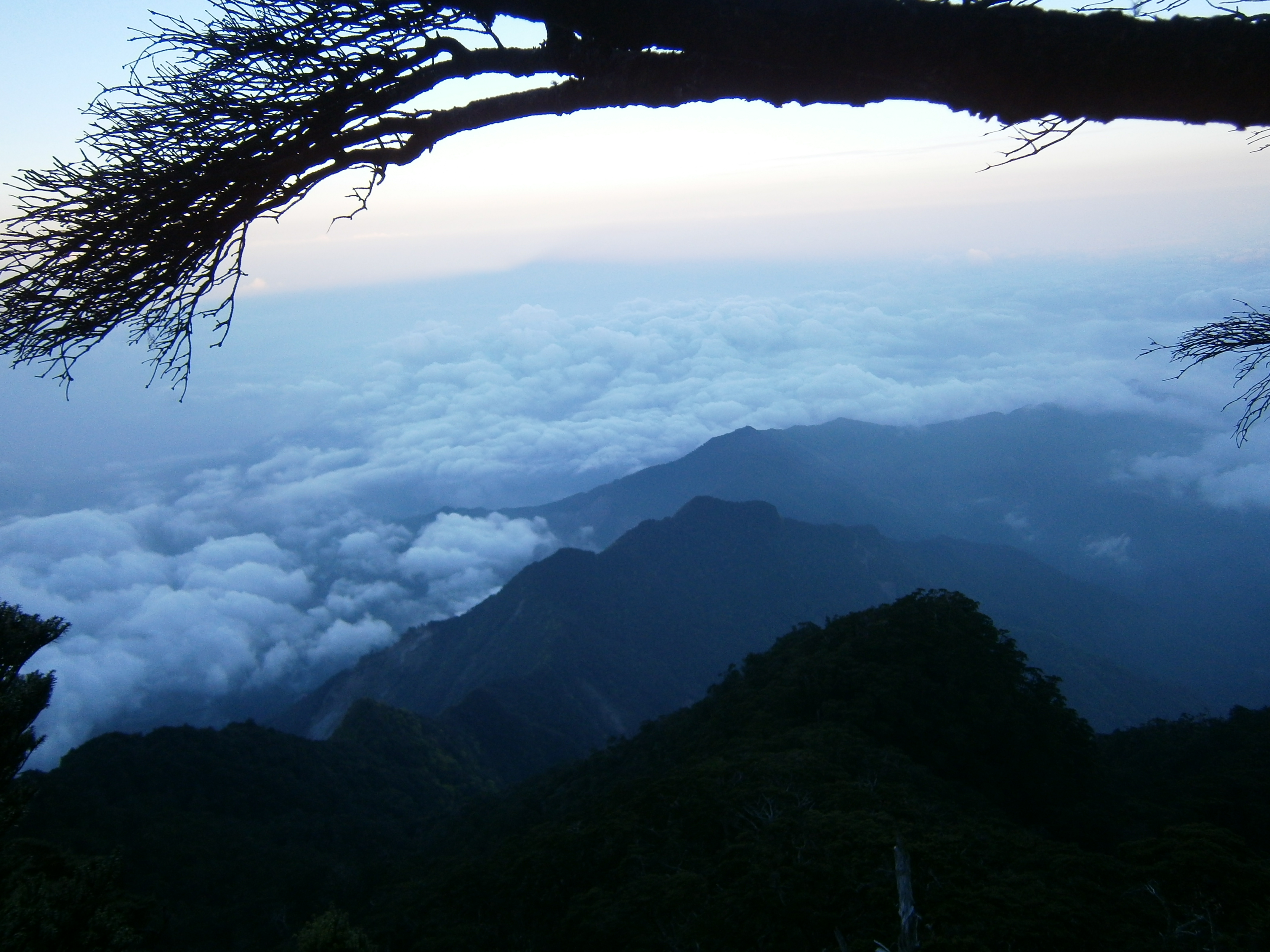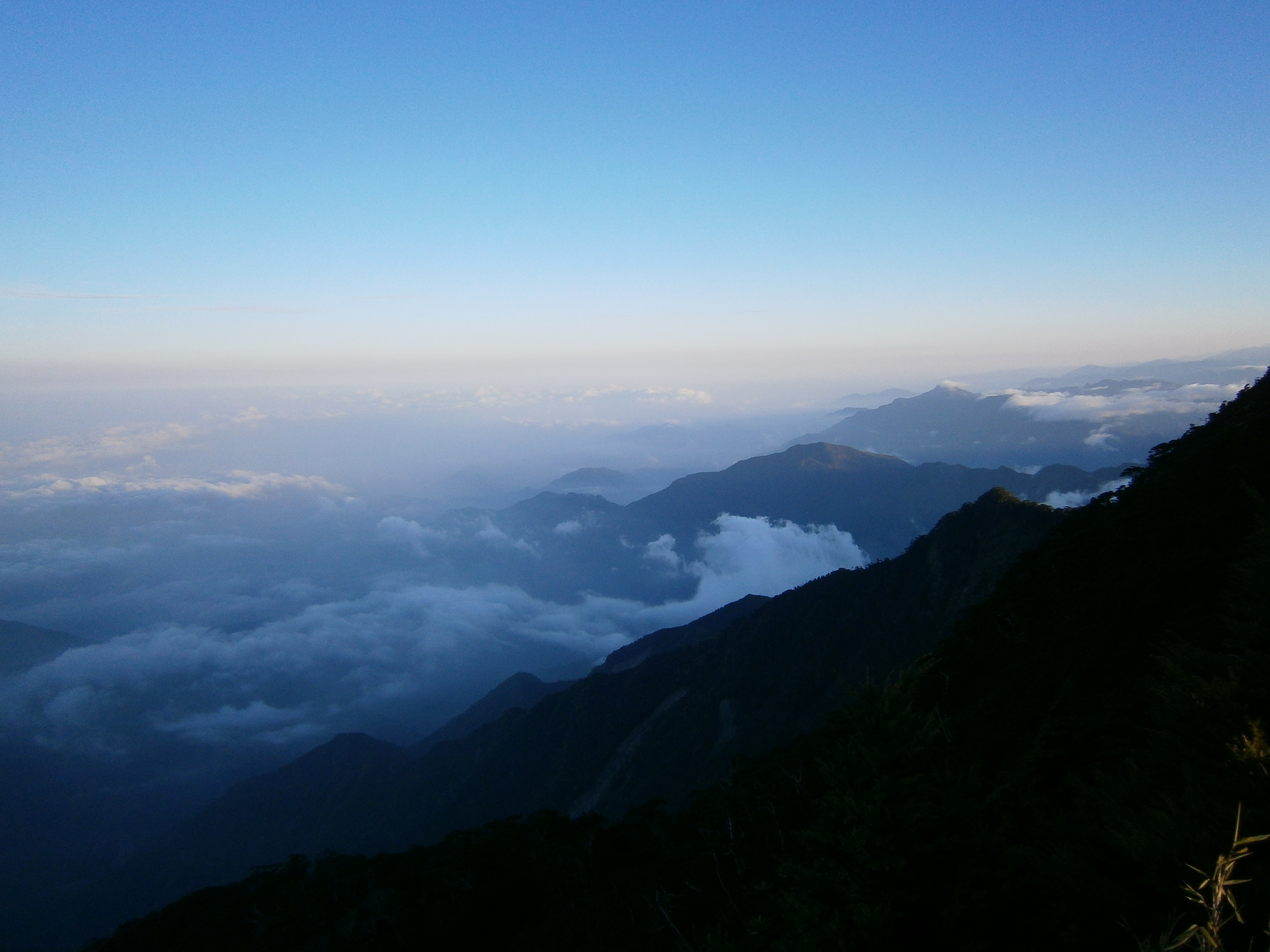
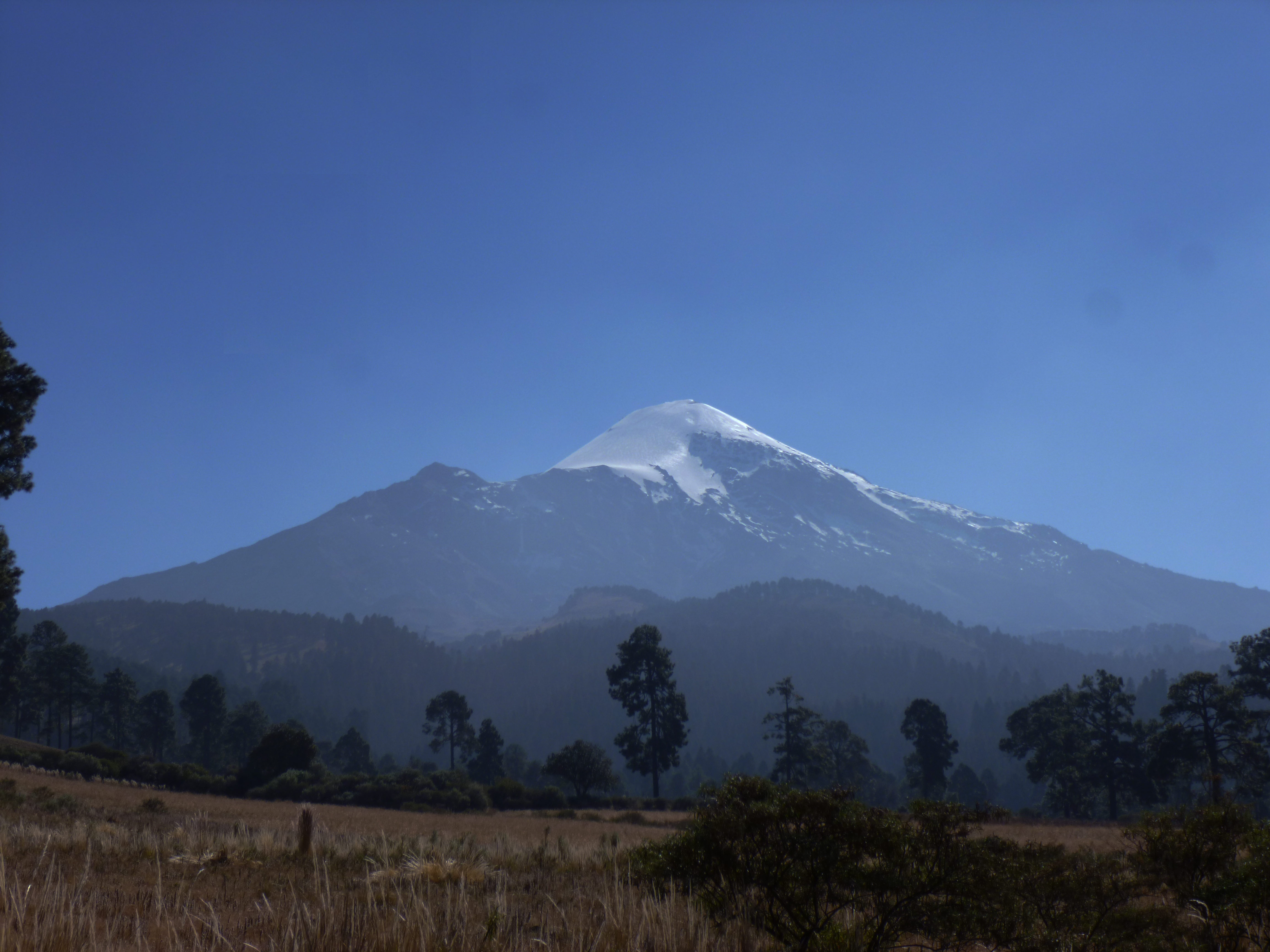
Pico de Orizaba – December 2012

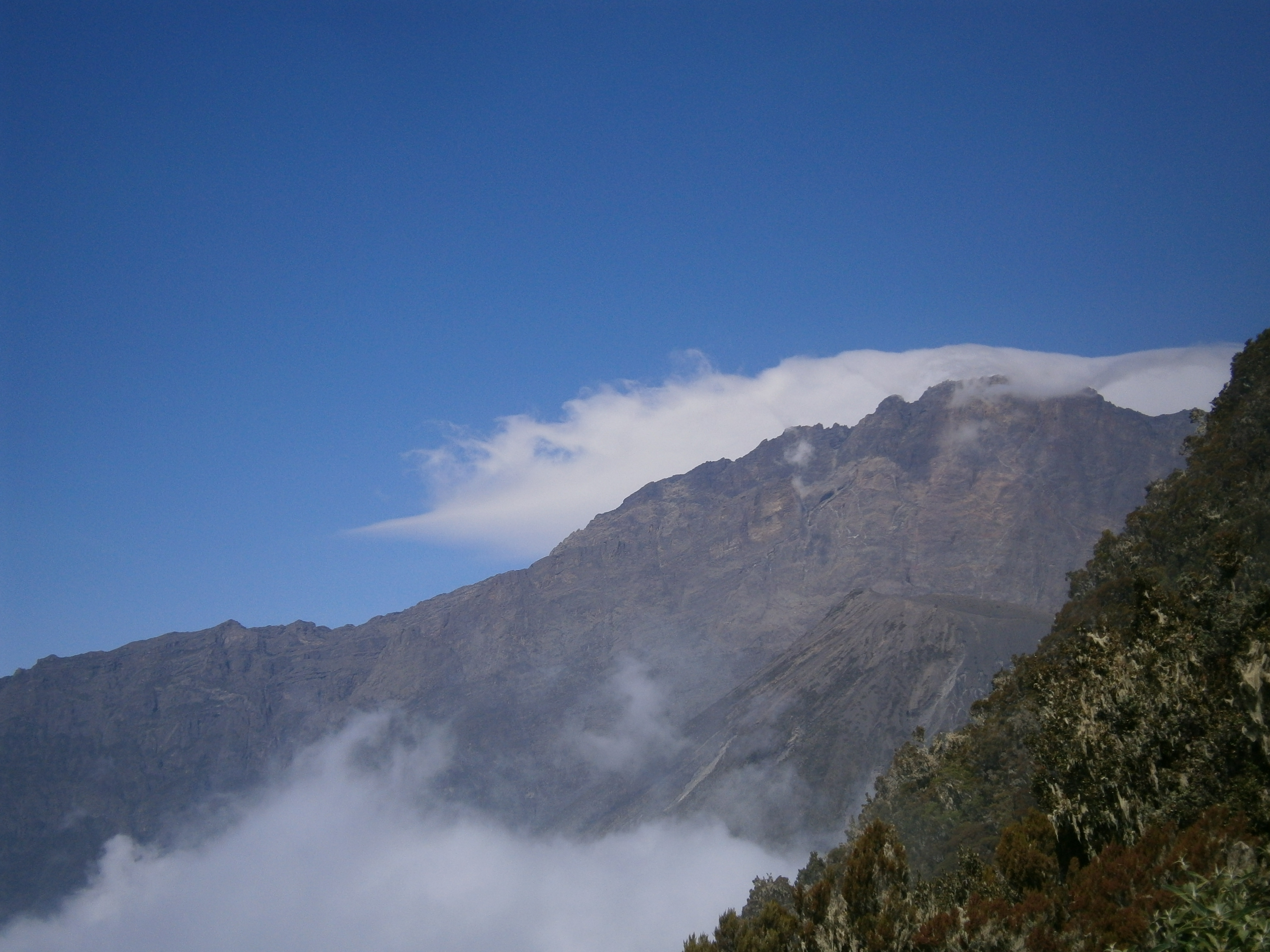
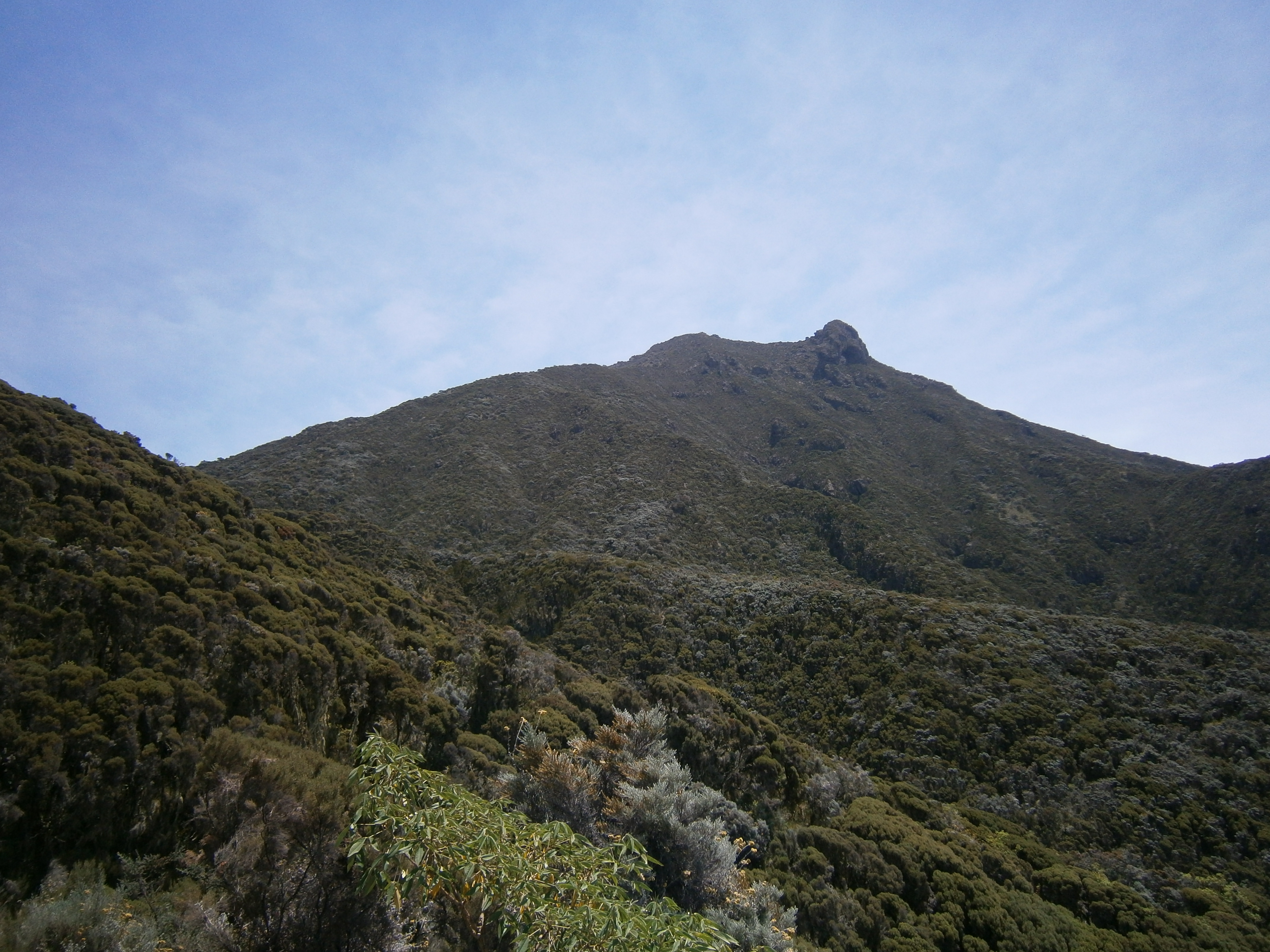
Pico de Orizaba.

Pico de Orizaba.

Pico de Orizaba

Pico de Orizaba, a 5636m stratovolcano, is the highest mountain in Mexico, and the 3rd highest within North America.  Climbing Orizaba in 2012 was relatively straightforward with only a moderate glacier and a short section of mixed rock and snow posing any technical challenge.  Orizaba is also called Citlaltépetl or ‘star mountain’ in Nahuatl.

Safety

Orizaba’s glaciers have continued retreating and are becoming less stable.  I encountered no objective risk, crevasses, or avalanche hazard in 2012.  However, a firsthand report and photographs of a 4m wide, 4-8m deep crevasse at 5500m elevation, near the top of the Jamapa Glacier normal route, were given to me in mid February, 2016.  5500m corresponds roughly with the area near the top of the Jamapa where rocks are visible protruding from the glacier.  The crevasse was hidden, covered with a thin and unstable snowbridge, which collapsed underneath a climber.  If planning a climb of Orizaba, do not assume that the glacier will be stable or devoid of crevasse hazards.  This crevasse presents a significant hazard, and if it opens up further will make the climb far more difficult technically.

Check up to date mountain conditions with locals or recent climbers before committing to a climb, and be aware of the constant potential for hidden crevasses when on any glacier.  Roping up with a guide or partner is only a viable safety technique if all members of the rope team are competent in self arrest, glacier travel techniques, and basic rescue.   Climbing solo on any glacier always involves a certain level of inherent risk.

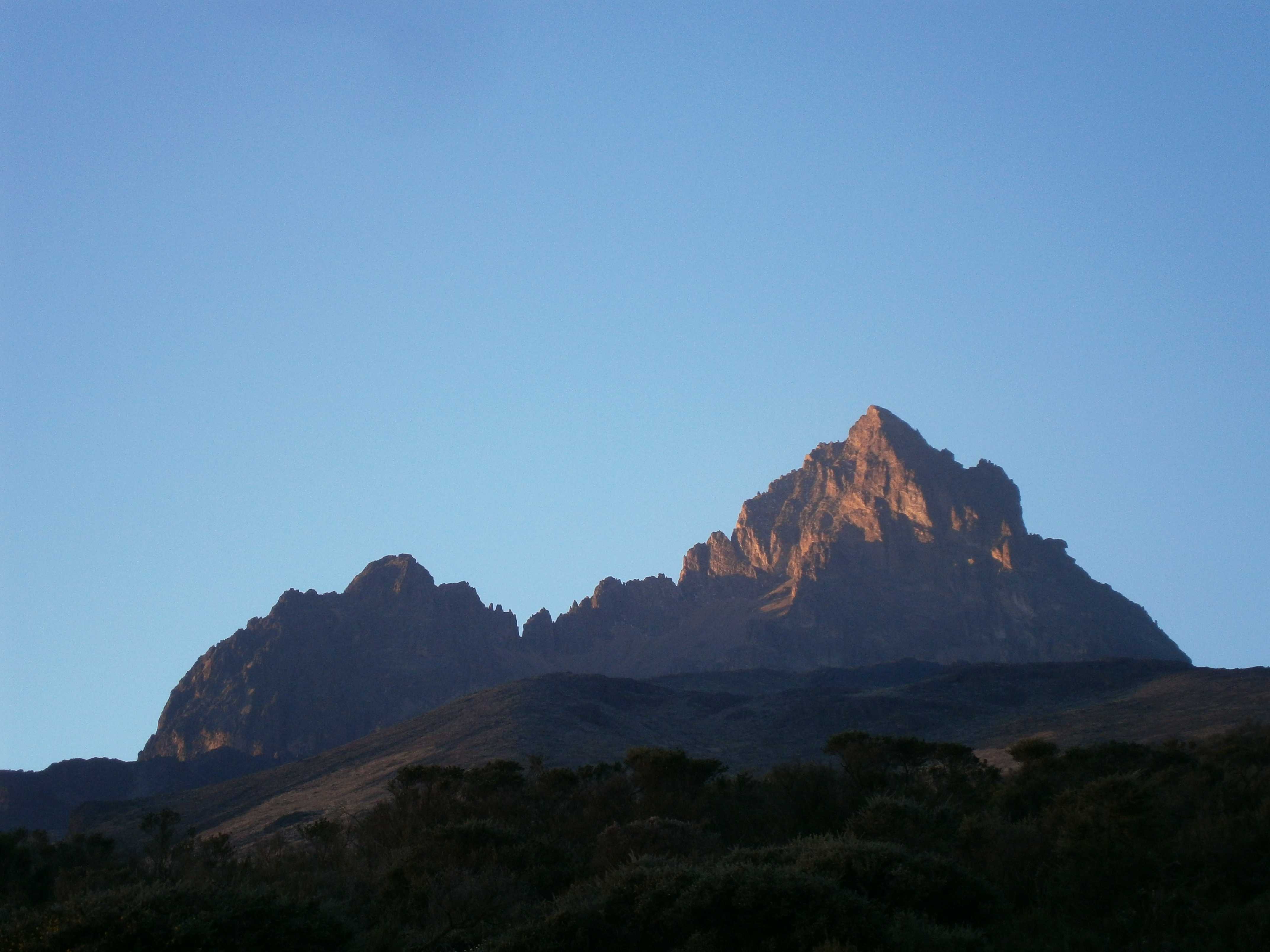
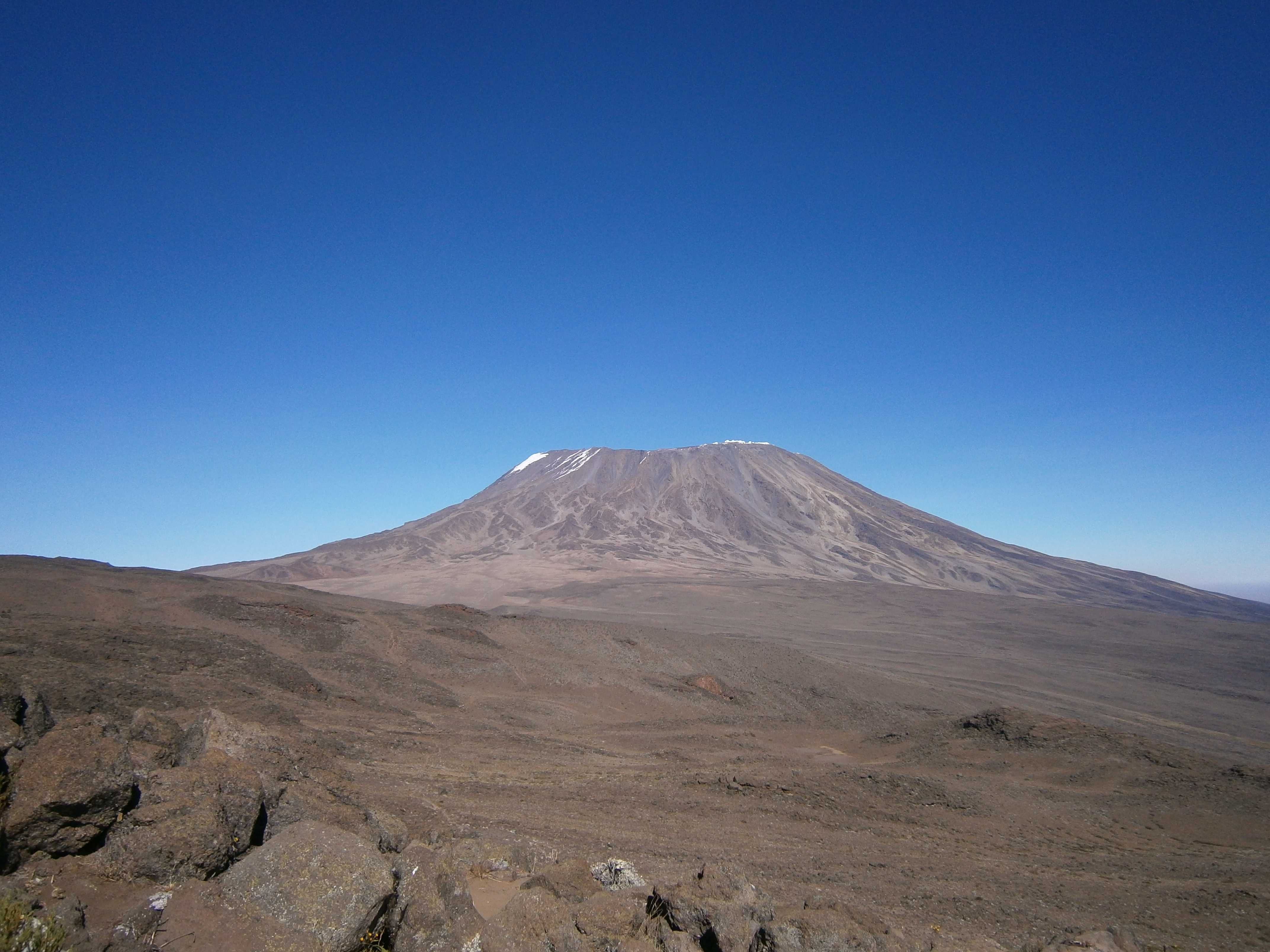
Seen from the nearby village of Tlachichuca, Orizaba's prominence is evident.

Seen from the nearby village of Tlachichuca, Orizaba’s prominence is evident.

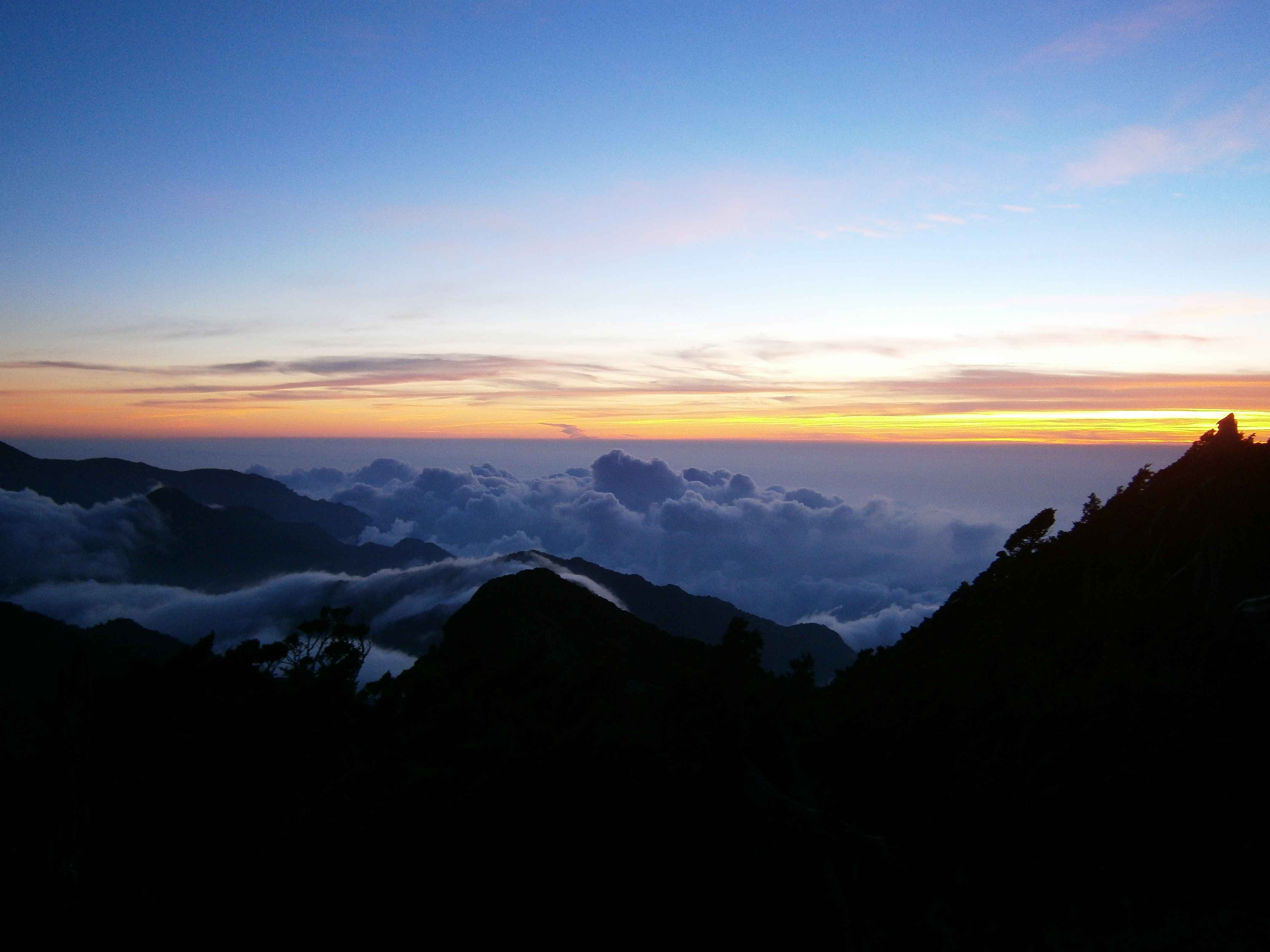
My view of Orizaba in the sunrise, from near the summit of Iztaccihuatl.

My view of Orizaba in the sunrise, from near the summit of Iztaccihuatl.

Pico de Orizaba Trip Report

The chief difficulty presented by Orizaba is that of altitude.  Orizaba is quite prominent, creating a danger for altitude sickness resulting from rapid ascent.  This makes a careful acclimatization schedule imperative to safely climbing it.  Prior to climbing Orizaba I spent three days acclimatizing by climbing 5230m Iztaccihuatl, another large Mexican volcano.
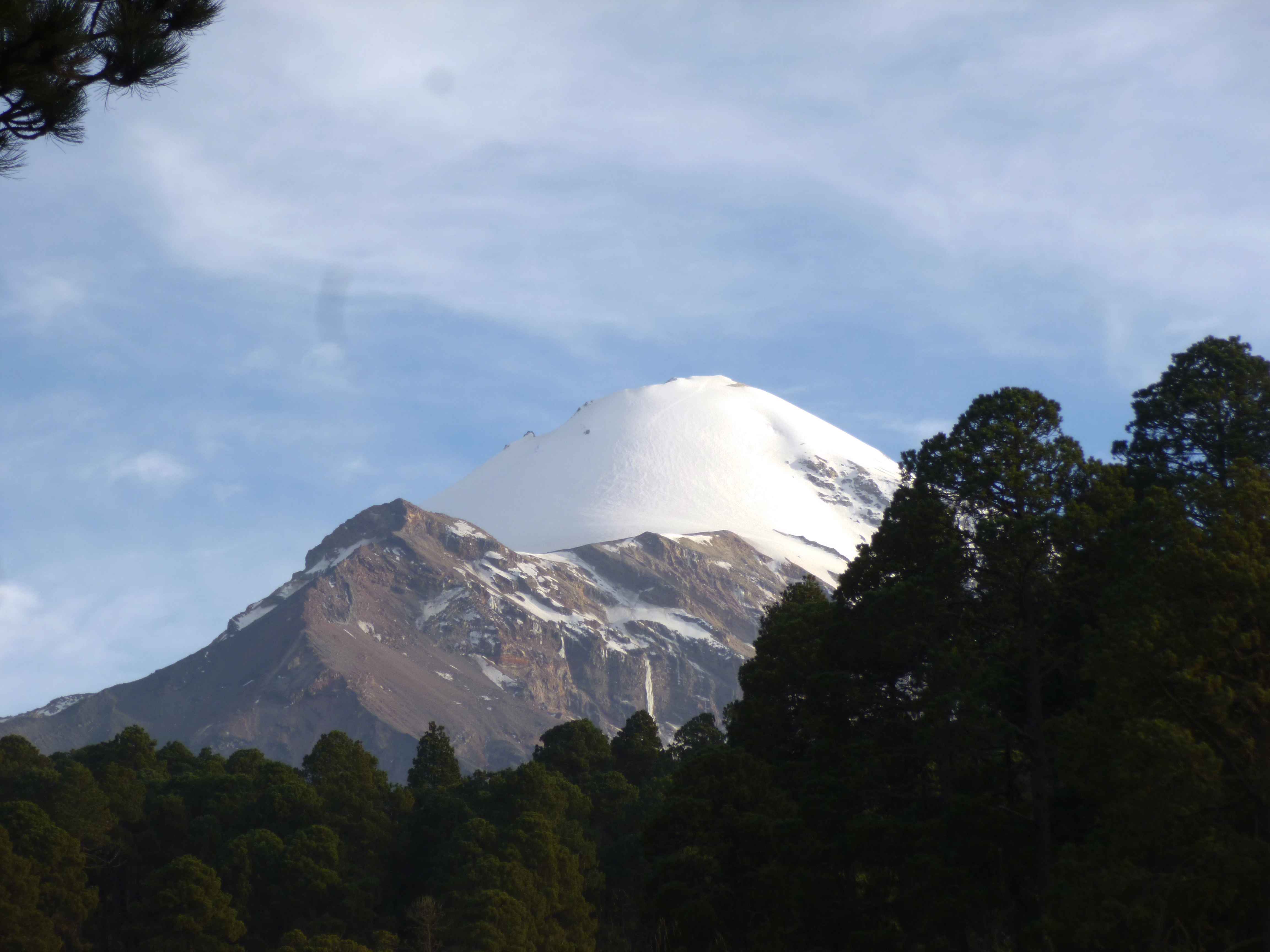
Orizaba from near the Piedra Grande hut.

Orizaba viewed from nearby the Piedra Grande hut.

Day 0: I arrived in the town of Tlachichuca, at an elevation of roughly 2750m, and got off the bus directly in front of the Cancholas compound.  The Cancholas family provides logistical support for climbing Orizaba, and I had booked lodging and transportation to the mountain from them in advance.  The bus to Tlachichuca runs from Puebla’s CAPU bus station, a major terminal.  CAPU can be accessed from Mexico City’s TAPO bus station via first class direct buses.
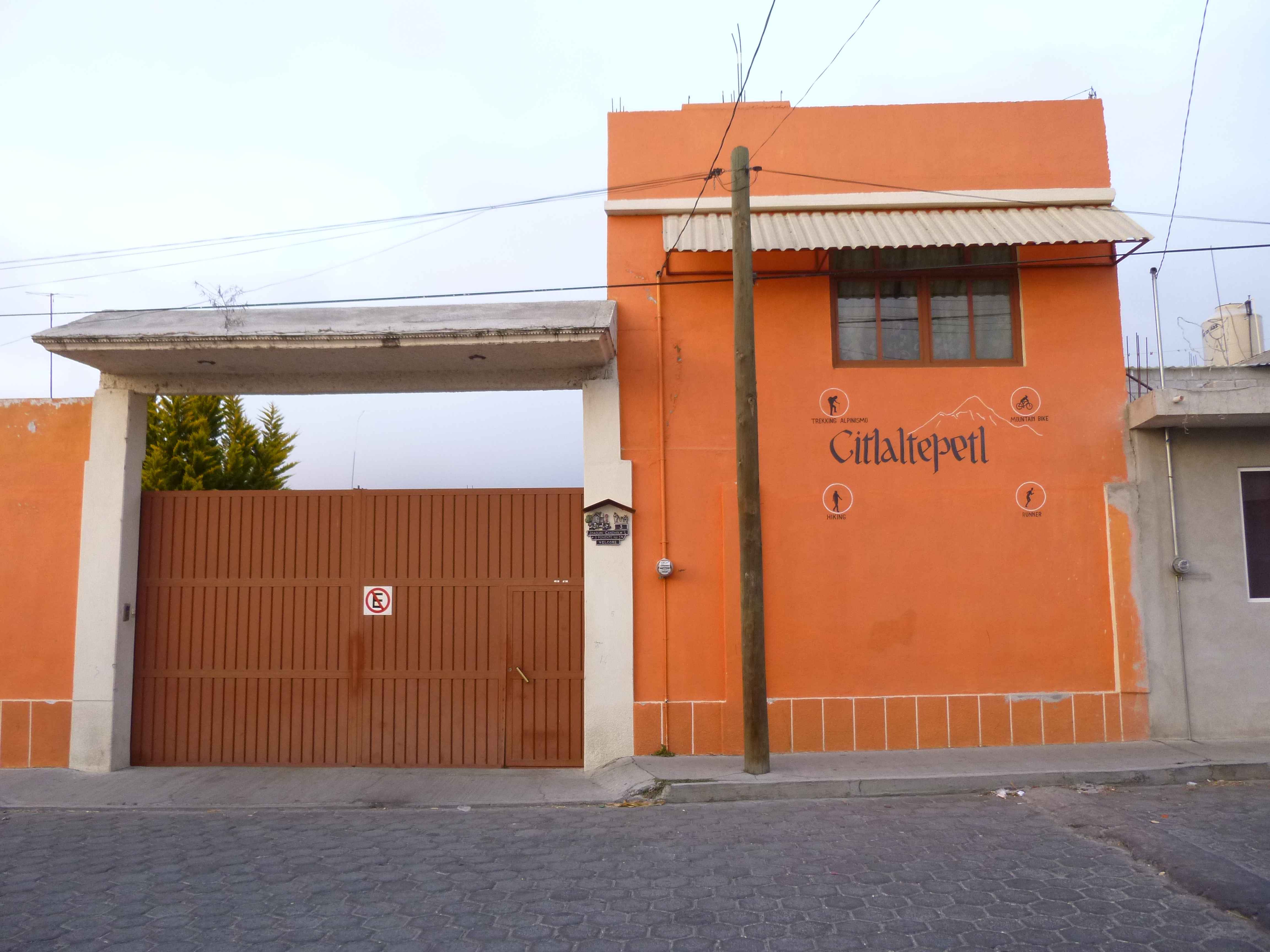
The Cancholas compound.

The Cancholas compound.

After a great dinner and some conversation with other climbers heading up, I turned in for the night.  Lodging at the Cancholas compound was comfortable, clean, affordable and safe – their service was superb and I would strongly recommend them.

Day 1: After a good night’s sleep, a hearty breakfast, and some final packing, the Cancholases drove me and several other climbers to the Piedra Grande hut on the north side of Orizaba using a 4×4 truck.  With an elevation of 4270m, many climbers use the Piedra Grande hut as an acclimatization point for two or more nights.

The Piedra Grande hut at the base of Orizaba (lower-left corner).

The Piedra Grande hut at the base of Orizaba (lower-left corner).

The Piedra Grande hut.

The Piedra Grande hut.

December is the dry season in Mexico, and there was no snow on the lower mountain.
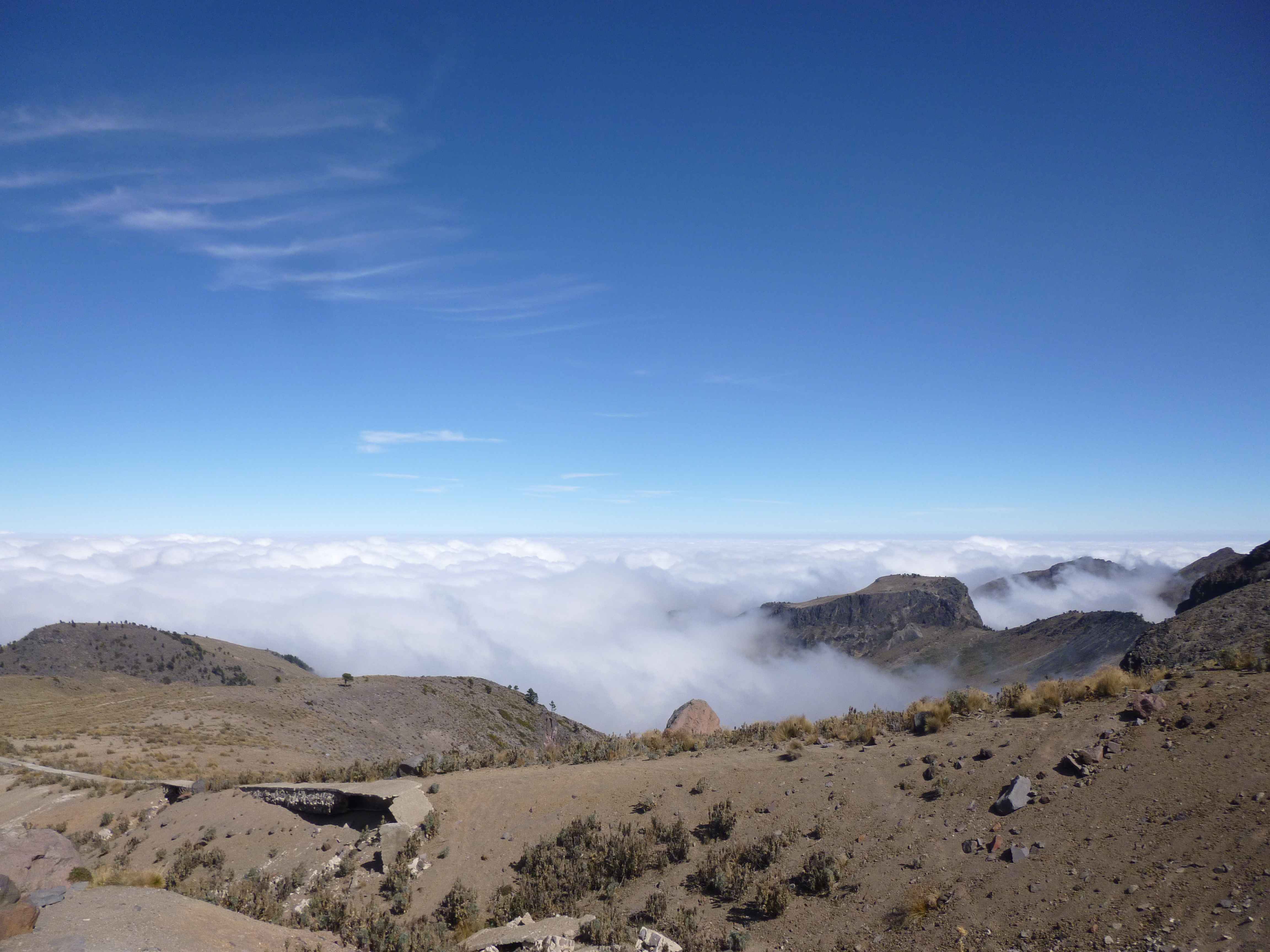
Looking south, above the clouds at the base of Orizaba.

Above the clouds at the base of Orizaba.

From here, the route to the top could be seen.  Having spent some time at altitude and feeling well acclimatized it was my intention to set a high camp at the base of the ‘labyrinth’, a mixed section of smooth rock and snow, and climb to the summit the following morning.  Here is a rough outline of the route I followed:
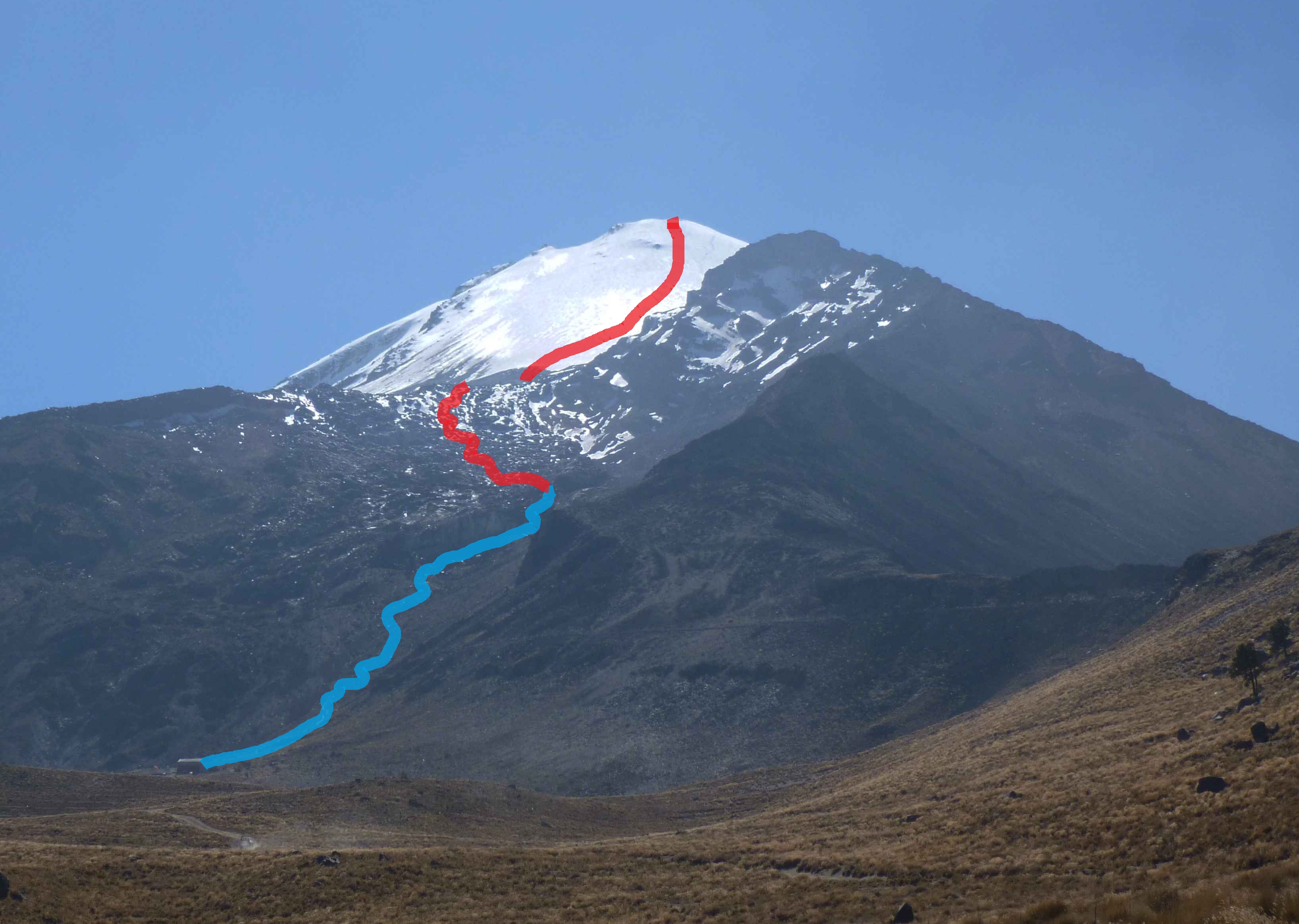
A rough outline of my route - day 1 blue, day 2 red..

A rough outline of my route – day 1 blue, day 2 red.

At the Piedra Grande hut I finished getting gear ready, and started up the mountain.  In addition to climbing and camping gear for contingency I packed 3 days worth of food and 12L of water.

Packed heavy, heading up to set high camp.

Packed heavy, heading up to set high camp.

From the Piedra Grande hut the route begins by following an old drainage aqueduct before heading up through a moraine of loose scree.
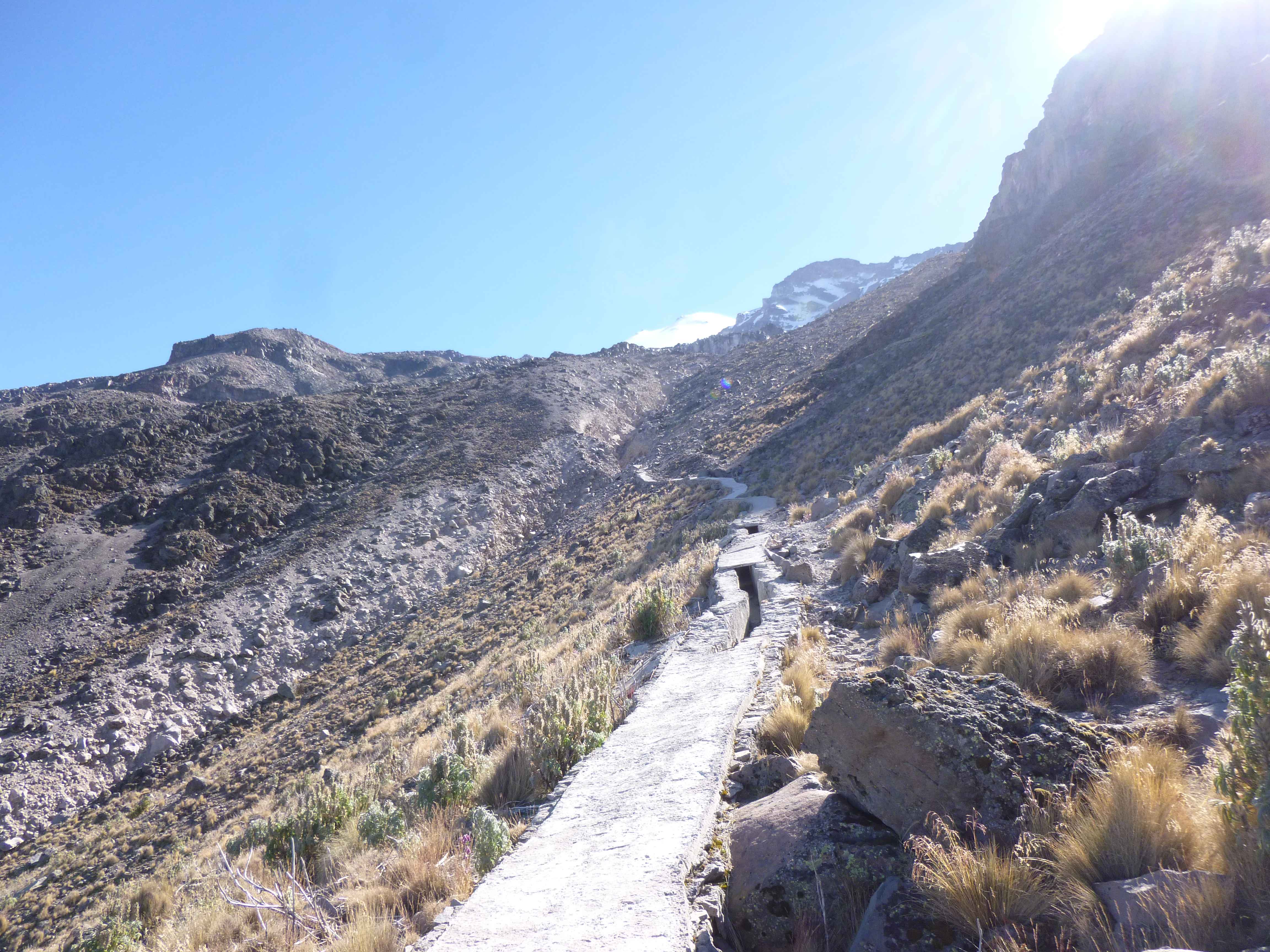
An old aqueduct marks the beginning of the route.

An old aqueduct marks the beginning of the route.

Heading up the lower mountain's scree.

Heading up the lower mountain’s scree.

The weather was perfect, and looking behind me I had great visibility.
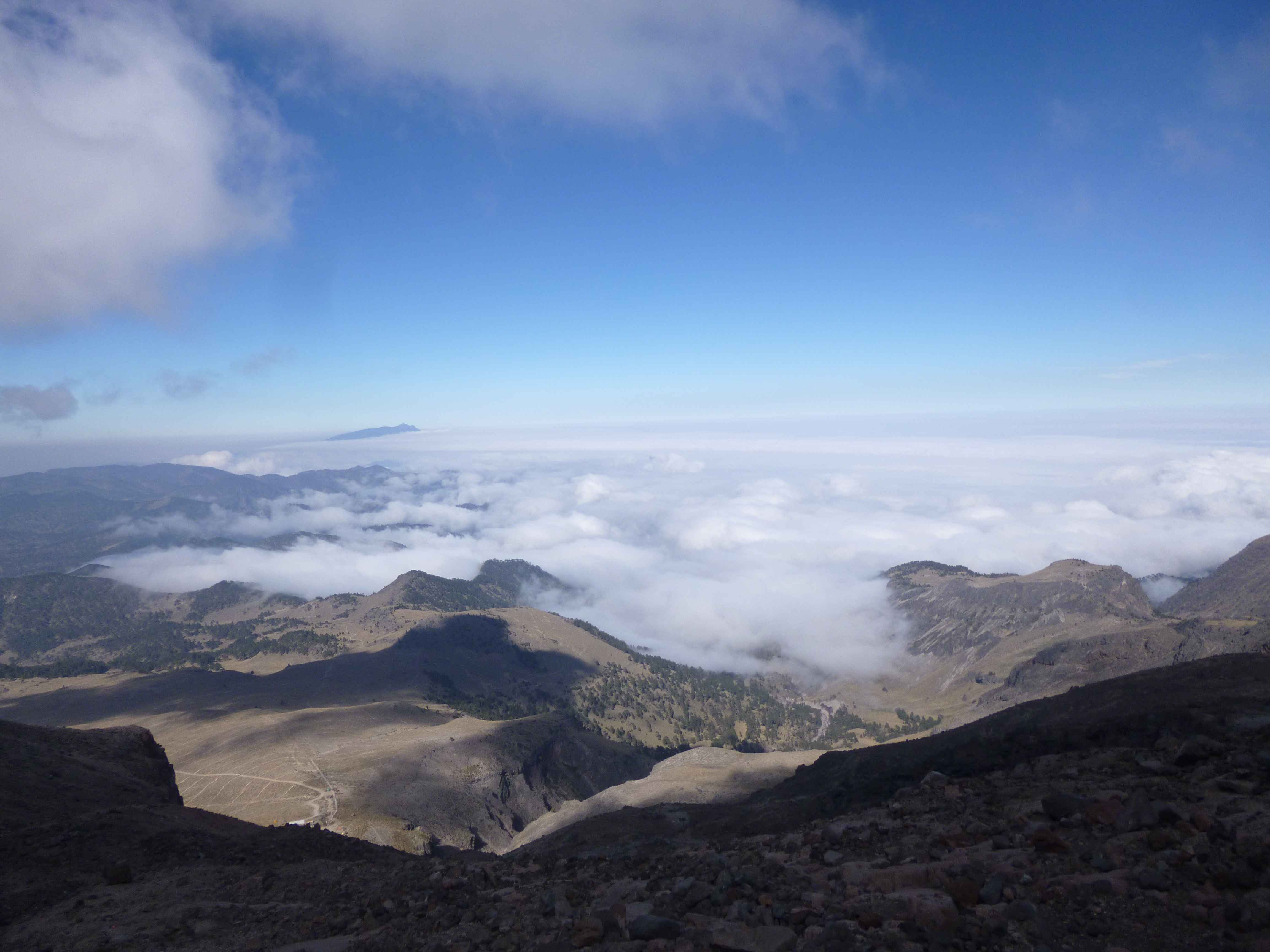
Looking north, halfway to the base of the labyrinth.

Looking north, halfway to the base of the labyrinth.

Further ahead were the first campsites.  Stone rings constructed by previous climbers to stop wind and protect tents were conveniently intact.  Keen on camping higher, I passed the first set of sites.
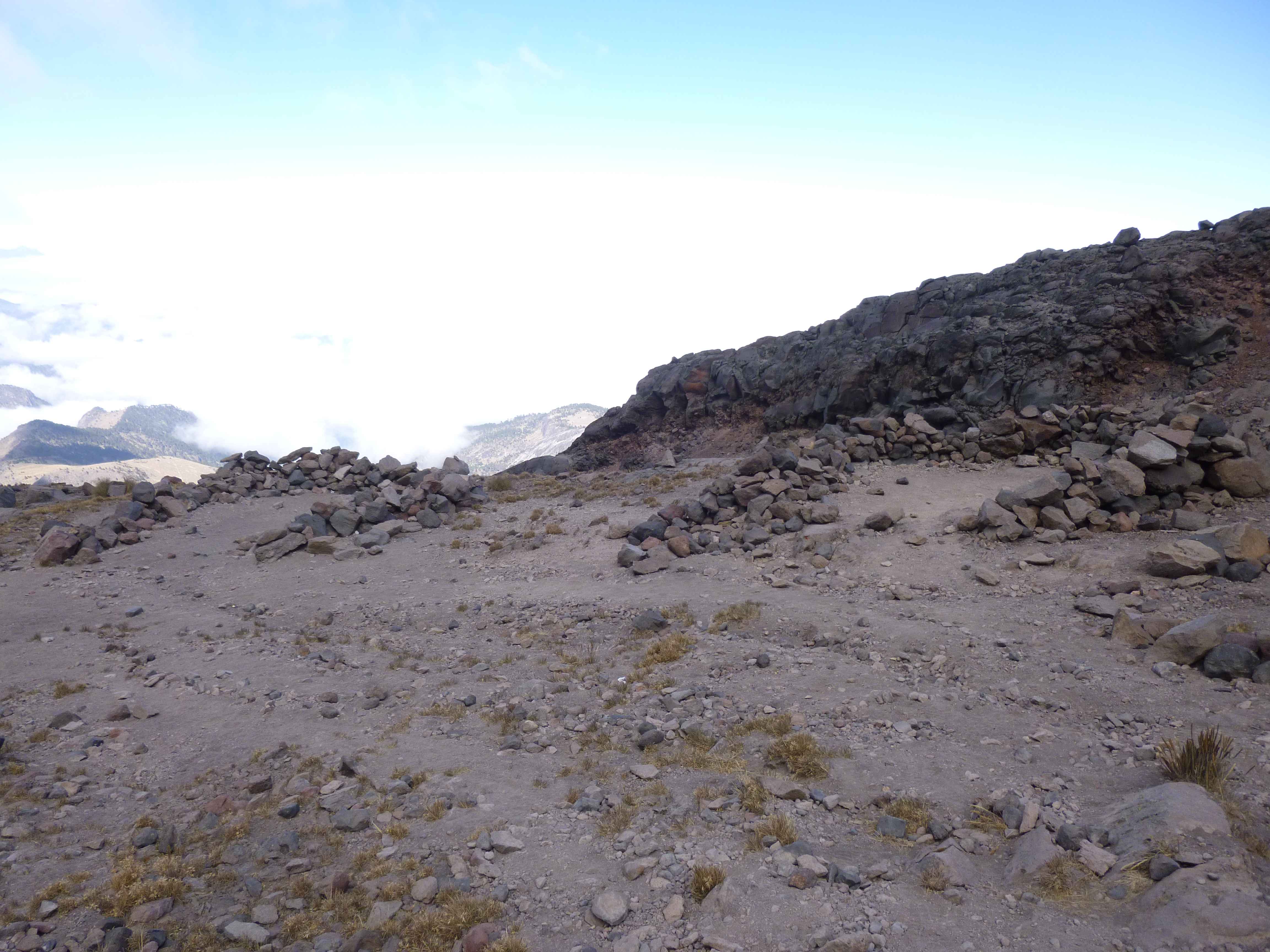
The first campsites, several hundred meters below the labyrinth.

The first campsites, several hundred meters below the labyrinth.

Higher still the scree eased into smooth rock, rounded like giant marbles.  The glacier once covered this section of the mountain.
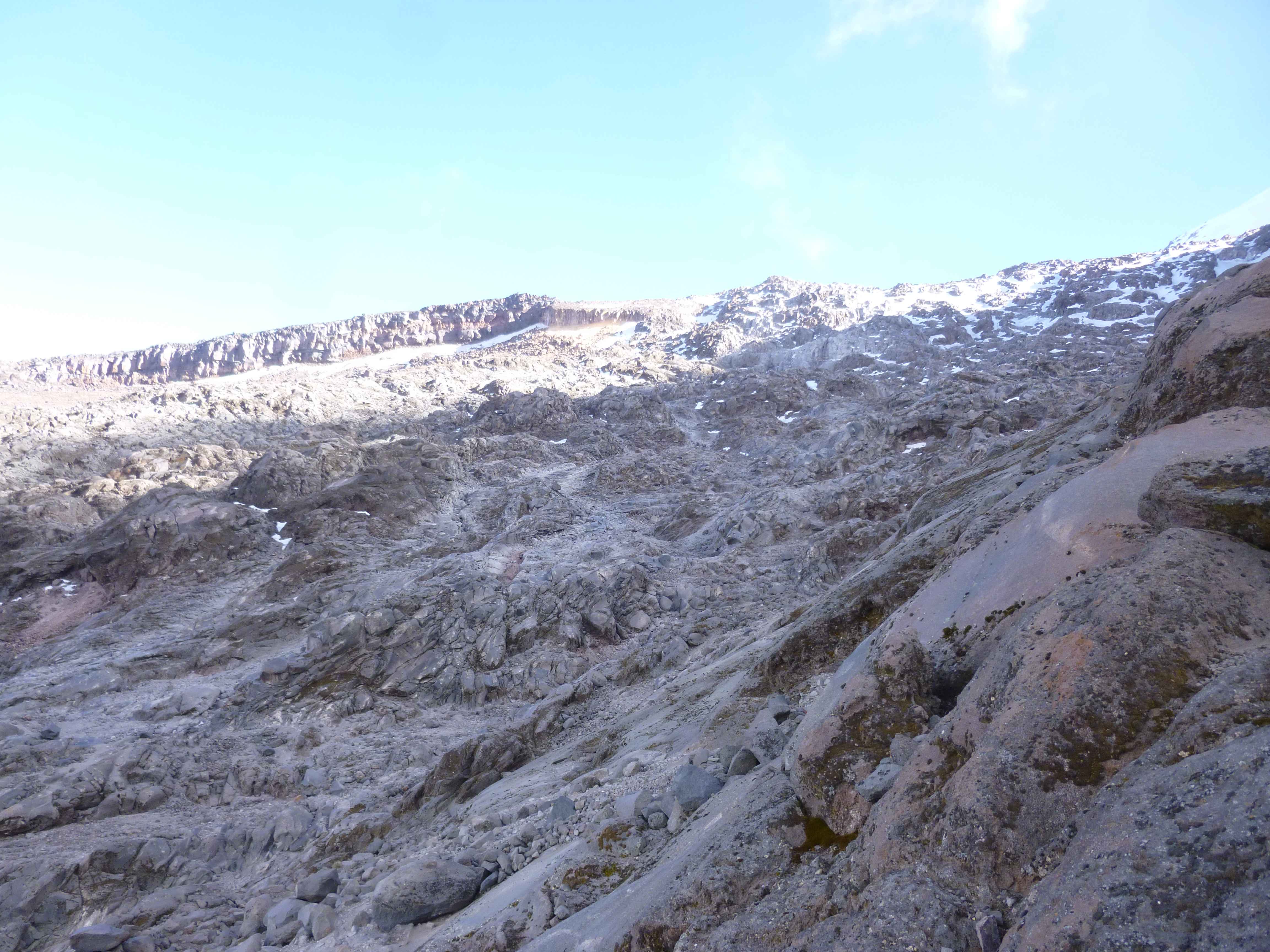
Smooth rock below the labyrinth.

Smooth rock below the labyrinth.

At the Piedra Grande hut I had met Oso, a well-known Mexican climbing guide, as he was getting ready to return to Tlachichuca.  He informed me that the labyrinth was in poor condition, steep gulleys of hard snow. Equally cautionary was a Brazillian-American climber I’d spoken with on Iztaccihuatl earlier in the week, whom I ran into again as he was descending from Orizaba’s summit.  He told me that he and his partner had found the labyrinth particularly icy, and tricky to ascend in the dark.  This information fresh in my mind, the labyrinth indeed looked frozen, but not too imposing.  Scouting it, I planned to ascend via the climber’s right hand side, straight up the second gully to the right.
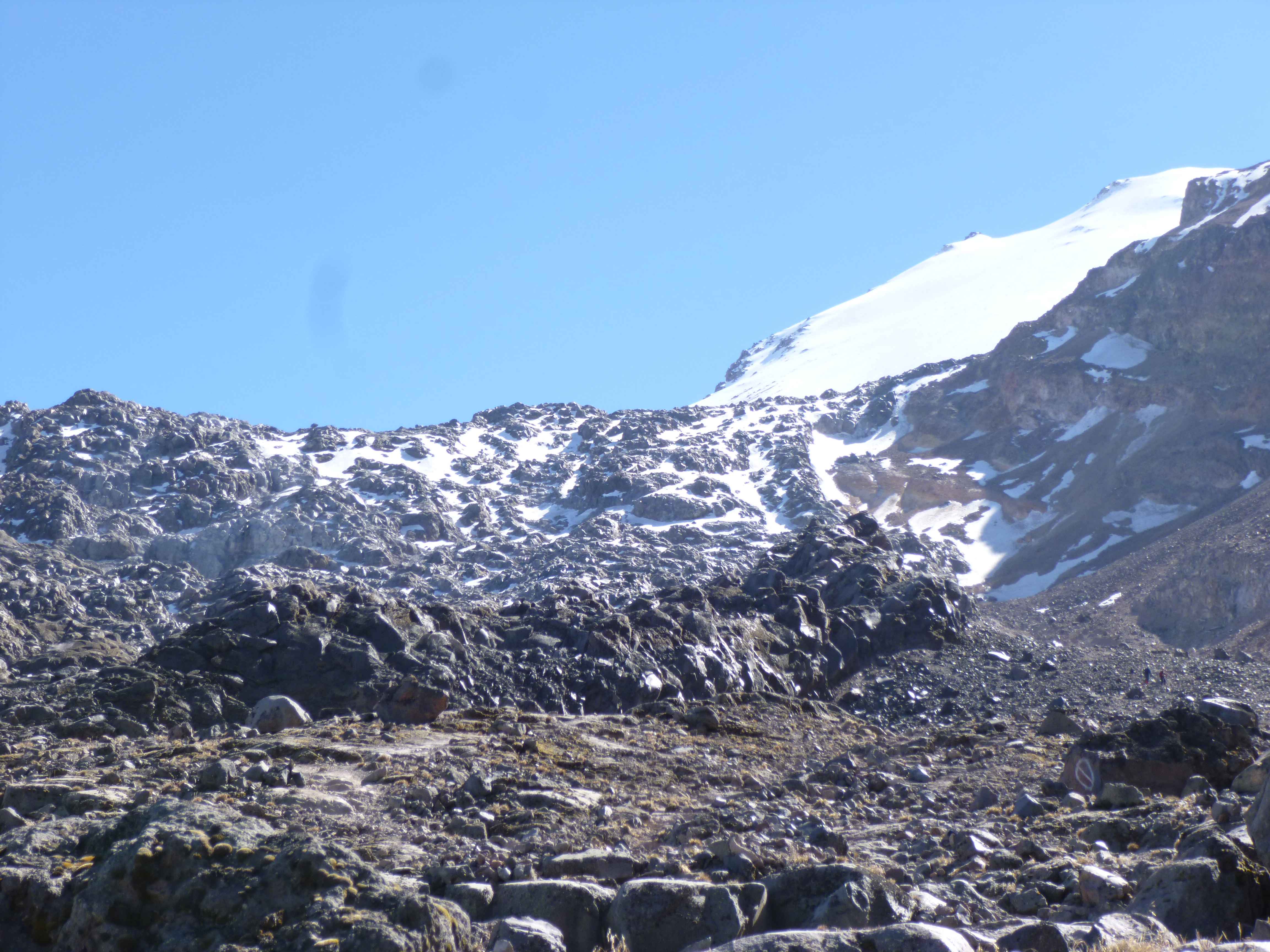
Looking up at the labyrinth.  Orizaba's summit is in the top right.

Looking up at the labyrinth. Orizaba’s summit is in the top right.

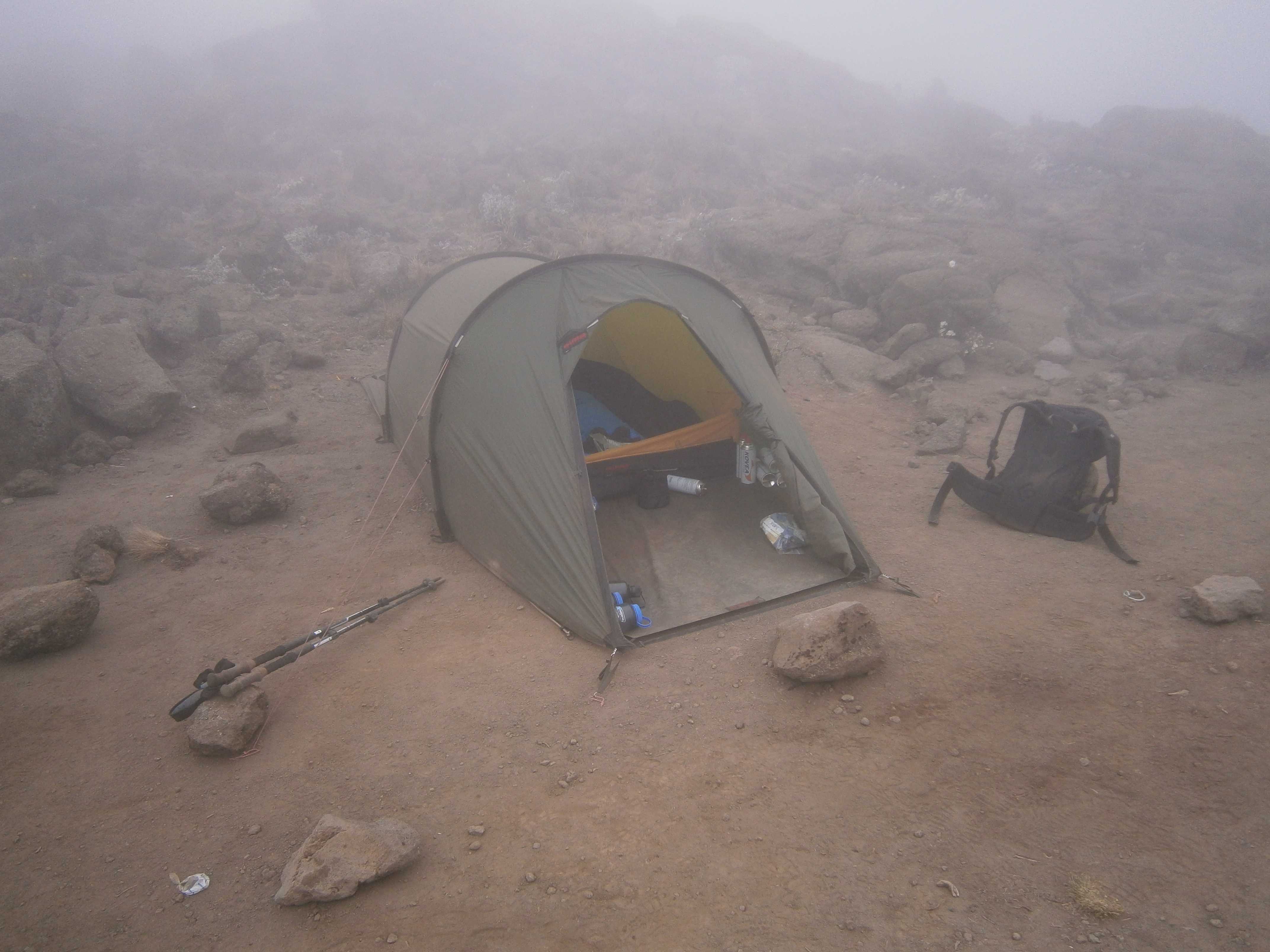
Moving higher, I found the last stone tent wall below the labyrinth and pitched camp.  Without objective measurement, I would estimate my campsite elevation at around ~4750m.

High camp below the labyrinth.

High camp below the labyrinth.

...

Heavy rocks anchored my tent nicely.
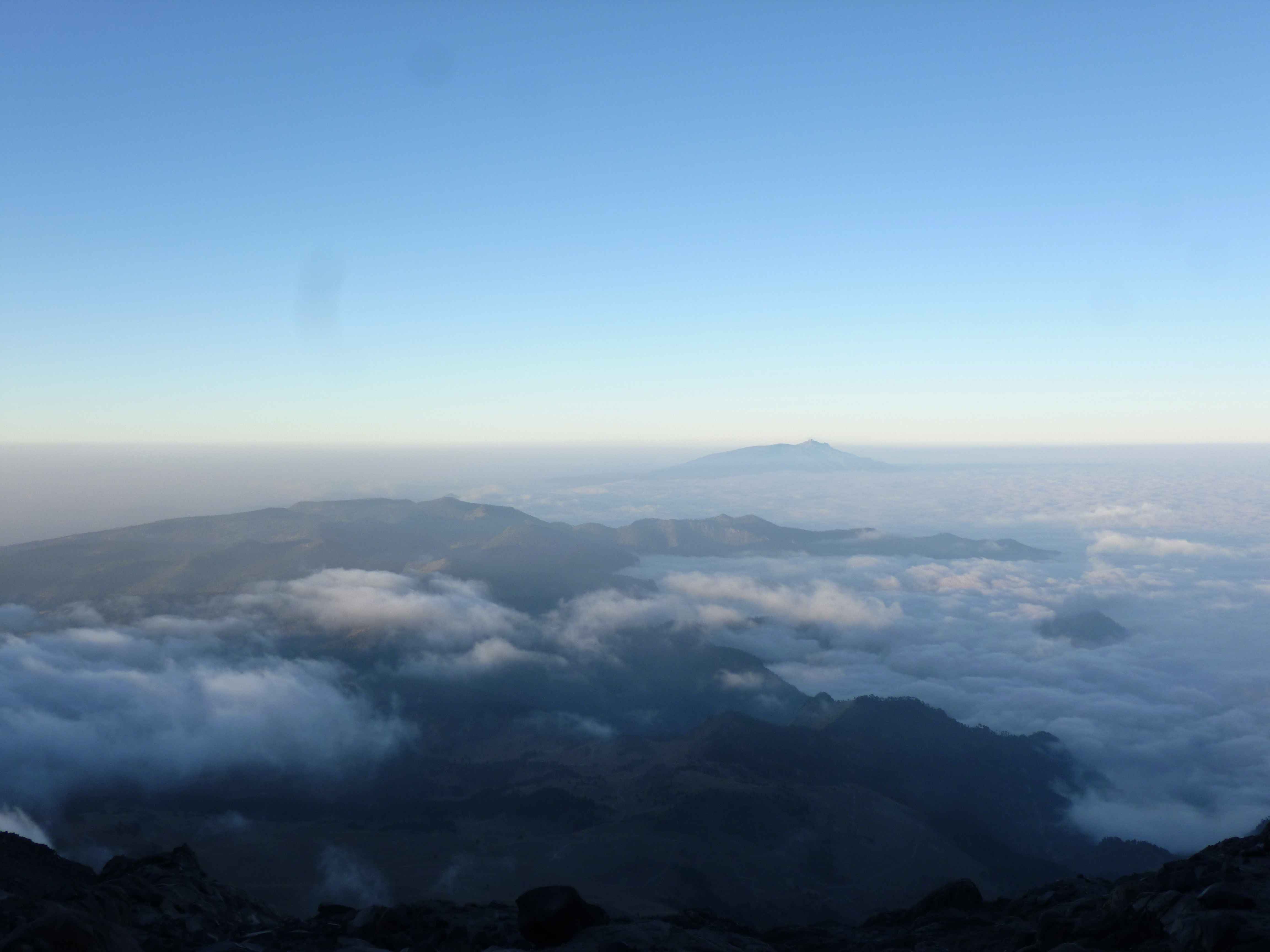
A nice view from my front door.

A nice view from my front door.

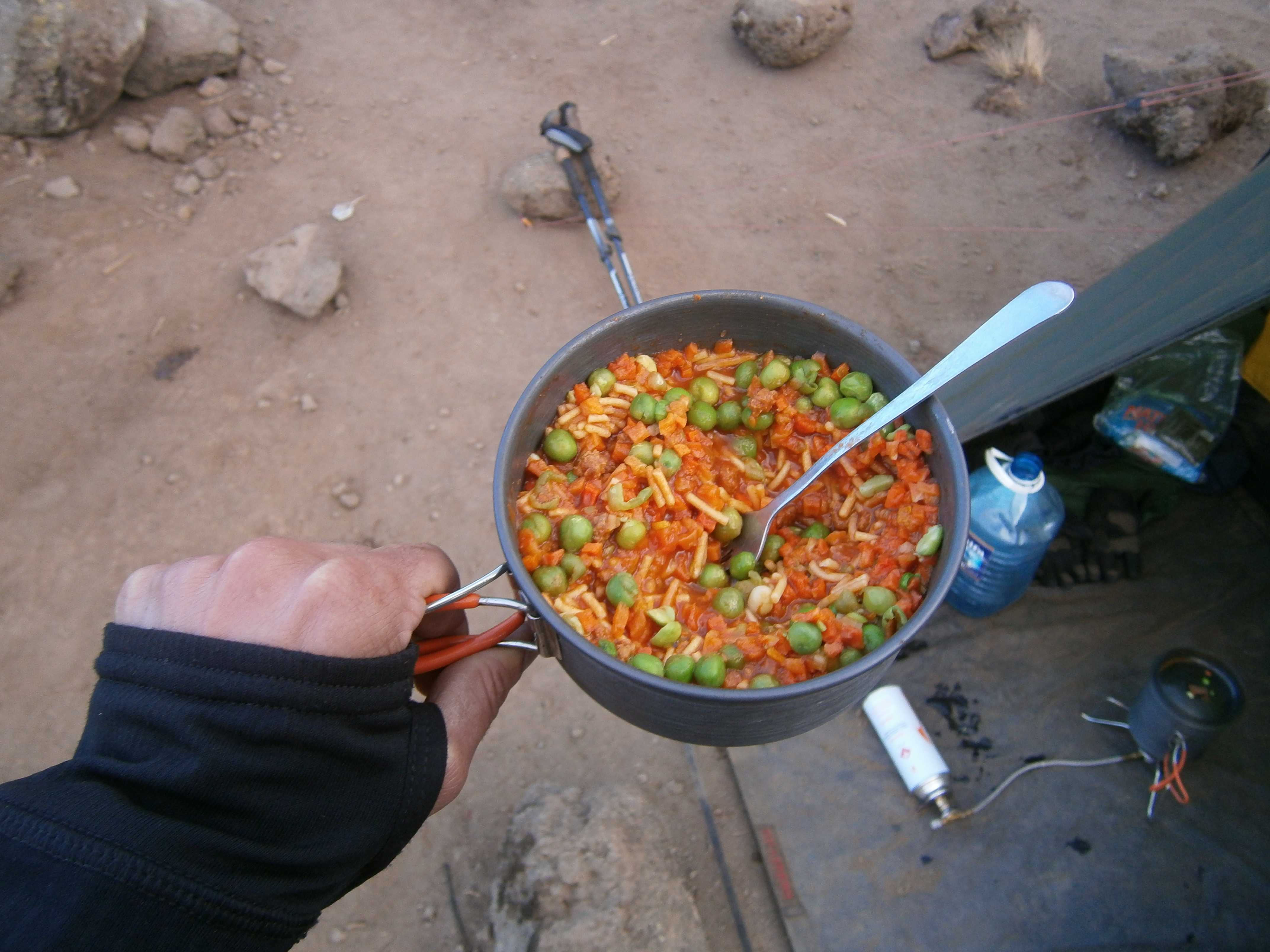
After cooking dinner I turned in for an early sleep.  It was cold overnight, with moderate wind.  In the dark of night glowing stars filled the sky, and the moon was bright enough to cast shadows.

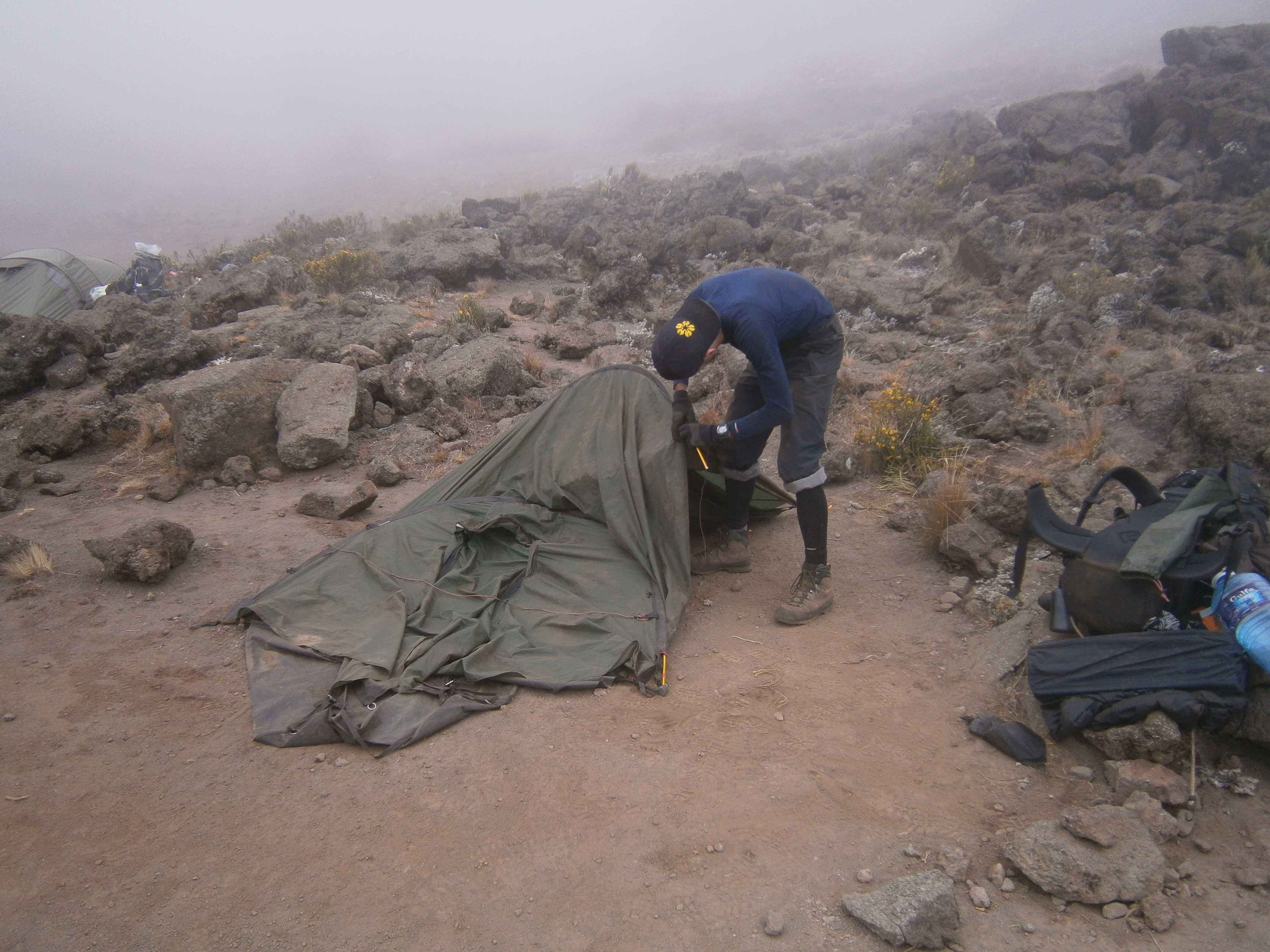
Day 2: I woke up at ~2:30 a.m. to the sound of other climbers passing my campsite.  I discovered that it was the trio of Canadians whom I’d climbed with on Iztaccihuatl a few days prior.  I wished them good luck, and went back to sleep.  Up again at 3:30 a.m I began to cook breakfast and prepare gear for the climb to the top.  As I was getting ready an Australian couple and their guide passed by, and a British/Mexican pair stopped to rest and chat.  This is the benefit of pitching camp in the middle of the route!  As I was getting ready to leave the guided Australian couple returned – the labyrinth was rock hard, and one of the Australians didn’t feel comfortable climbing it.  They asked if she could use my tent to rest and wait for the others, to which I agreed.

Getting ready to climb to the summit.

Getting ready to climb to the summit.

Departing my campsite at 4:30 a.m., I was soon at the base of the labyrinth where, as warned, snow and melt water had frozen.
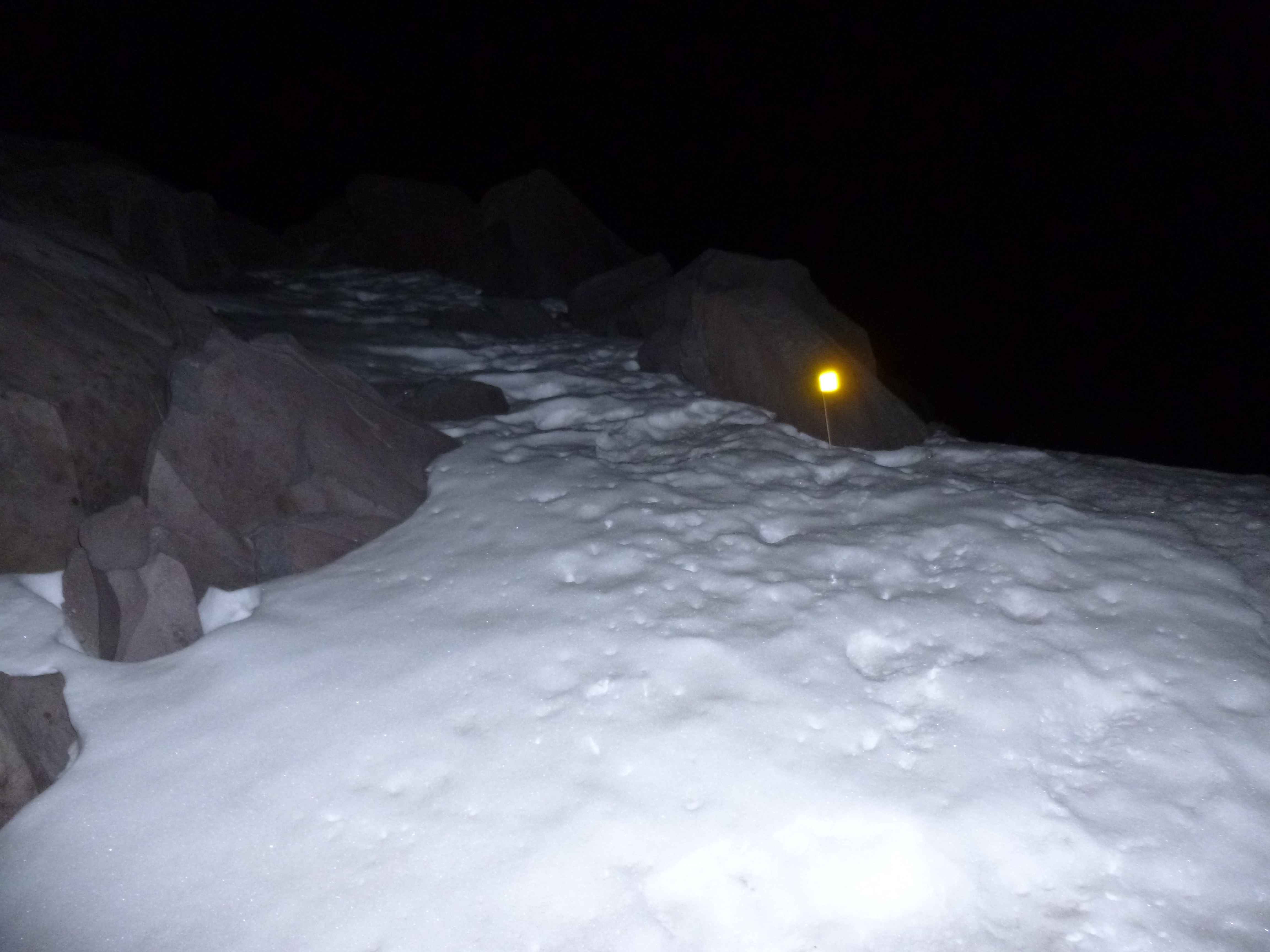
Reflective flags marked the route to the labyrinth's base.

Reflective flags marked the route to the labyrinth’s base.

After a brief stop to put on crampons and switch from trekking poles to ice ax, I began to head up the right hand gulley I had scouted earlier.  While of moderate steepness, overnight it had frozen and was covered in bulletproof ice, providing poor purchase.  The gulley’s sides were well pronounced, and on the ice it would be difficult to arrest a fall.  Worse, falling was potentially quite dangerous, with nothing to stop a slide all the way to the bottom.

Off to the left I saw the headlights of the Australian and his guide taking a different route up, and so after ~25m I turned around and descended to the labyrinth base.  Following the lights of the others I found slightly steeper, equally icy pitches, but with the benefit of many more rocks to guard a potential fall.  The Australian and his guide were short-roped together, although as they weren’t placing protection I am unsure whether it would have helped or hindered them given a fall.  Some 30 minutes later the terrain leveled out and the labyrinth was finished.  After a short, flat section of loose rocks, I was on the Jamapa glacier.

Looking west across the Jamapa glacier.

Looking across the Jamapa glacier.

Contrary to the labyrinth, the glacier was in superb condition.  Crisp, firm snow gave excellent purchase.  The glacier begins at a very moderate angle, and slowly gets steeper.  As I continued upwards, the sun began to rise.
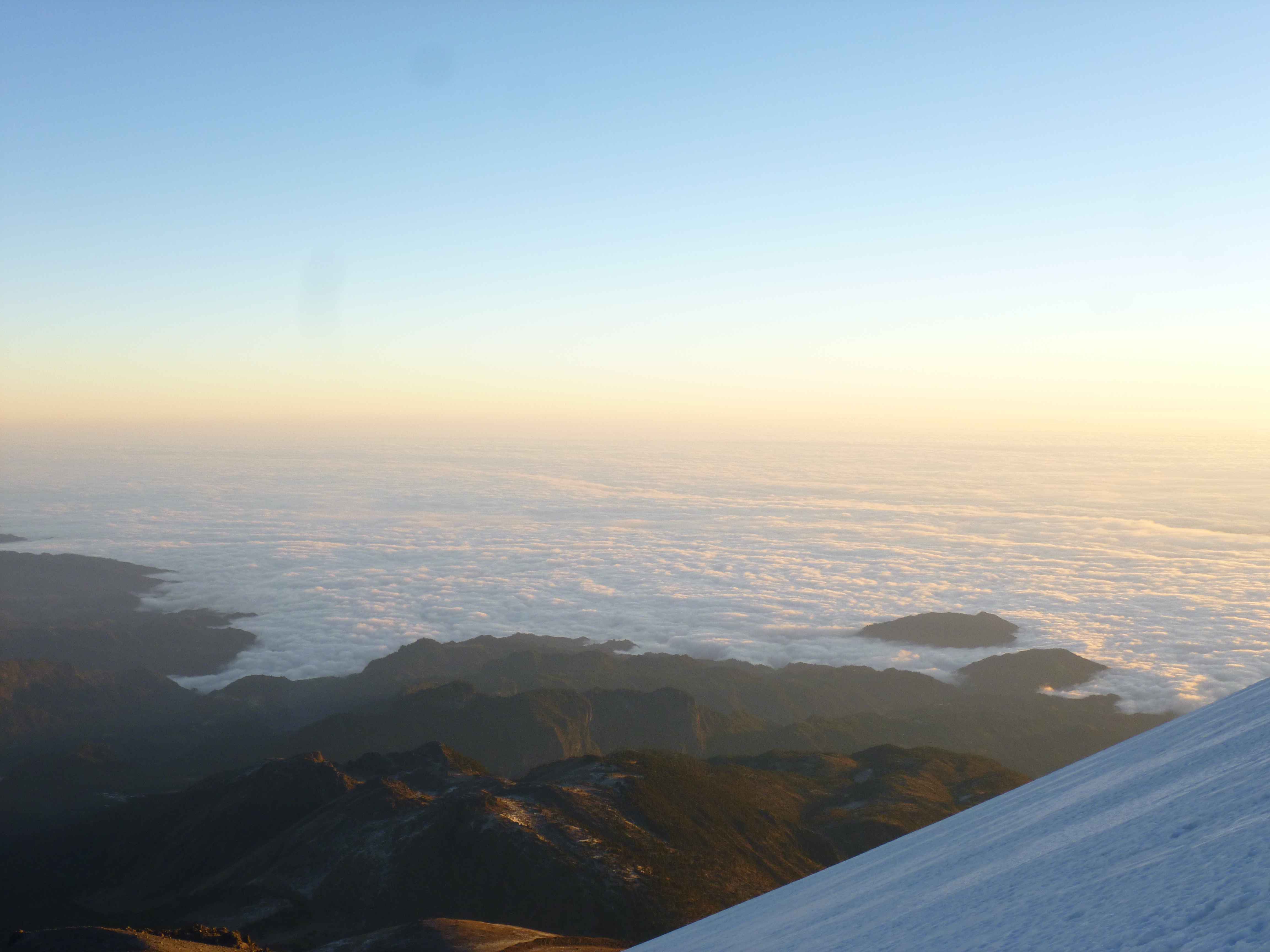
A cloud ocean far below.
A cloud ocean far below.

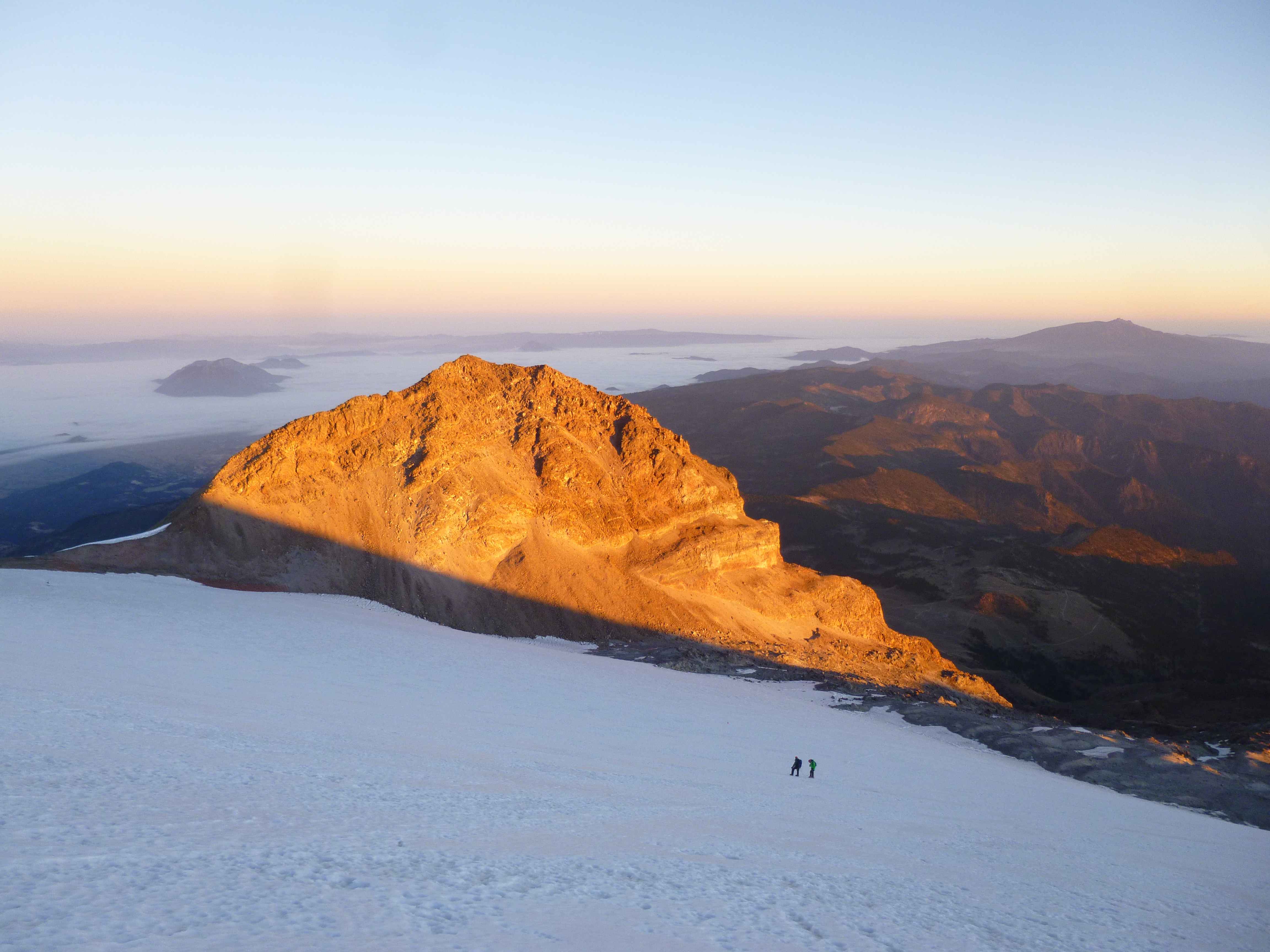
Sunrise on the 'sarcophagus' rock.  The Australian and his guide are climbing up.

Sunrise on the ‘sarcophagus’ rock. The Australian and his guide are below.

Above, the glacier provided a direct route to the summit.
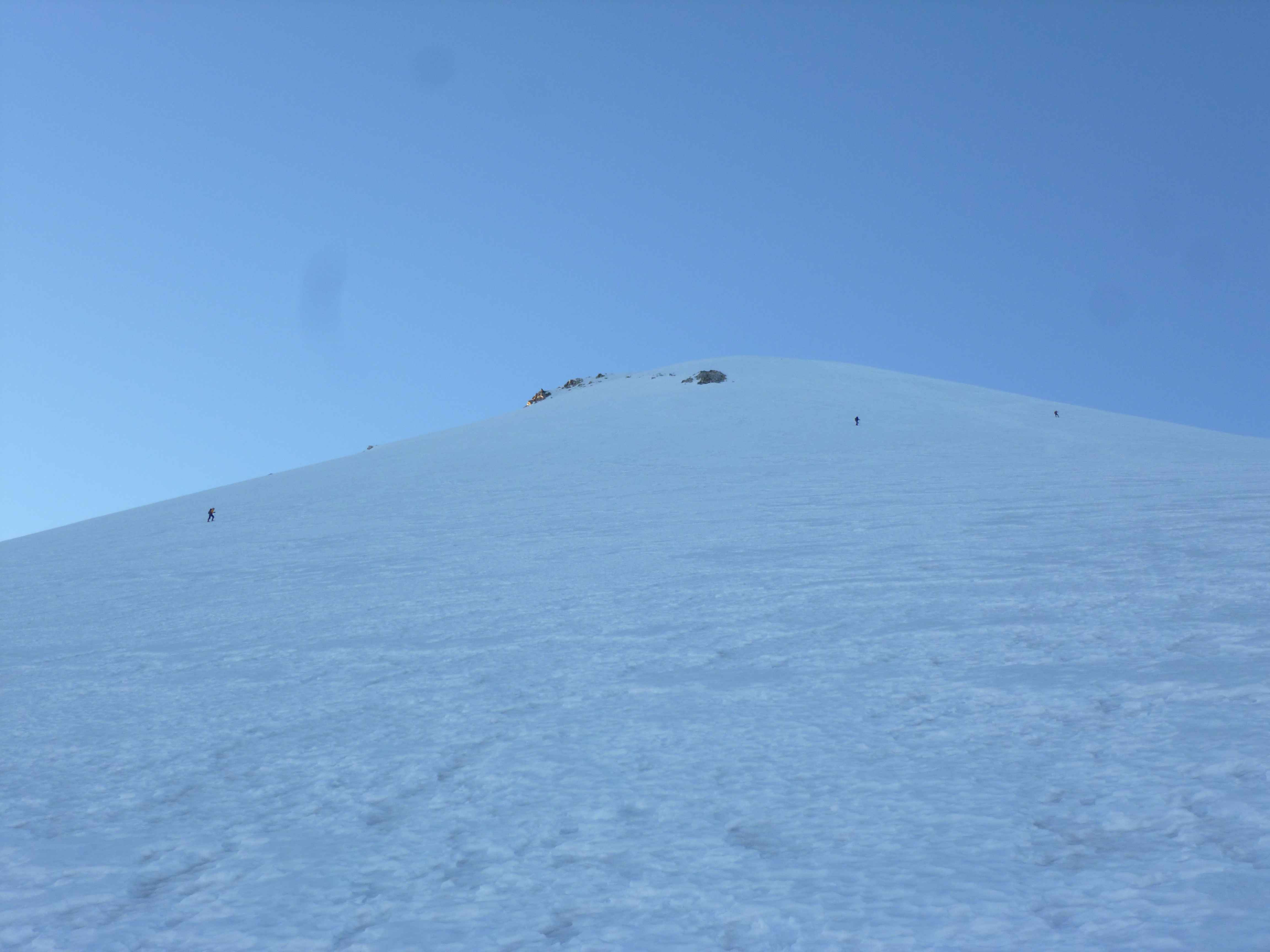
Looking up the Jamapa glacier - the three Canadian climbers are above.

Looking up the Jamapa glacier – the three Canadian climbers are above.

Orizaba casts a giant shadow during sunrise.

The shadow of Orizaba.

The shadow of Orizaba.

Near the top, the glacier was roughly 35-40 degrees at its steepest.  The snow condition was fantastic, and made for sturdy, enjoyable climbing.

The glacier was steepest - roughly 40 degrees - near the top.

The glacier was steepest near the top.

At 9:00 a.m. I reached the top, and was startled by how narrow the crater rim was.  Directly in front of me the rim dropped off abruptly into the crater itself.  ~10m away the true summit was marked with a pile of crosses, blown over and destroyed by high winds.

Orizaba's true summit is marked by a jumble of broken crosses.

Orizaba’s true summit is marked by a jumble of broken crosses.

Various summit markers have been destroyed by weather, leaving a heap of junk.

Various summit markers have been destroyed by weather, leaving a heap of junk.

A rough panorama of the summit crater.

A rough panorama of the summit crater.

Two of the Canadian climbers were already at the top when I arrived, and their friend soon followed.  Everyone was in a great mood as they helped me take some photographs.

Once again I met the three Canadians at the summit.
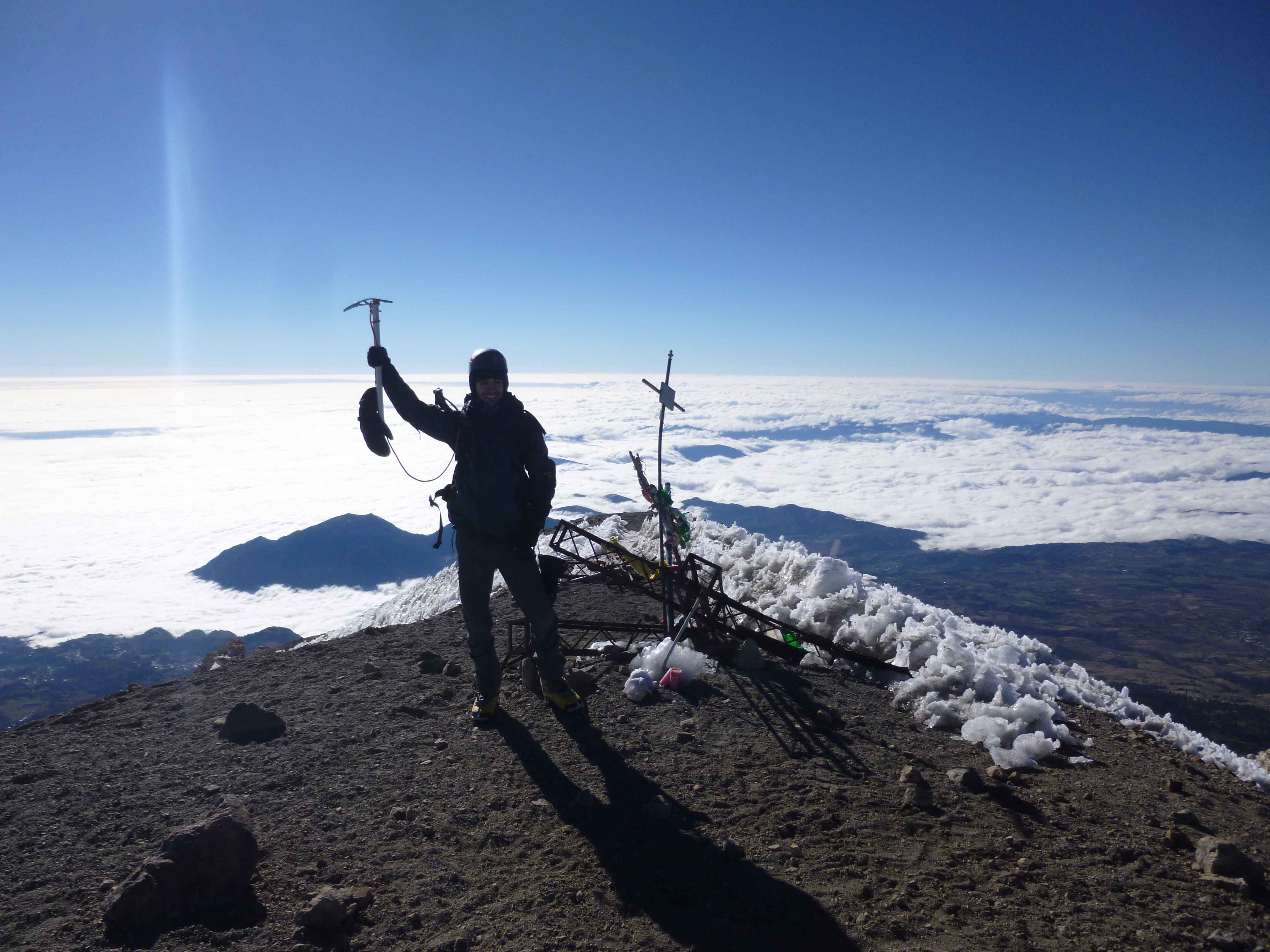
Once again I met the three Canadians at the summit.

Feeling great in the sunshine on the summit!

Feeling great in the sunshine on the summit!

The view was excellent, with an endless cloud ocean stretching out far below.
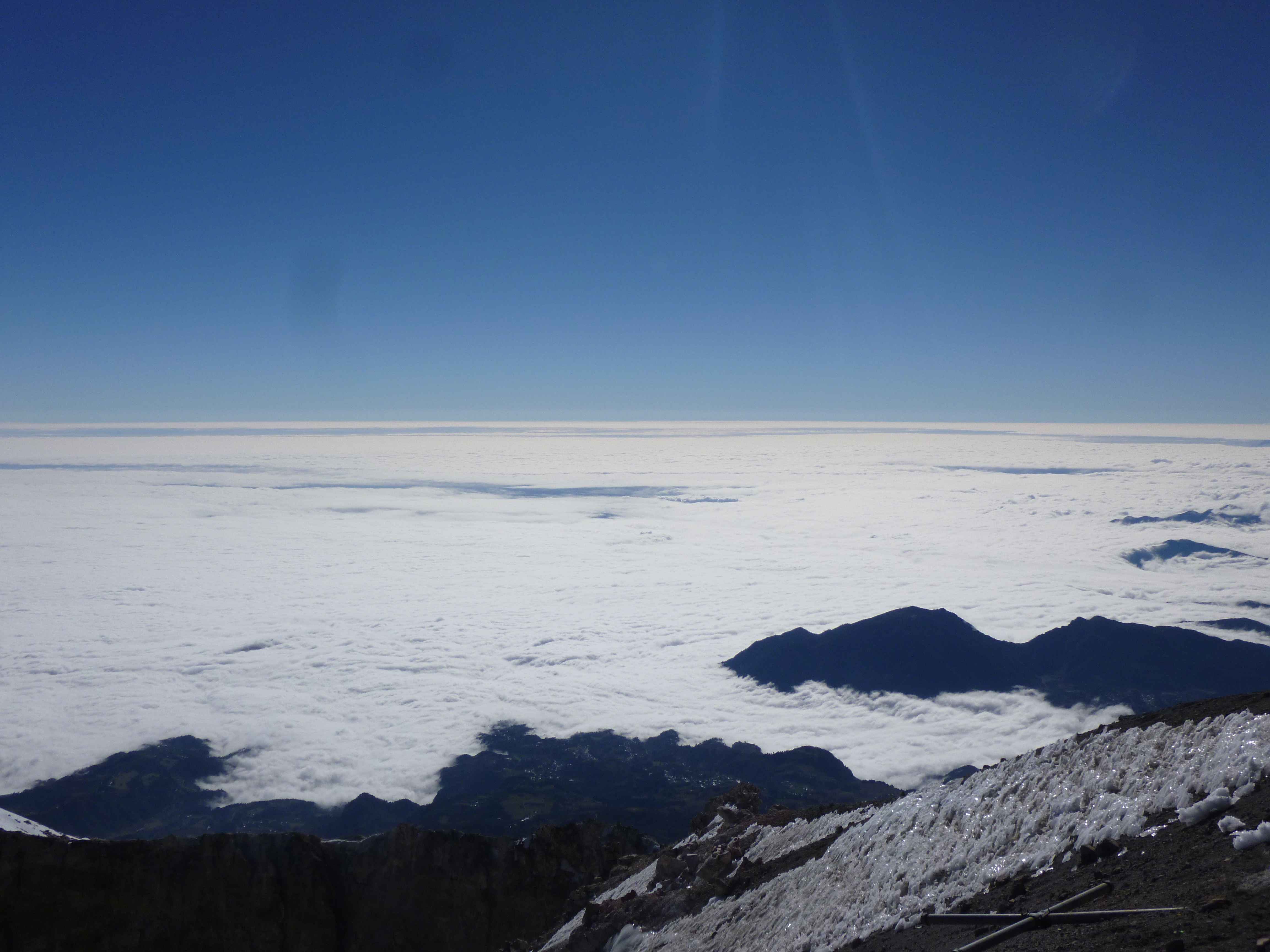
Seemingly endless clouds.

Seemingly endless clouds.

The air was clear enough for me to make out 5230m Iztaccihuatl and 5426m Popocatépetl.  Popocatépetl, an active volcano, was emitting small plumes of smoke.  It was really neat to see these mountains from Orizaba, as I had climbed Iztaccihuatl earlier in the week and enjoyed numerous, clear views of Pico de Orizaba along the way.

Iztaccihuatl and Popocatépetl could be seen in the distance.

Iztaccihuatl (right) and Popocatépetl (left) could be seen in the distance.

After some 30 minutes on the summit, I began to descend.  Once over the crater rim, I could see the Piedra Grande hut far below.
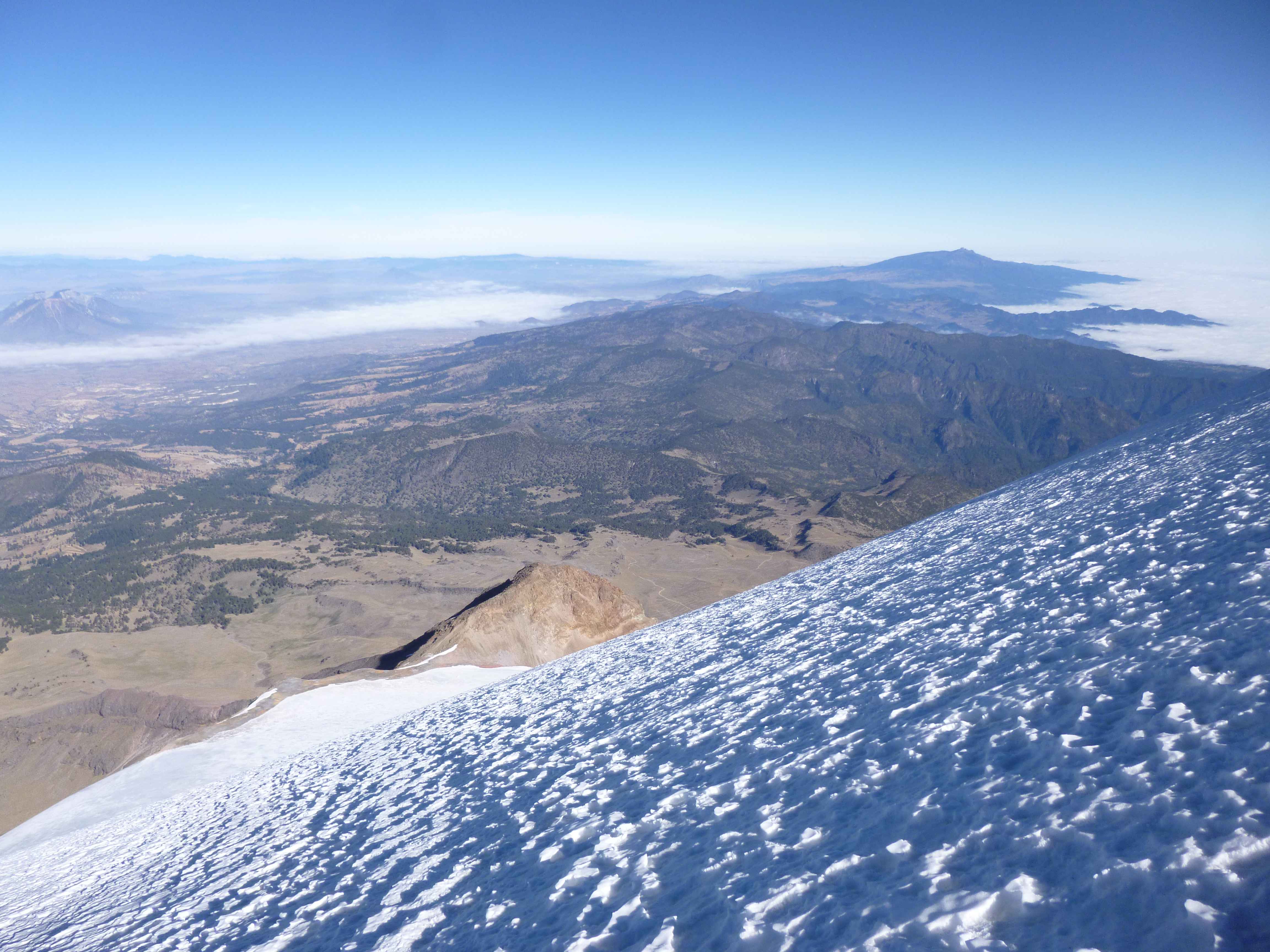
Looking north down the glacier, from near the summit.
Looking north down the glacier, from near the summit.

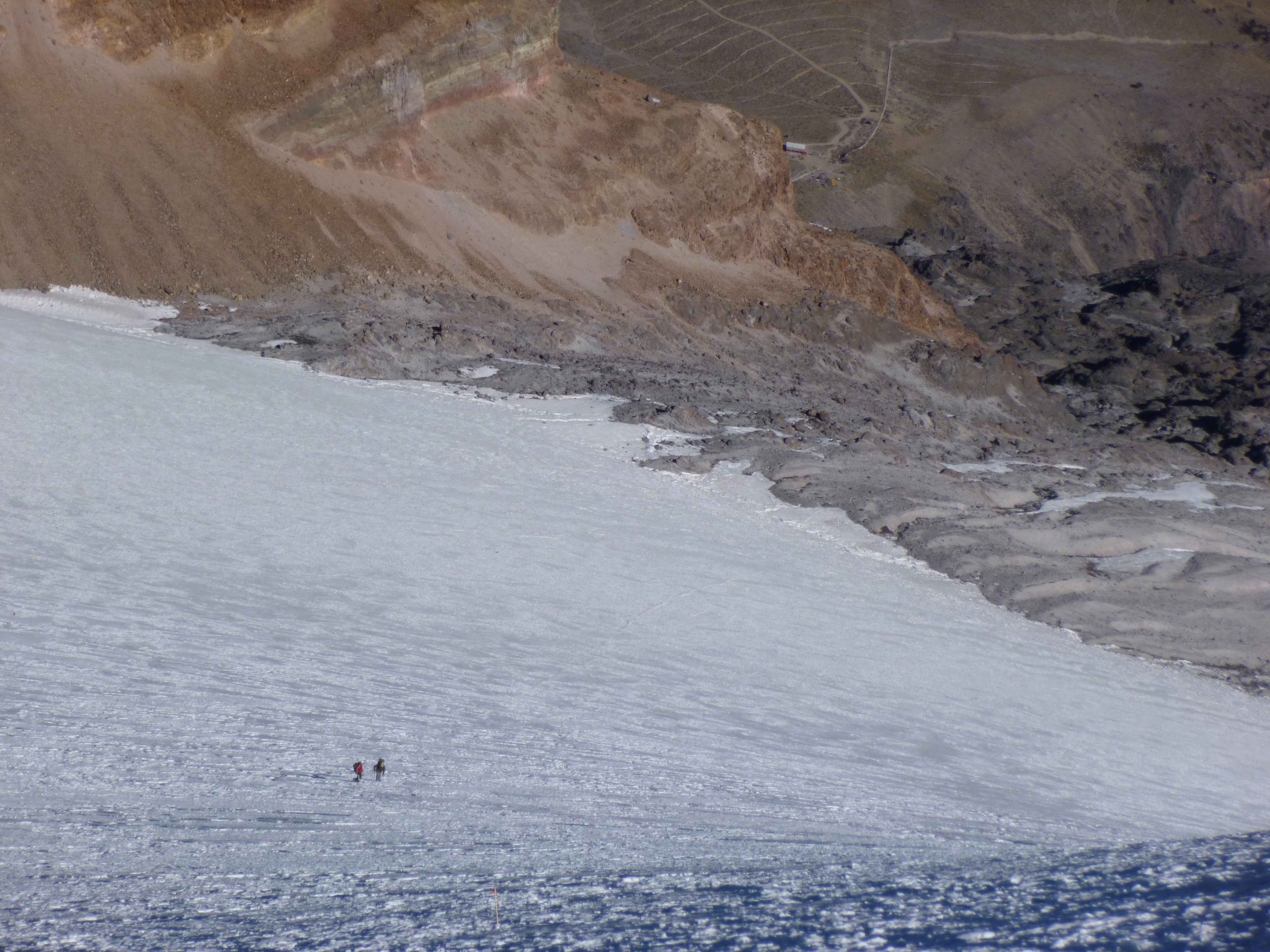
Looking down the glacier.  The Piedra Grande hut is visible in the top right corner.  The British/Mexican pair are heading up.

Looking down the glacier. The Piedra Grande hut is visible in the top right corner. The British/Mexican pair are heading up.

Behind me, the glacier shone in the sunlight.
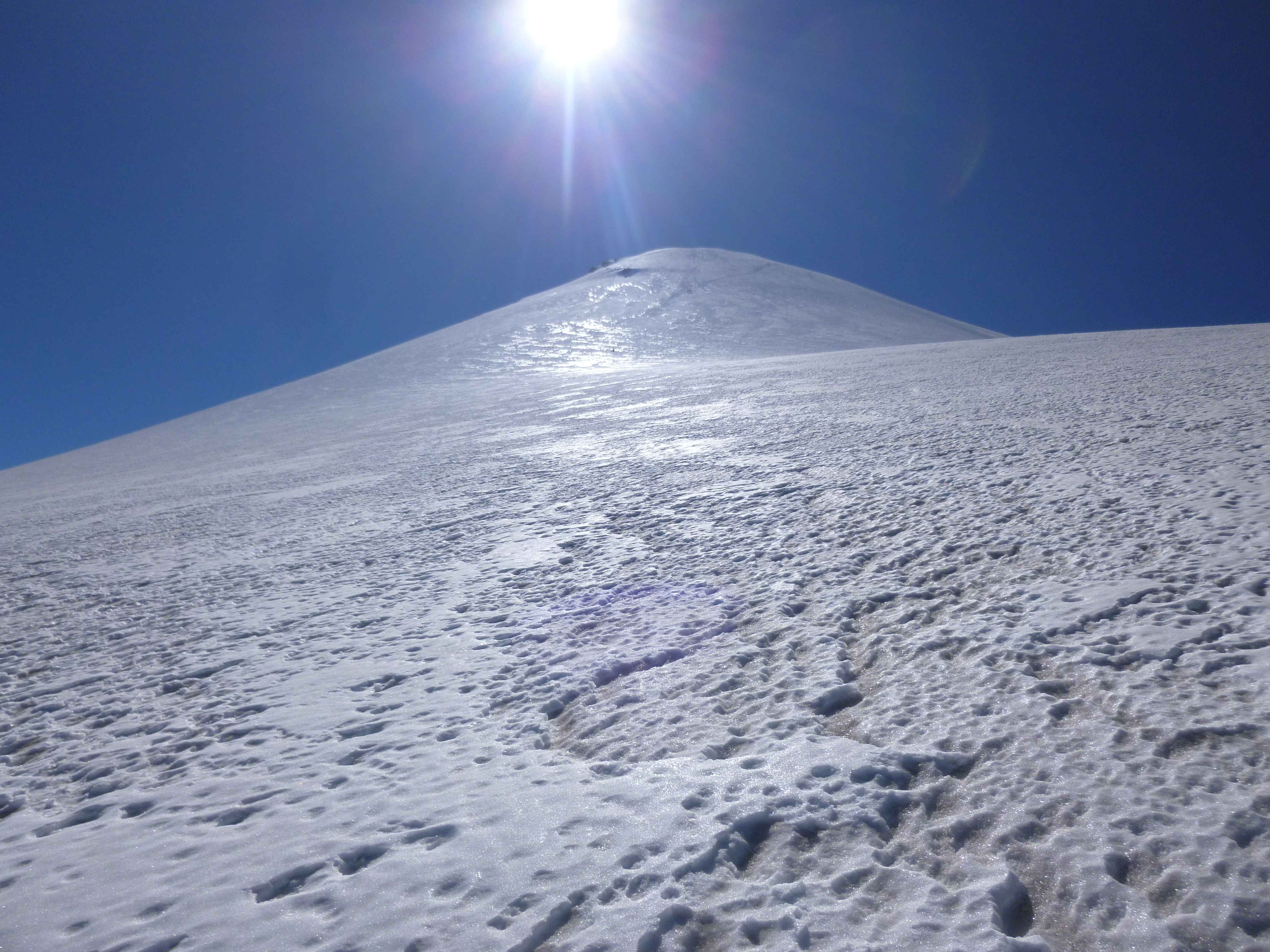
LookIng back up the glacier.

Looking back up the glacier.

In daylight, route finding was easy.  I retraced my path across nearly level terrain back to the top of the labyrinth.
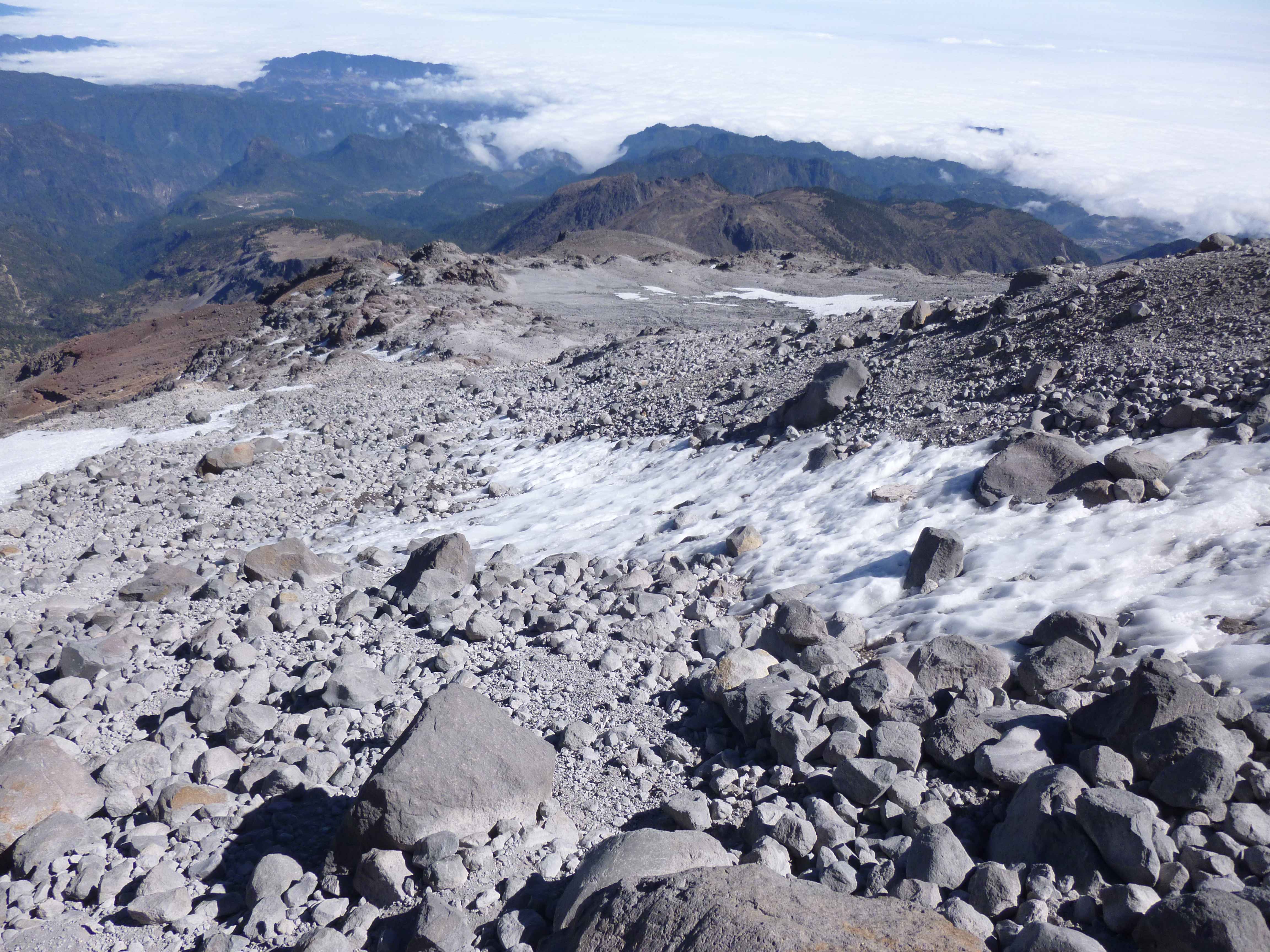
The top of the labyrinth.

The top of the labyrinth.

In sunshine the labyrinth ice had begun warming, creating better traction, so I opted to descend along the right hand side.  This gave me a good view of the left-hand route I’d ascended in the dark.

View from the right hand side of the labyrinth.  I ascended the series of gulleys furthest from this vantage point.

View from the right hand side of the labyrinth. I ascended the series of gullies furthest from this vantage point.

Descending the labyrinth was a bit awkward in places, but nowhere near as difficult as the morning’s ascent.  When I reached my tent I broke camp, dumped my extra water, and packed up to descend back to the Piedra Grande hut.  Below my campsite, the route transitioned back to scree.

Heading down the mountain through scree fields.

Heading down the mountain through scree fields.

Piedra Grande hut below.

Piedra Grande hut below.

Once back at the hut I cooked up some lunch, chatted with other climbers, and relaxed in the sun until the Cancholases arrived for the 4×4 drive back to Tlachichuca.  On the way out I enjoyed lovely views of the mountain in the clear afternoon air.

Looking back at Orizaba.

Looking back at Orizaba.

Once finished, it felt like Orizaba had gone by quickly.  I had come prepared for several days, allowing myself additional time on the mountain in case I felt like I needed more acclimatization, and to accommodate the potential for high winds preventing access to the summit.  Iztaccihuatl before Orizaba was an excellent decision, and made for a very thorough acclimatization course – I experienced no symptoms of altitude sickness, and felt strong throughout the climb.

Climbing Orizaba solo was very rewarding, especially because my planning for the trip worked out perfectly – afterwards I almost felt as if I had over-prepared in regards to my schedule, food, and gear.  Reaching the summit after all of my preparation felt like a great personal accomplishment.  Spending a night alone, high on a mountain, is a powerful experience.

Accessibility

Pico de Orizaba’s chief obstacle is that of elevation – a careful acclimatization schedule is critical for avoiding potentially dangerous altitude sickness and to climb Orizaba safely.

a firsthand report and photographs of a 4m wide, 4-8m deep crevasse at 5500m elevation, near the top of the Jamapa Glacier normal route, were given to me in mid February, 2016.  The crevasse was hidden, covered with a thin and unstable snowbridge, which collapsed underneath a climber.  If planning a climb of Orizaba, do not assume that the glacier will be stable or devoid of crevasse hazards.  This crevasse presents a significant hazard, and if it opens up further will make the climb far more difficult technically.  Check up to date mountain conditions with locals or recent climbers before committing to a climb, and be aware of the constant potential for hidden crevasses when on any glacier.  Roping up with a guide or partner is only a useful safety technique if all members of the rope team are trained in self arrest, glacier travel techniques, and basic rescue.  Climbing solo on any glacier always involves a certain level of inherent risk.

Pico de Orizaba is easily accessible.  From the Mexico City airport, take an airport taxi to the TAPO bus station, where you can catch a first class bus to Puebla’s CAPU bus station (~2 hours transit time).  From the CAPU station a second class (multiple stop) bus runs to Tlachichuca (~2.5 hours transit time).  There are information booths in both bus terminals, and staff are very helpful in assistance finding ticketing/departure gates.  For perspective, I speak less than ten words of Spanish, and didn’t have any serious issues finding my way.

Orizaba can be climbed year round, but the dry season occurs from November through March, and this is the most popular time to climb.

In Tlachichuca I used the services of the Cancholas family for lodging and transportation to/from the mountain, and I was very pleased.  The Cancholas compound has comfortable beds, showers with plenty of hot water, and ample space for sorting/packing gear.  Breakfasts and dinners were delicious and filling, with a great balance of fresh food.  They even provided beer after my climb, and were eager to accommodate their guests as much as possible.  When I first walked into the compound, Maribel greeted me with “Welcome!  This is your home.”, a statement which they certainly lived up to during my stay.  Finally, their service was affordable and easy to book in advance.  You can view their website here: http://www.summitorizaba.com/

Zhongyangjian Shan – 中央尖山 – August 2012

Zhongyangjian Shan, at right.  Nanhuda Shan is the broader peak to the left.

Zhongyangjian Shan, at right. Nanhuda Shan is the broader peak to the left.

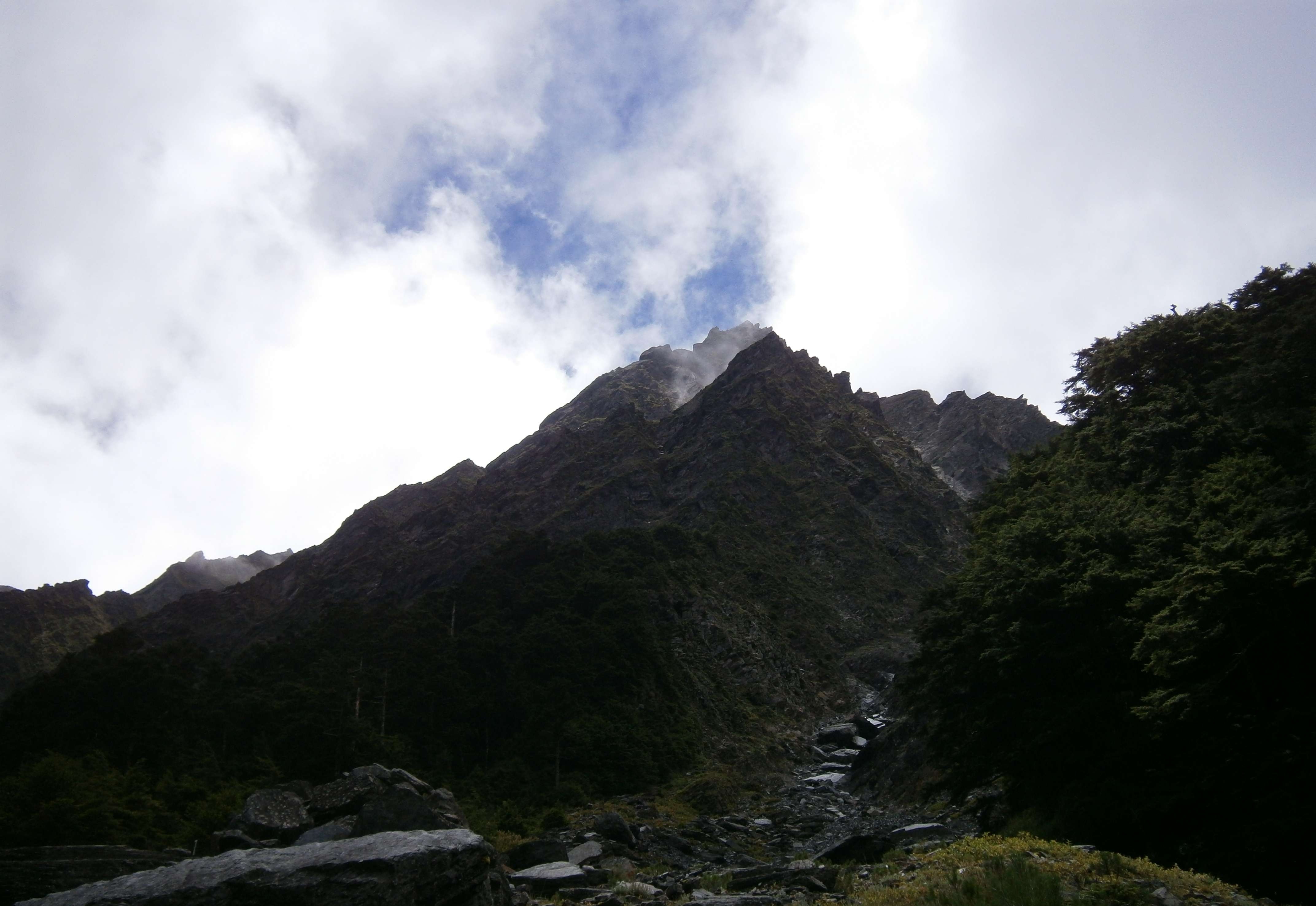
3705m Zhongyangjian Shan, located in one of the most remote sections of central Taiwan, is among Taiwan’s highest.  Having viewed the stark, rocky pyramid of Zhongyangjian Shan far in the distance during several other hikes within Taiwan’s central mountains, I had long been eager to hike it.

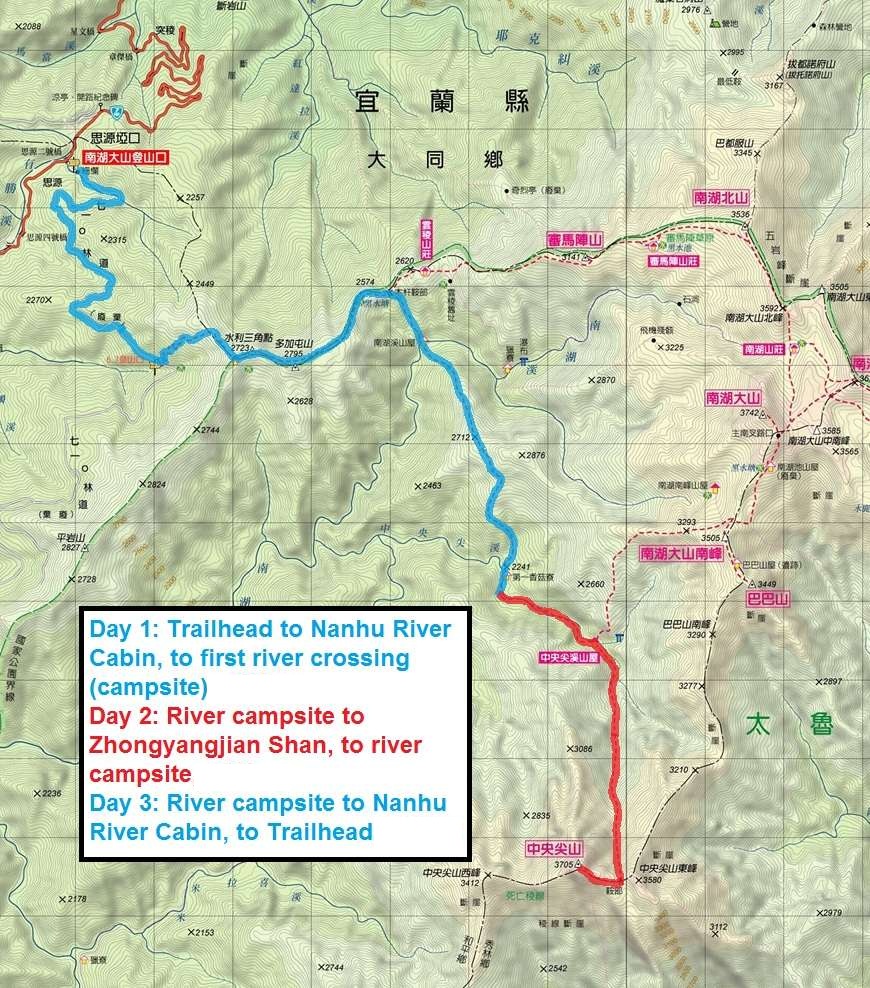
My three day itinerary.

My three day itinerary.

I had hiked in this area before, and was familiar with the initial leg of the route, which is shared with the Nanhuda Shan trail.  Knowing roughly what the terrain was like, I planned a three day trip using a single campsite.  Unfortunately, a typhoon had passed over the island the week prior to my hike, damaging sections of the road into the trailhead, and as I would later discover, obstructing the trail itself.

P4041426

The Nanhuda Shan Trailhead.

Day 0: To get to the trailhead, I first took a bus to Luodong, in Yilan county.  Luodong is a convenient starting point for hiking the Nanhuda Shan circuit because it is a popular tourist destination with frequent bus access from Taipei, closer to the trailhead than Yilan, and most importantly, because it is a very easy place to rent a cheap motorcycle.  Unfortunately, I learned of the severe road damage when I arrived, and was informed that the trailhead was inaccessible to motorbikes.  Undeterred, I found a taxi driver willing to drive me in.  By the time we arrived at the trailhead it was 9 p.m., and my driver was not in a good mood – the road was almost destroyed in sections, with numerous landslides making it all but inaccessible in places, and the driving was very slow.  I tipped him generously, then pitched a quick camp by the trailhead and turned in for the night.  I wouldn’t see another person for the next three days.

My first night's camp - by the trailhead.

My first night’s camp – by the trailhead.

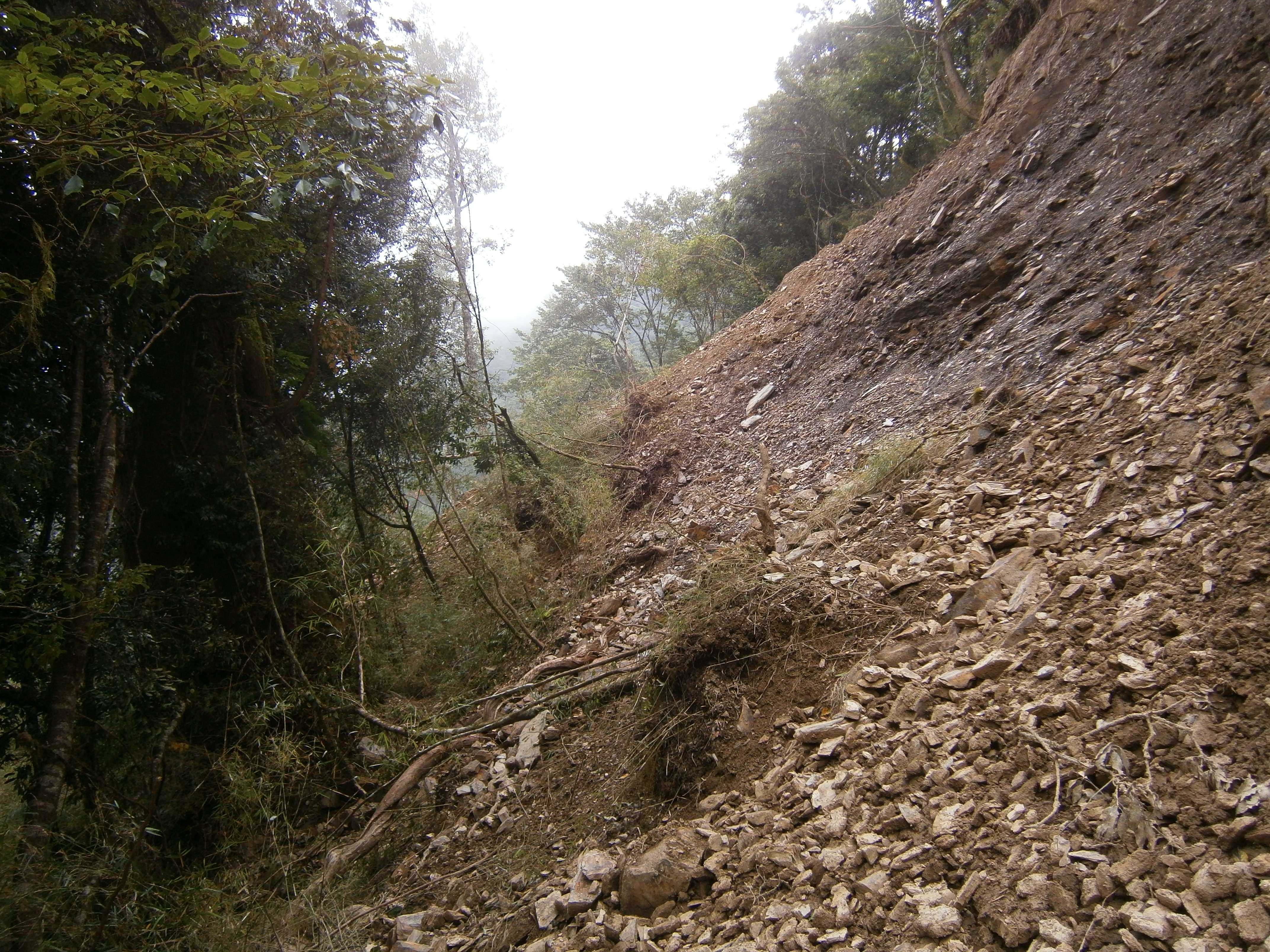
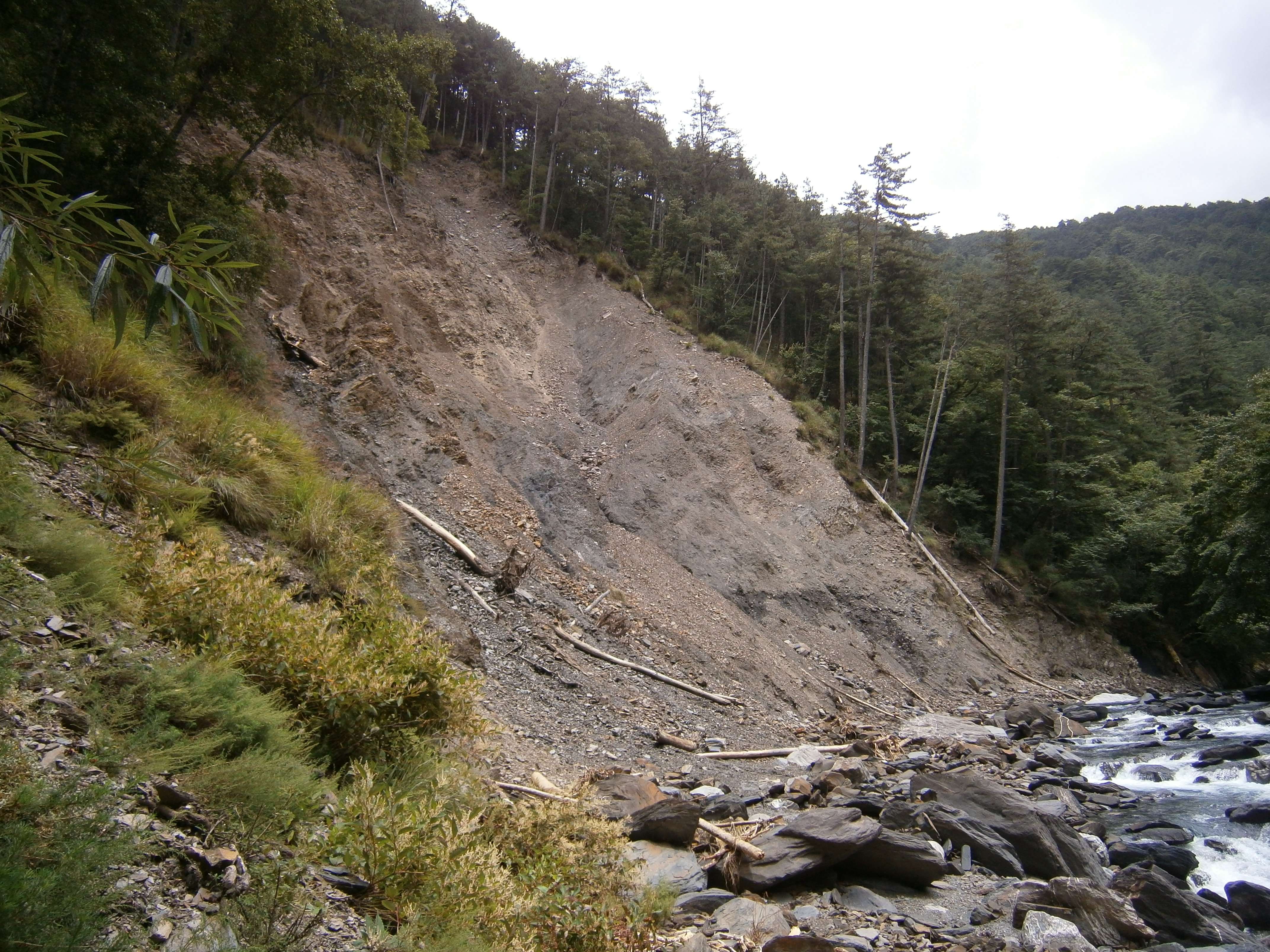
Day 1: Packed up and moving by 6 a.m., I started down the normal Nanhuda Shan route.  This follows an old road, long destroyed by typhoons, landslides, and earthquakes.  The route was much different than the last time I had hiked it; it was obstructed by several large, fresh landslides.  These were unmarked, so I crossed over them carefully.

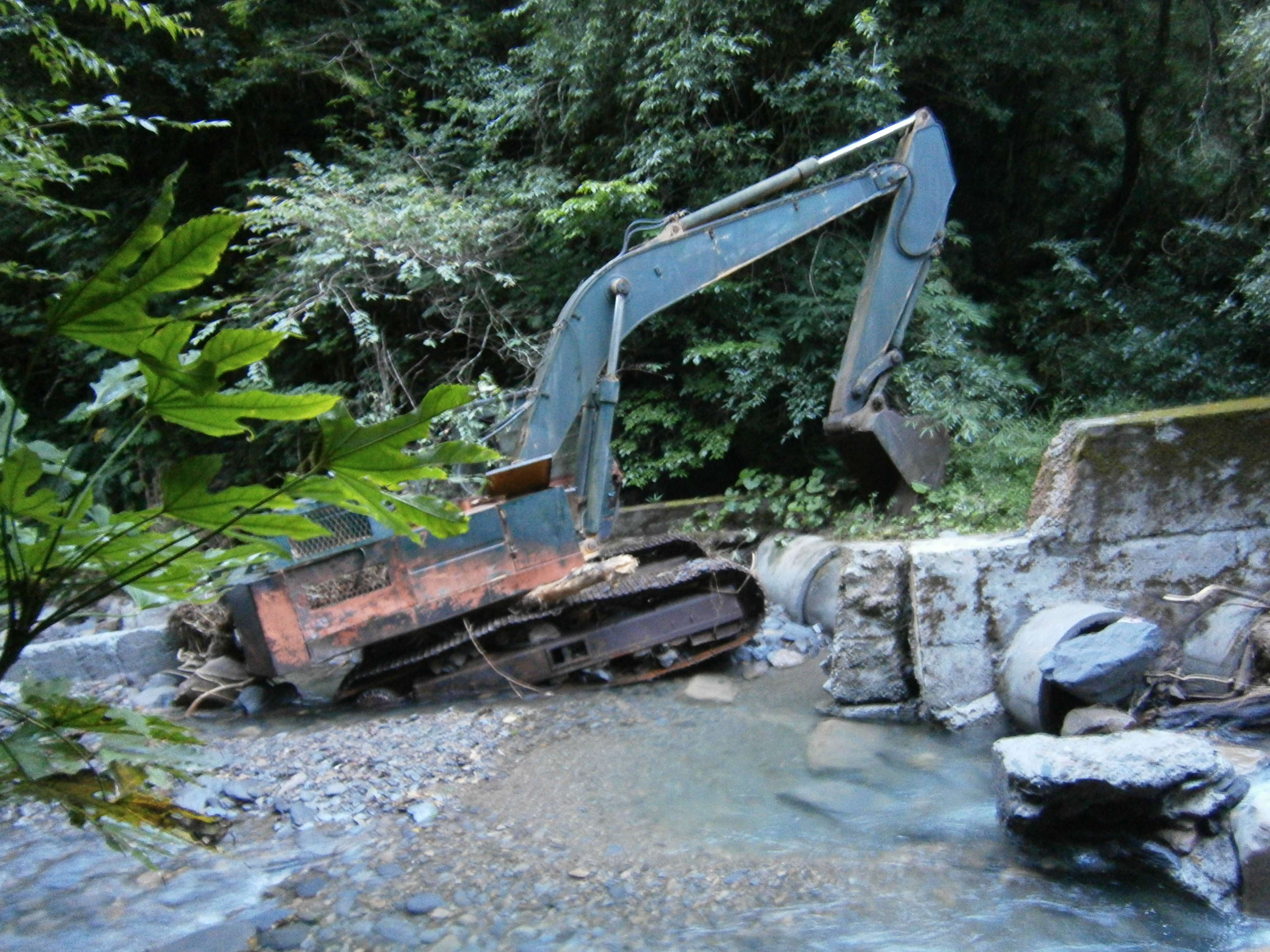
Long abandoned equipment on the old road.

Long abandoned equipment on the old road.

Some big landslides disrupted the first section of the route.

Some big landslides disrupted the first section of the route.

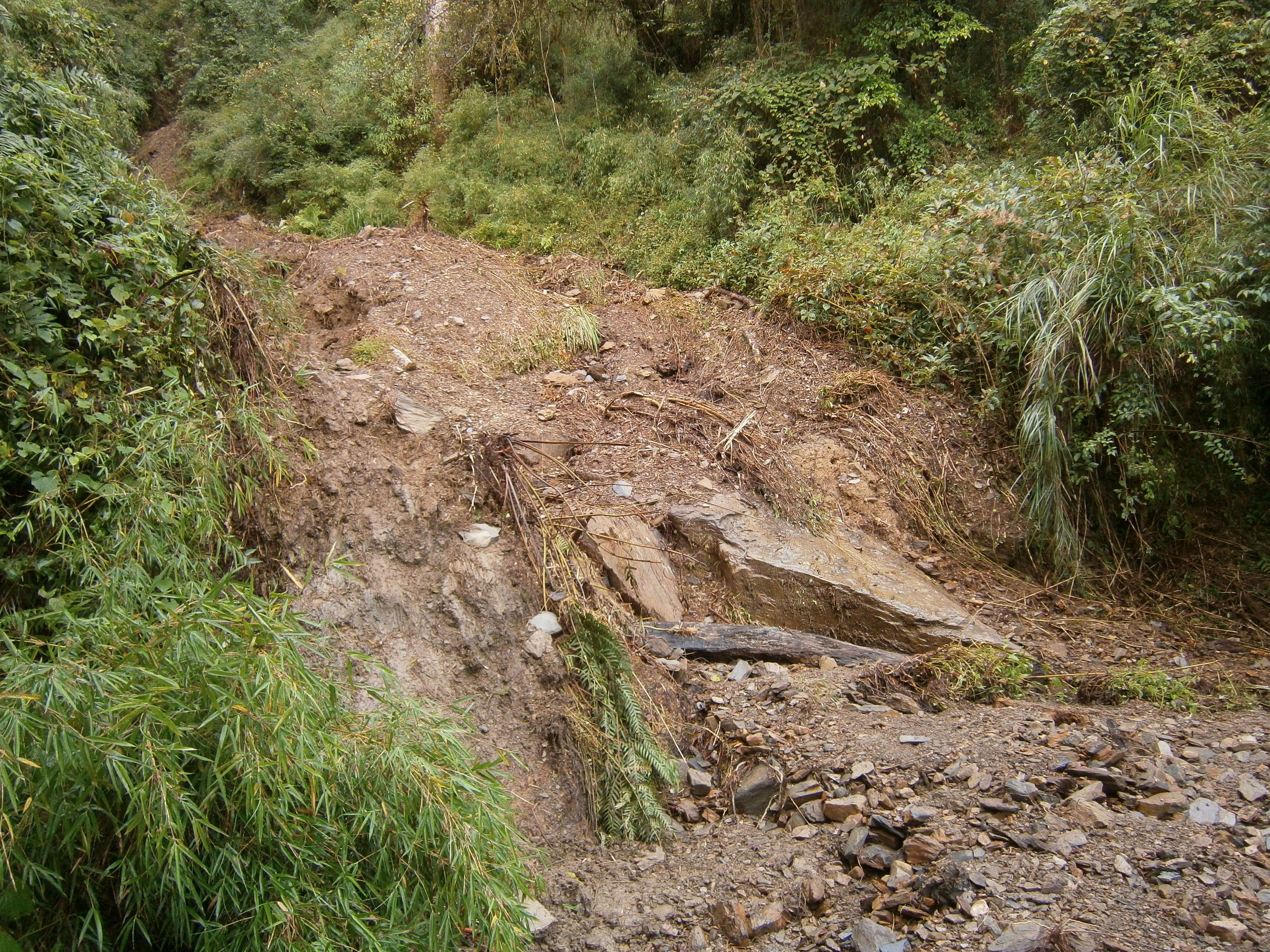
Some of the landslides looked like they had been crossed before, but none of them were marked, and no trails were broken.

Some of the landslides looked like they had been crossed before, but none of them were marked with tags, and no trails were broken.

As I continued, I was met with more walls of foliage and soil, brought down by heavy rain.

As I continued, I was met with more walls of foliage and soil, brought down by heavy rain.

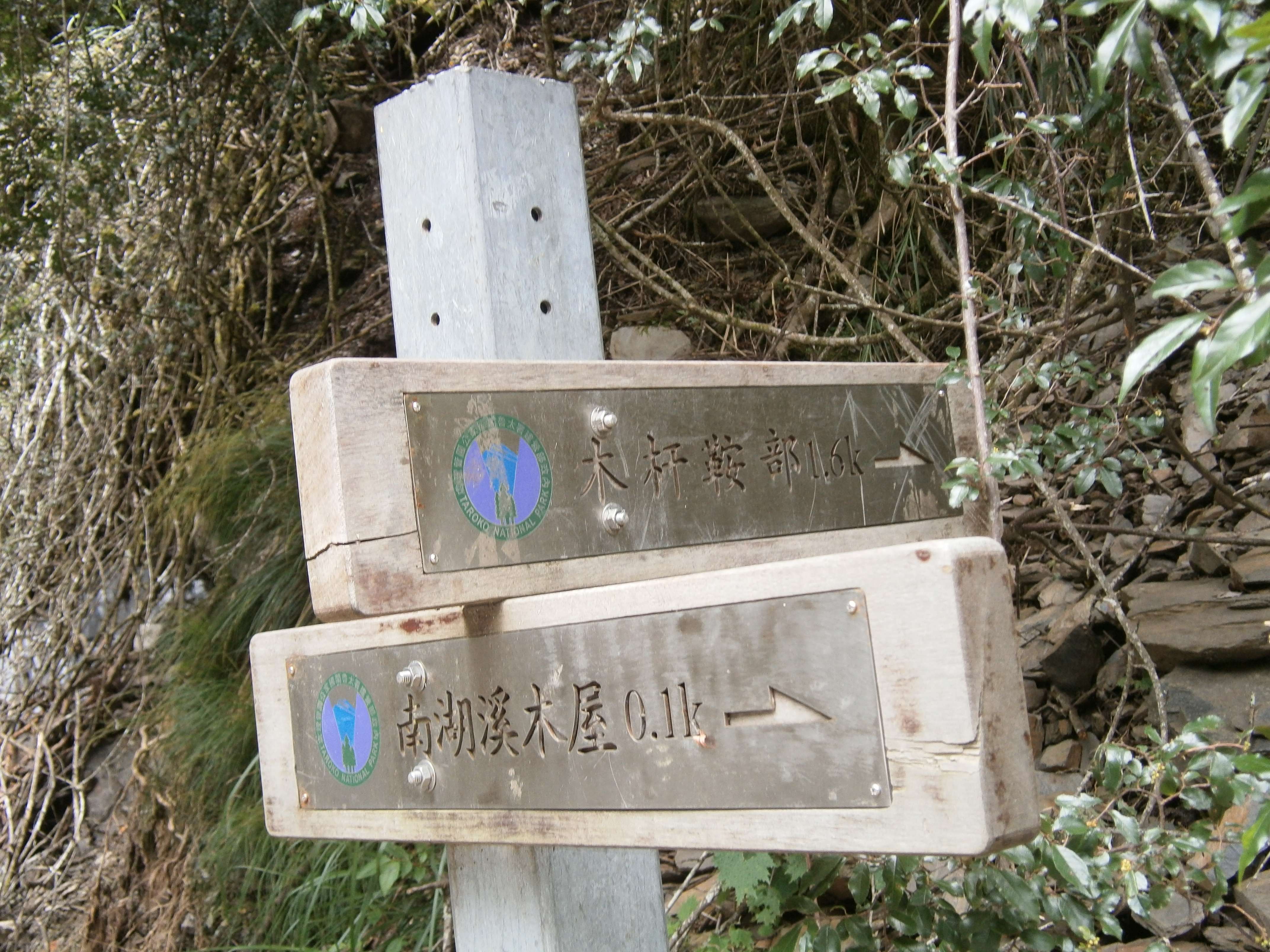
The landslides made this portion of the route grueling and seemingly endless – with my heavy pack, it took several hours to get through it.  After this first section I reached the ‘old trailhead’, a large clearing with a drop box for permits and space for several tents.  A switchback trail heads upwards, eventually breaking onto a ridge which continues to a junction in the trail.  Here a separate path breaks south towards Zhongyangjian Shan.  One can continue to the Yunling cabin and Nanhuda Shan, or split towards the Nanhu river cabin (南胡溪木屋) and Zhongyangjian Shan.  Clouds over Zhongyangjian Shan obscured the view, although this area is one of the best vantage points of the mountain.

The junction, marking the trail split and 1.7km south to the Nanhu river cabin.

The junction, marking the trail split and 1.7km south to the Nanhu river cabin.

Here the route drops off of the ridge and downhill into a valley through forest, quickly joining a stream.  From here to the bottom of the valley there is no longer a trail, and the route follows the rocks of the stream.  Going is slow along this section, as the route is slippery.

The trail slowly becomes less defined, but trail markers were abundant.

Trail markers were abundant, along with the odd rope.

Eventually the trail disappears, and the route continues along the side of the stream.

Eventually the trail disappears, and the route continues along the side of the stream.

Looking back up the stream.

The stream is rocky, and strewn with boulders.

Steeper sections with water were protected with chains and posts.

Steeper sections with water were protected with ropes and posts.

Eventually the stream reaches a river, where a second signpost points in the direction of the Nanhu River cabin.

At the bottom of the valley the stream meets a river, where a signpost indicates the direction to continue.

A signpost indicates the direction to continue.

From here the trail continued a short distance along the riverbank.  More fresh landslides blocked parts of the route along this short section.

More landslide aftermath along the riverbank.

More landslide aftermath along the riverbank.

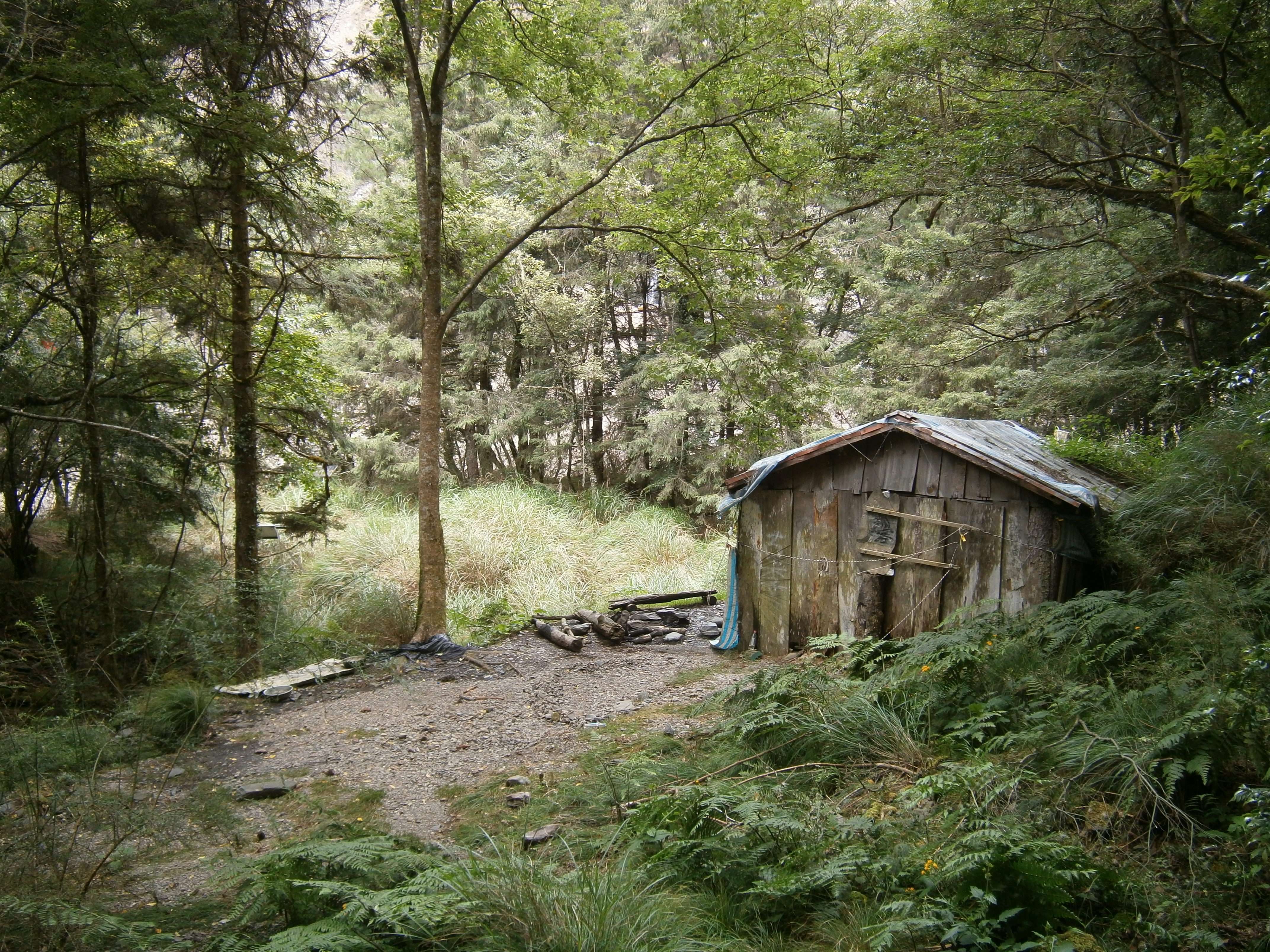
A short distance downstream I found the Nanhu River cabin.  It is roughly constructed and quite run down, but could be used as shelter if necessary.  Were one to break this trip up over four or five days, the area around the cabin would serve as a decent first night’s campground.

The Nanhu River Cabin.

The Nanhu River Cabin.

Past the cabin a trail leaves the river and heads south, uphill.  This trail was marked with hiking tags.  The overland section here is long, 8.3km according to the map, and ascends some several hundred meters before descending back down to the river on the other side – uphill both ways.  On the other side of the overland trail, another signpost points in the direction of the Zhongyangjian River Cabin (中央尖溪木屋), a further 2.2km along the banks of the river.  To my dismay, I found the Zhongyangjian river swollen and running deep, likely due to the recent typhoon and heavy rains.

The Zhongyangjian River cabin is a further 2.2km south once the route rejoins the river.

The Zhongyangjian River cabin is a further 2.2km southeast once the route rejoins the river.

The river was deeper than anticipated.

The river was deeper than anticipated.

From here on the route follows the Zhongyangjian river to the base of Zhongyangjian Shan itself.  It had been a long day, and I decided to stop here and pitch my camp in a clearing near the river.  I would use this campsite for the next two nights.

My campsite for two nights.

My campsite for two nights.

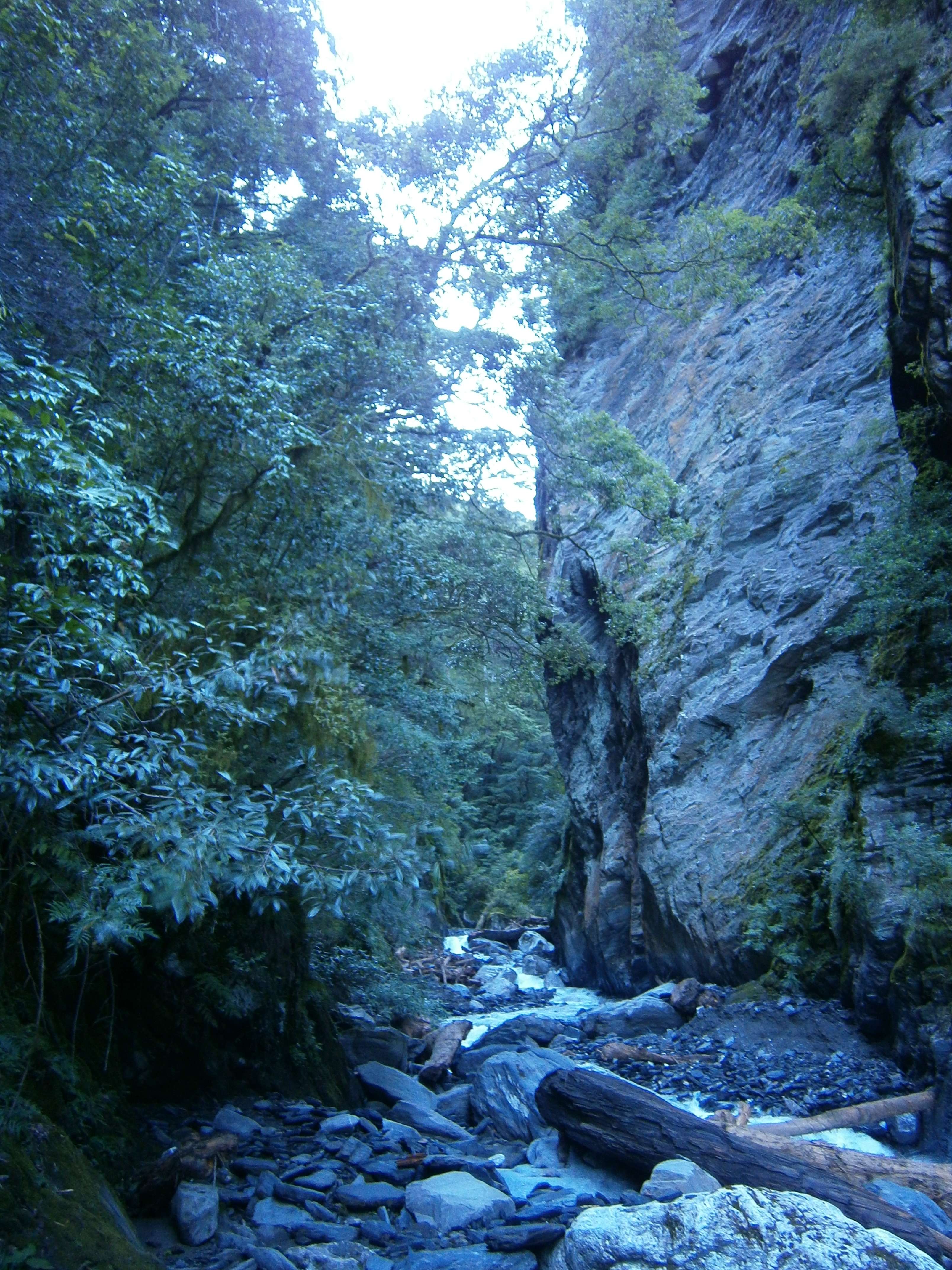
Day 2: Up early, I began following the river southeast towards the Zhongyangjian River Cabin. This section of the route follows rocky riverbanks, but frequent crossings are required due to the cliffs which line both sides of the water and occasionally protrude over the water.  This became very taxing, as with the water higher than expected there was usually no means of crossing the river without getting wet.  After taking my boots off for the first two crossings I gave up and kept them on, guaranteeing wet feet for the rest of the day.

Looming rock walls framed sections the river.

Looming rock walls framed sections of the river.

A nice waterfall at a bend in the river. just before the Zhongyangjian River Cabin.

A nice waterfall at a bend in the river, just before the Zhongyangjian River Cabin.

I reached the Zhongyangjian River Cabin and took a short break to take a look inside.  A little trail off of the river makes the cabin hard to miss.  Similar to the Nanhu River Cabin, the hut is crude and run down.  Another good area for camping, but staying in the hut itself wouldn’t be pleasant.

The Zhongyangjian River Cabin.

The Zhongyangjian River Cabin.

The very basic cabin interior - it looked leaky!

The very basic cabin interior – it looked leaky!

Continuing along the riverside, now moving south, the river grew narrower and crossings were more frequent.

The river grew narrower, its walls more defined.

The river grew narrower, its walls more defined.

The river cuts through rock, creating some visually interesting terrain.

The river cuts through the rock, creating some visually interesting terrain.

Further upriver, I finally caught sight of Zhongyangjian Shan in the distance.  Clouds were moving overhead and granted only brief windows of view.

My first glimpse of Zhongyangjian Shan.

My first glimpse of Zhongyangjian Shan.

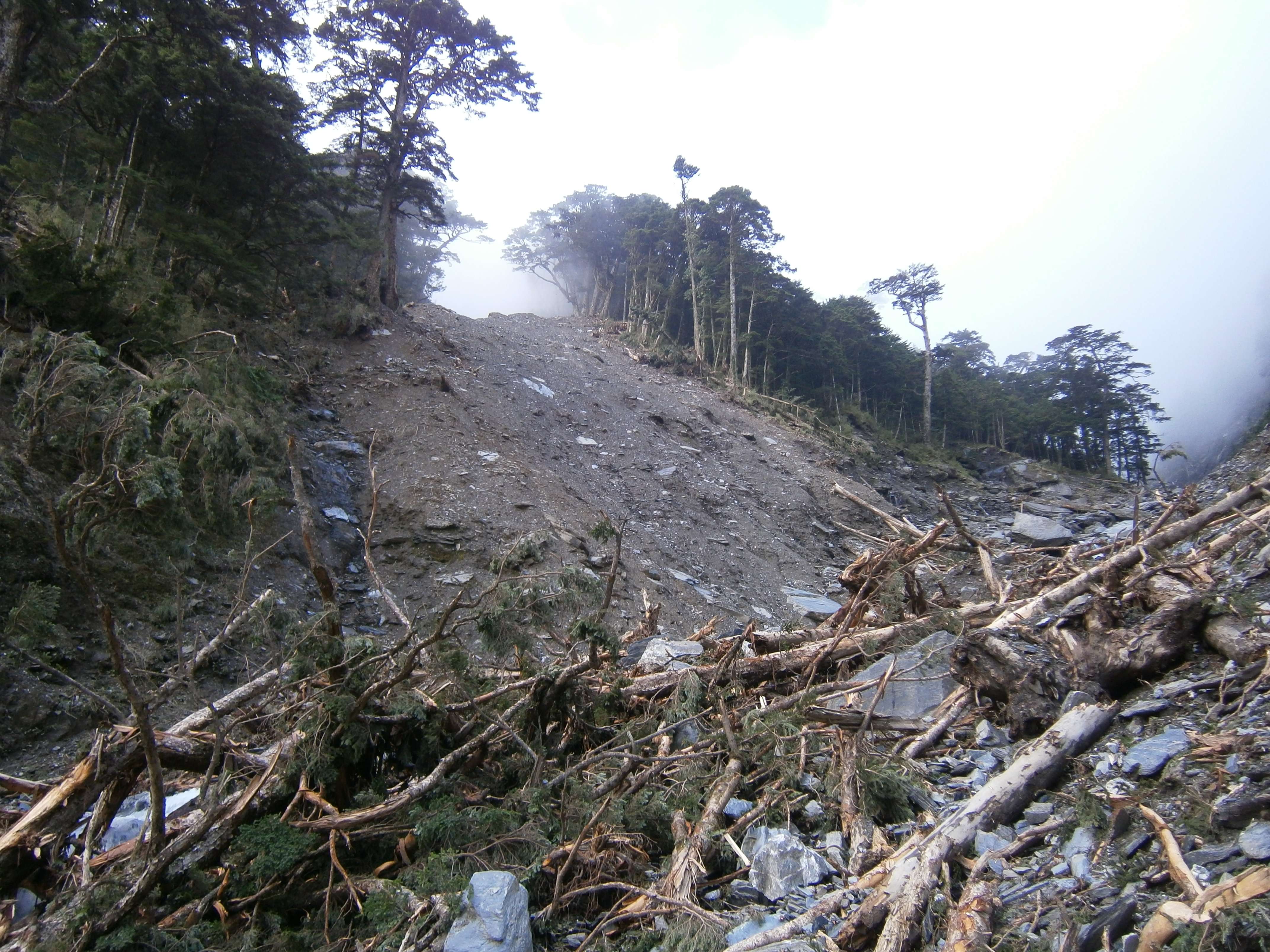
Near the base of the mountain the terrain begins to get steeper, and the river continues uphill.  Huge, freshly collapsed landslides had wiped out sections of forest along the riverbank, and clogged the river with debris.

Looking upriver towards Zhongyangjian Shan, the river obstructed by landslides.

Looking upriver towards Zhongyangjian Shan, the river obstructed by landslides.

Going was slow here, as the only way forward was through a mess of trees, branches, rocks, and dirt.

In the middle of one of the worst sections.

In the middle of one of the worst sections, Zhongyangjian Shan in the distance.

Looking back at the landslide below.

Looking back at the landslide below.

Continuing upriver, another cliff had to be overcome.

Continuing upriver, a small cliff had to be circumnavigated.

Ahead I could see the mountain through brief gaps in the clouds churning overtop.  The river tapered off, replaced by a moderate slope of loose scree.

Zhongyangjian Shan waited ahead.

Zhongyangjian Shan waited ahead.

A scree slope leads to the mountain above the river.

A scree slope continues after the river disappears.

Looking behind me I could see the river and the route I’d taken far below.

Looking down the scree slope from near the top.

Looking down the scree slope, near the top.

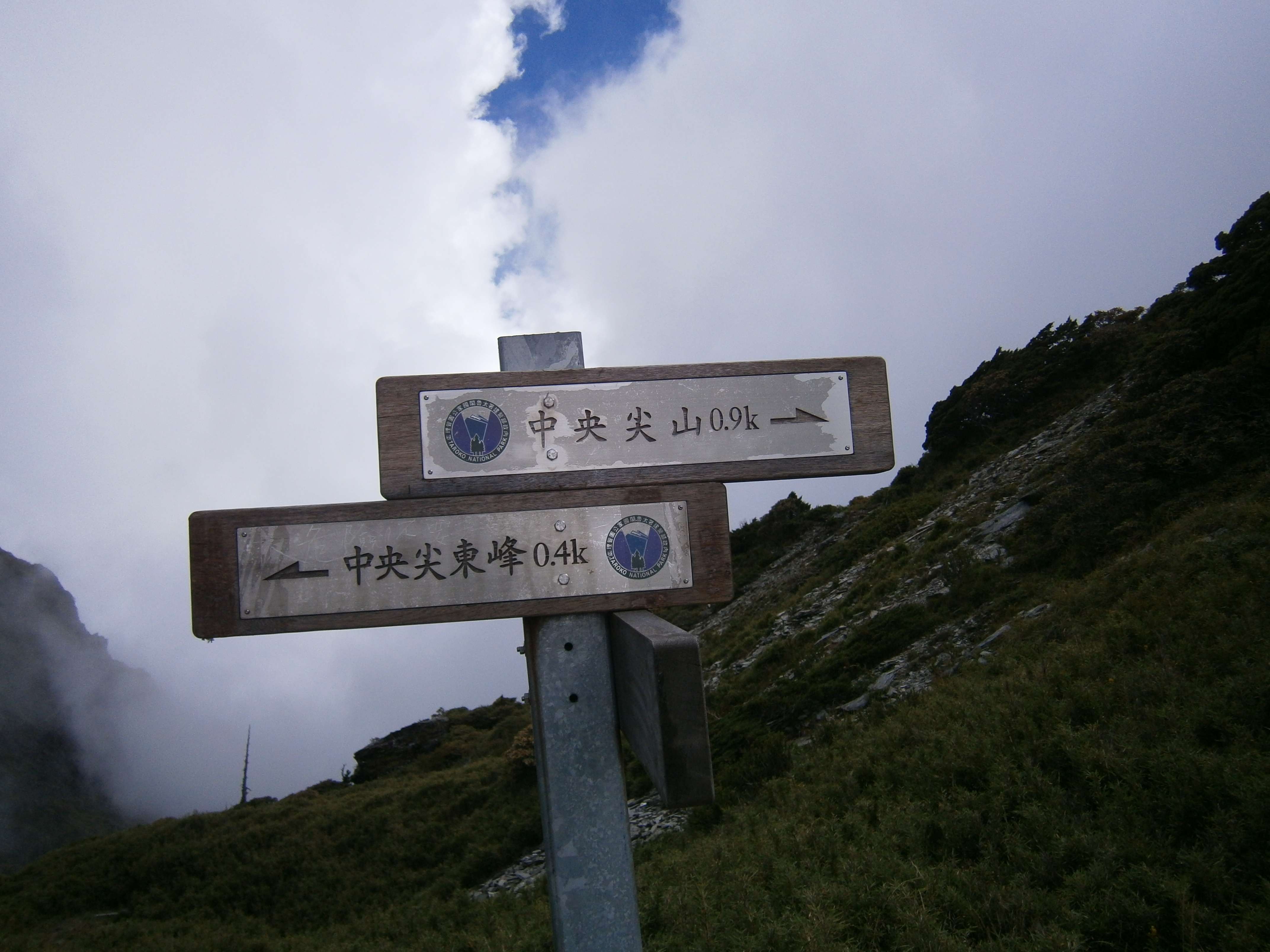
Eventually, the scree breaks onto the saddle between Zhongyangjian Shan’s main peak and east peak.  Up here the ground is covered in grass and even some trees.  As soon as I reached the saddle, clouds rolled in and a light drizzle began.

A signpost marks the saddle at the top of the scree slope.

A signpost marks the saddle at the top of the scree slope, the main peak less than 1km away.

The saddle is covered in vegetation.  Looks like a nice sheltered spot to camp.

The saddle is covered in vegetation.

A usage path leads upwards to the summit.  One final, steep section at the top has mounted ropes.

A path leads to the summit.

A path leads to the summit.

Ropes just below the summit.

Ropes just below the summit.

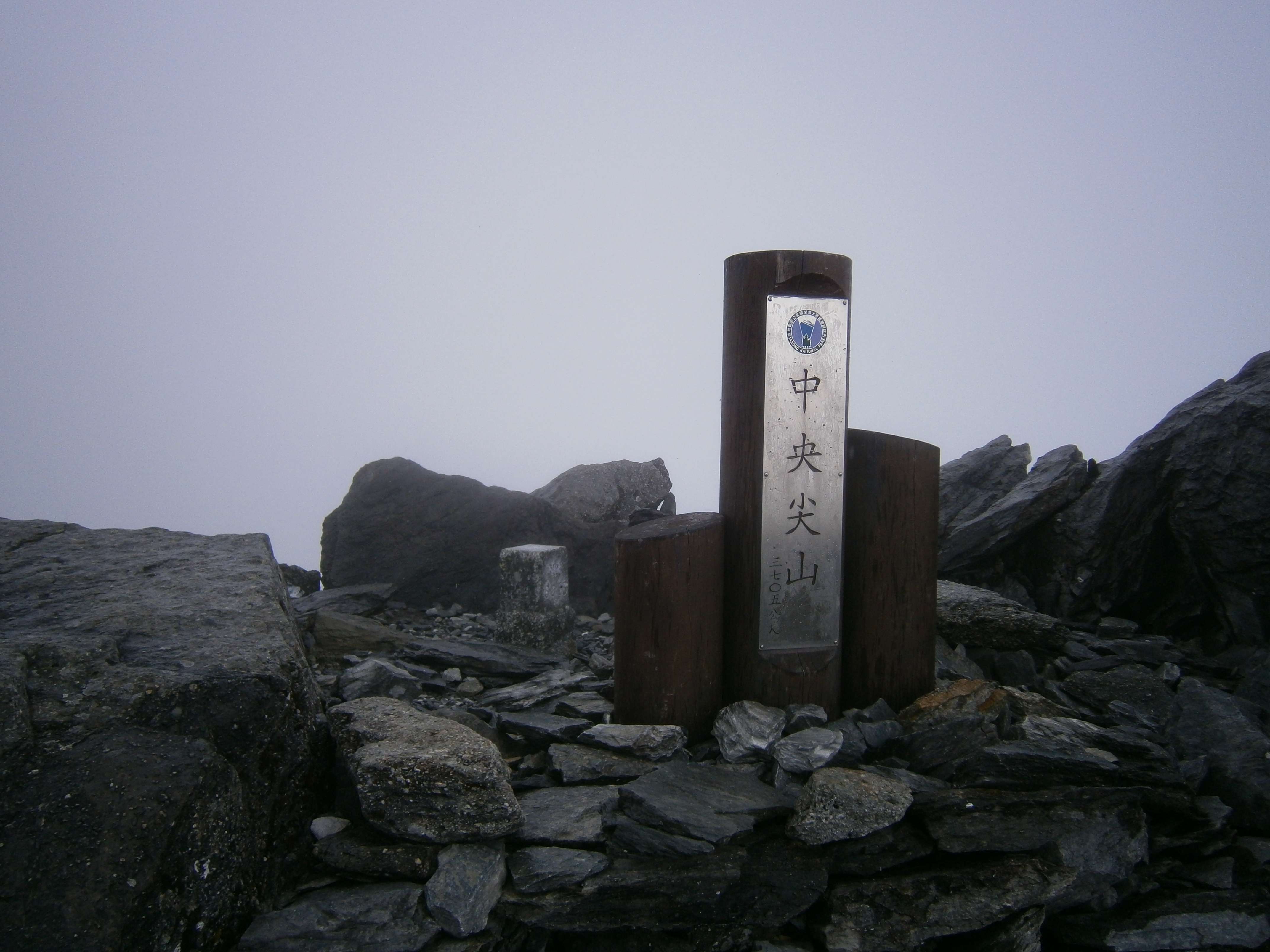
At the top I stayed long enough to take a few photos, and then began to descend, concerned that the light rain might develop into an afternoon shower, which could make the return trip down the river tricky and dangerous.

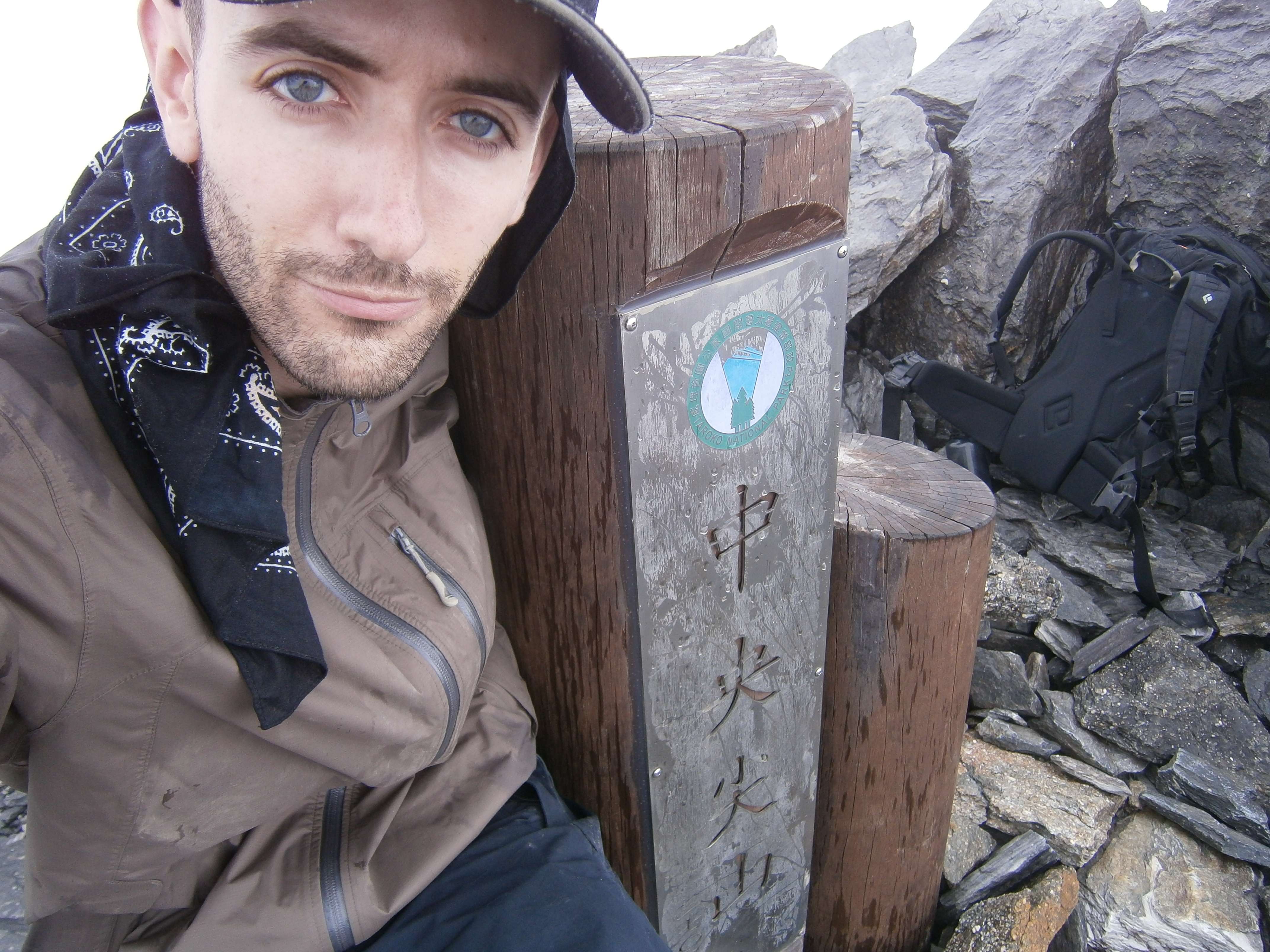
The summit sign.

The summit sign.

Feeling accomplishment, despite the clouds and lack of view.

Feeling accomplishment, despite the clouds and lack of view.

On the way down the clouds moved onwards, and blue skies returned.  This would be my final view of the mountain – clouds would return soon and obscure it for the rest of this day, and all of the next.  After seeing Zhongyangjian Shan in the distance so often during other hikes, its fierce shape compelling me to plan a climb, the mountain’s continually clouded presence seemed somehow symbolic.

A short window in the clouds.

A window in the clouds gave me a final view.

On the way down I stopped to take better photographs of the large landslides along the river.

A closer look at one of the landslides near the base of the mountain.

A closer look at one of the landslides near the base of the mountain.

The recent typhoon had taken out swathes of forest along the river.

The recent typhoon had taken out swathes of forest along the river.

From my vantage point uphill, I could see that the much of the debris I had encountered earlier came from the landslides above.

Debris in the river.

The debris-filled river from above.

Near my campsite, I found what appeared to be fresh deer tracks in the mud.

Tracks in the mud.

Tracks in the mud.

By the time I returned to camp it had been a 13 hour day of hiking – much, much longer than planned due to frequent river crossings and slow progress over the landslides.

Day 3: I packed up camp, and headed back overland towards the Nanhu River Cabin.  My route out was identical to my route in, with no exceptional differences to the first day of the trip.  Of note, the section of stream which had taken me down towards the Nanhu River Cabin was slower and trickier on the way up and out.

Back at the first trail split, on the ridge which leads to the Yunling cabin and Nanhuda Shan, I was delighted to find a perfect, clear view into Syue Ba National Park.  Zhongyangjian Shan, unfortunately, remained cloud covered and was not visible to the south.  On the ridge I met a pair of hikers headed for Nanhuda Shan, the first people I’d encountered in three days.

A lovely view of Syue Ba National Park and some of its mountains.

A lovely view of Syue Ba National Park and some of its mountains.

Back at the trailhead, some 11 or 12 hours of hiking from my campsite, I hitchhiked all the way home with a truck driver hauling vegetables from rural Ilan into Taipei City.  We made several stops across Ilan county to load up bundles of cabbage and other produce.  I couldn’t have been luckier, not only was the road leading to the trailhead damaged and traffic very sparse, but the trucker’s drop off was close to where I’d left my motorcycle in Taipei, just one MRT stop away.  Riding with this trucker was an experience unto itself, and gave me an interesting firsthand perspective on rural Taiwan.

Hiking Zhongyangjian Shan was one of the best mountain trips I’ve had in Taiwan.  The mountain is very remote, with an approach lengthy enough for a solid multi-day trip.  Hiking Zhongyangjian Shan alone really immersed me in the environment of the mountain; the final portion of the route up the river was especially memorable.

Accessibility

Once past the Nanhu River Cabin, there are several good spots for camping along the route, with reliable water from the river.  Officially, however, one is only supposed to camp at the cabins themselves.  Past the Zhongyangjian River Cabin, there are no areas large enough to accommodate camping until one reaches the Zhongyangjian Shan saddle.

The Nanhuda Shan trailhead, also the entry point for a Zhongyangjian Shan hike, is fairly easy to access.  Take a bus or train to Yilan City or Luodong, and rent a motorbike.  Alternatviely, a taxi in costs around NT$2500.  Be sure to check road conditions beforehand – the road is typically damaged or even wiped out after a big typhoon.

Hiking Zhongyangjian Shan requires national park entry permits from Taroko National Park, as well as Police issued mountain entry permits. The park entry permit requires two Taiwanese group members; one as the “group leader”, and one as the “emergency contact”.  I did this hike alone, but still needed to have a Taiwanese friend on my permit.  The Taroko National Park permit website (In Chinese) is located here:
http://permits2.taroko.gov.tw/welcome/index.aspx
Police permits can be applied for here (In Chinese).  For the website to load, you need to use Internet Explorer (other browsers do not work with this website) and adjust the encoding for ‘Chinese Traditional, Big5′ (found through Page -> Encoding):
http://eli.npa.gov.tw/E7WebO/index02.jsp

Mount Meru – August 2012

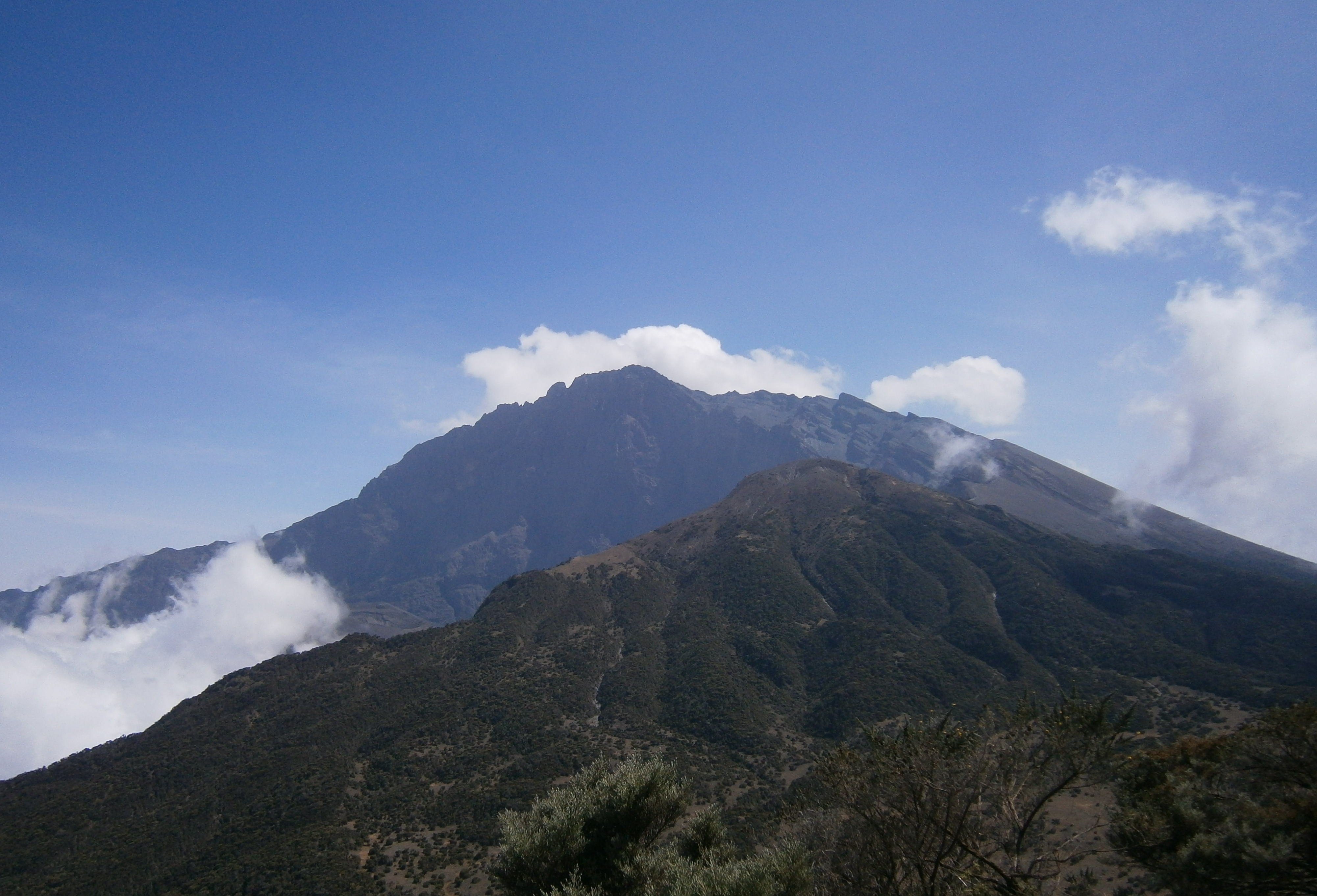
Mount Meru.

4566m Mount Meru is Tanzania’s second highest mountain, a prominent volcano near the city of Arusha.  It is speculated that Mount Meru may have once been larger than Kilimanjaro, as a large eruption ~8000 years ago destroyed the eastern side of the mountain, greatly reducing its size.    The volcano is still active, resulting in some interesting geographical features.  I hiked Mount Meru as a warm-up and pre-acclimatization for Kilimanjaro.

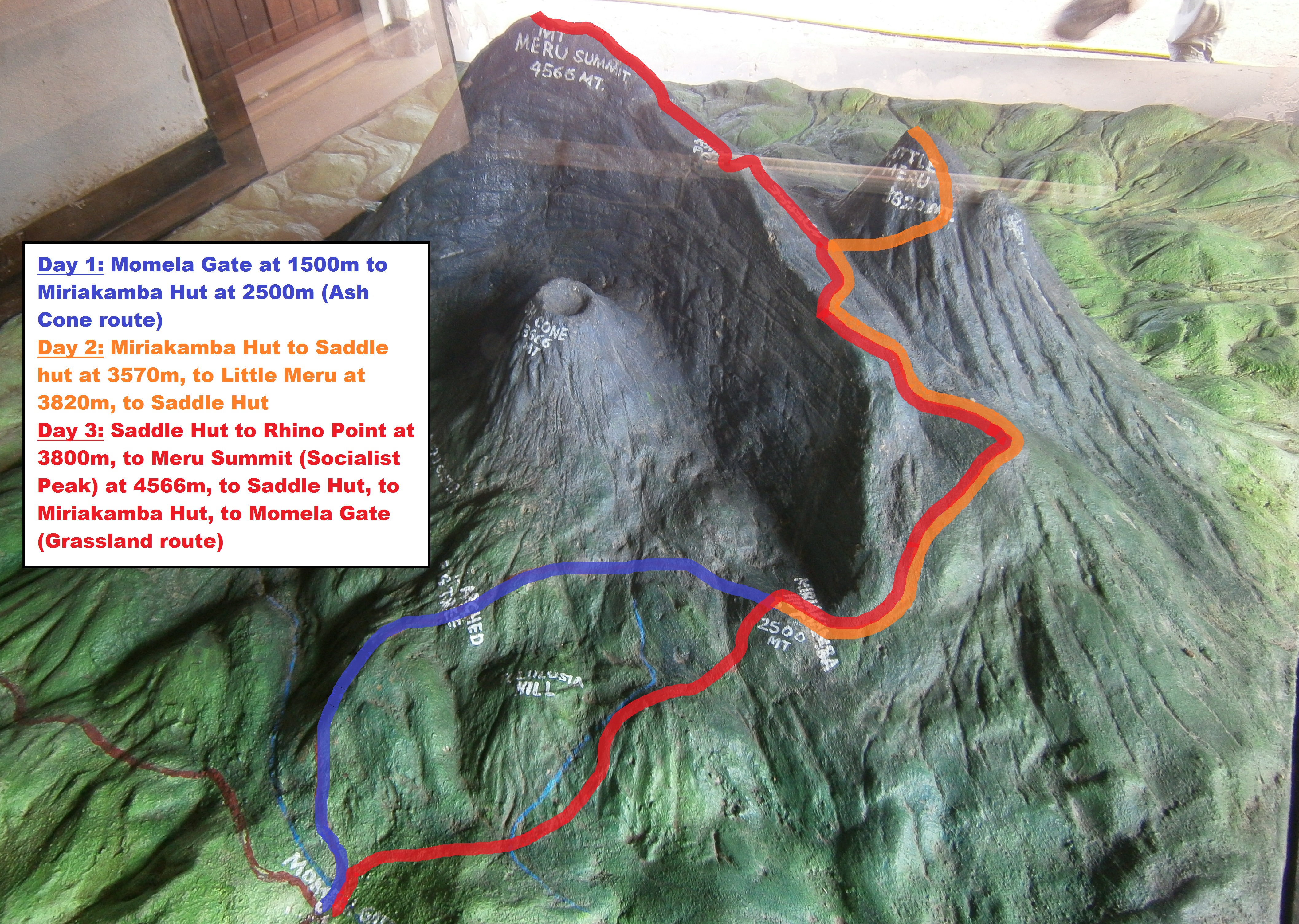
A map of my route.

Day 1: After a short drive to the Arusha National Park, I arrived at the Mount Meru visitor’s center.  There, along with an abundance of information on local wildlife, was the above model with the various hiker’s huts marked.

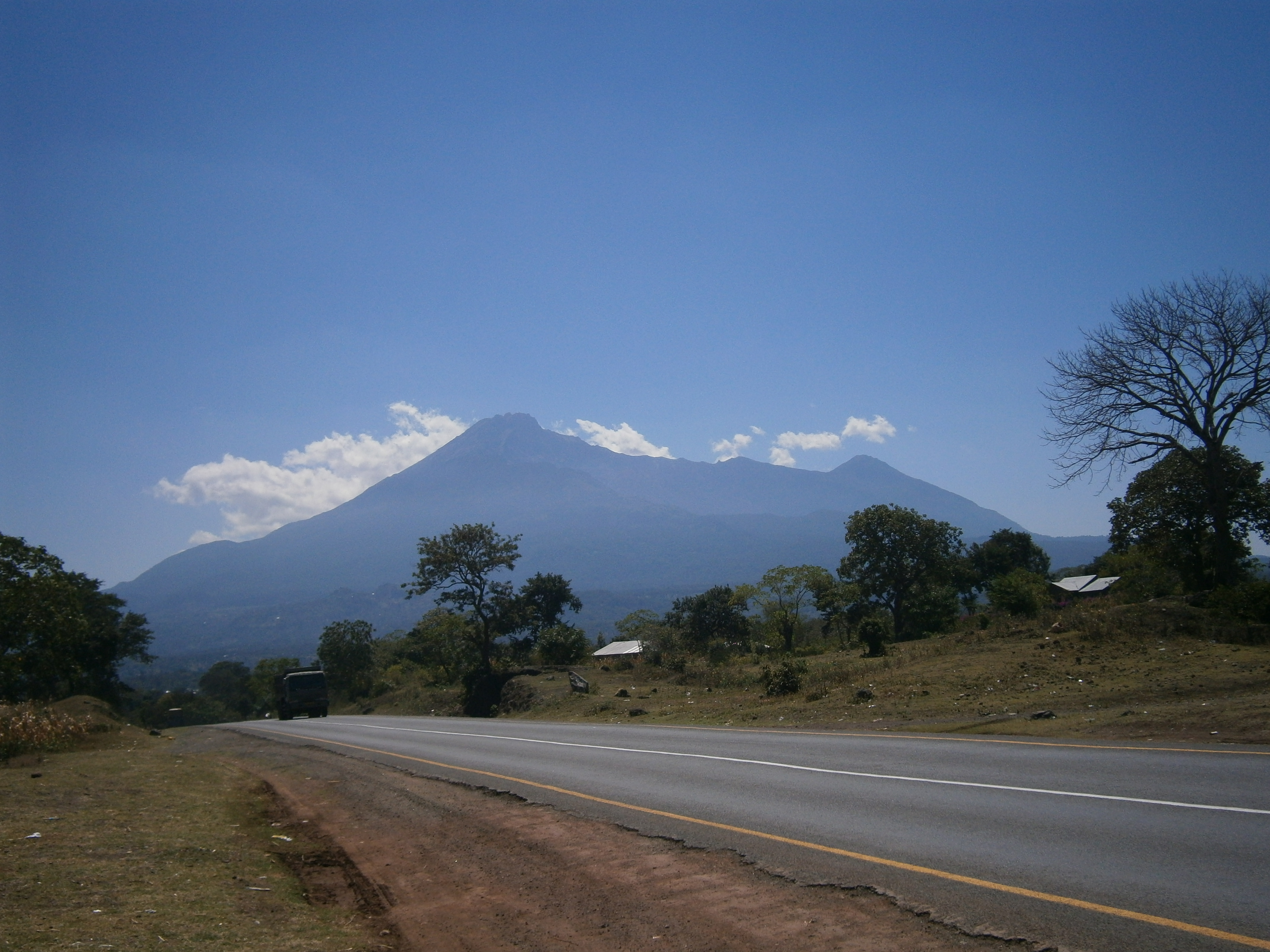
Mount Meru as seen from just outside Arusha.

Mount Meru is fairly prominent, and can be clearly seen from the city of Arusha.

The park ranger, armed with a rifle.

One interesting aspect of Meru is the considerable amount of wildlife inhabiting its lower slopes.  Because of the animals, it is required that one ascend to the first hut accompanied by a park ranger, who carries a rifle.  When asked, he told me that a warning shot would scare off most anything, and that he’d never had to fire on an animal before.

A large fig tree arches over the beginning of the lower trail.

After considerable delay waiting for the park authorities, we began moving up the trail towards the first cabin at 12:30 p.m.  We decided to take the long route up, which would take us through Meru’s crater.

On the mountain’s lower slopes, lovely forest and grassland surrounded the trail.

A small waterfall marked a lunch break.

After about an hour of easy hiking over a gently sloped trail, we took a lunch break at a small waterfall.

These brightly colored plants were abundant on the lower mountain, and in the crater.

Mount Meru’s crater.

As the path continued upwards, we reached Meru’s crater.  While the volcano is still considered active, it hasn’t had an eruption since 1910.  The crater is filled with vegetation, and apparently is often visited by animals.

Interesting trees covered in Spanish moss dotted the crater.

The crater walls are covered in plants and moss, creating a lush impression.

This sign marked the approach to Miriakamba Hut, the first overnight stop.

Moving at a relaxed pace, we reached Miriakamba Hut, the first night’s rest point, at around 4:30 p.m.  At only 2500m, and after a very short day with an incredibly late start, I was quite surprised when the Park Ranger announced we would stop for the day!

The huts were basic and sturdy.

There were huts for sleeping, cooking, and even a washroom.

The cooking hut.

On arrival I went to the cook hut and prepared my dinner.  The room was crowded with porters, preparing meals for their clients.  Here is where I first experienced issues with my stove, a temperamental piece of kit which would later cause much annoyance on Kilimanjaro.  Fuel cells cannot be transported by air, and I was unable to bring a liquid fuel stove/bottle, so I had to source both stove and fuel in Arusha. Almost all hikers in Tanzania use porters – who carry heavy kerosine tanks for cooking – and thus portable propane/butane fuel and personal cooking gear is somewhat difficult to obtain, and of poor quality.

The dorm rooms were sturdy and comfortable.

The rooms were simple but comfortable.  Basic mattresses were provided, and I ended up with a four-person room to myself.

My cabin in the morning.

Day 2: In the morning, a substantial fog had settled over everything.  After cooking up some breakfast, and waiting for the park ranger, I began heading up to the next overnight, Saddle Hut at 3570m.

Part of the trail above Miriakamba Hut – man-made wooden staircases up the mountain.

The trail remained easy and well maintained, with man-made staircases forming large portions of the path.  To this point, between the clear trail and cabin lodgings it didn’t really feel like I was on a mountain at all.

These spiny plants were everywhere, most unpleasant to step in.

The vegetation remained dense.

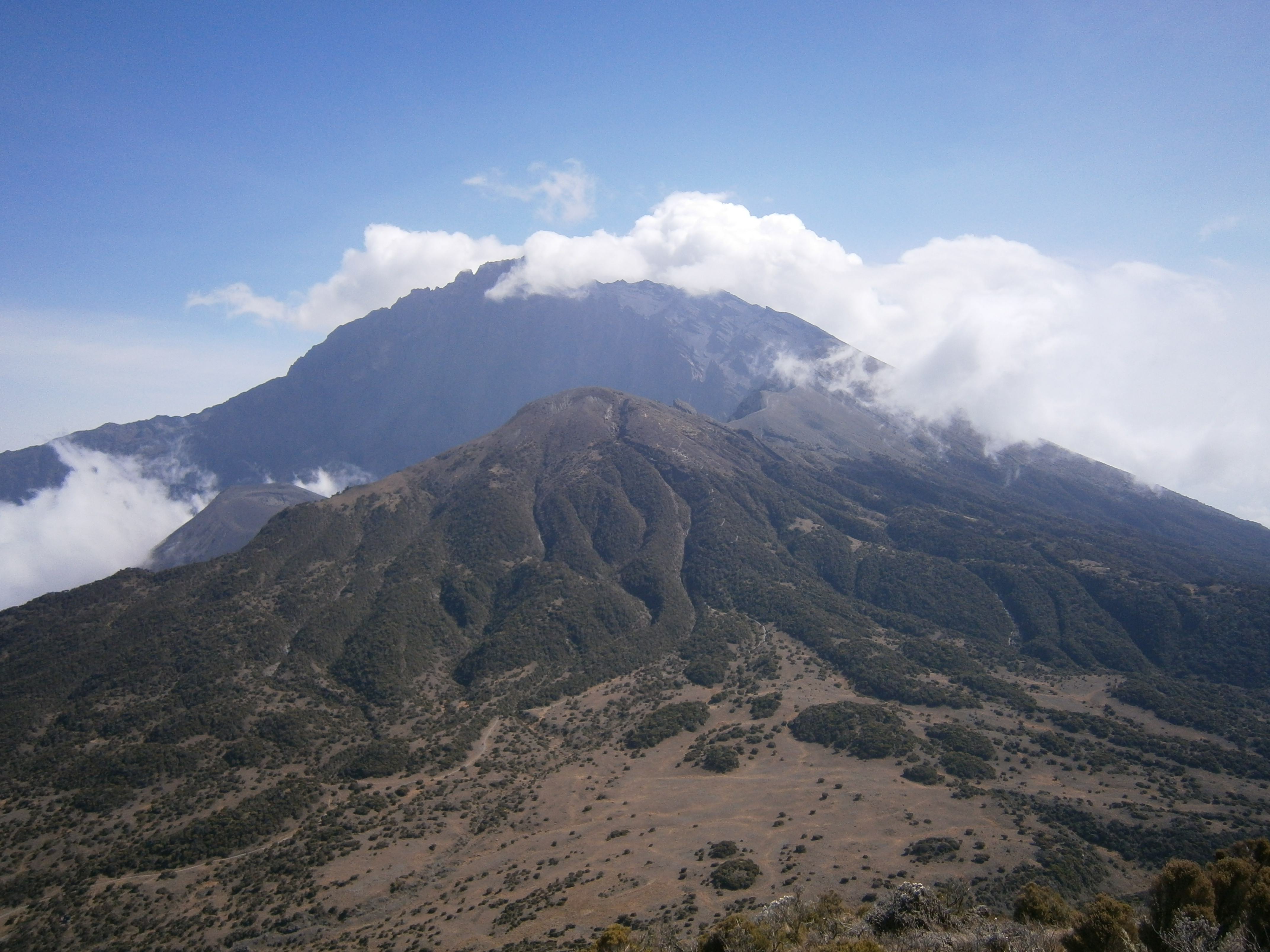
Mount Meru finally became visible.

The fog finally lifted, and a gap in the trees granted a view of Meru’s peak.

Little Meru, which rises above Saddle Hut.

Further ahead, Mount Meru’s secondary peak, ‘Little Meru’, could be seen jutting into the sky.

A lovely cloud ocean on the way to Saddle Hut.

These plants began to appear in great number along the trail.  I would later see fields of them on Kilimanjaro.

The final stretch of trail, prior to arrival at Saddle Hut.

Saddle Hut, clearly signposted like everything else on Meru.

We arrived at Saddle Hut around 1 p.m.  The weather was lovely and sunny, with no trace of the morning fog.  Once again, the park ranger announced that the day was over.  Traditionally, Meru’s summit is hiked overnight, with a ~1 a.m start.

This approach to the mountain – two abnormally short days at low altitude on easy, well groomed trails, followed by one long-haul combining an overnight push to the top and a lengthy descent – doesn’t make a lot of sense.  Unfortunately, schedule on Meru is inflexible, and determined entirely by the ranger.

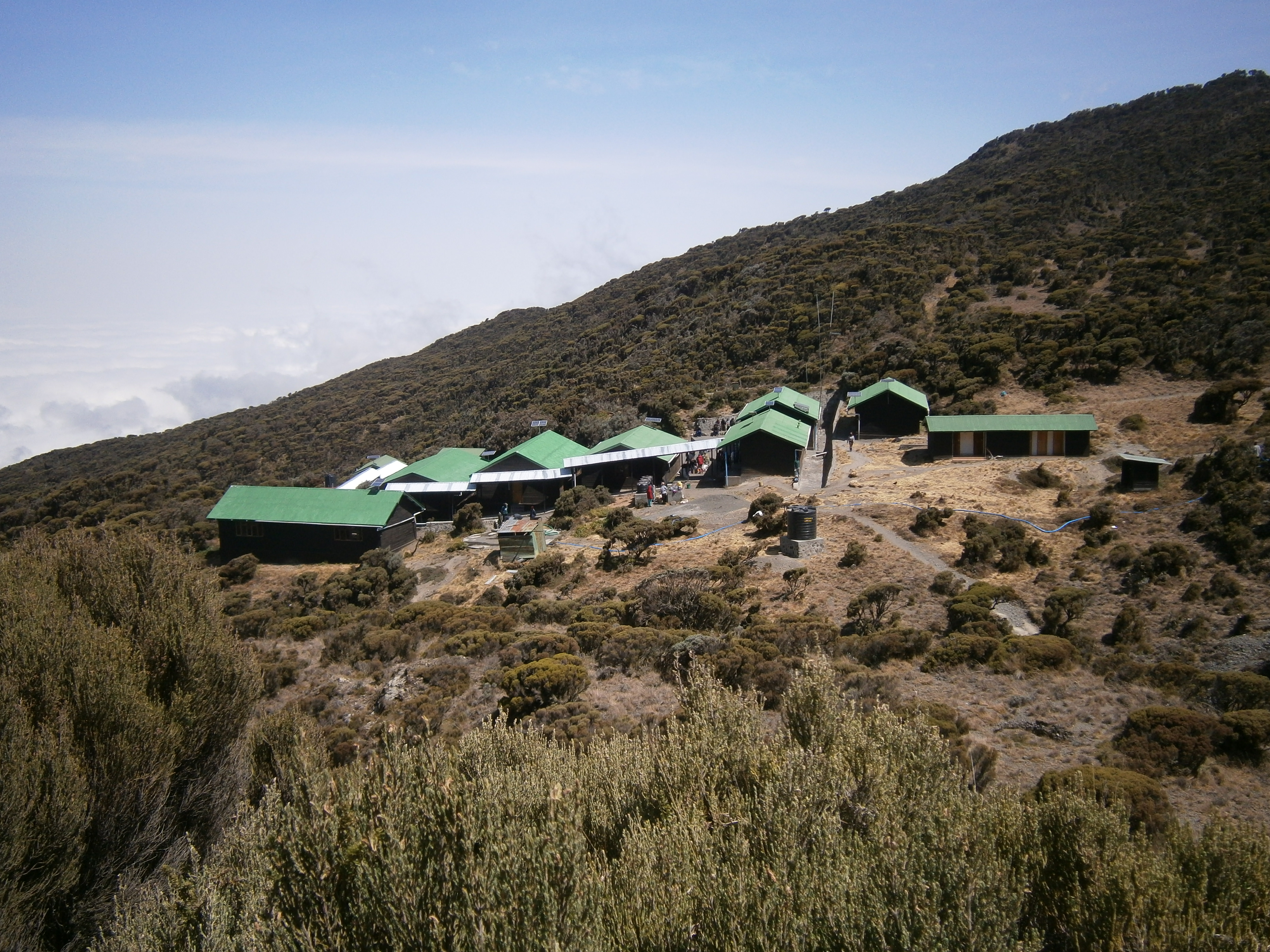
Saddle Hut, much like Miriakamba Hut, provided lodging in dorms.

Similar in design to Miriakamba Hut, Saddle Hut consisted of a number of dormitory style bunk houses, a kitchen room, and toilets.

Ravens were numerous here, hunting for scraps.

Saddle Hut in its entirety.

After unpacking my gear and cooking lunch, I headed up the trail towards Little Meru.

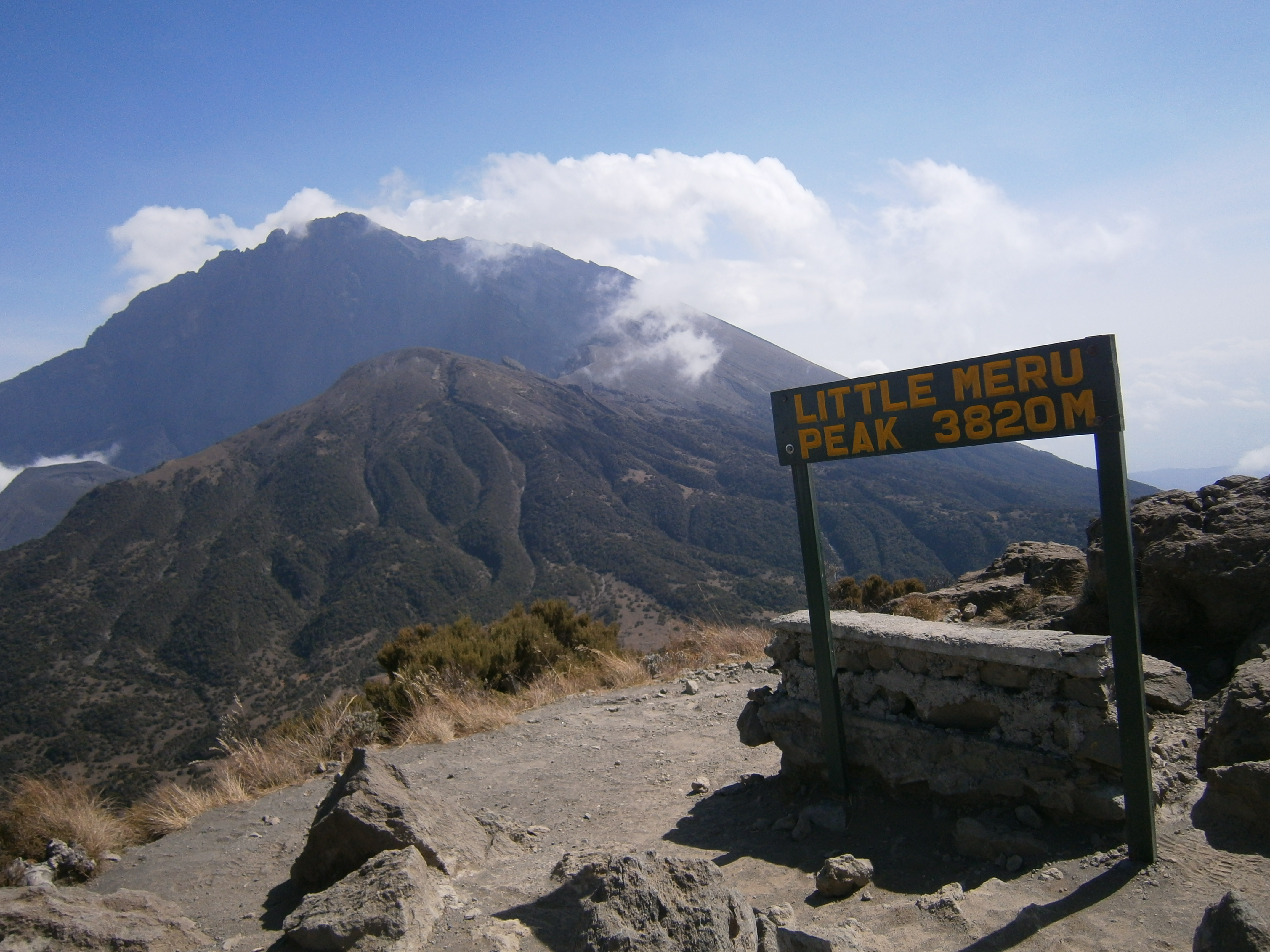
Near the top of Little Meru.

Little Meru Peak.

3820m Little Meru had a great view of Mount Meru’s main peak, and the route I would hike at night.

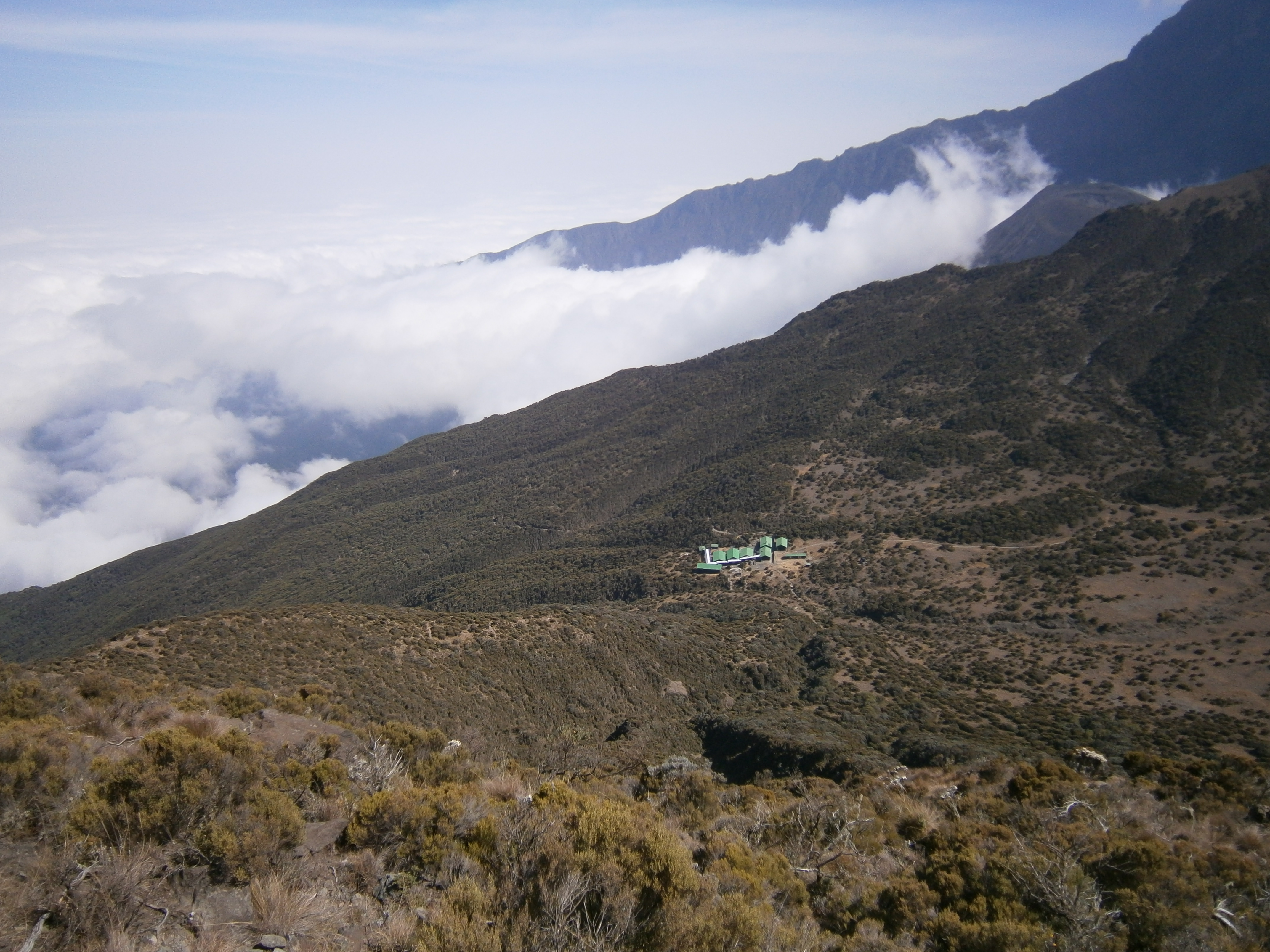
Saddle Hut, far below, from Little Meru.

Clouds rolling over Mount Meru.

Back at Saddle Hut I ate an early dinner, and went to bed around 5 p.m.

Day 2: Awake at half past midnight, and on the route up to the top of Meru at 1:30 a.m.  The weather was foggy, and fairly cold due to wind.  The route followed cairns and spray painted markers, the first time with no clearly defined trail.

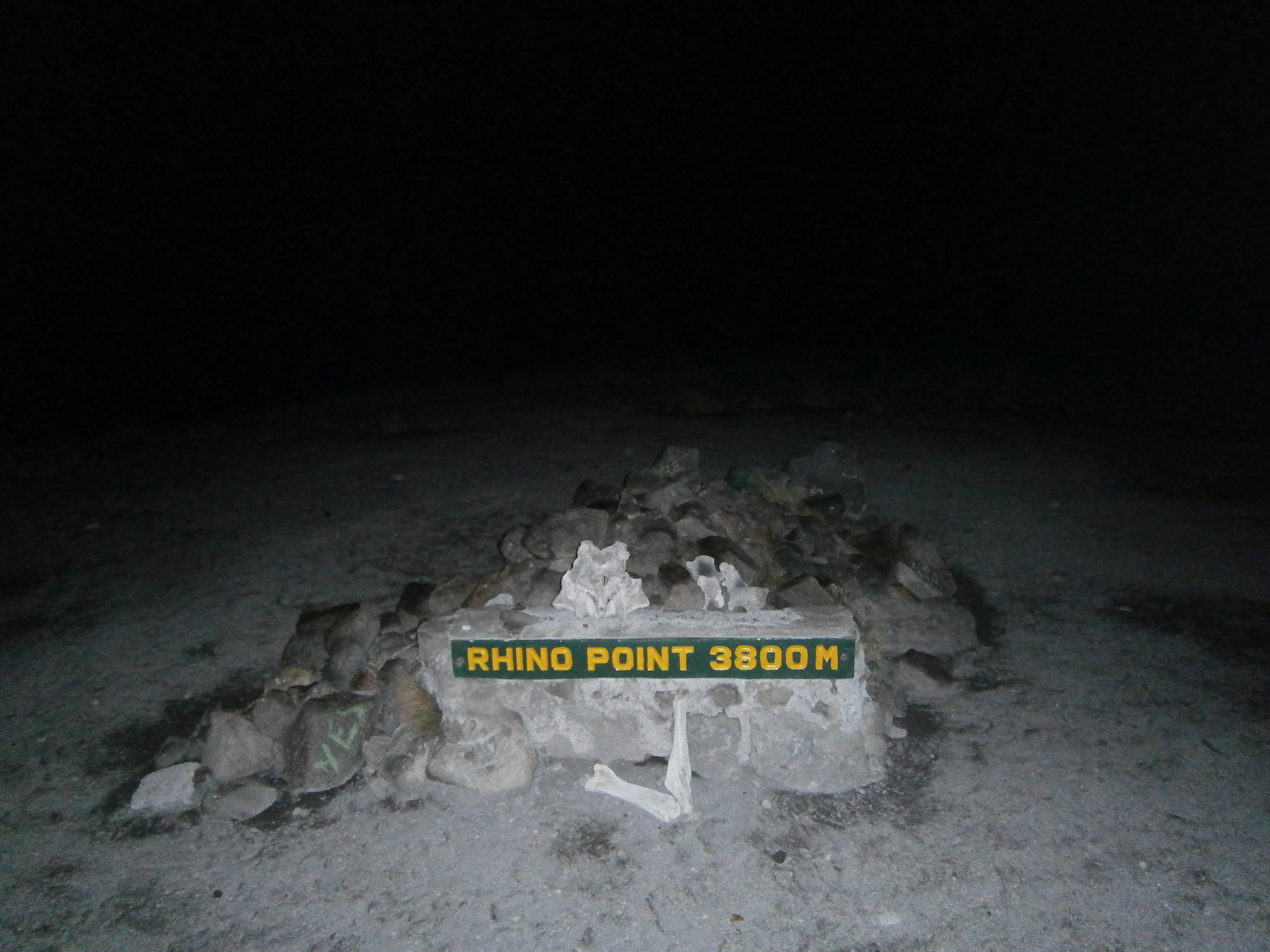
Rhino Point, a hump in the route where it is said a rhino skeleton was once uncovered.

After several hours of steady progress across rough volcanic rock, I reached the summit, Socialist Peak.  The morning fog obscured the views, but the sunrise created a lovely effect, glowing pinkish-orange through the cloud cover.

Mount Meru’s main peak.

With high winds, the mountaintop was cold and felt exposed.

Looking west, where Meru slopes steeply downwards in a field of loose scree.

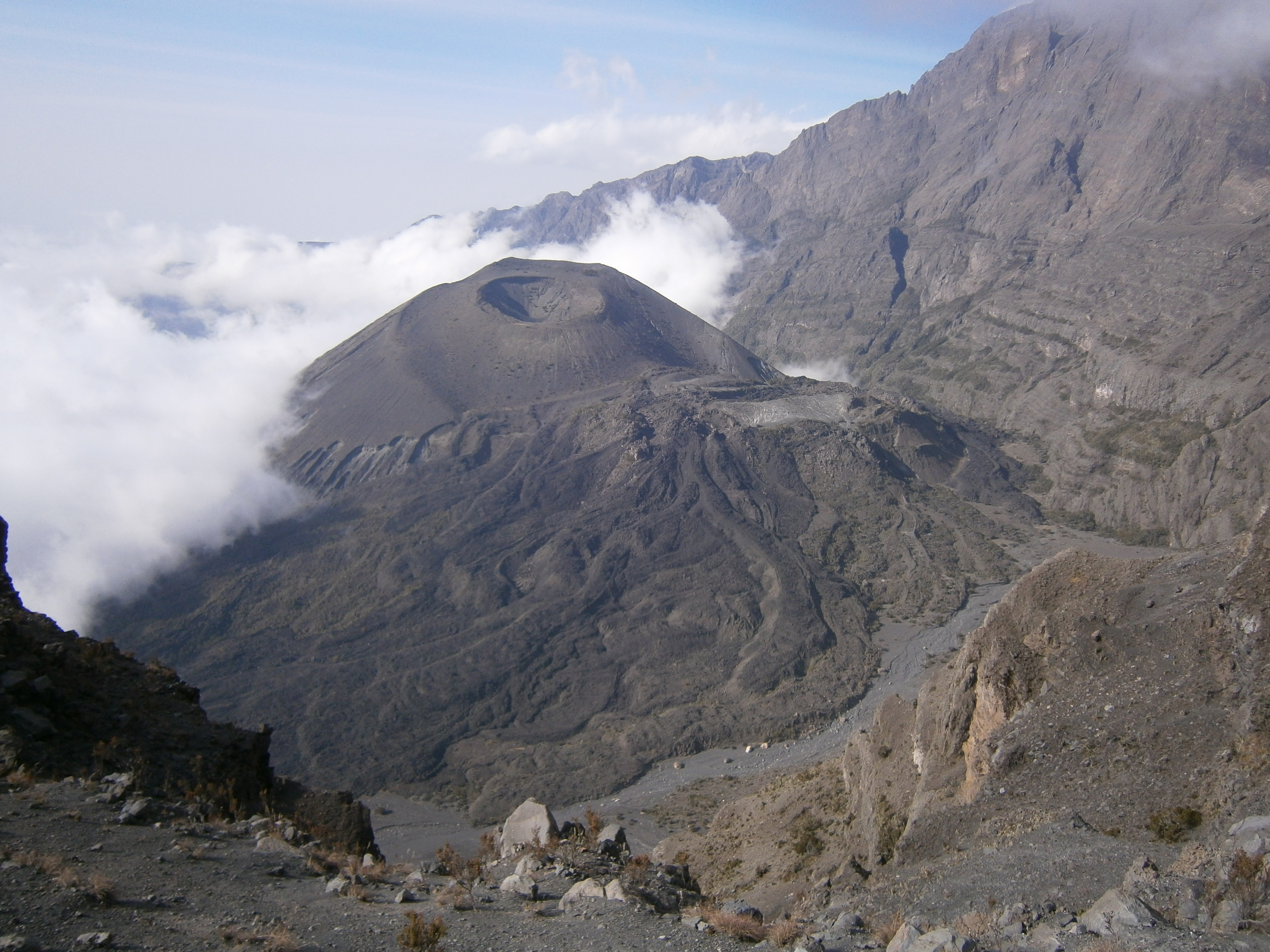
During descent the fog lifted, and provided great views of the volcanic ash cone in Meru’s crater.

The ash cone.

Meru is still considered to be an active volcano, and the large central ash cone is the result of minor activity.

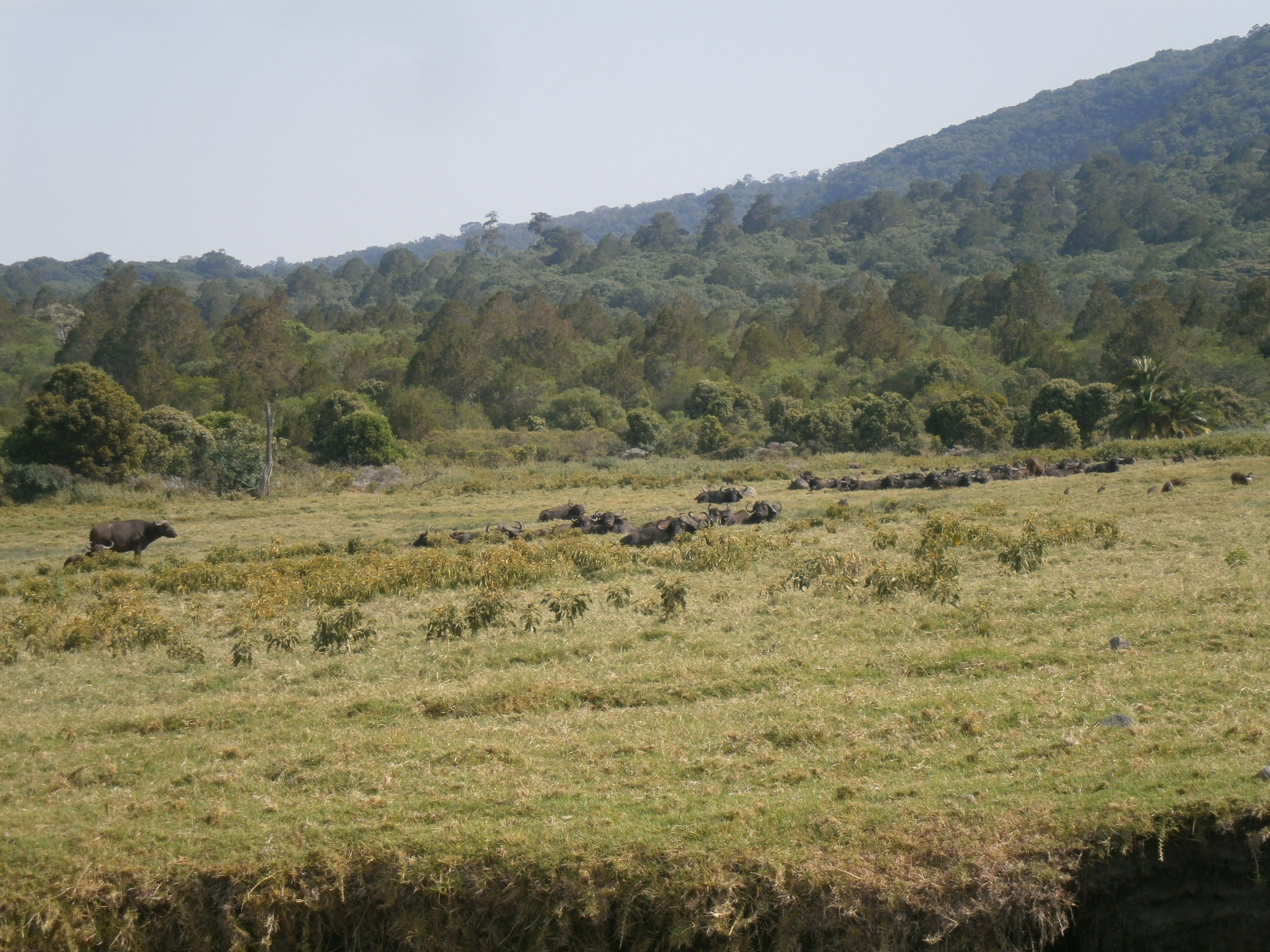
Back at Saddle Hut I packed up the remainder of my gear and began descending.  The entire descent would be undertaken in one shot.  On the way down, I opted to take the short route, avoiding the crater and passing through Meru’s lower grasslands instead.  Here I was lucky enough to encounter some wildlife.

A large herd of buffalo, grazing on Meru’s lower slopes.

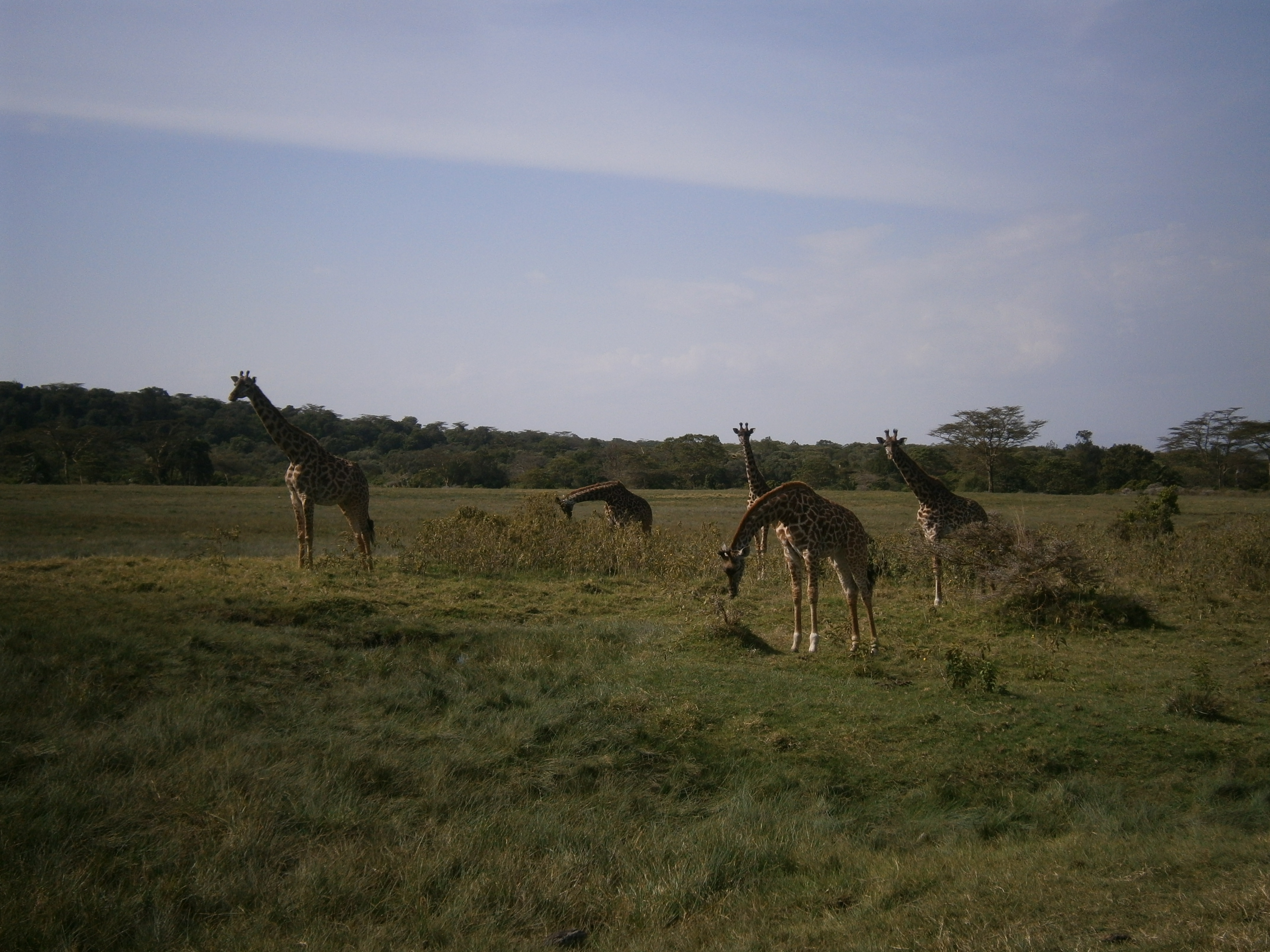
Along with a big herd of buffalo was a family of five giraffes.

The giraffes didn’t seem particularly surprised to see me.

I was told that giraffes, and elephants as well, are a common sight on Meru, where they are protected from hunting.

Back at the park gate I got one last view of Mount Meru, and got a ride back to Arusha with my hired driver.

Mount Meru in the distance.

All said and done, the hike was enjoyable enough, scenic if not particularly strenuous.  As pre-acclimatization for Kilimanjaro, it served well.  A different itinerary would have been more logical and more enjoyable.  The summit definitely doesn’t require an overnight push, and would be far nicer in daylight, clear of morning fog.

Accessibility

Hiking Mount Meru is fairly straightforward.  Fees for cabin lodging are paid at the park, where a Ranger will be assigned to you.  From Arusha, a driver can be hired at minimal cost.

Most outfitter companies which provide services to Kilimanjaro also run hikes on Mount Meru, and can provide full-service with porters, cooks, and a guide.  While the majority of hikers do seem to use porters, the hike is moderate enough that it is unnecessary.  Each cabin has a stable water source, and a light pack can easily be managed due to the indoor lodging.  My pack weighed less than 15kg, with a liberal amount of extra food.  The dormitory rooms are comfortable enough, and have locking doors for storing spare gear.

A good amount of information exists on hiking Meru, and many of the outfitter websites also incorporate detailed planning information.

Mount Kilimanjaro – August 2012

Kibo, Kilimanjaro’s central and highest volcanic peak, as seen from the Mawenzi saddle.

At 5895m, Kilimanjaro is the highest mountain on the continent of Africa.  Kilimanjaro is a massive volcano which has three distinct peaks, Shira (3962m), Mawenzi (5149m), and Kibo (5895m).  Uhuru Peak (“Freedom Peak” in Swahili) is the highest point on the mountain.

Kilimanjaro, as seen from near the airport, is remarkably prominent. Kibo to the left, Mawenzi to the right.

For some time I had been keen on broadening my hiking experience at higher altitudes, and Kilimanjaro seemed like the perfect extension of the hiking and climbing I had been doing in Taiwan.  I planned a 7-day schedule, but ended up finishing in 6.

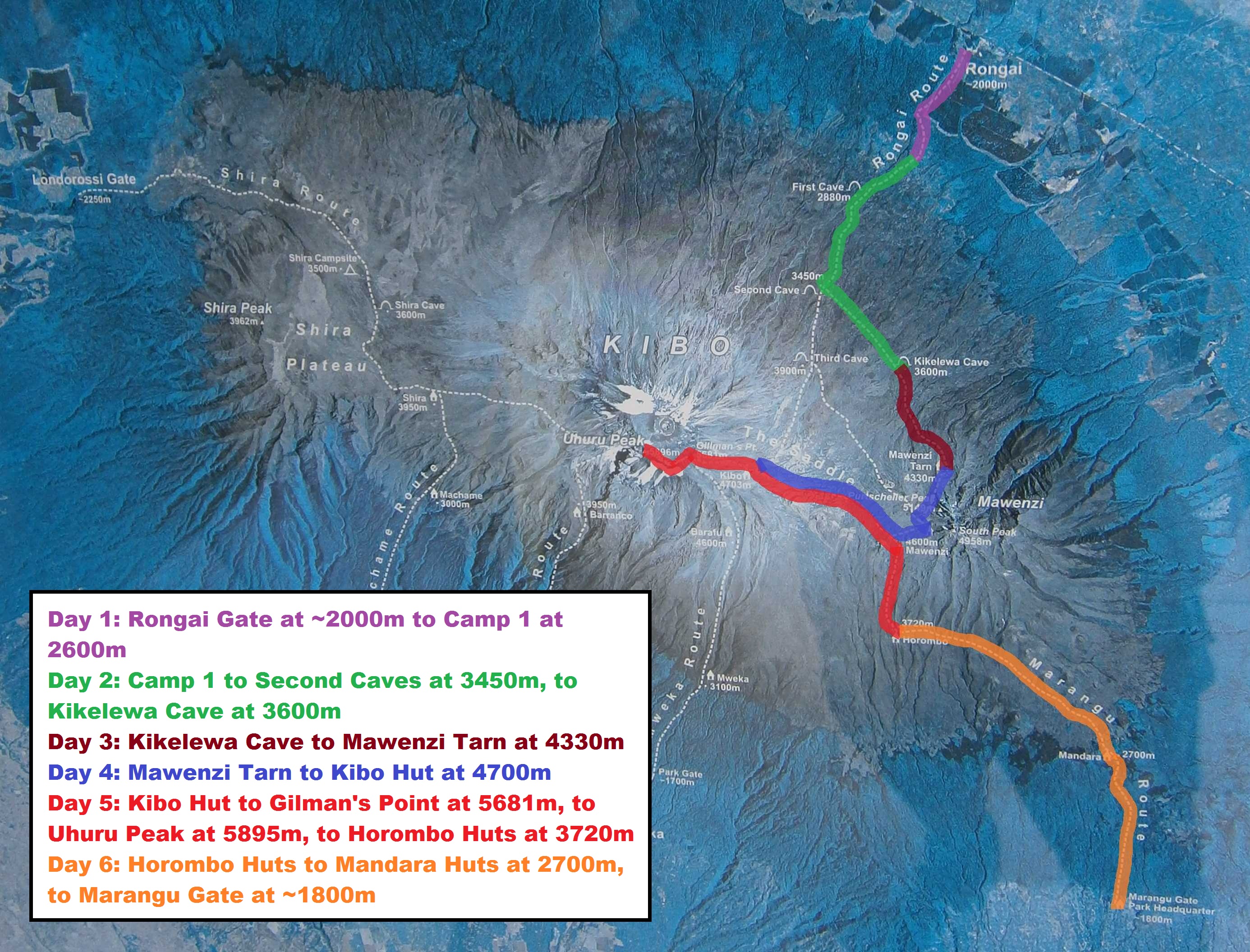
A map of my route.

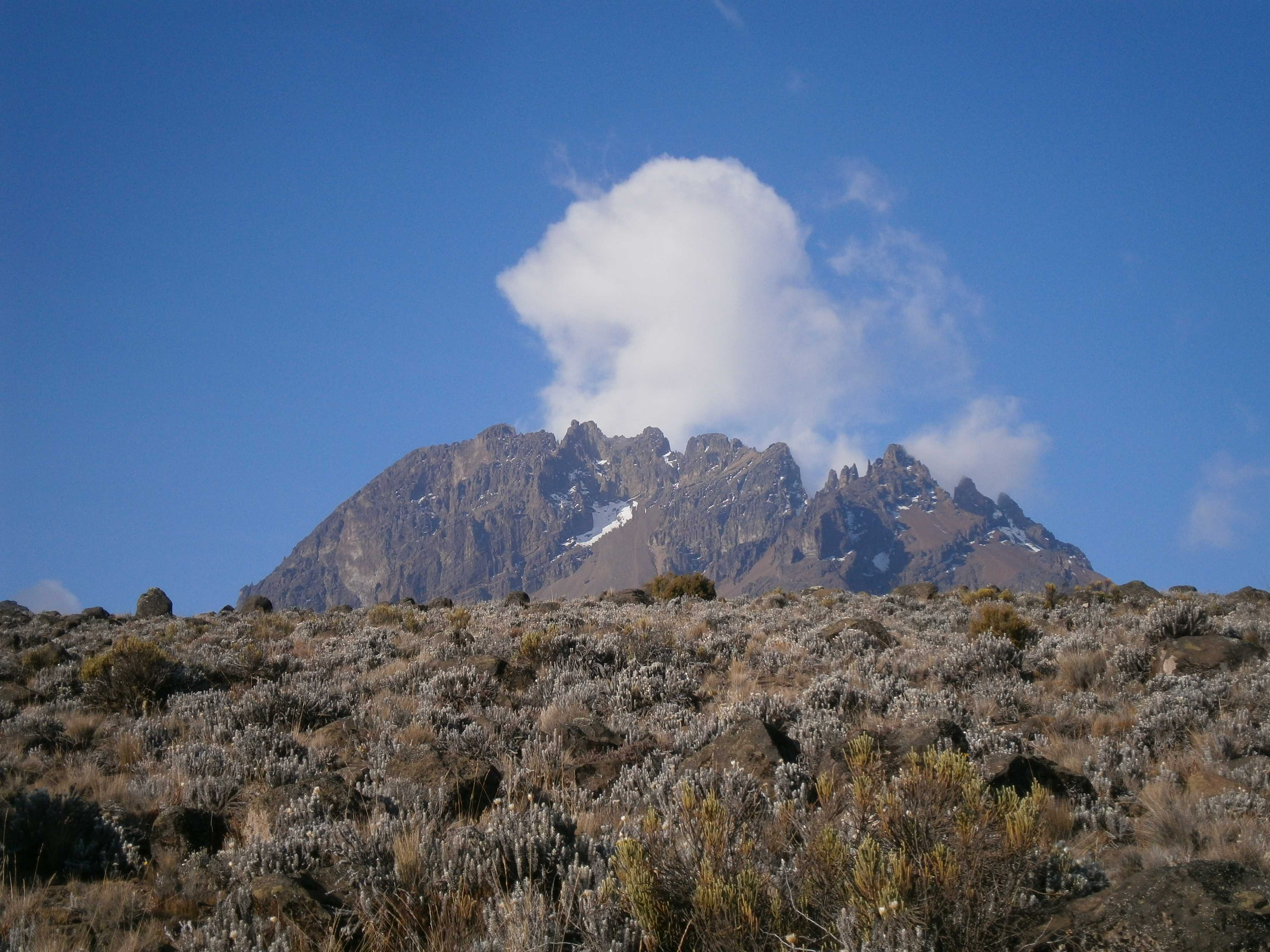
I chose the Rongai route pictured above due to its abundance of acclimatization opportunities, great views and interesting geology.   My route passed below Mawenzi, Kilimanjaro’s second highest volcanic peak.

Prior to beginning Kilimanjaro I spent three days hiking 4566m Mount Meru, Tanzania’s second highest mountain, for additional acclimatization.

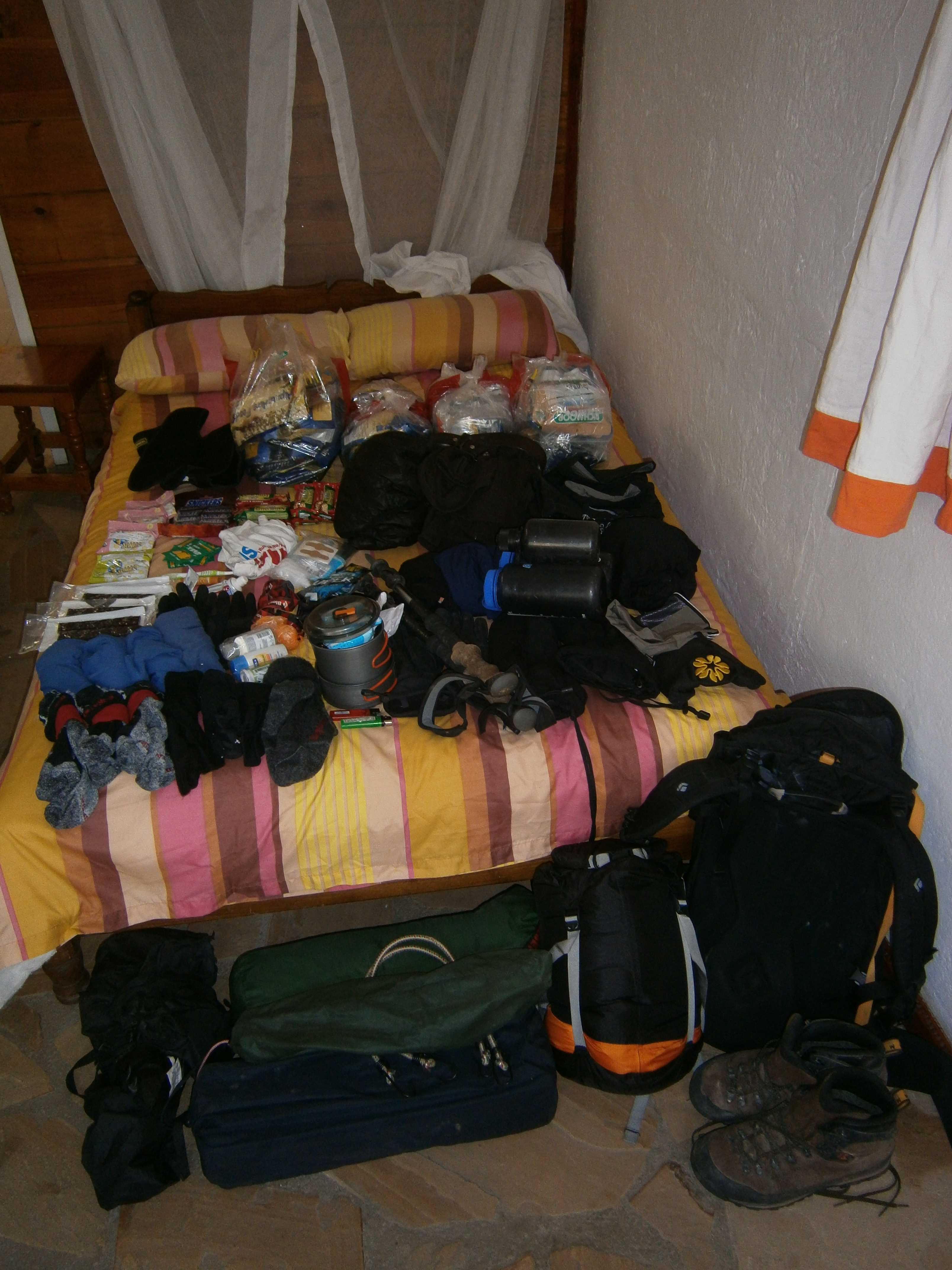
My gear and food supplies for seven days.

Most who approach Kilimanjaro do so with full logistical support – with porters and cooks – but this is not strictly required to access the mountain, as the law only requires the use of a licensed guide.  I decided that I wanted to hike unsupported, and manage my own gear, schedule, food, and water.  I would carry everything that I used, and I would provide everything for myself.  This also made my hike much less expensive, since I didn’t hire porters or cooks.

To obtain my permit, I did have to use a guide.  My guide Jackson was not only great company, but also possessed in-depth knowledge regarding the mountain’s endemic species, and the mountain’s history.

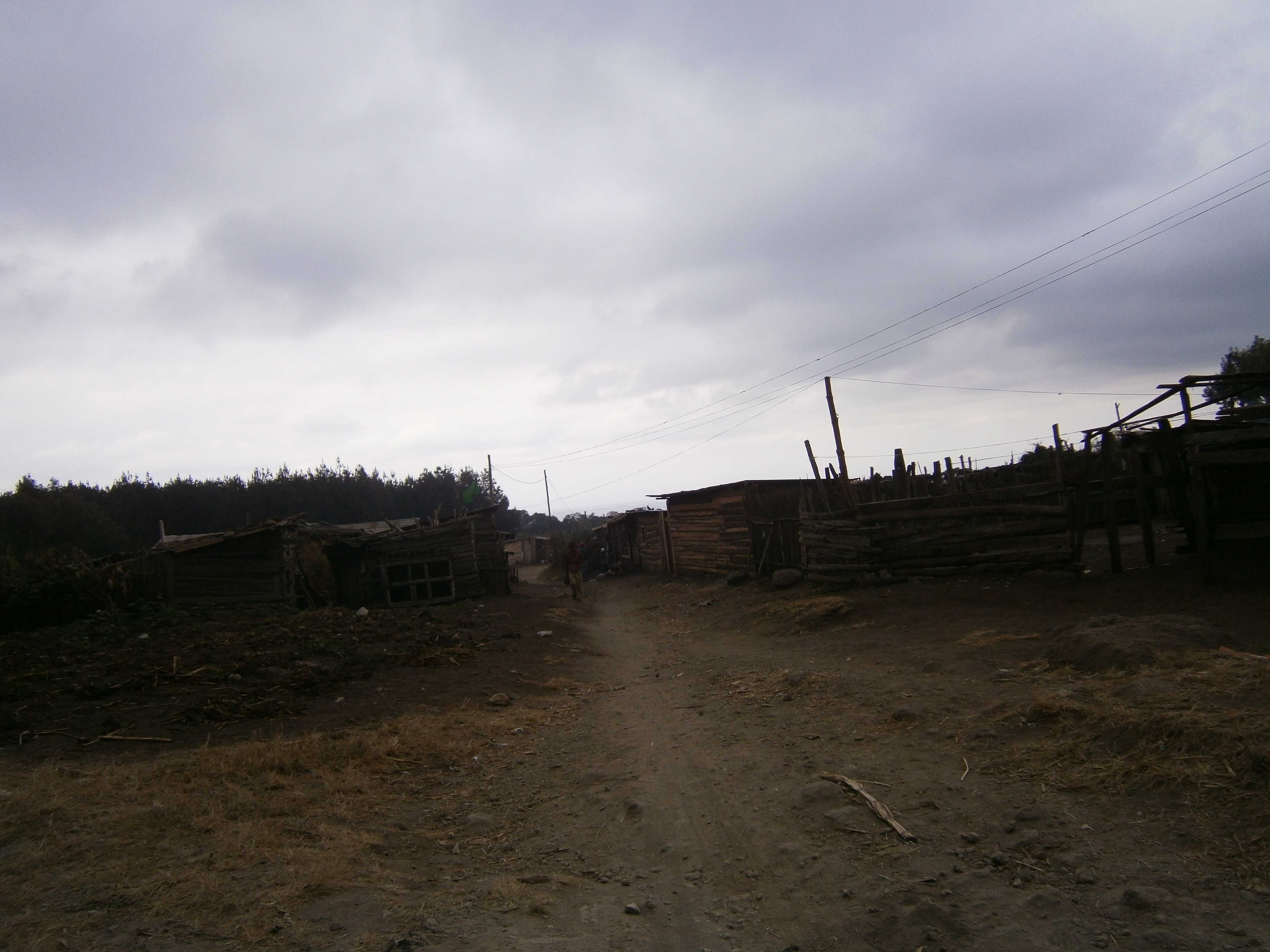
The last village on the way to the Rongai Gate, near Tanzania’s border with Kenya.

Day 1: Met my guide and our driver in Arusha, and drove ~5 hours north to the Rongai gate.  Started hiking from the Rongai gate, 2000m, with my pack weighing in at 21.5kg without water.

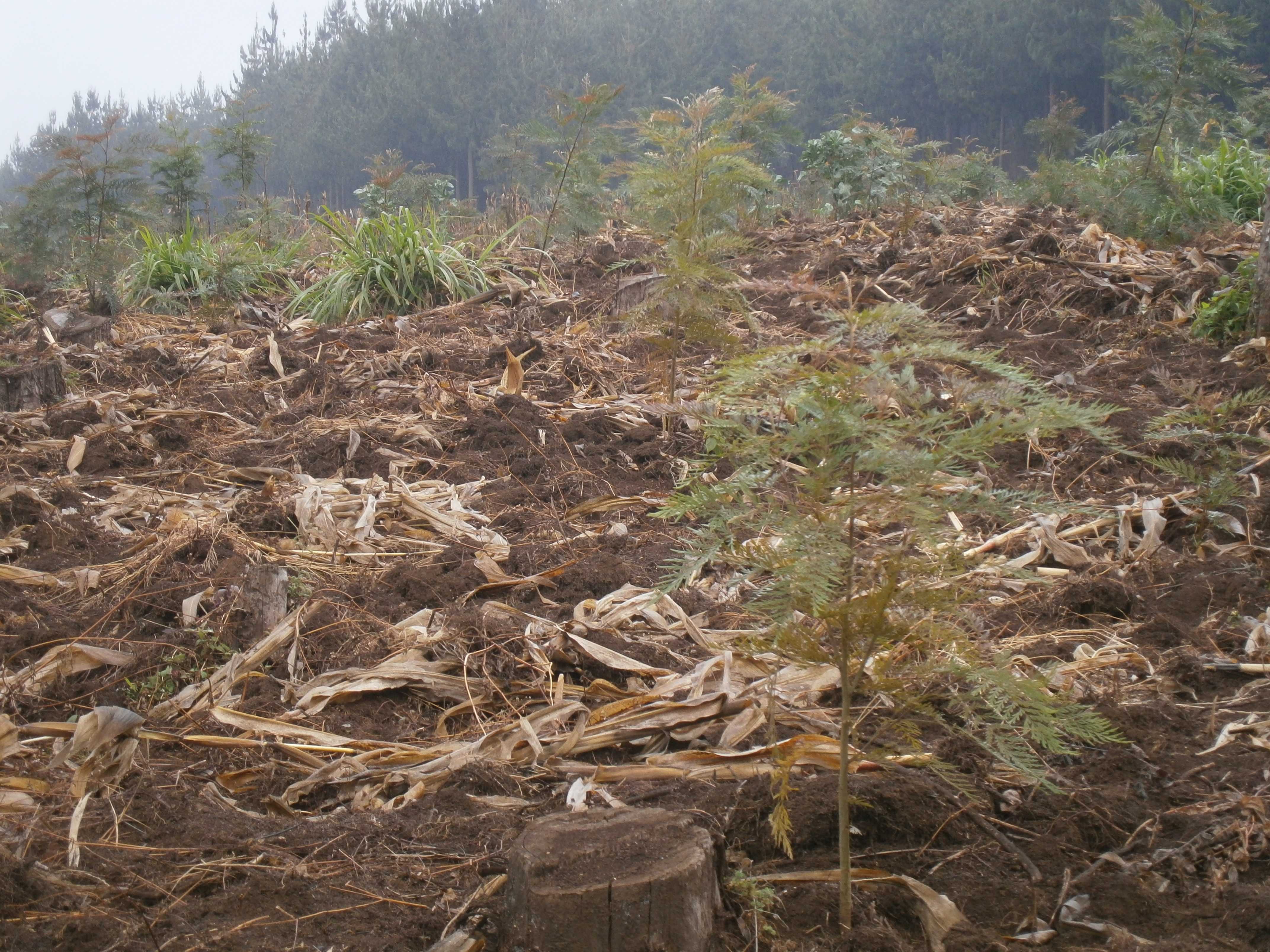
Near the Rongai gate seasonal farming communities grow maize corn.

The Rongai trailhead, marked by a list of warnings.

The area’s maize corn had mostly been harvested. Of interest, the corn is grown alongside trees, to be harvested once mature, several of which can be seen here. The farmers are permitted to grow corn in this area only so long as they also take responsibility for the trees.

Man-made forest near the Rongai gate. I was told that these trees will be harvested for producing paper and lumber.

A small stop past the Rongai gate – some people from the farming community have set up a small shop selling fruit, drinks, and snack foods.

Further along, rough volcanic rock became visible, though the terrain remained gently sloped.

Near the first campsite I took a short detour to a nearby stream for cooking water.  I collected water at camp each evening, and restricted myself to carrying just ~2.5L for use during the day.  For effective acclimatization, it is imperative that one stay well hydrated – in addition to my day-supply of drinking water, I consumed an additional ~4L per day.

The first water source, a small runoff stream a ~5 minute walk off of the trail.

After covering roughly 6.5km, I reached the first campsite at 2600m.  The campsite was large, but surprisingly crowded.

My campsite on Day 1.  I found a nice, quiet corner for my tent.

Porters arriving at camp.

Many others camped nearby; here are the tents of a large group.

To make the weight manageable, my meal planning involved using a lot of freeze-dried food, mixing pre-made meal packs with freeze dried vegetables and rice.

First night’s dinner. Looks terrible, tasted great!

Day 2: In the morning the sky was clear and bright, and I enjoyed some excellent views of Kibo in the distance.  The day started slowly, due to problems with my stove.

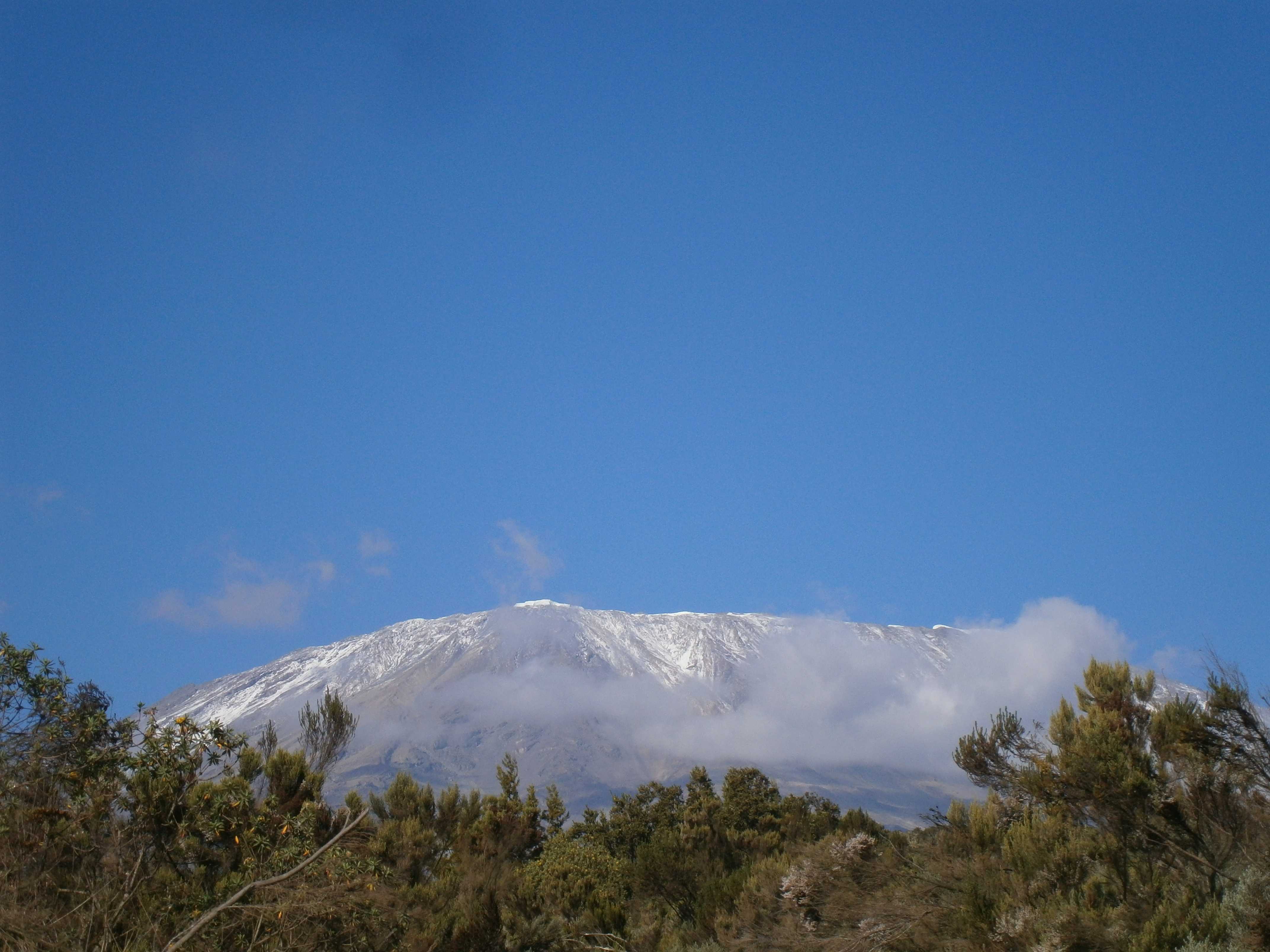
On the morning of the second day I had my first good view of Kibo.

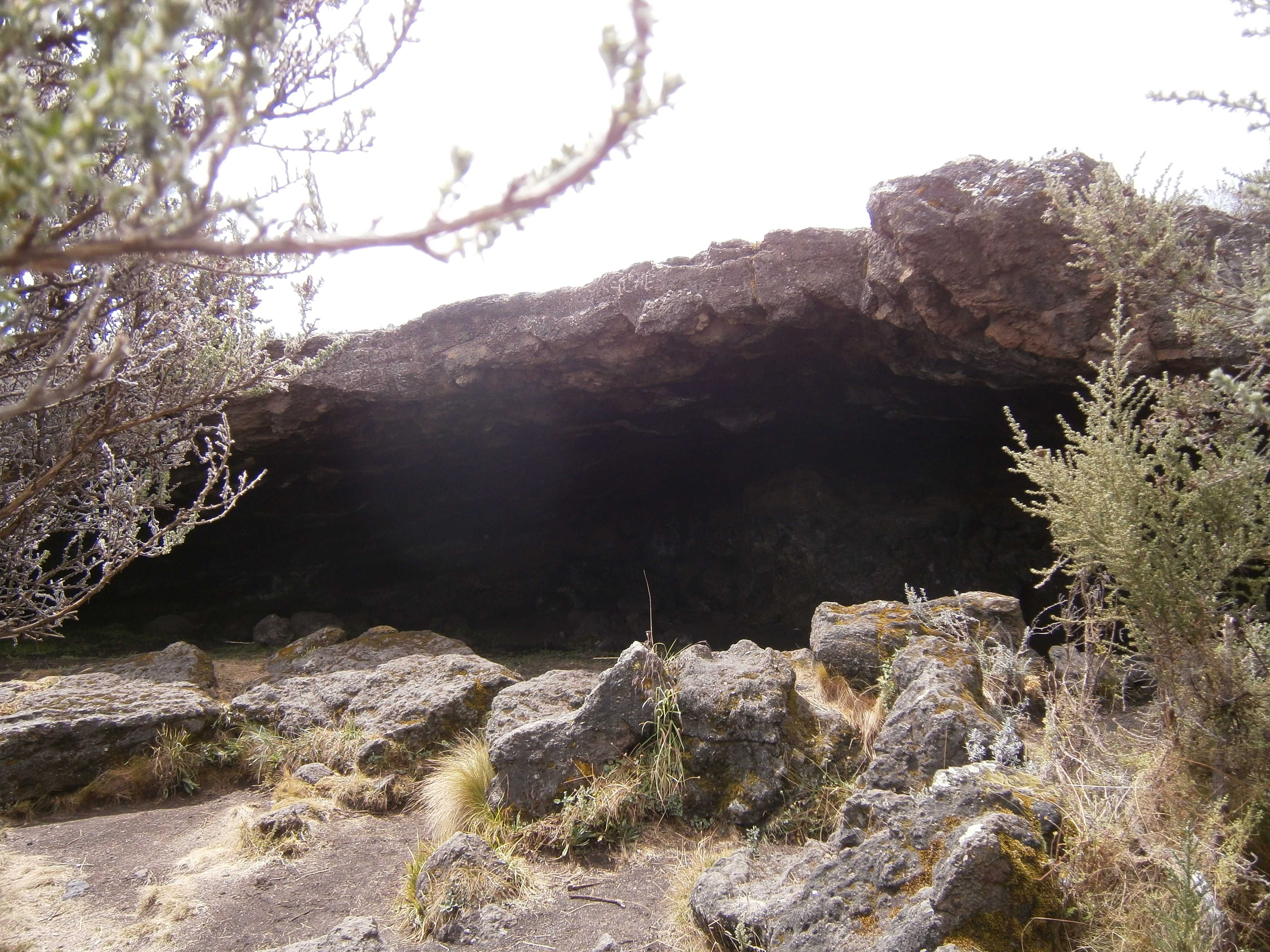
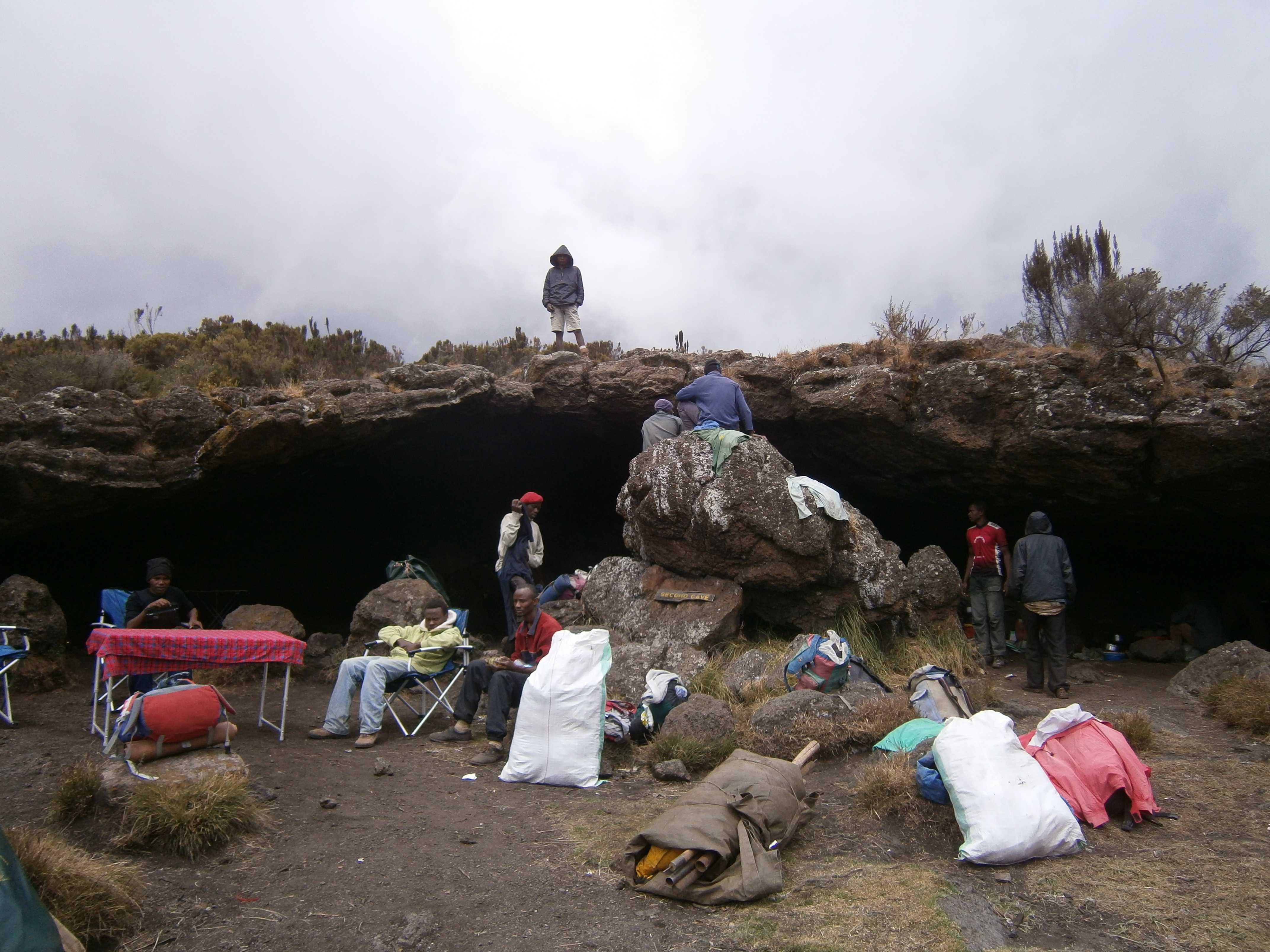
After 5.8km of hiking, I reached the day’s lunch stop, a volcanic cave named “Second Cave” at 3450m which provided great shelter for cooking.

This cave, “Second Cave” provided a nice shelter for cooking lunch.

The porters of a large group quickly deployed tables and chairs and began cooking for their clients.

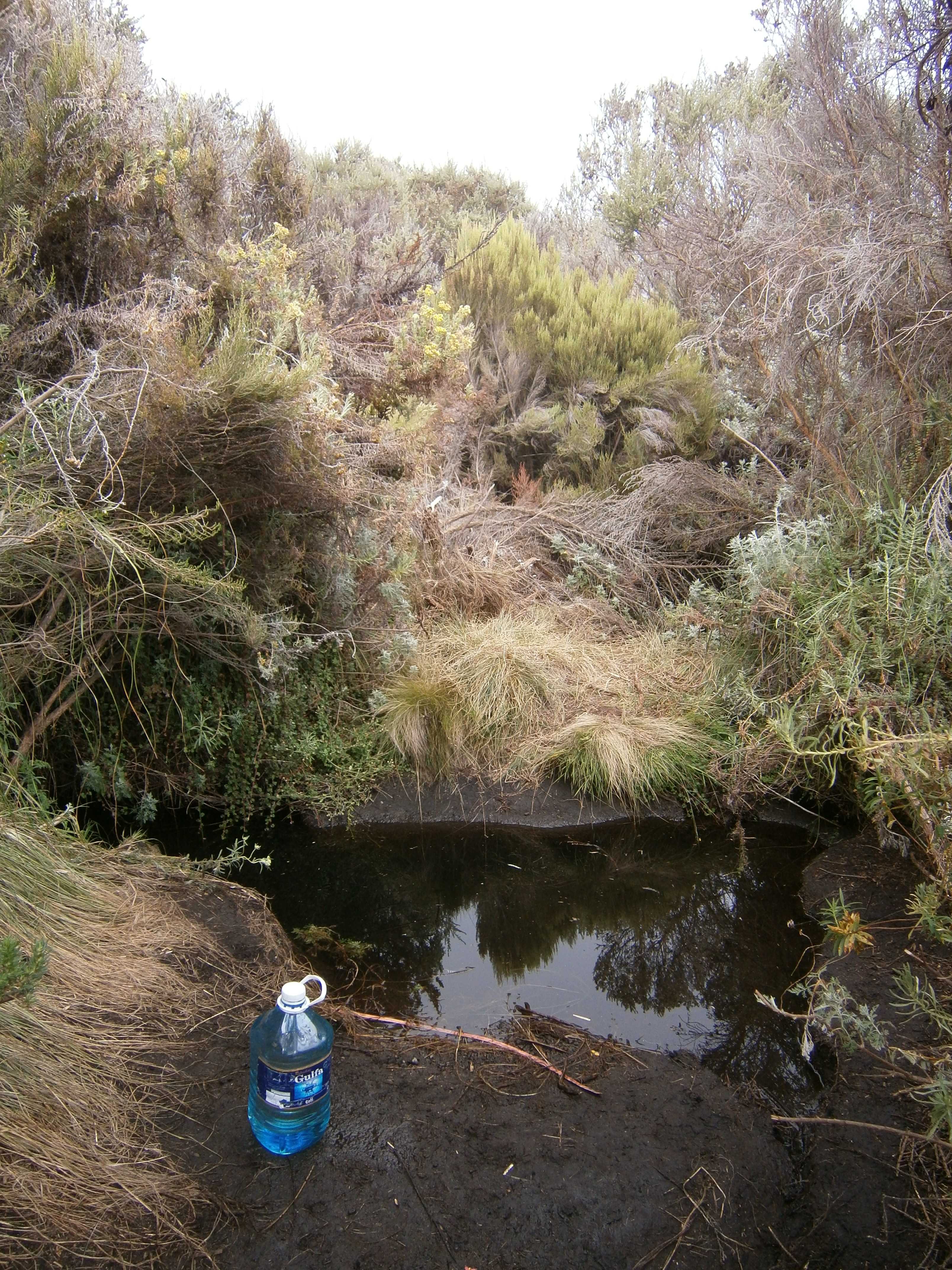
A stagnant water source nearby the lunch stop. From here on, water needed to be filtered carefully.

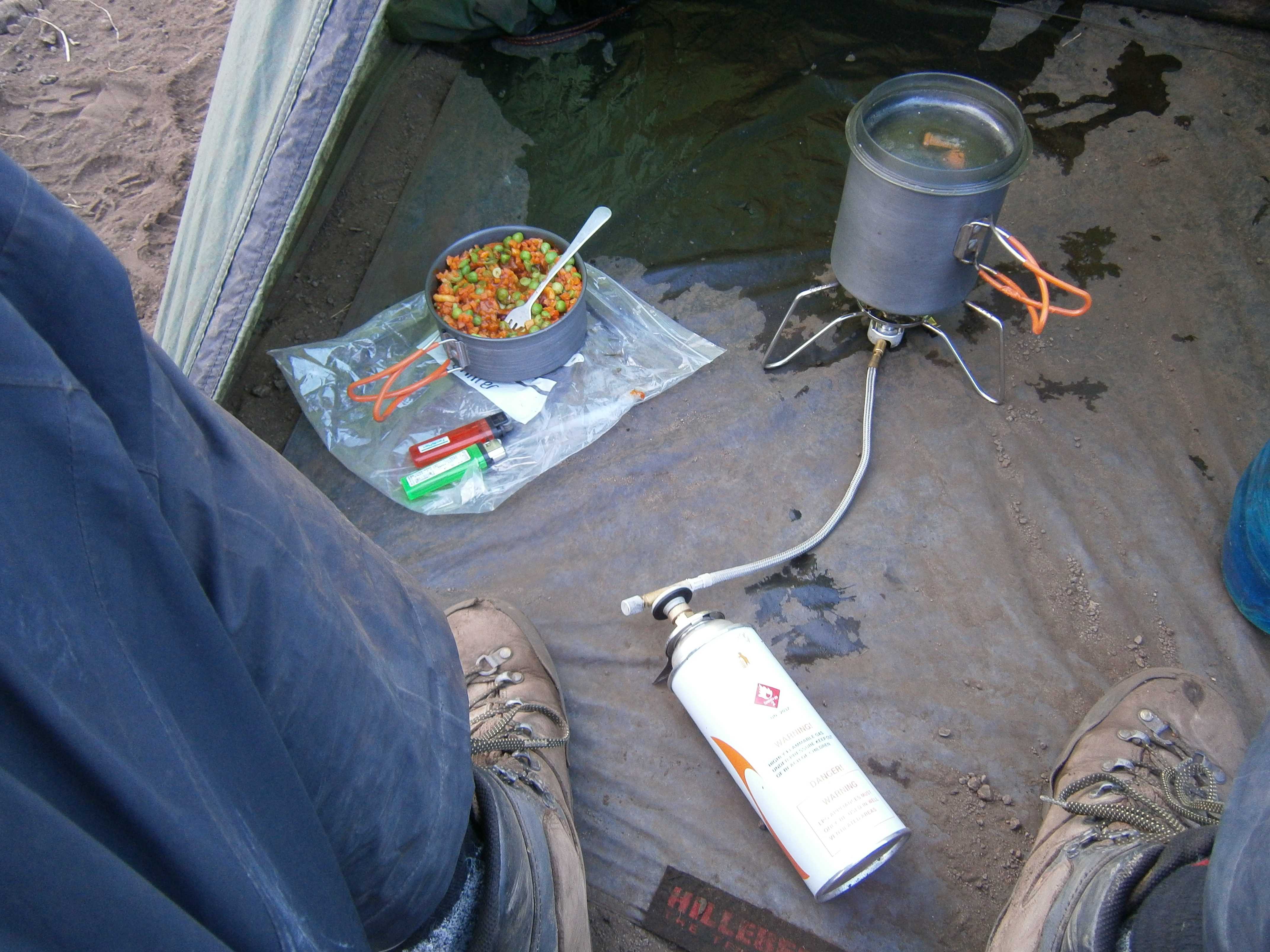
While cooking lunch, my stove continued to cause issues. The thing was temperamental throughout the hike; sometimes it worked fine, but far too often it leaked gas at the joints, flared up suddenly, or stuttered the gas flow.  Fuel cells cannot be transported by air, and I was unable to transport a liquid fuel stove/bottles, so I needed to buy both a stove and cooking fuel in Tanzania.

Because most hikers use porters, who haul enormous and heavy Kerosine cooking rigs up the mountain, sourcing appropriate fuel and a stove in town was remarkably difficult.  Most stores only sold pierce-able gas canisters, which incorporated no valve and could not be resealed once opened.  I finally ended up with a good Propane/Butane fuel mix, but could only find a really dodgy stove which required an adapter to fit the non-standard threaded gas cartridges.

Cooking lunch, keeping a close eye on stove.

After lunch, continuing onwards the terrain remained gently sloped and easy to navigate.

Past the Second Cave I crossed a large barren area which had suffered a forest fire.

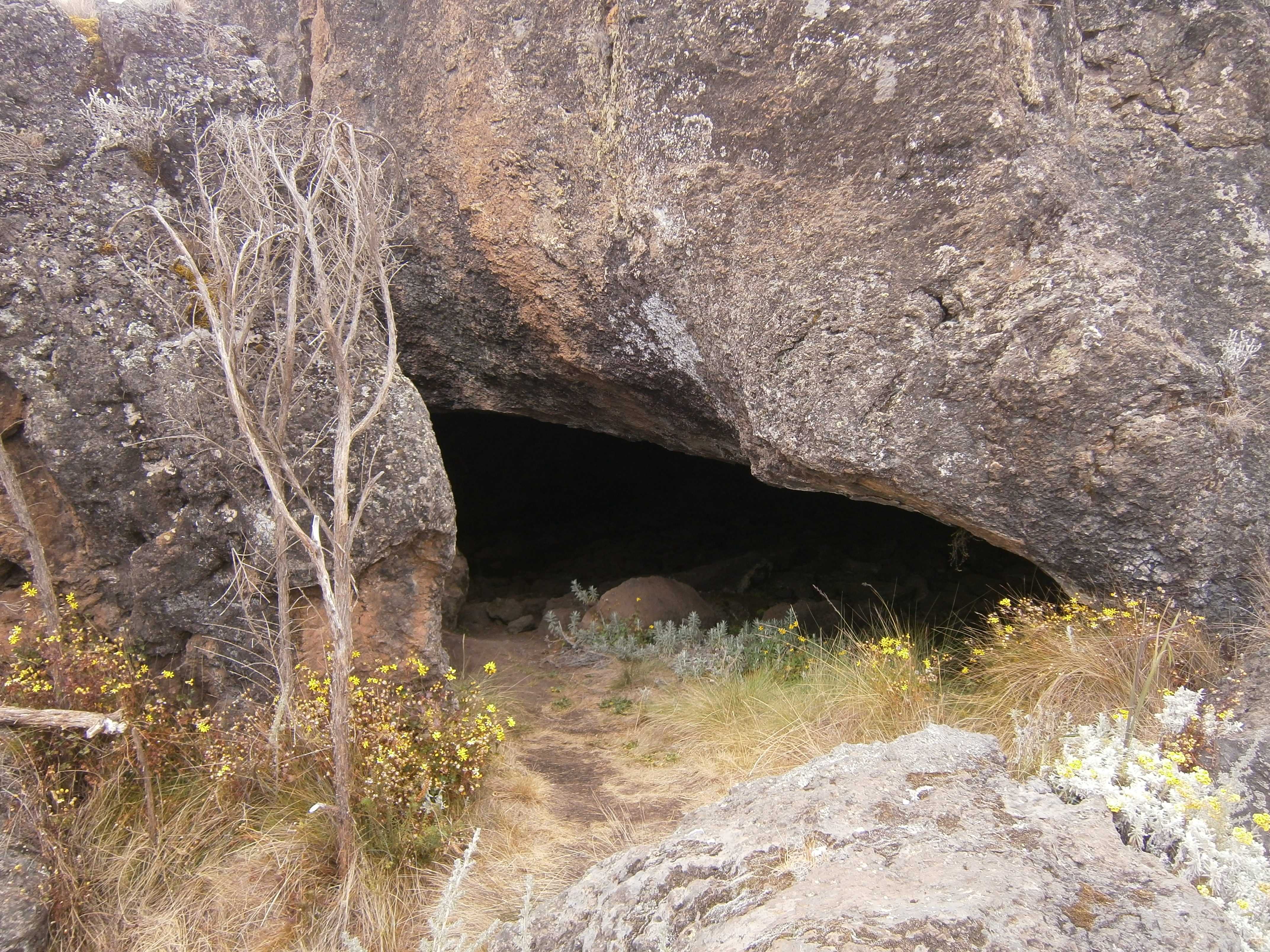
Halfway to the second day’s campsite, Jackson suggested we stop to explore another cave nearby.  He told me that this one had only been discovered some years ago, and wasn’t too well known yet.

Jackson proposed a short detour to explore another cave.

The cave entrance was difficult to spot, even from a short distance away.

This cave was formed by volcanic activity; hardened volcanic rock forms the ceiling, and long-term erosion from rainfall and runoff has hollowed out the ground underneath it.

6km beyond the lunch stop at Second Cave I reached my second day’s campsite, Kikelewa Cave at 3600m.  The sky was overcast, and a thin fog covered the mountain, preventing any views.

Looking up at Kikelewa Cave, my second campsite.

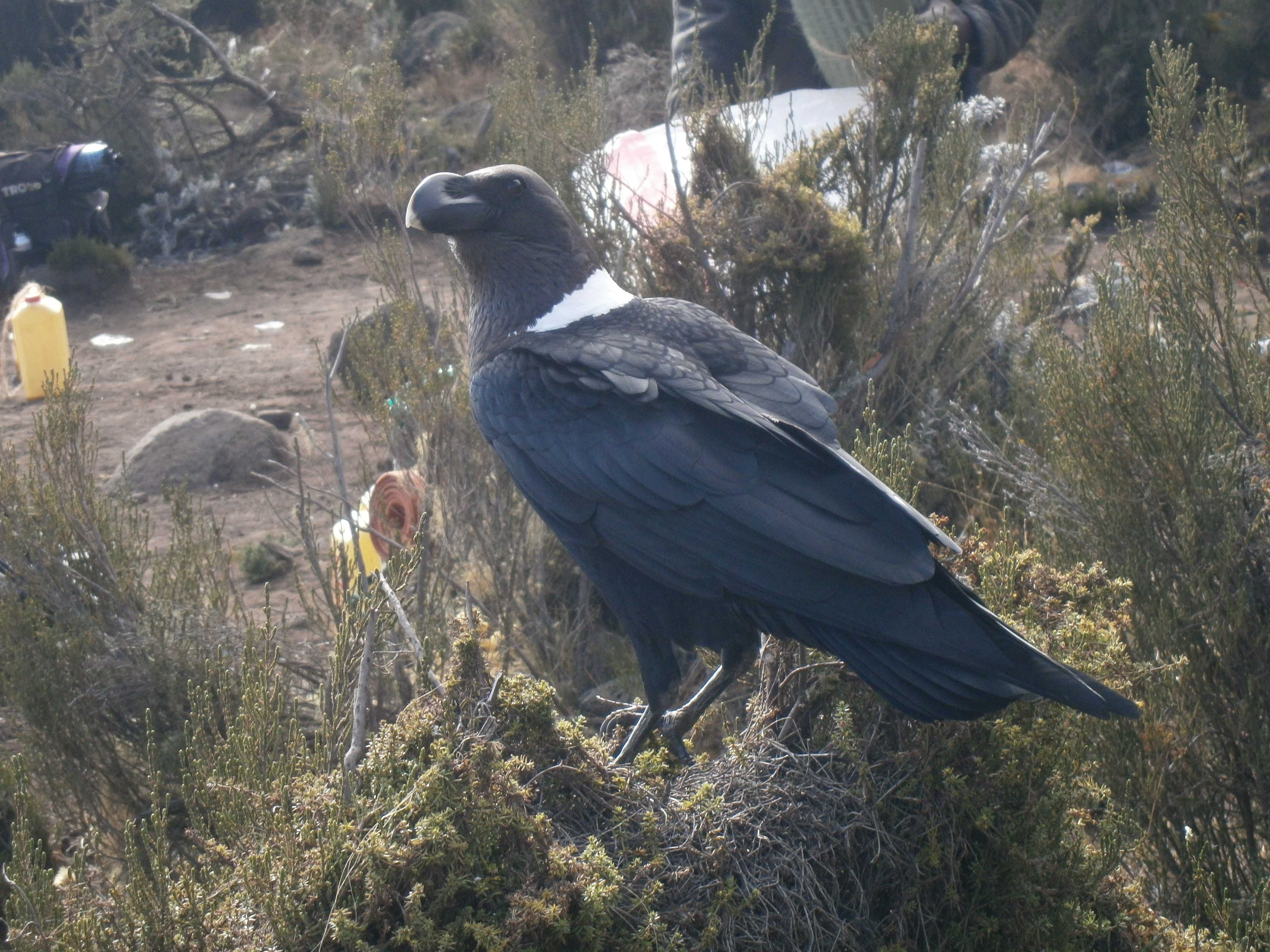
Large ravens such as this one combed the campsites for scraps.

My water source, a runoff stream conveniently close by.

My second day’s camp.

Inside my little tent – very comfortable for one person!

My second dinner on the mountain; cooking, eating and drinking occupied a lot of my time at camp.

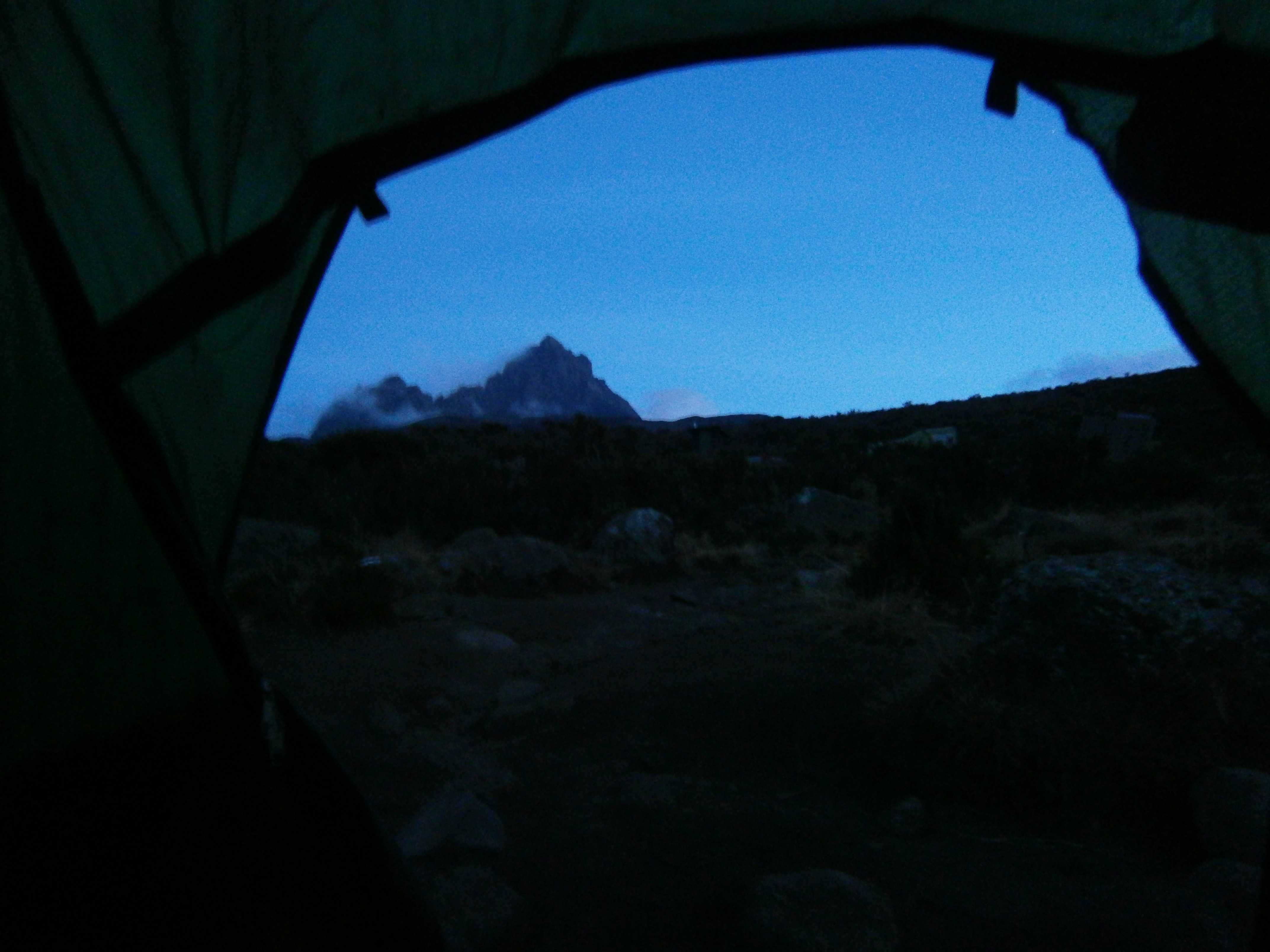
As the sun set, the fog cleared, and Mawenzi appeared in the distance.  At night the temperature plummeted, and unnecessary forays outside the tent became unpleasant, so I enjoyed the view from the warmth of my sleeping bag.

Mawenzi at dusk, distant, but right outside my front door.

Day 3: The morning air was clear and fresh.  This day’s destination would be the Mawenzi tarn, a small mountain lake at the base of Kilimanjaro’s Mawenzi peak.  In clear air, Kibo and Mawenzi were visible on the horizon.

Mawenzi in the sunrise.

Kibo rose out of the horizon. It is massive, very impressive to see in the distance.

Getting ready to break camp down, enjoying the morning sunshine and the views of Kibo in the distance.

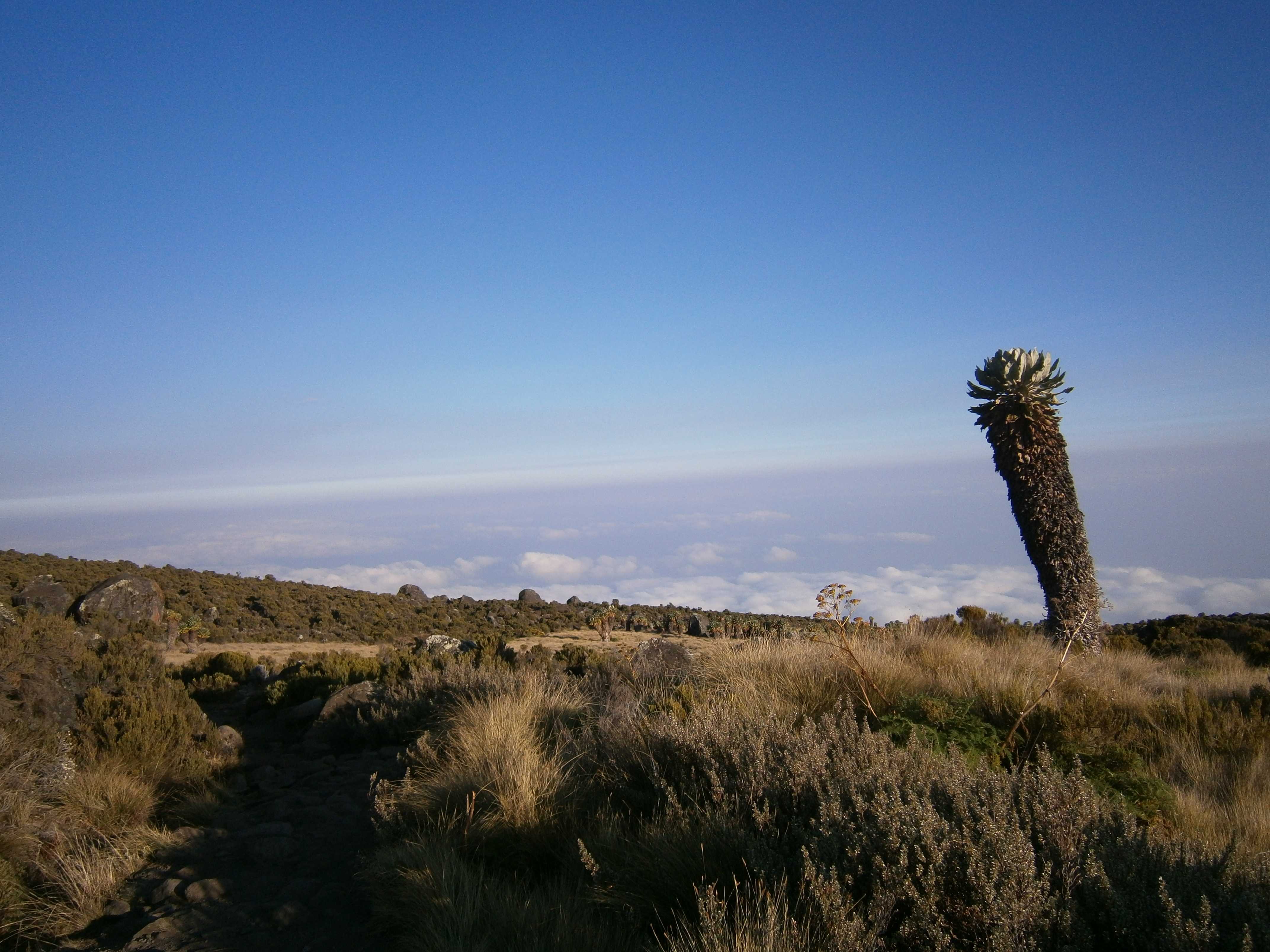
An interesting plant, growing in dense patches on the lower mountain.

These plants grew all over the mountain at this elevation, creating the appearance of snow.

As I got closer to Mawenzi, interesting volcanic rock formations dotted the terrain.

Throughout the hike I often shared campsites and trail-space with large groups such as this one.

Around ~4200m I spotted this lizard just off of the trail. It looked cold!

After a short ~2 hours of hiking, covering 3.7km, I arrived at the Mawenzi Tarn campsite at 4330m.  The porters of several large groups had arrived before me, and so when I came into the campground it was fairly crowded with tents.  Thick fog hung over camp, for the most part socking everything in and obscuring views.

The Mawenzi Tarn campsite.

Pitching my tent in the fog.

My third campsite.

The Mawenzi tarn, a mountain lake at the base of the  Mawenzi volcano, served as a very convenient water source.  Overnight, it froze over completely.

The Mawenzi tarn.

After pitching camp and preparing drinking water, I went for an acclimatization hike towards Mawenzi.  I climbed roughly ~400m above my campsite, and rested for half an hour before descending to cook dinner and sleep.

The campsite, as seen from partway up Mawenzi. Fog obscured views higher up.

A nearly full moon appeared at dusk.

Third night’s dinner – spaghetti, peas, and corn!

Day 4: The morning came with a bright sunrise, unveiling a clear blue sky.  Mawenzi was stunning in the morning light.  The ground here was very dry, and gritty dirt began to cover my gear.  From here on, everything remained very grimy.

Mawenzi, catching the dawn.

Breaking camp, taking my time in the sunshine.

With the fog gone, the cloud ocean was visible far below.

I decided to head towards my high camp today, and so set off towards Kibo Hut, located across the Mawenzi saddle.  Kibo Hut is located in dry alpine desert and has no stable water source, so I had to carry the next day’s water supply up with me. Hauling the extra 7.5L of water made this a slow and difficult morning for me.  Despite this, I enjoyed perfect weather and amazing views of Kibo and Mawenzi as I crossed the saddle.

Kibo, across the saddle.

Looking back at Mawenzi, from the saddle.

Loaded up with water and gear, crossing the saddle.

Kibo hut, my fourth campsite, far in the distance. Crossing the saddle was demoralizing not only because my pack was burdened with extra water supplies, but also because the distances were visually deceptive.

This plane wreckage, still scattered across the saddle, is left over from a 2008 crash.

I was nothing if not relieved when I finally arrived at Kibo Hut, 4700m.

My fourth night’s campsite at Kibo hut.

I was feeling strong, and so decided to head up to the summit the next morning.  After pitching my camp and unloading gear, I began my final acclimatization hike.  I followed the summit-trail up to Hans Meyer Cave at 5243m, where I rested for an hour before heading down to my campsite to cook an extra-large dinner, hydrate, and sleep.  The summit trail followed a face of somewhat steep loose scree.

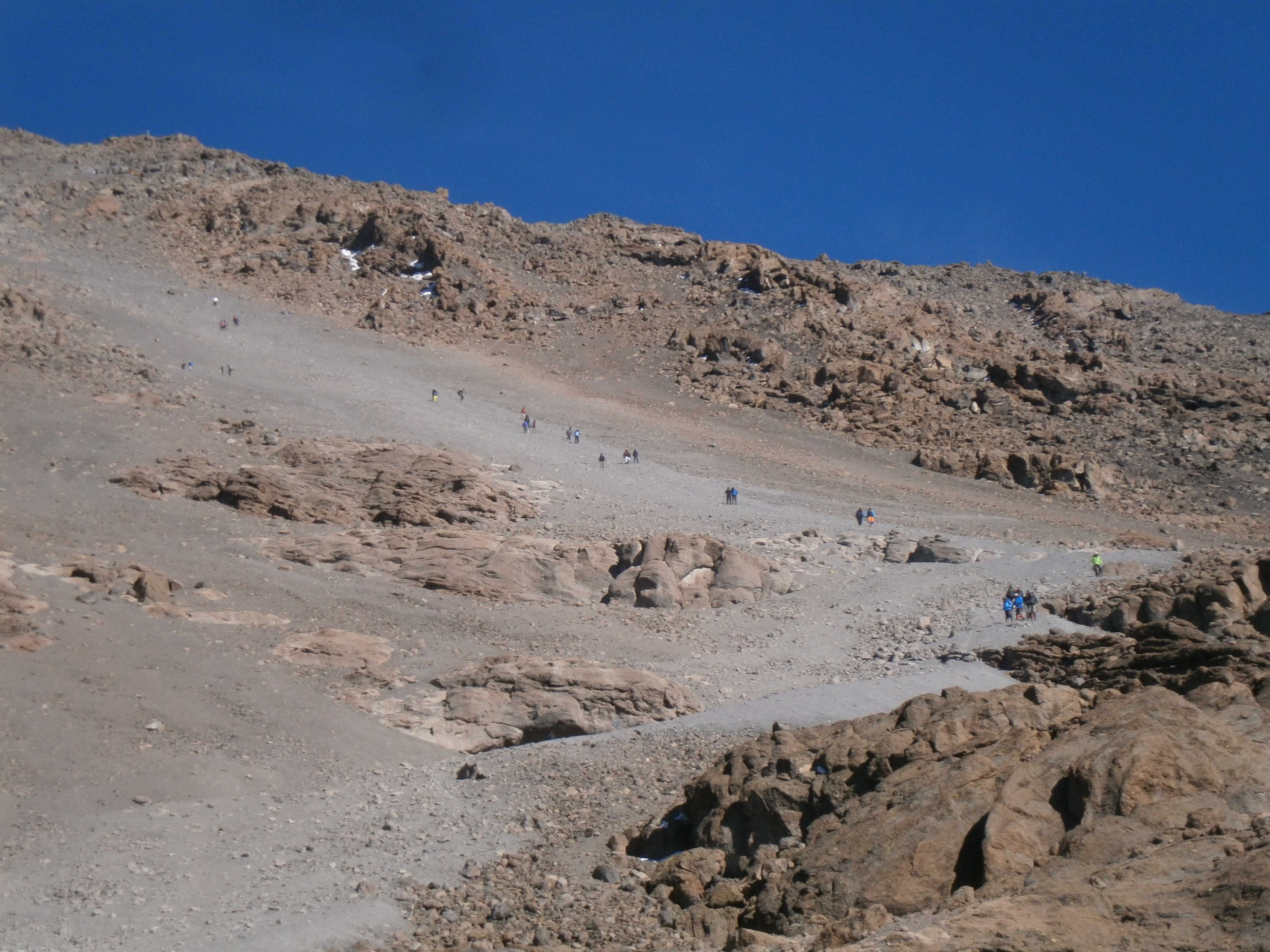
The summit trail. Steep, loose scree all the way to Gillman’s point, roughly 950m of gain.

Resting at Hans Meyer cave, 5243m.

As I prepared to go to bed, the sunset created a beautiful glow behind Mawenzi, highlighting a nearly full moon.

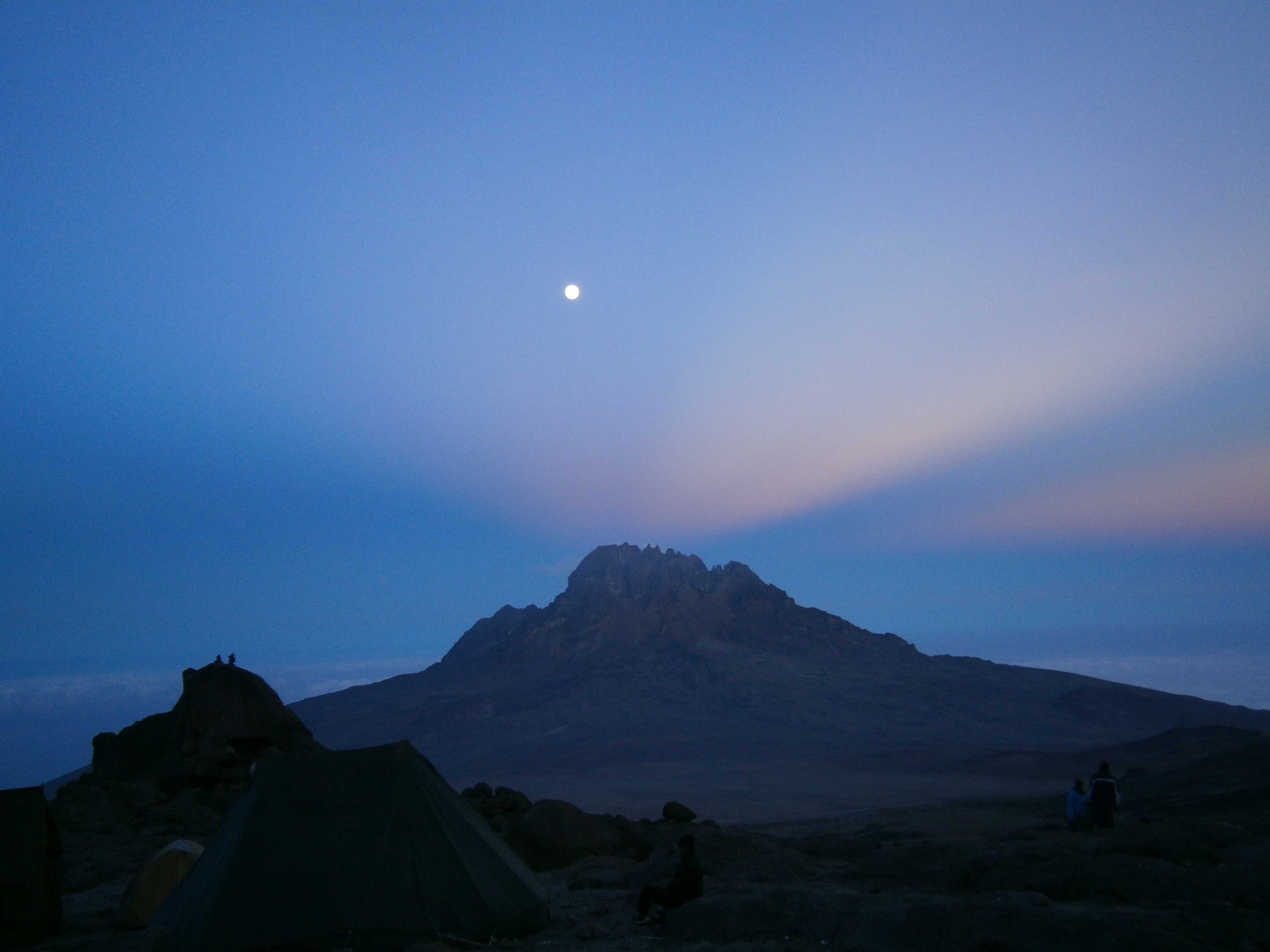
Mawenzi from Kibo Hut, at sunset.

Day 5: Summit day.  Most who climb Kilimanjaro opt to begin hiking to the summit around midnight, climbing overnight and reaching the top in the morning.  I didn’t fancy the idea of sharing the scree-covered trail with a large crowd, and was also keen to avoid the darkness and cold of nighttime.  Pace hadn’t been a problem to this point, so time wasn’t a big concern.  With all of this in mind, I made it my plan to climb to the top during the day. This turned out to be an excellent decision.

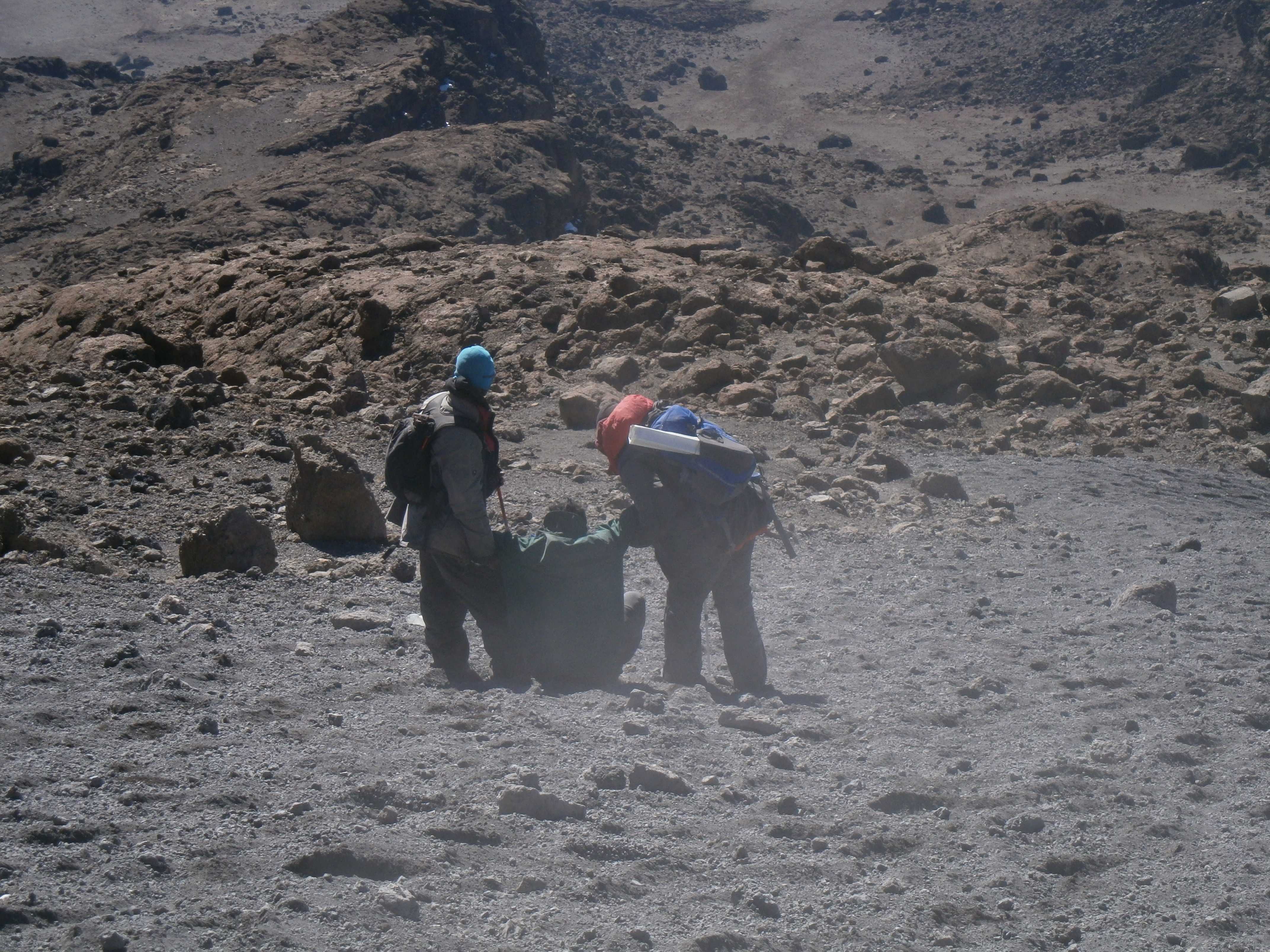
I woke up at 6 a.m., spent an hour boiling a liter of water (more problems with the stove), ate a fast breakfast, and started up the summit trail at 7:20 a.m.  On the way up, I encountered large groups of other hikers coming down.  Quite a few were in poor condition, suffering from severe altitude sickness, and several were unable to walk unassisted.

Many other hikers were descending, as I headed up.

I encountered quite a few porters and guides assisting the descent of climbers suffering from altitude sickness. I wondered why their clients had been pushed to continue.

I reached 5243m Hans Meyer cave at 9:00 a.m., about 30 minutes faster than I had managed during the prior day’s acclimatization push.  Mawenzi loomed on the horizon, a brilliant and seemingly endless cloud ocean behind it.  Up the scree slope, I could see the rocky outcrop which marks Gilman’s point, the end of the scree and the beginning of Kibo’s crater ridge.

Mawenzi on the horizon, a huge cloud ocean behind it.

Gilman’s point, the rocky outcropping in the middle of the picture.

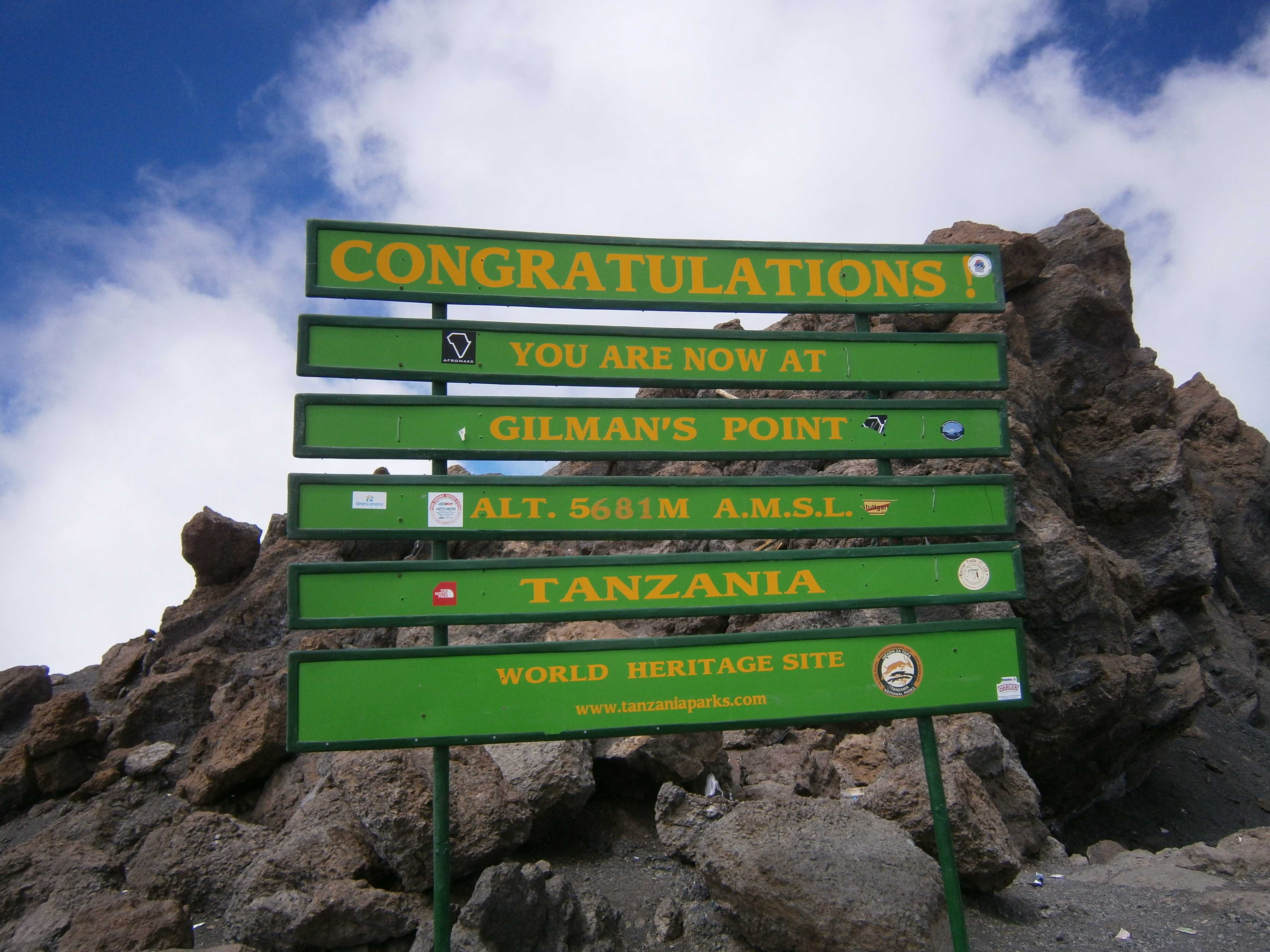
I reached 5681m Gilman’s Point at 10:45 a.m.  Here, I had my first glimpse of Kilimanjaro’s famous glaciers.

A large sign marks Gilman’s Point.

Distant glaciers were visible from Gilman’s point.

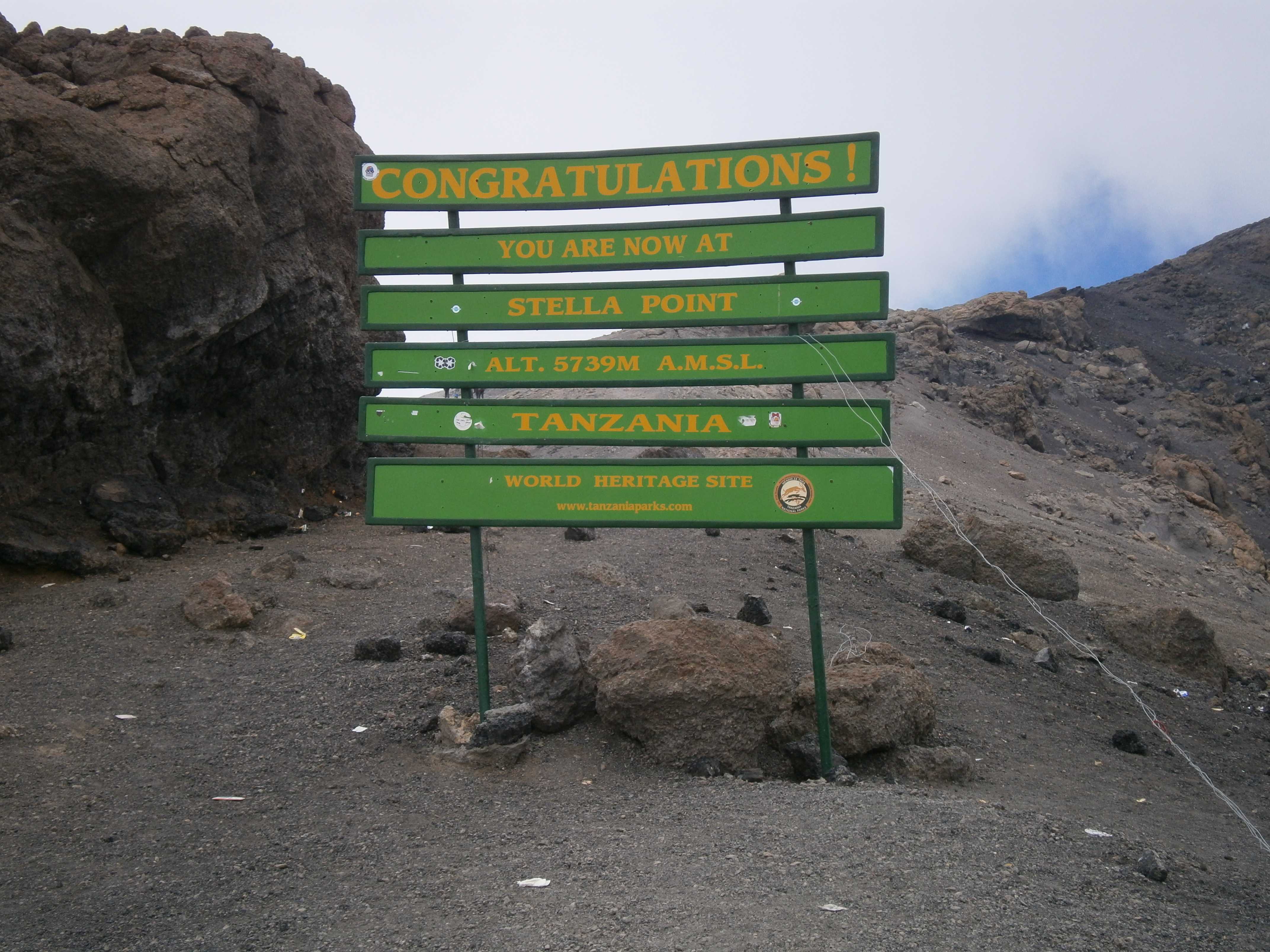
Further along, Uhuru Peak was visible in the distance.  At 11:20 a.m. I reached 5739m Stella Point, roughly one hour away from the summit.

Uhuru Peak in the distance (center).

Another large sign at Stella Point.

The landscape inside Kibo’s crater rim was barren and devoid of life.  The path followed the rocky crater ridge, covered in volcanic scree and snow.

Alpine desert, inside Kibo’s crater.

The path past Stella Point, heading towards the summit.

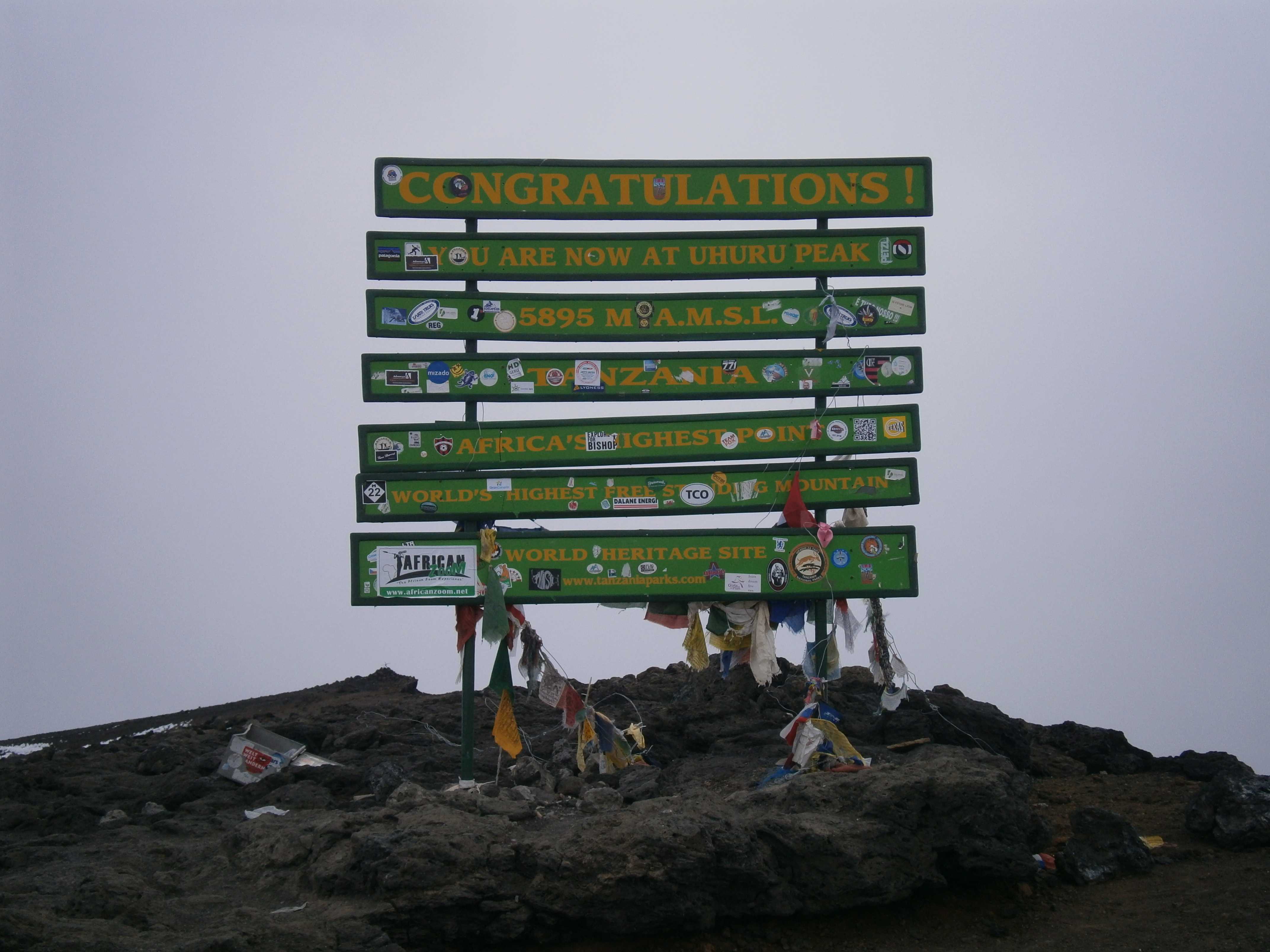
As clouds billowed past, the famous sign which marks the true summit of Kibo, Uhuru Peak, became visible.

The summit sign finally appeared.

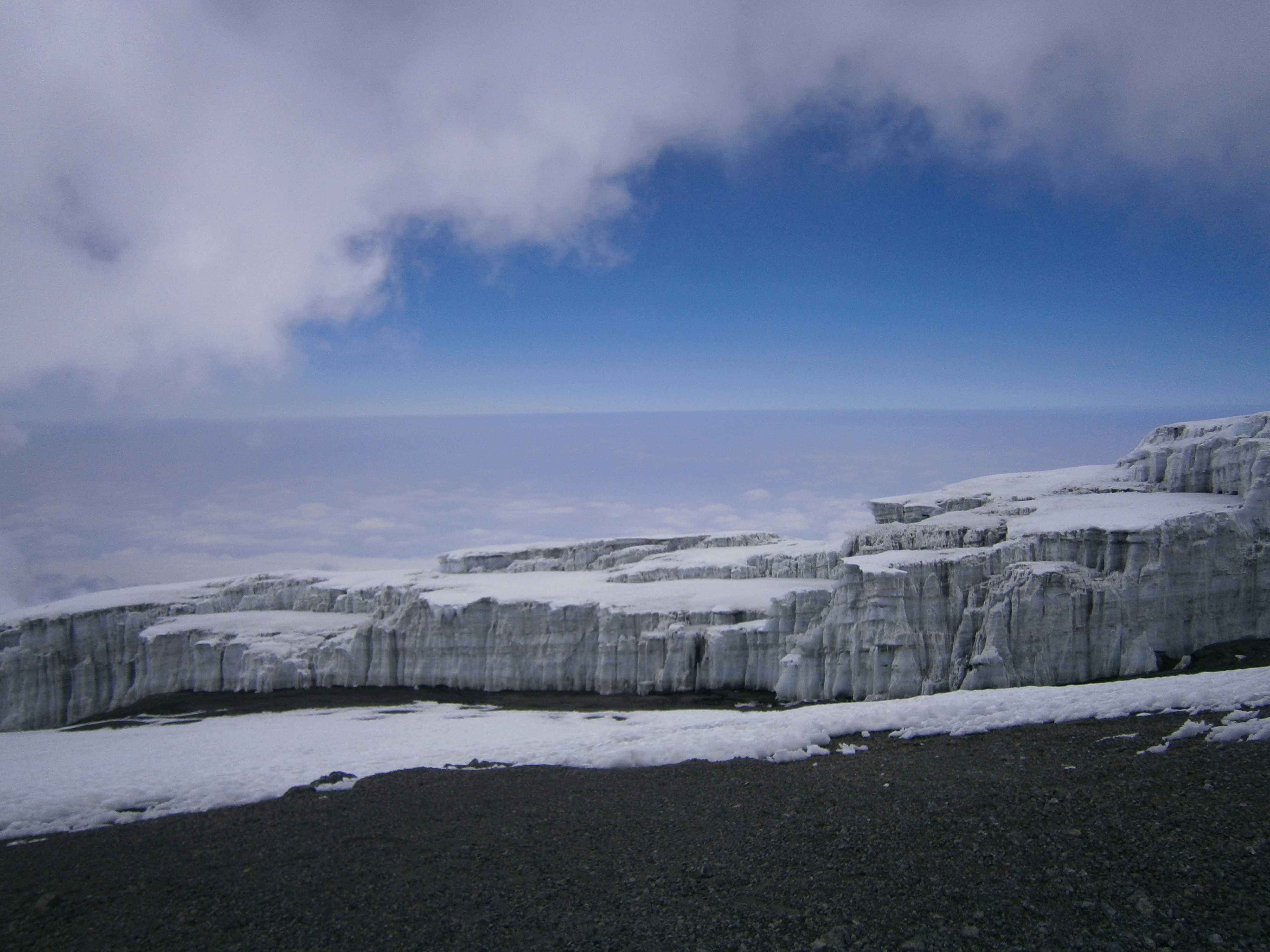
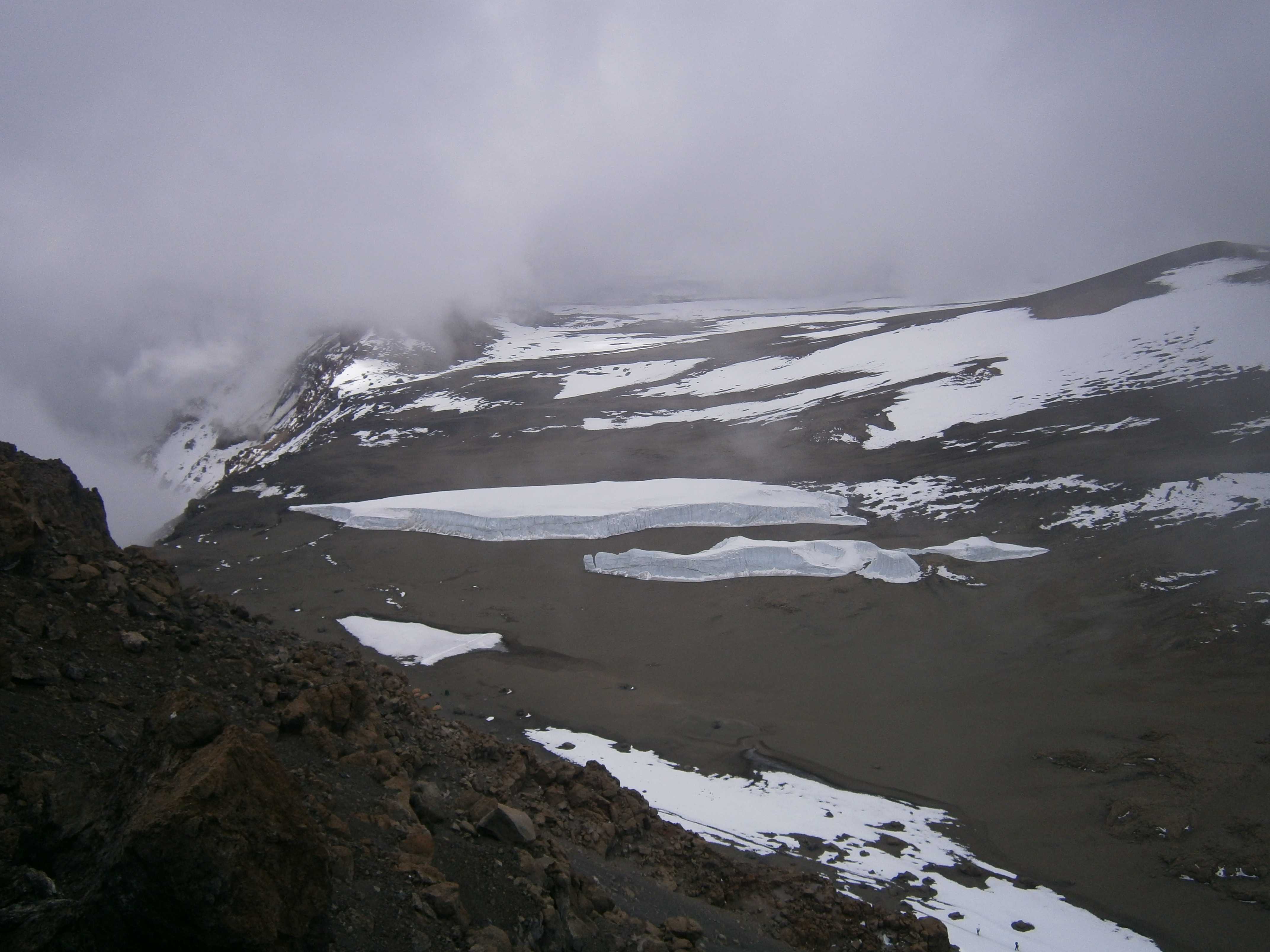
The glaciers on Kibo were impressive, but it was clear from their appearance that they had been receding.

The glaciers were prominent near the top.

It was incredible to see the size and height of the glaciers.

Bits of glacier inside of the crater ridge had almost melted completely.

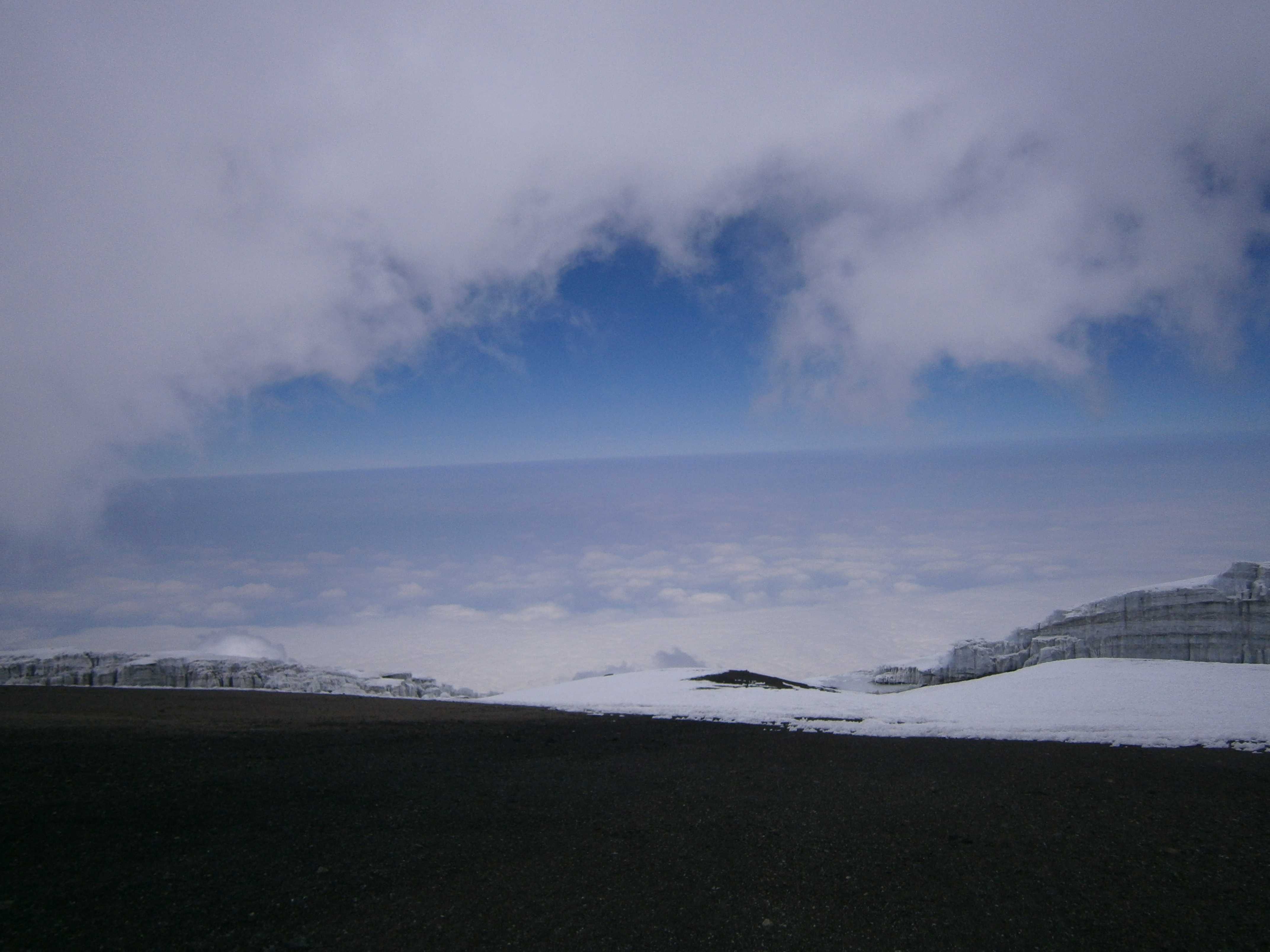
The cloud ocean seemed to stretch on forever.

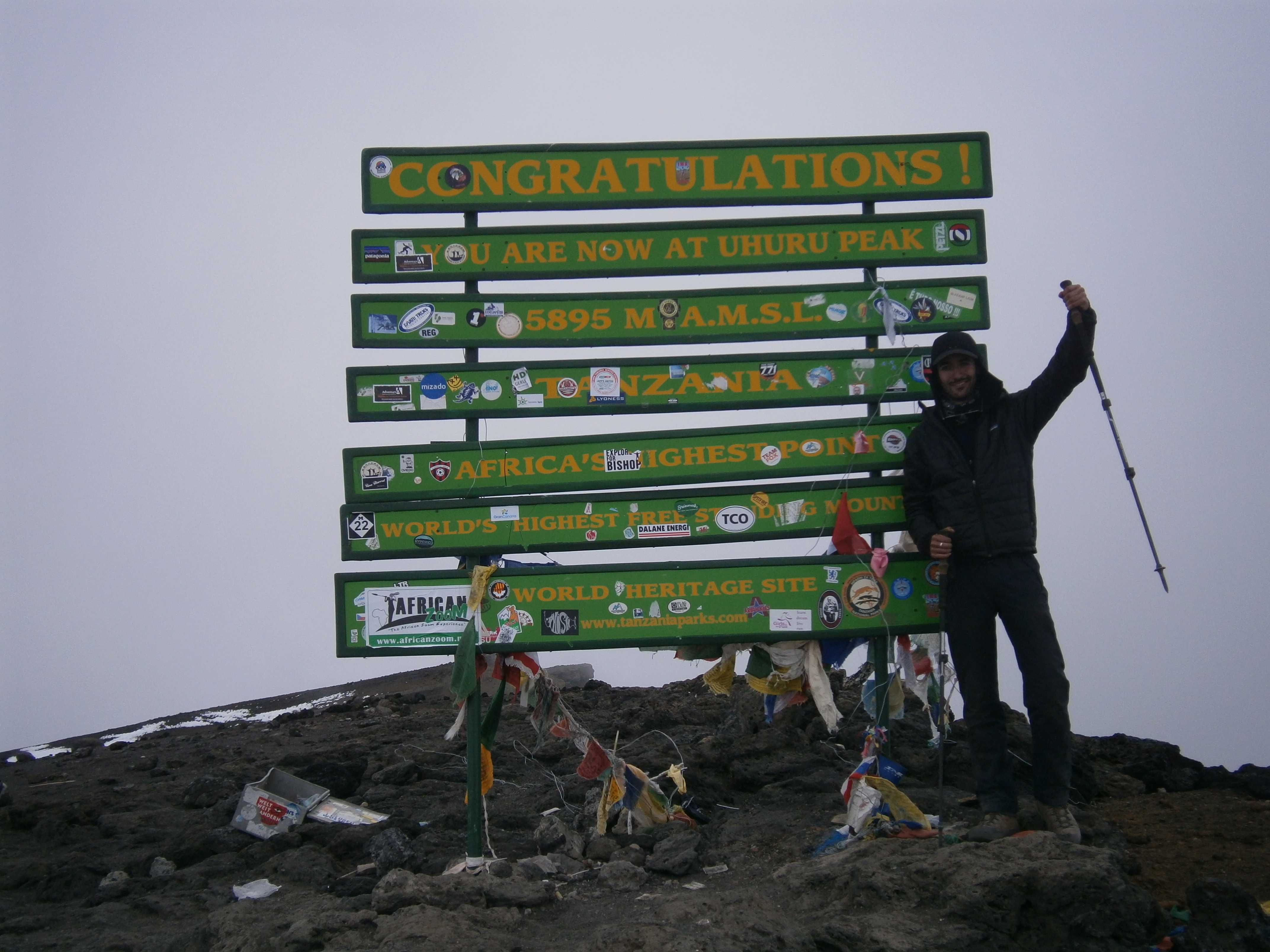
Stopping often to absorb the scenery and take lots of photographs, I arrived at 5895m Uhuru peak, the highest point in Africa, at 12:25 p.m.  I spent around 25 minutes on the summit before heading back down.

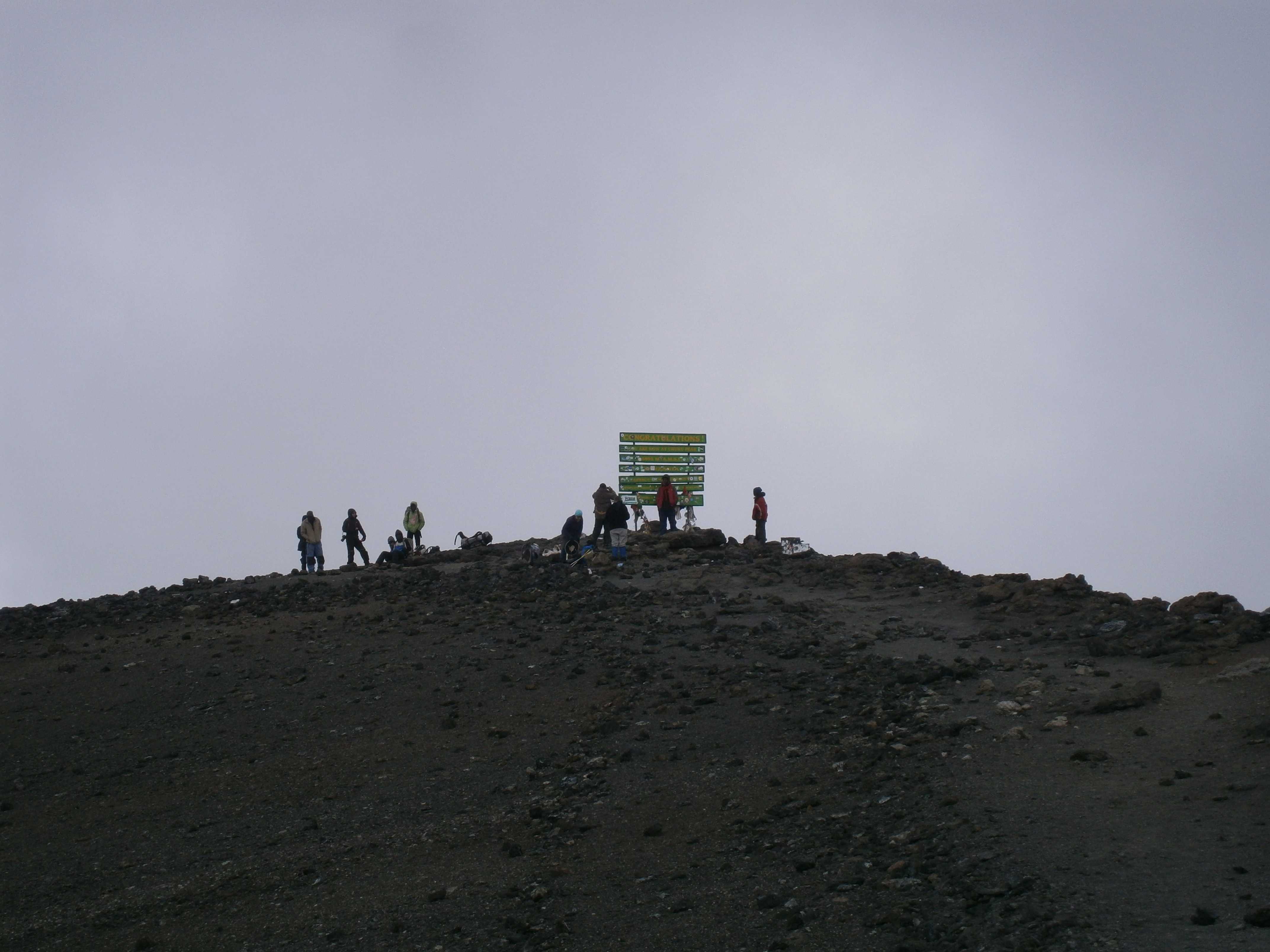
The final leg to the summit, where a small group was taking photographs and getting ready to descend.

The summit sign.

Feeling great at the top!

Retracing my steps along the crater ridge trail.

I arrived back at my campsite at 2:40 p.m., a 10.8km round trip.  After cooking a quick meal, I packed up all of my gear, and began descending another 9.6km to the Horombo campsite.

Packed up and ready to begin descending.

The route to Horombo was mostly level. The Mawenzi/Kibo saddle is vast, dusty, and very flat.

Mawenzi looked much different from the east.

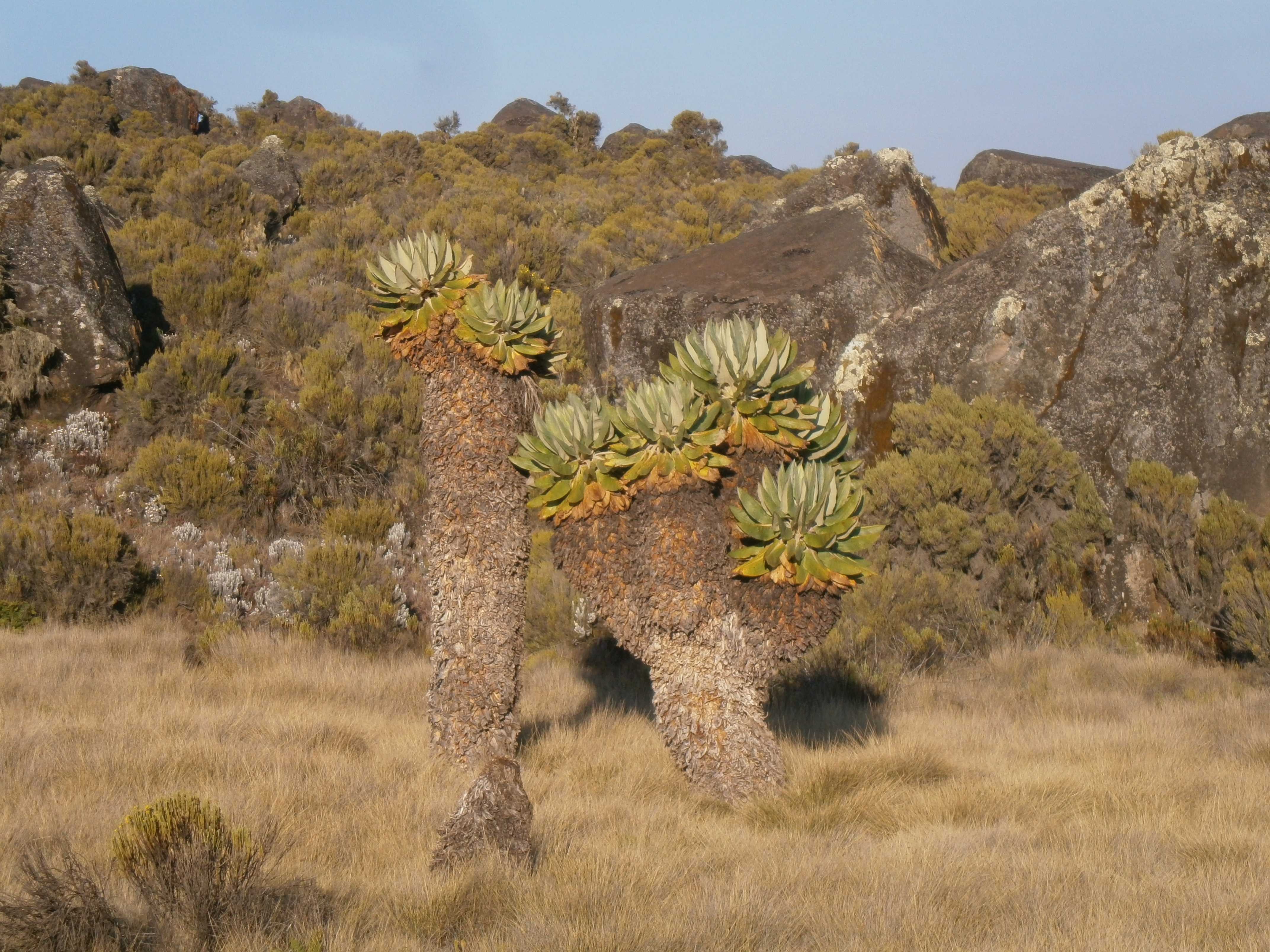
Many of these giant plants, Senecio Kilimanjari, were growing along this part of the route.

The furry trunk of these plants is covered in their dead leaves. These apparently help insulate from the cold.

Horombo, my sixth campsite at 3720m, was more like a small village than a campground.  Numerous huts housed hikers and their support staff, and there was even running tap water!

Approaching Horombo, where huts have capacity to accommodate a large number of people.

My final campsite.

Day 6: I slept in until 7 a.m., cooked a big breakfast, and prepared to leave the mountain. My final day, I descended from 3720m Horombo down to the Marangu Gate trailhead at 1800m.  The trail down from Horombo was wide, and very gently sloped, so despite the substantial elevation loss the descent wasn’t too strenuous.

The morning view from Horombo.

An abundance of interesting vegetation covered this side of the mountain.

The trail from Horombo was wide and level.

From the east, Kibo and Mawenzi were visible together.

At 2700m I passed Mandara, another campground with an abundance of huts.

As I descended further the vegetation thickened, and the path passed through forest.

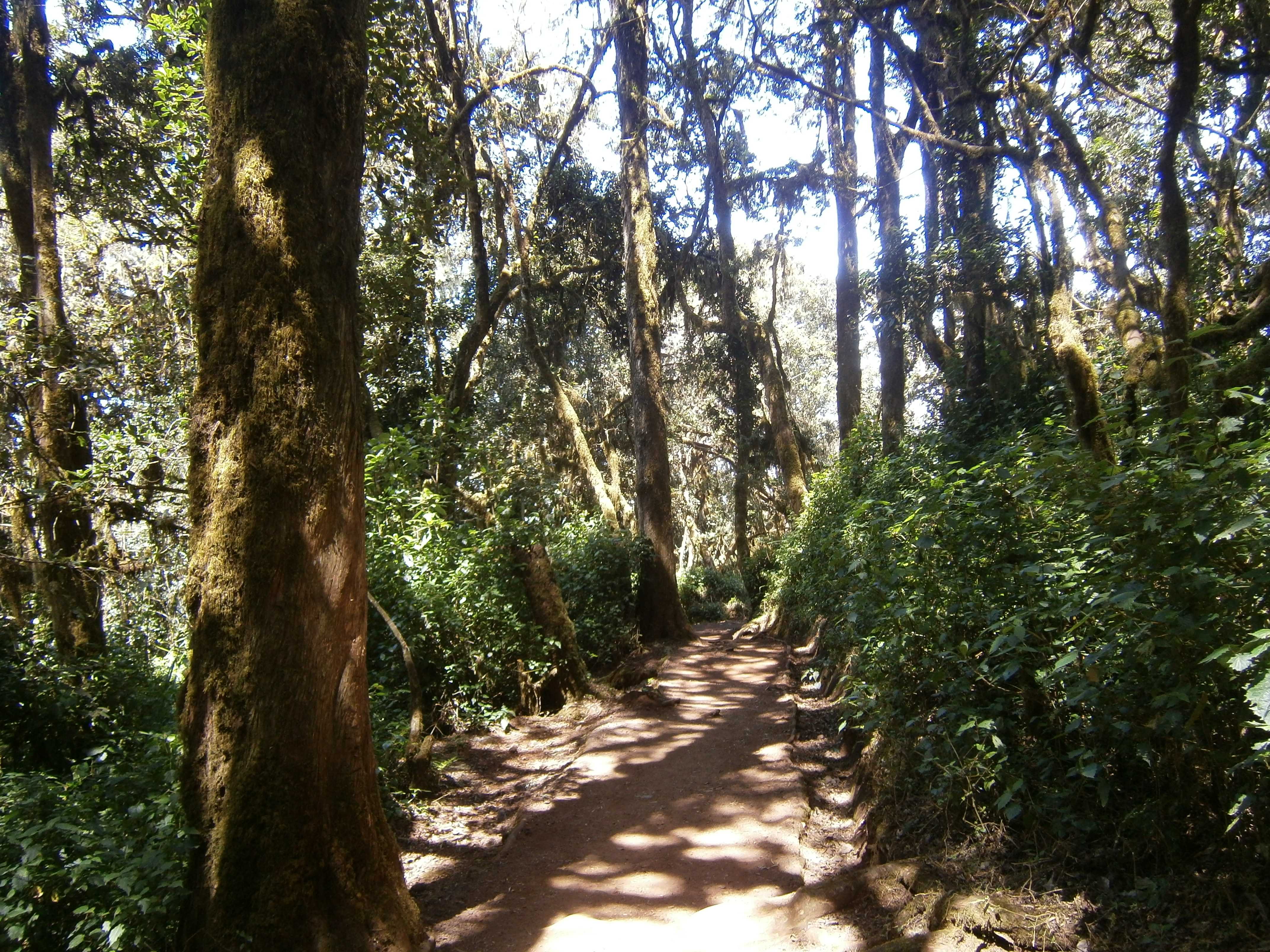
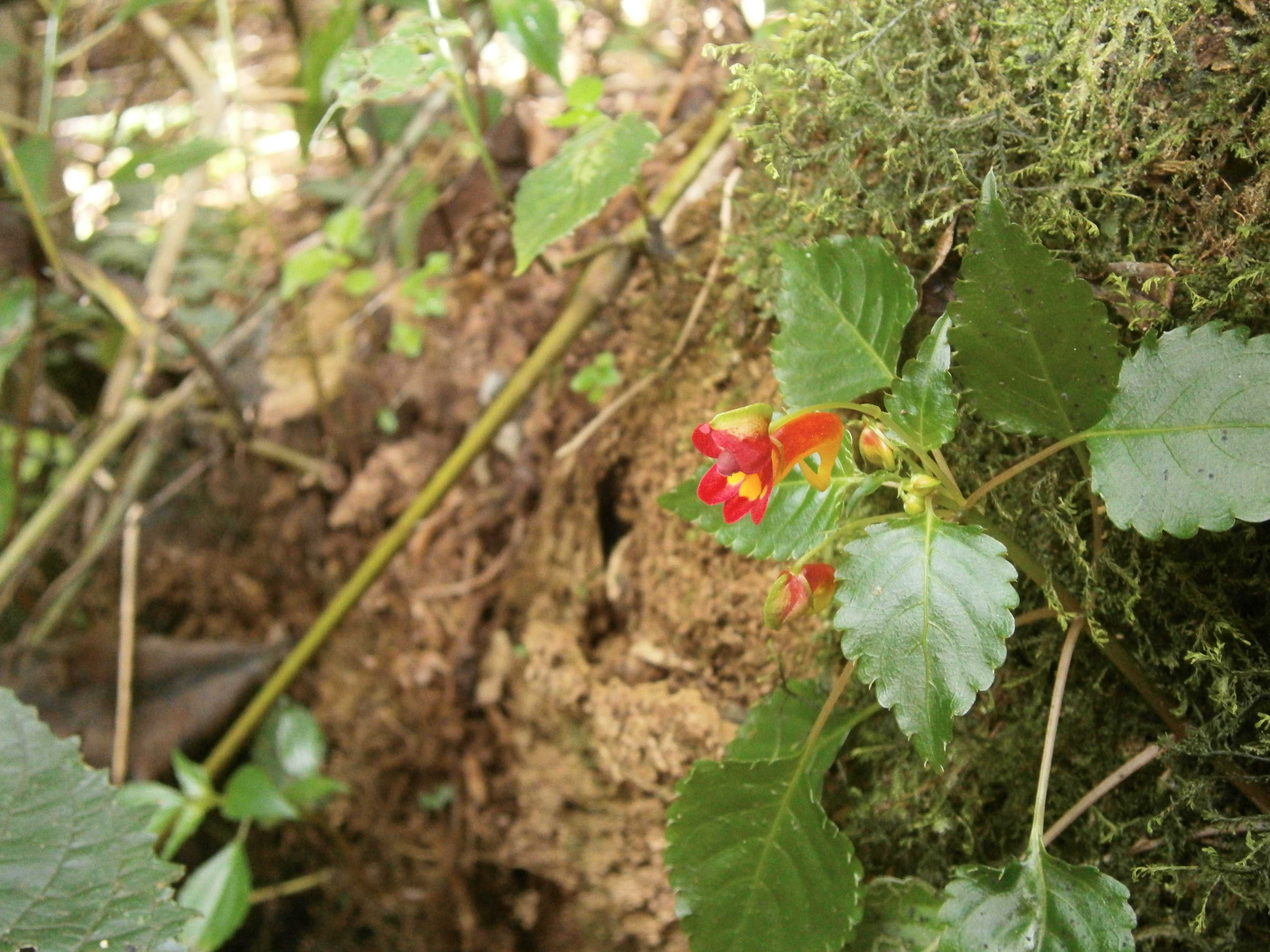
Many of these small, bright ‘elephant’s trunk’ flowers grew everywhere.

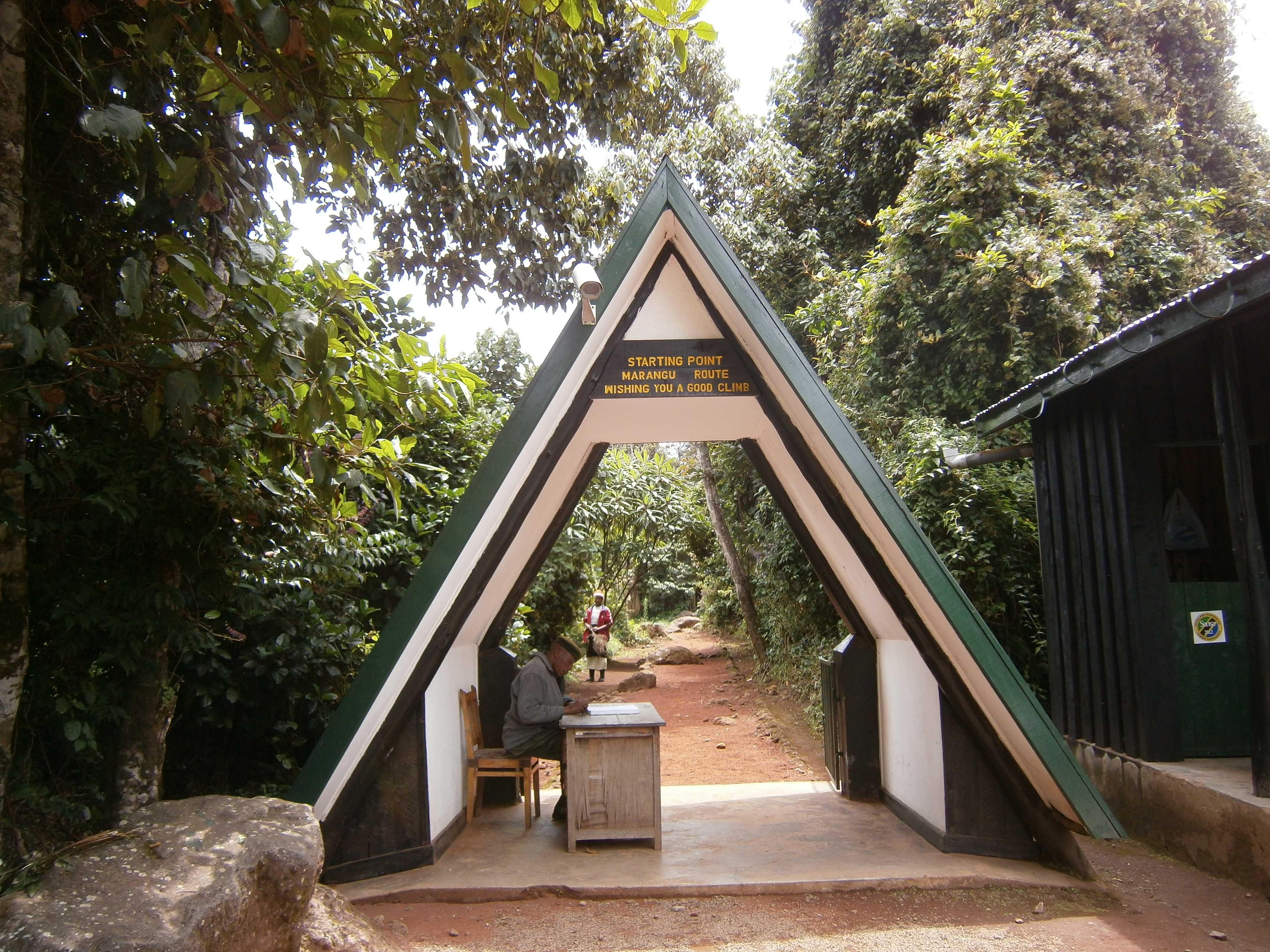
Finally I reached the Marangu Gate, my exit point and the starting point for hikers taking the Marangu route up the mountain.

At the Marangu Gate I checked out with the park rangers, weighed my pack at 17.5kg, and took a bit of time to look at some interesting commemorative plaques, maps, and signs near the gate.  After six days on the mountain, it was a little bit peculiar how quickly I found myself back in civilization after reaching the trailhead.  Jackson and I met our driver, had a huge lunch of cheeseburgers, salad, and cold beer, and drove back to Arusha.

A plaque at Marangu gate, commemorating Hans Meyer, the first European to climb Kilimanjaro.

Another plaque, dedicated to Hans Meyer’s climbing team.

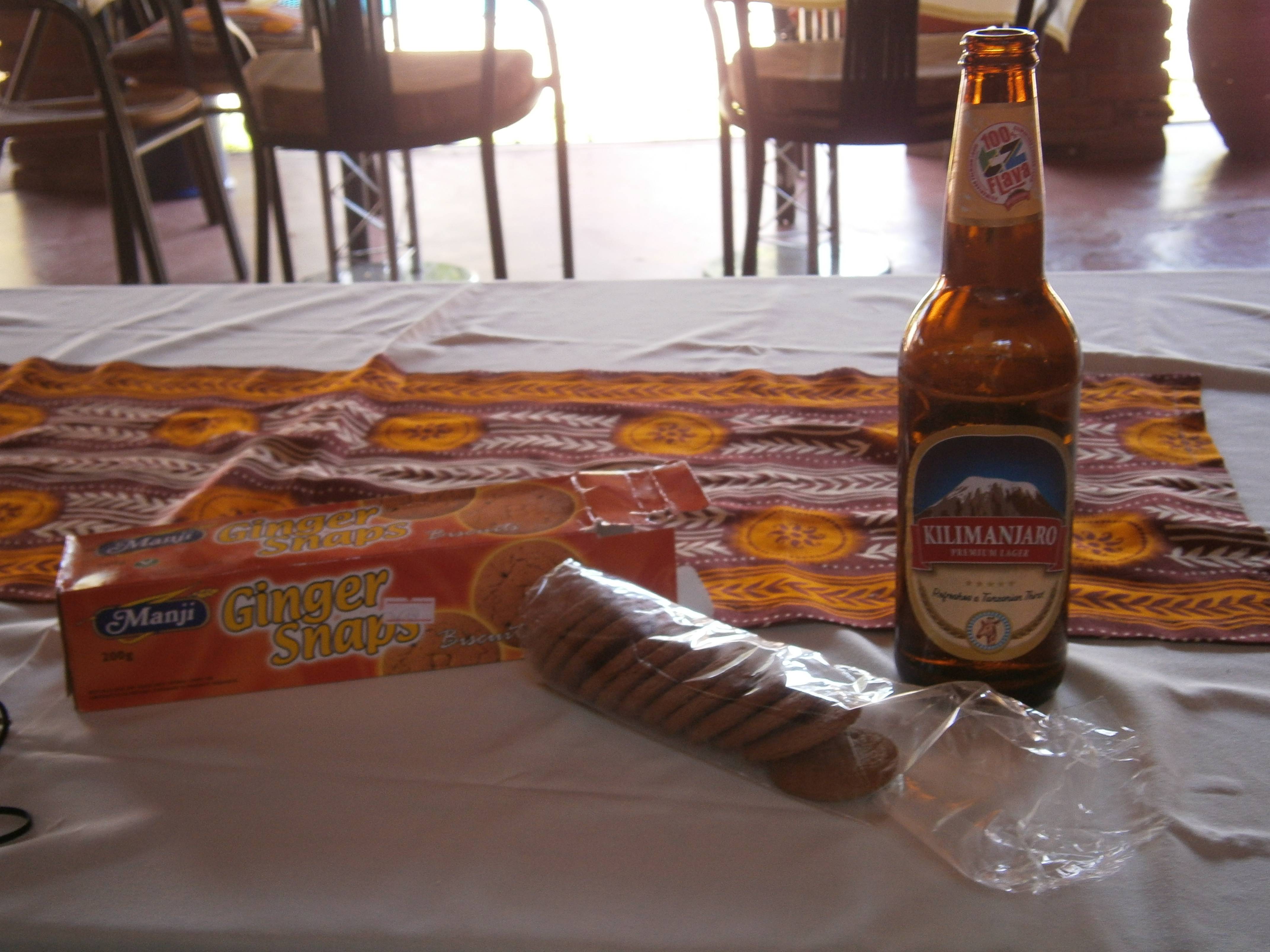
Kilimanjaro beer and ginger cookies back at my hotel.

In all, the climb went almost perfectly as planned.  Aside from persistent – but manageable – issues with my stove, everything went smoothly and was enjoyable. I was lucky with weather, and mostly had clear days.  Climbing to the summit during the day was excellent; it afforded great views and allowed me to avoid the crowds and cold.

Above ~5000m the altitude made physical output more challenging, but I didn’t have any issues with altitude sickness or related discomfort.  My acclimatization definitely benefited from spending three days hiking Mount Meru before beginning Kilimanjaro, and I feel that the geography of my route also helped a great deal.  I was surprised at the crowds on the mountain, and a little bit disappointed by the amount of garbage I saw, especially near the top, left behind by other hikers.  Doing the climb unsupported kept my days busy setting up camp, cooking, obtaining water, and managing gear, which made for a rewarding hike!

Accessibility

Kilimanjaro is highly accessible.  Numerous guide and tour companies exist, and offer a wide variety of support options for hikers.  Price varies dramatically, and largely depends on the level and quality of support provided.  Most companies incorporate transportation, accommodation, and related logistics into their trip pricing. The Kilimanjaro Airport offers easy access into Arusha and Moshi.

At minimum, a guide is required for climbing permits, and I hired mine through a no-frills outfitter called Kilimanjaro Alpine Service, who offer unsupported ‘superlight’ services (no porters, cooks, gear or food).  I stayed at the Outpost Lodge in Arusha, which I found to be very comfortable and reasonably priced.  A wealth of information exists on hiking Kilimanjaro, and some outfitter websites also serve as quite detailed resources.

Snow Mountain North Peak – 雪山北峰 – July 2012

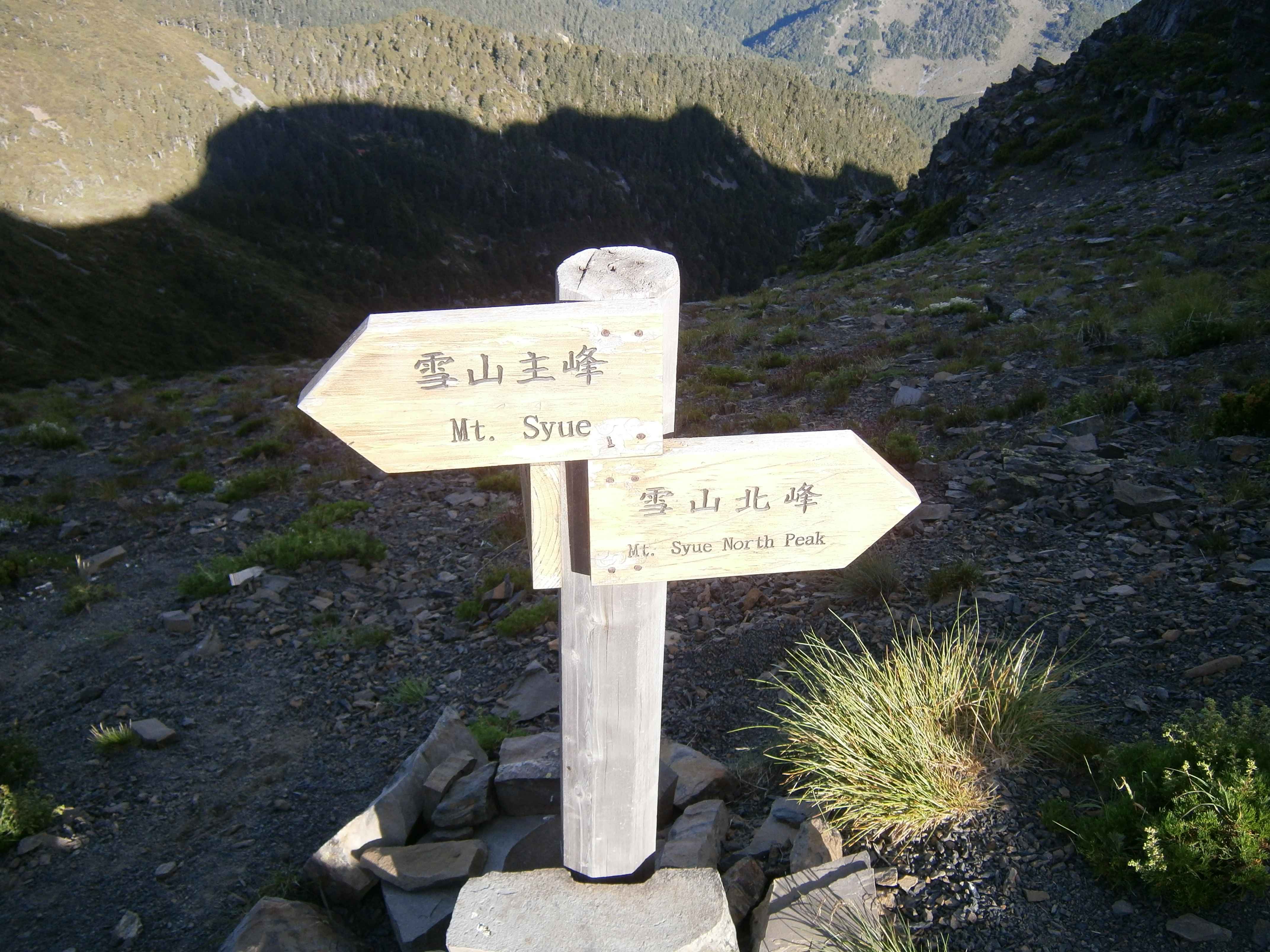
Snow Mountain’s North Peak.

Snow Mountain, with its Main Peak at an elevation of 3886m, is Taiwan’s second highest mountain.  After an exciting climb up the Main Peak in deep snow and inclement weather the past January (Snow Mountain – 雪山 – January 2012), I was eager to return for more hiking.

Snow Mountain’s Main Peak, viewed from the north ridge.

Having already made two winter hikes of the ‘standard’ eastern route up the Main Peak, I decided to take a longer, alternative route up and along the mountain’s ridge-line to visit Snow Mountain’s North Peak, and spend the night camping up on the ridge.

This map outlines the route I followed:

My hiking route.  Longer and more strenuous than the traditional Main Peak ascent, but worth it for the experience of hiking the ridge!

Day 0: Bus to Yilan, rented a scooter, drove to the eastern trailhead at Wuling Farm.  Hiked for ~45 minutes to Chika cabin, arriving quite late.

Day 1: Up eary, and hiking by 5:30 a.m.  The sky was clear, and the morning moon was bright.  As the trail moved higher up a series of switchbacks, the views got better and better.

The morning moon.

The air was clear, and to the east there was a great view of Nanhuda Shan (left), and Zhongyangjian Shan (right).

The weather was fantastic.  Blue skies and almost no clouds, but very hot.  A far cry from the winter weather I was accustomed to on this trail!

The trail looked unfamiliar in the summer weather.

After several hours of hiking, the trail reached Snow Mountain’s East Peak. In the wonderfully clear air both Snow Mountain’s Main Peak and the northern ridge were visible, looming in the distance.

On the East Peak of Snow Mountain, the Main Peak and north ridge in the distance.

A closer view of Snow Mountain’s Main Peak (far left) and North Shoulder (middle), as seen from the East Peak.

Further away, the Wuling Sixiu ridge could be seen.  At an even greater distance, Chilai Shan scratched the horizon.  The bright, clear sky was truly delightful.

The Sixiu ridge from the eastern Snow Mountain trail: Pintian Shan, Chiyou Shan, and Tao Shan left to right.

Chilai North Peak (left), and Main Peak (right) were visible far, far away.

Below the East Peak, 369 cabin rested in an alpine meadow, a barren stretch of terrain created by a forest fire.

369 cabin to the west, below the East Peak.

I reached 369 cabin at 9:00 and took a good rest.  I left 369 cabin at 10:30, heading along a rough forest path and across a stream, towards Kailantekun Shan and the north ridge of Snow Mountain.

The forest route looked great in the morning sunshine.

A small stream crossing near the end of the forest.

Higher up, the trees began to thin out, and eventually disappeared altogether.  As I broke out of the forest, I was greeted by an intimidating sight.  The fearsome cliffs of the northern ridge towered above me, and a steep trail of loose scree led upwards, cutting past the cliff faces and onto the ridge itself.

As I ascended above the treeline, this cliff face was my first view of the north ridge.

The north ridge is startlingly steep, crowned by vertical cliffs.

The path upwards was steep, and covered in loose scree.

The scree was tiring and unpleasant to climb, especially given my full backpack and large water supply. From the top of the ridge, I had great views of Snow Mountain’s northern ‘2nd’ glacial cirque.

The north, ‘2nd’ glacial cirque of Snow Mountain, located right behind Snow Mountain’s North Shoulder. This bowl-like formation is a remnant of ancient glacial movement.

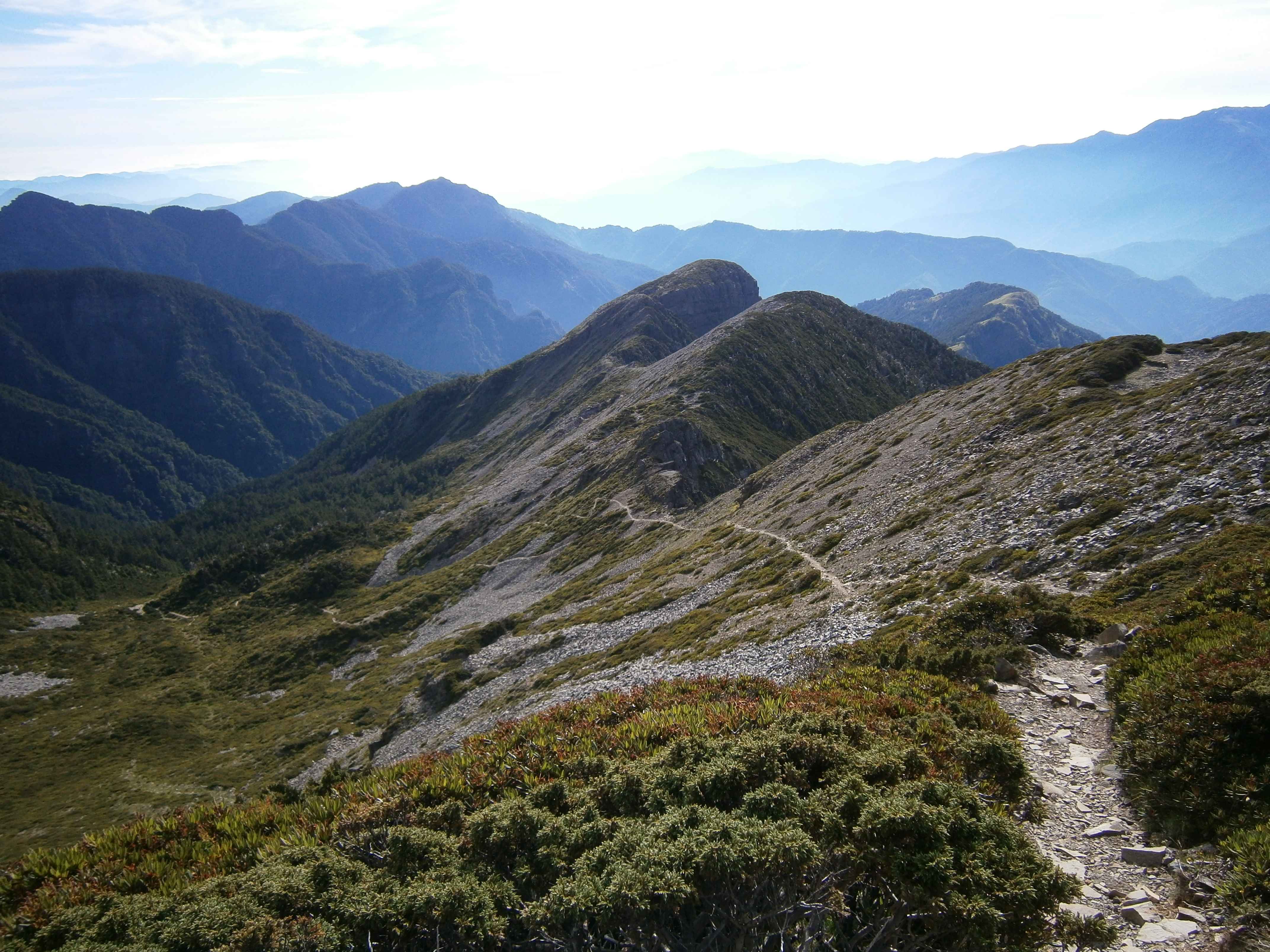
Further along the ridge-line, I could see the North Peak jutting out to the west.

The North Peak beckoned.

369 cabin and the East Peak looked tiny below me.

369 cabin and the East Peak below.

As I moved north along the ridge, the weather began to deteriorate.  Huge, dark clouds began to form.  Thunder boomed in the distance, and the temperature dropped.

Ominous clouds were forming, accompanied by thunder. A gap in the clouds revealed blue skies over Zhongyangjian Shan.

The trail along the ridge wound up and down, alongside vertical cliffs and across rocky slopes.  The ridge offered some really exciting and enjoyable hiking!

The ridge trail followed the cliffs.

To the west, thick clouds billowed up and over the ridge.  I was certain that a downpour would begin any minute.

The clouds were moving in, and rain seemed imminent.

I finally reached the base of the North Peak.  Cairns of rock marked the summit.

Cairns on the North Peak.

The heavy clouds obscured any views from the top.  A roughly constructed rock sign sat atop the largest cairn.

The triangulation marker on top of the North Peak.

The North Peak summit sign.

As I returned south, heading towards the Main Peak, the clouds began to clear. I was lucky to avoid rainfall; the ridge is exposed, and any amount of rain would have been uncomfortable.

As the storm clouds cleared, the view returned. Here 369 cabin and the eastern trail are framed by Nanhuda Shan and Zhongyangjian Shan.

Further south, I passed back over the summit of Kailantekun Shan, marked with a neatly engraved metal post.

The Kailantekun signpost.

I reached the Kailantekun Shan saddle at around 5:30 p.m., and upon finding a small area of flat ground, decided to pitch camp.

My rough campsite on the ridge. The spot was very tight, and while my vestibule was a little bit crooked, I had just enough flat ground to sleep comfortably.

The sun began to set, and I enjoyed a colorful evening sky as I ate dinner in the vestibule of my tent.

I had a nice view of the horizon from my tent.

The sunset was colorful and very pleasant.

After a great night’s sleep, I awoke at 4:15 a.m.  The sunrise was unimpressive, and mostly obscured by clouds.  I cleaned up my campsite, and continued heading south, towards the Main Peak.  Looking back, I could see the winding ridge I’d traveled, the North Peak (far left) prominent.

Looking back at the north ridge.

At the base of Snow Mountain’s North Shoulder, more scree awaited me.  Scree is remarkably annoying to ascend.

More scree on the way up Snow Mountain’s North Shoulder.

The top of the North Shoulder was marked with another neatly engraved post.  Below, I could see huge groups of hikers headed up the ‘standard’ eastern route towards Snow Mountain’s Main Peak.

The top of the North Shoulder.

Below me, big groups of hikers were headed up the eastern trail to the Main Peak.

Watching the crowd below, I was happy to be approaching the Main Peak from the north, to this point with the trail all to myself.

From the top of the North Shoulder, a steep descent took me to a saddle between the Main Peak and North Shoulder.

The North Shoulder cast an interesting shadow past the saddle.

Looking back, the North Shoulder’s cliff was an impressive sight.  The route down towards the Main Peak curves past the sheer drops.

Looking back at the North Shoulder’s sharp face.

The Main Peak was crowded with other hikers.  It was a strange sight, given I’d been completely alone with the trail all to myself since passing 369 cabin the previous day.

The Main Peak was very crowded, and I had to line up to take a photo with the summit rock.

On top of the Main Peak.

From the Main Peak, I had a great view of Dabajian Shan.

Dabajian Shan, with the North Peak in front of it, from the Main Peak.

In the summer weather, the route down from the Main Peak was much different than the icy, snow-drift covered face I had experienced on previous Snow Mountain hikes.

The eastern Main Peak trail, my descent route.

Behind me the North Shoulder looked impressive on the way down.

The North Shoulder, viewed from the eastern trail.

Further down, I returned to the evergreen forest.  It was vibrant in the morning light.

I descended back through the forest, enjoying sunshine through the trees.

An opening in the trees, glowing with sunshine, marked the end of the forest.

From 369 cabin to the trailhead, the hiking was uneventful but pleasant.  The weather was hot and sunny, but not the slightest bit humid, and so quite comfortable.

One final signpost near the end of the trail.

I reached the trail head at 12:30 p.m., had a snack, packed up my gear, changed my clothing, and drove my rental bike back to Yilan.  This had been a fantastic hike, and I left feeling grateful to once again have had great luck with weather.  Camping on the ridge was exciting and beautiful, and the strenuous first day (most notably that short burst up the north ridge’s scree slope) had paid off through great views and enjoyable hiking terrain.

Accessibility

Wuling Farm, where the trailhead is located, is fairly easy to access.  I drove in via rental motorbike from Yilan. You need a Taiwanese driver’s license to rent.

Hiking Snow Mountain requires a national park entry permit, as well as police issued mountain entry permits.  Both are easy to apply for.  The Shei-Pa National Park permit website (in Chinese) is located here, and offers a very intuitive, easy to follow interface (perhaps the best of all Taiwan’s national parks):
https://apply.spnp.gov.tw/
Police permits can be applied for here (In Chinese).  For the website to load, you need to use Internet Explorer and adjust the encoding for ‘Chinese Traditional, Big5′ (found through Page -> Encoding):
http://eli.npa.gov.tw/E7WebO/index02.jsp

Jade Mountain Main Peak – 玉山主峰 – December 2011

The Main Peak, as seen from the north saddle. This photo was taken on my April 2012 trip.

Jade Mountain, Taiwan’s highest at 3952m, is also perhaps Taiwan’s most famous.  A popular two-day hike, Jade’s Main Peak is relatively easy to access via a well-maintained – perhaps best described as ‘groomed’ – trail from the western trailhead at Tataja.

The first ~8 km of the western trail follows a cliff. Areas prone to landslide have been reinforced, and the trail is wide and smooth.

Doing more and more day hikes around Taipei, I had slowly begun looking into a Jade Mountain hike with some friends.  As I was fairly new to Taiwan’s system of mountain permits (a system especially pronounced at Jade, perhaps the country’s most popular high-mountain hike) the two day trip took some planning, and came with high expectations! We planned to use the Yuanfong cabin to overnight, as the Paiyun lodge was undergoing renovation at the time of our trip.

Here is an outline of the itinerary we took:

An outline of our two-day hiking itinerary.

Day 0: Took a bus from Taipei to Jiayi, where we rented scooters.  Drove to the western trailhead at Tataja, and overnighted in the Dongpu hostel, near the restricted access road at the base of the mountain.  The drive from Jiayi takes roughly three hours, and the Dongpu hostel is a very comfortable place to base a hike out of.

The beginning of Yushan national park, near the Dongpu hostel.

Day 1: After a good night’s sleep, we were up for an early start up the service road. After an hour of walking on pavement, we reached the official trailhead.

Our group at the trailhead.

The weather wasn’t ideal; overcast and very humid.  It looked like rain.  The trail upwards took us along the side of a cliff and through a deep valley, with very steep drop offs in sections.

Trees growing from the side of the cliff.

The trail is very well maintained, and for additional safety numerous chains have been installed where the path is narrow.

In rockier areas, the trail navigates across boardwalks.

Steep drops lay below.

Some of the drop-offs at the side of the trail were very impressive, and the views of the valley below were noteworthy, despite the fog and overcast sky.  We began to appreciate the wide trail; unmaintained, a narrow trail along this steep cliff would be quite dangerous!

Numerous rocky outcroppings extend above the valley.

Looking out across the valley.

Further in, the forest became denser, and some beautiful trees could be seen lining the path.  The hike to this point was fairly easy and very straightforward, due largely to the great trail and gentle ascent.  As we entered the forest, fog began to roll into the valley, obscuring most of the views but contrasting nicely with the trees along the path.

A thick blanket of fog poured into the valley.

We had to accept that the views were gone.

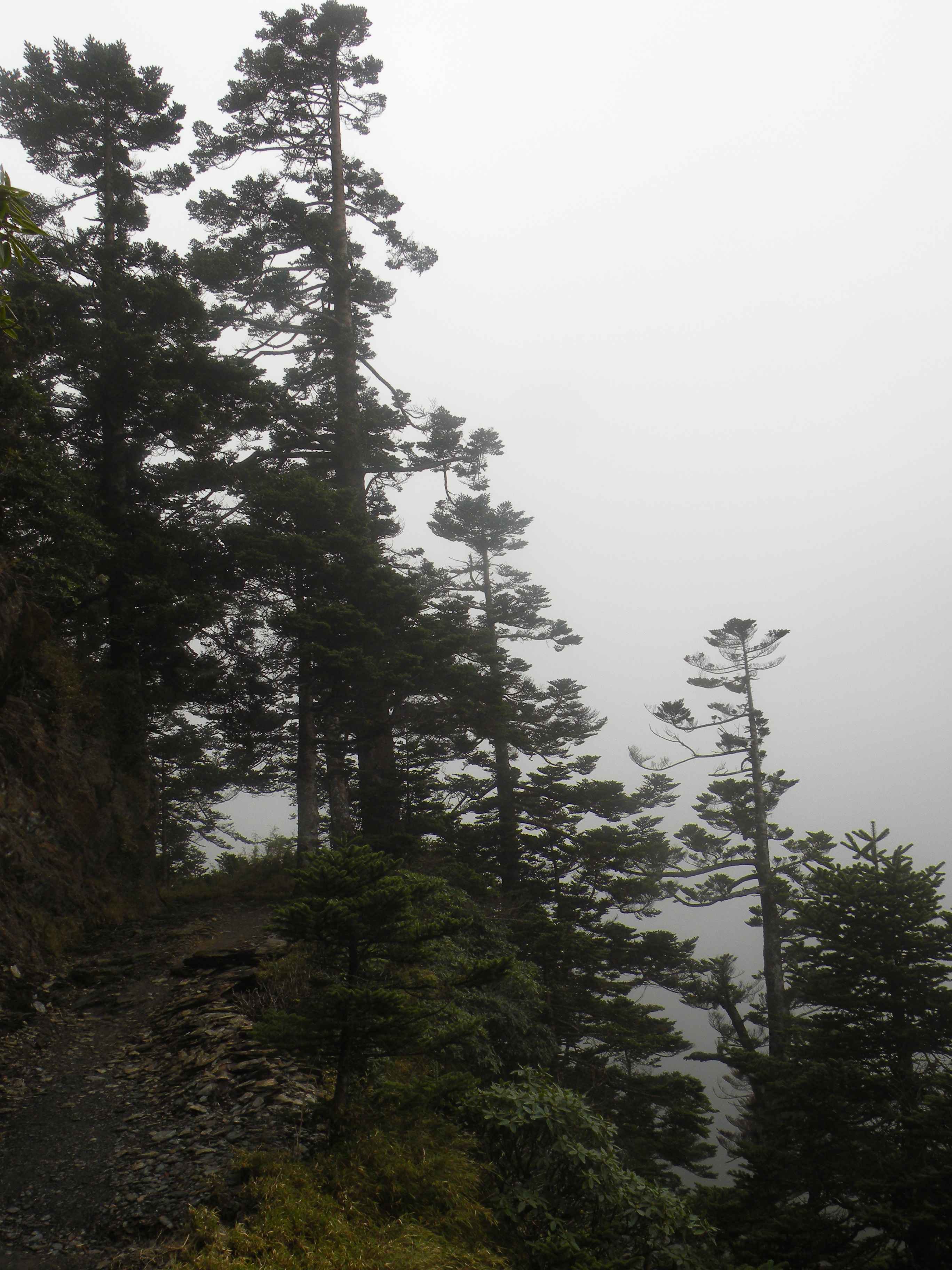
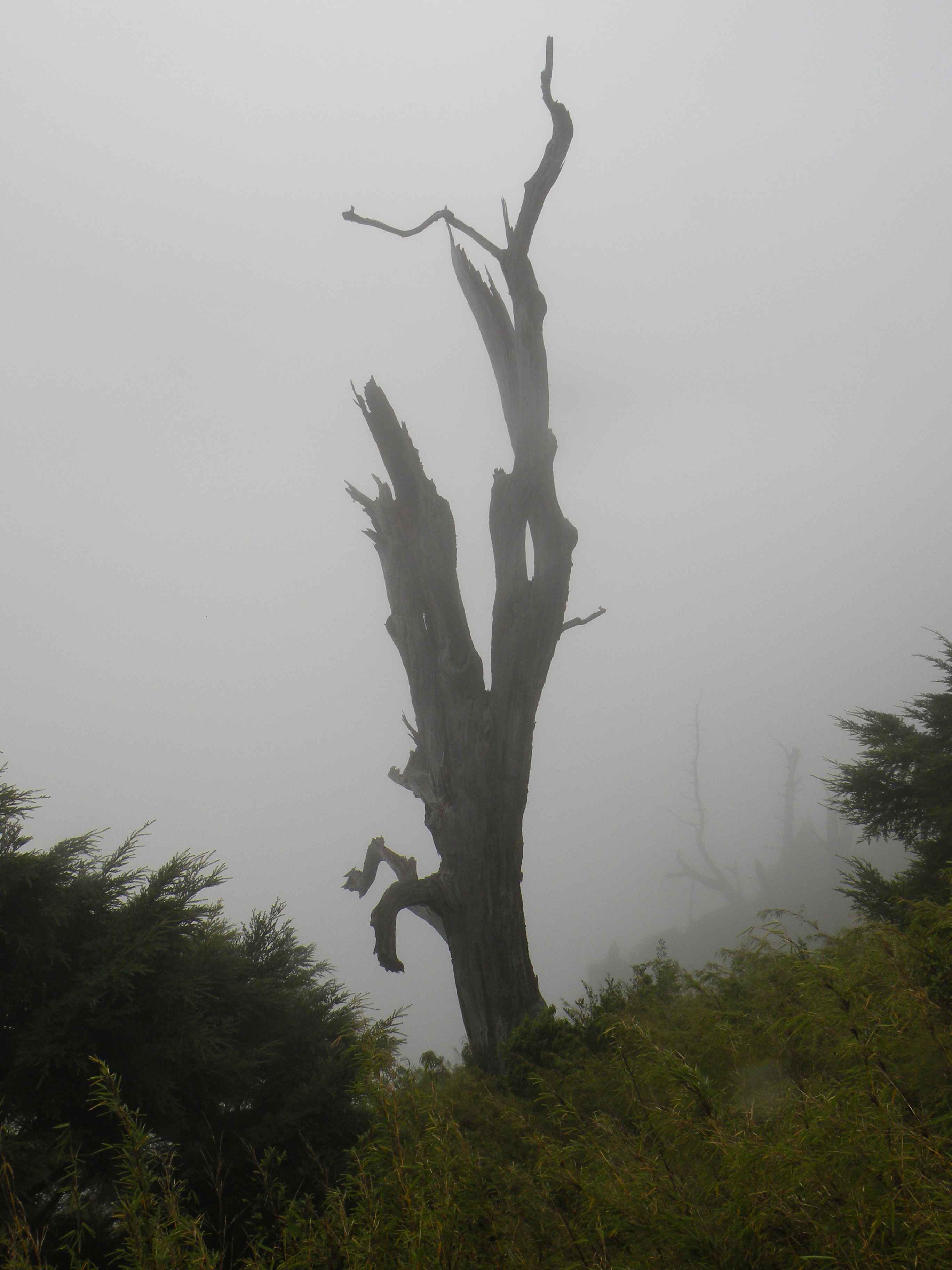
Dead trees on the side of the cliff created an eerie atmosphere in the fog.

Taking a sandwich break along the way, a pair of plump little birds joined us.  No doubt looking for food!

The birds, pondering us with inquiring minds (or so it would seem).

They were bold little creatures, and definitely expected some handouts!

After a few hours of progress a light drizzle began, and the trail began to ascend more sharply, following a series of rocky switchbacks.  We found ourselves enjoying the terrain, and began to feel like we were actually climbing up a mountain.

The path became rockier as we headed upwards.

Further along, we reached “the great precipice”, a steep and severe rock wall bypassed by a section of boardwalk and some clever trail construction.  It was impressive to look at, and a great spot to take a little break.

At the start of the precipice.

Resting on the boardwalk.

After the wall, the rain began coming down in earnest.  The fog thickened, and the great views we had been hoping for higher up were completely obscured.  We passed Paiyun cabin, and as we gained altitude, the weather got even worse.  Our original plan had been to wake up early the next day and head to the top for a sunrise, but we reasoned that this plan wouldn’t bear fruit for us given the weather.  We agreed that if it continued raining the next day we would rather sleep in, and thus we decided to head to the top in one push.

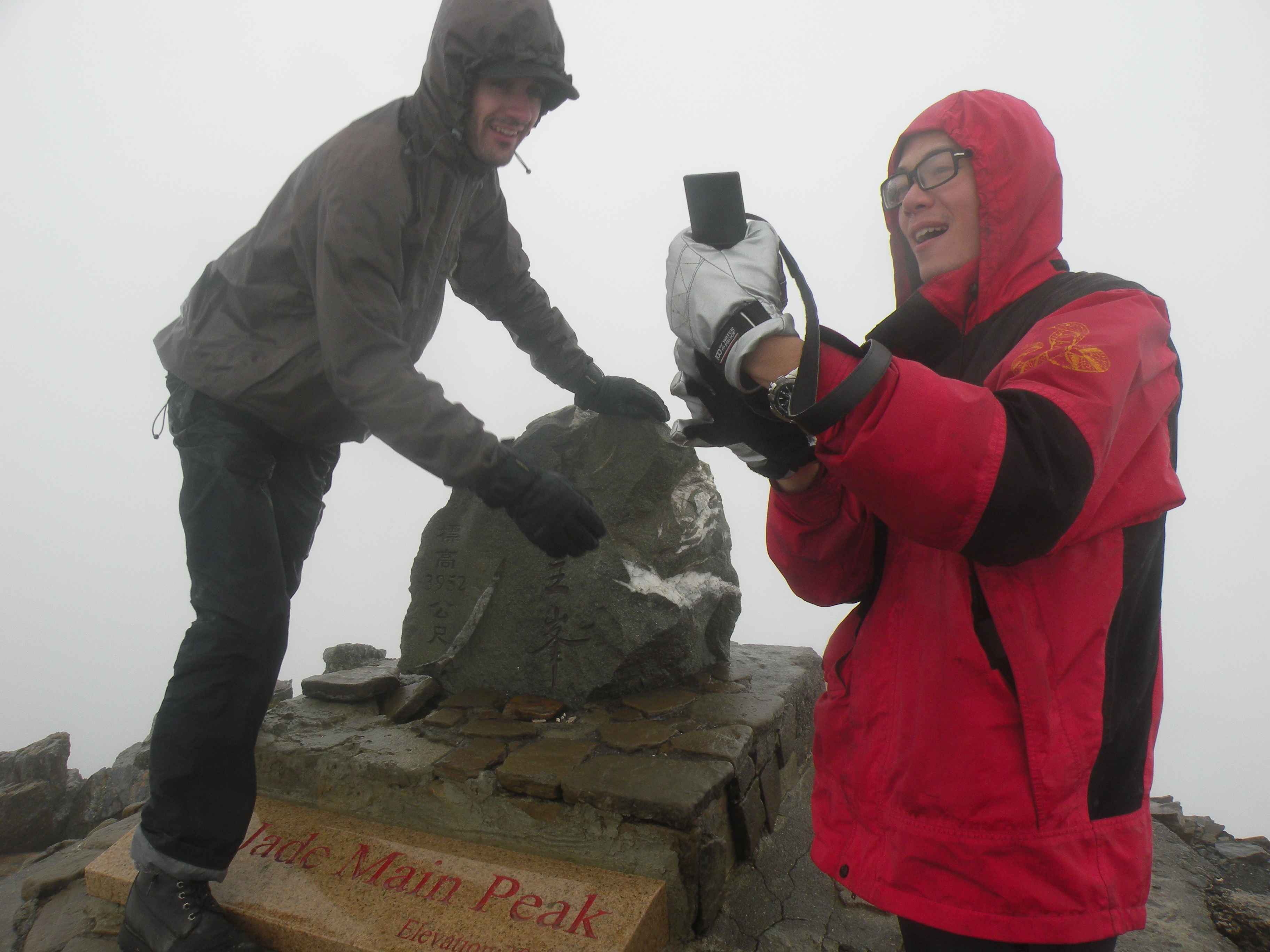
The wind worsened as we moved up the final portion of trail, a rough and very direct scramble over loose scree and crumbling rock.  I would learn later, on my third hike of Jade, that there is an alternative, much easier switchback route which branches off to the side – but the direct trail is more fun!  In strong winds and rain we felt as if we were climbing up into a storm.  Visibility was very poor.  When we finally reached the top, I was yelling at my friends to stay low, for fear the wind would take us right off!  The weather was heinous.

Taking pictures in the wind and rotten weather at the top of Jade Mountain.

My facial expression is a mixture of happiness, relief, and annoyance.

We spent less than five minutes on top; just long enough for some quick pictures.  We descended quickly, eager to make the Yuanfong cabin and get out of the weather.  The Yuanfong cabin is very basic inside, but it was dry, and we had it to ourselves.  I can’t imagine sharing it at capacity, with twelve other people.  It would be very unpleasant.

Yuanfong Cabin.

A basic A-frame, the cabin was nonetheless nice and dry.

“Bedspace” is allocated as part of the permit application process. You are designated a section of floor to sleep on. Luckily, we had the entire thing to ourselves.

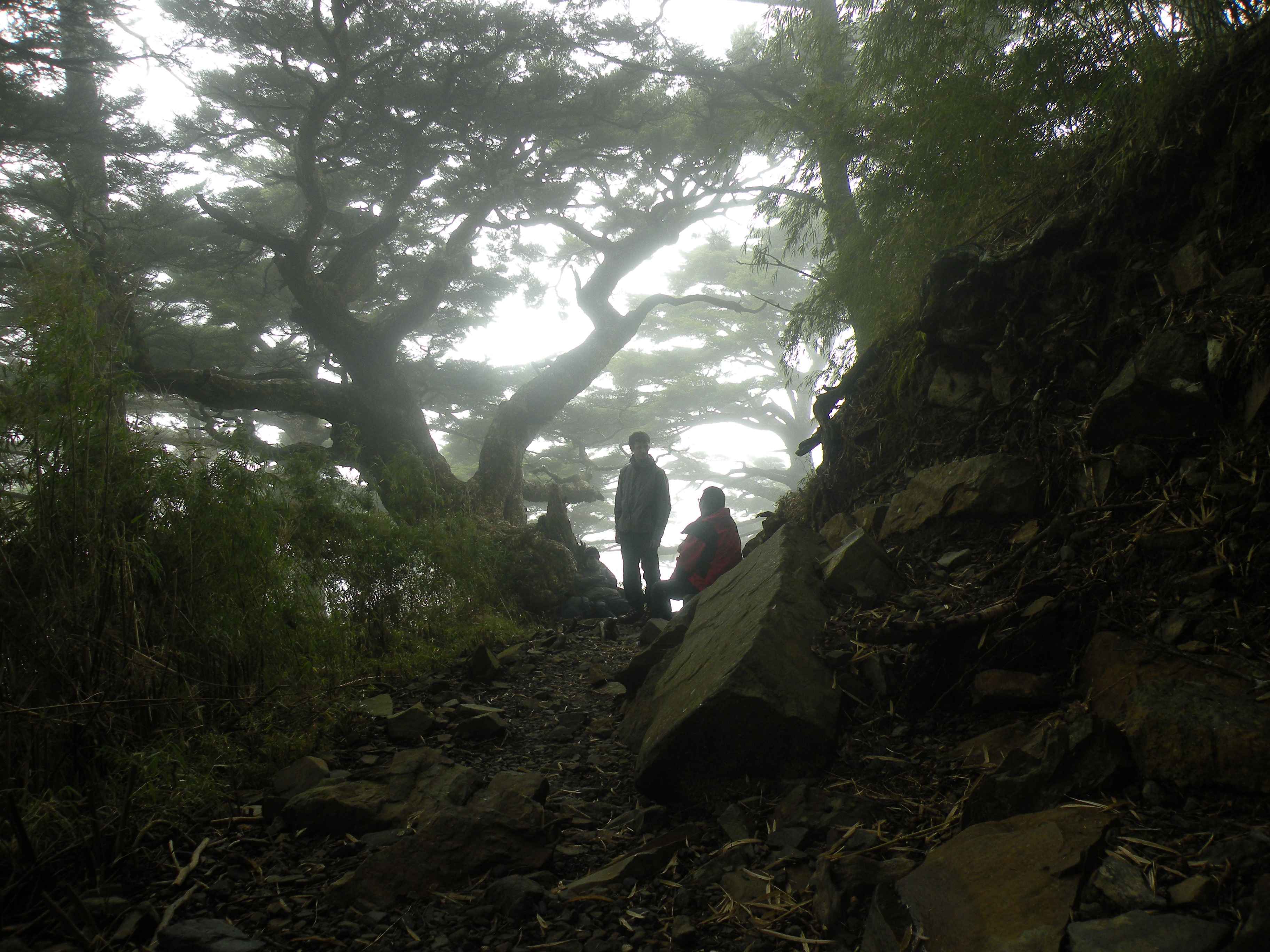
Day 2: The next morning, our decision to sleep in paid off, as the weather had refused to clear up overnight.  Fog still hung over everything, and rain continued to drizzle down.  We ate a hot breakfast, packed up, and began to head down.  Roughly halfway down, the rain stopped, and we enjoyed a nice glow through the fog and trees.

Taking a break underneath an interesting old tree.

The air cleared a bit, and we enjoyed some morning light.

After four or five hours of descent, we reached the restricted access road that marked the trailhead.  By now the rain had stopped, and we comfortably headed back to the Dongpu hostel to pack up and head home.  We ate a nice lunch at the Dongpu hostel, and drove back to Jiayi, catching a train from there back to Taipei.

Eating snacks while walking the restricted access road.

Accessibility

We chose to use the Yuanfong cabin, and booked space for it through the permit application process.  At the time of our trip, the Paiyun cabin – the use of which would make climbing the Main Peak easier – was still closed for construction.  It will probably open soon.  Yuanfong has a reliable water source.  It is also possible to make a single-day ascent/descent of the Main Peak (and, with determination, probably one of the East, or North, or West peaks as well), provided you can illustrate experience and physical fitness  – email the permit application staff through the Yushan National Park website (linked below) to obtain the paperwork for this.

The Dongpu hostel (東埔山莊), located at the base of the mountain near the restricted-access service road, is very comfortable, and even provides warm bedding.  Bedspace can be booked, their phone number is 0492702213.

Getting to the trailhead isn’t difficult.  We took a bus to Jiayi, rented motorbikes, and drove ~3 hours to the trailhead.  This is by far the least expensive means of getting there!

Hiking Jade Mountain requires a national park entry permit, as well as police issued mountain entry permits.  Jade Mountain is a popular hike, and it is difficult to obtain a weekend permit; with Paiyun under construction, the number of hikers allowed access per day is limited.  Plan on going during the week.  The Yushan National Park permit website (in English) is located here:
http://mountain.ysnp.gov.tw/english/CP_how.aspx?pg=03&w=2&n=23001
Police permits (In Chinese) can be applied for here.  For the website to load, you need to use Internet Explorer and adjust the encoding for ‘Chinese Traditional, Big5′ (found through Page -> Encoding):
http://eli.npa.gov.tw/E7WebO/index02.jsp

Nanhuda Shan – 南湖大山 – February 2012

Nanhuda Shan.

Nanhuda Shan.

Zhongyangjian Shan and Nanhuda Shan

Nanhuda Shan (left) and Zhongyangjian Shan (right) viewed from North Hehuan Shan.

The air was clear, and to the east there was a great view of Nanhuda Shan (left), and Zhongyangjian Shan (right).

Nanhuda Shan (left), and Zhongyangjian Shan (right) viewed from near Snow Mountain’s East Peak

Nanhuda Shan, Taiwan’s fifth highest at 3742m, is one the most beloved mountains among Taiwanese hikers and is famous for its views and impressive, rocky faces.  Many experienced Taiwanese hikers will tell you that Nanhuda Shan is the most scenic, the most beautiful of Taiwan’s mountains.  I visited Nanhuda Shan in early February, and unfortunately experienced absolutely terrible weather on all four days of my trip.

Walking the entry road near the trailhead on the first day, before the weather turned to soup.

Despite the awful weather, the hiking was exceptional.  The route initially heads up through forest, but breaks the treeline after the first day, leading one across an awesome landscape of barren rock.  In the snow higher up, it was an eerie and severe place.

Here is an outline of my four day hiking route:

My four day hiking itinerary.

Day 0: Caught a train from Taipei to Luodong, in Yilan county, and stayed overnight in an inexpensive hotel.

Day 1: Up early, caught a taxi (NT$2500) from Luodong to the trailhead.  We opted to shell out for a Taxi, rather than rent a much cheaper motorbike, due to the already very unpleasant weather.  Rain showers and thick fog on the drive up.

From the trailhead, we walked 6.7km along an old overgrown service road, long rendered impassable to vehicles due to earthquakes, landslides, and typhoon damage.  Not so much a road as a wide, level hiking path.  Several detours took us off of the road, and over sections wiped out by landslide.  The weather began to worsen, and fog descended over everything.  It began to rain again.

The ‘road’ is overgrown and rough. Mostly level, we covered the 6.7km at a fast pace.

From the “true” trailhead, we hiked another couple of hours to the Yunling cabin, where we would camp for the first night. The Yunling cabin has plenty of bedspace and is well constructed, but we had opted to use our tents.  The weather was wet and wretched, and as night fell it became quite cold.  The temperature hovered around 0C; not quite cold enough for snow, and very unpleasant in the constant drizzle.  I had a good night’s sleep, but the friend who accompanied me this far was feeling ill, and didn’t sleep well.

Yunling cabin, with two friendly hikers whom I met on the third day.  We’re all wet!

Day 2: In the morning, my friend was much worse; he had stomach pain, and could not keep food down.  After much discussion, he decided to accompany another team who was headed home, and get off of the mountain.  The team he went with conveniently lived in Taipei, nearby his house. They gave him a lift all the way home!  I continued alone.

From Yunling cabin, I hiked upwards towards the Nanhu Cabin/campsite, passing Shenmazhen Shan and Nanhubei Shan on the way.

Shenmazhen Shan. Wet from the drizzle.

Nanhubei Shan. Terrible visibility and heavy rain.

Finally reaching the Nanhu Cabin, I pitched camp nearby.  The weather was even worse up high.  Colder, but just as wet.  I headed off to the Main Peak of Nanhuda Shan with two friendly Taiwanese hikers whom I met in the cabin. One, a businessman who spoke fluent English, had hiked Nanhuda Shan twice before, and told me that he had never seen such awful weather!  The route up to the Main Peak was surreal.  The fog was so dense that we could only see a few meters in front of us, and no trail had been broken through the snow.  We climbed up to the saddle between the East and Main Peaks, and then went about the business of finding trail markers, still visible despite the snow.  The terrain was rocky and desolate.

At the Main Peak, soaking wet. Whiteout visibility.

Getting back from the Main Peak took us much longer than it would have in decent weather.  We got lost a few times, and had to carefully backtrack.

Returning to the campsite, I crashed in my tent for a few hours of sleep.  When the sun set the temperature dropped, creating mucky fog and sleet.  It is hard to imagine worse camping weather.

Day 3:

I woke up feeling strong, and decided to take one more trip up the ridge before heading down.  My two new friends from the day before descended all the way to the trailhead, deciding to leave early due to the weather.  The temperature had dropped, freezing everything.  The sleet/rain stopped, but the fog remained.  Visibility was poor – I was completely socked in.  Retracing our route from the evening before, this time I turned east on the saddle, heading over fields of ice and snow towards the East Peak of Nanhuda Shan.  The trail was rough, rocky and almost totally devoid of plant life.  I built rock cairns as I went, to protect myself from getting lost in the low visibility fog.

The East Peak of Nanhuda Shan. Zero visibility!

From the East Peak, I returned to the Nanhu cabin.  There, I packed up my camping gear, and headed back to the Yunling cabin.  It began to rain again. At Yunling, I pitched camp in the rain, cooked a hot dinner inside and went to bed.  I slept like a rock; compared to the freezing sleet and saturated humidity of the night before, the rain was pleasant!

Adjusting my tent pitch, in the rain, on the third evening. Yunling had plenty of space, and I managed a nice comfortable setup.

Day 4: I slept in until 7 a.m., packed up, and hiked out to the trailhead.

Despite the weather, I thoroughly enjoyed this trip. The terrain at Nanhuda Shan is impressive, varied, and exciting higher up.  Hopefully I’ll get some views, and some better photographs next time!

Accessibility

The Yunling cabin is well built and appeared spacious enough for sleeping.  I chose to camp at Yunling, and did so quite comfortably for two nights.  The area around Yunling has space for two or three tents.  Yunling has a reliable water source.  You can book cabin space and camping space during the permit application process.

The Nanhu cabin is quite large, and was very comfortable.  There are numerous spots for camping at the Nanhu cabin, and plenty of space, as well as a reliable water source (a nice stream).  Nanhu campsite is above the treeline and very exposed.  In the high humidity and freezing rain/sleet I experienced, it was definitely not ideal for camping.  There is also a ‘middle’ cabin located between Yunling and Nanhu, the Shenmazhen cabin.

The Nanhuda Shan trailhead is fairly easy to access.  Take a bus or train to Yilan City or Luodong, and rent a motorbike.  A taxi in cost us NT$2500.

Hiking Nanhuda Shan requires national park entry permits from Taroko National Park, as well as Police issued mountain entry permits. The park entry permit requires two Taiwanese group members; one as the “group leader”, and one as the “emergency contact”.  After the first day I did this hike alone (and the friend who accompanied me on the first day isn’t Taiwanese).  My Taiwanese friend was, unfortunately, feeling under the weather and couldn’t make it. The Taroko National Park permit website (In Chinese) is located here:
http://permits2.taroko.gov.tw/welcome/index.aspx
Police permits can be applied for here (In Chinese).  For the website to load, you need to use Internet Explorer and adjust the encoding for ‘Chinese Traditional, Big5′ (found through Page -> Encoding):
http://eli.npa.gov.tw/E7WebO/index02.jsp

Beidawu Shan – 北大武山 – March 2012

The summit of Beidawu Shan, as seen from the ridge-line trail which approaches from the south.

3090m Beidawu Shan (北大武山), located in Pingdong county, is Taiwan’s southernmost 3000m+ mountain. Remarkably prominent, visibly towering over the surrounding area, the  trail up to the top of Beidawu Shan ascends almost 2000m, making for a really solid hike.

The trail winds up over staircases of rock and tree root, crossing a narrow ridge.

This particular mountain is well renowned for its ‘cloud ocean’ in clear weather.  I had great luck with the weather on this trip, and wasn’t disappointed – above the cabin I had fantastic views.  Here is an outline of the route I took:

A map of my two day hiking route.

Day 1: I caught the overnight train from Taipei to Kaohsiung, arriving in Kaohsiung at 6 a.m.  I rented a motorbike in Kaohsiung and drove to the trailhead.  Getting to the trailhead was a nightmare – after passing the Pingdong Train Station and leaving Route #1 (see the linked map below) the road goes through some very rural farming areas, and signage is absolutely horrendous.  I had to stop and ask for directions several times, despite having a map and basic instructions.  If making this trip for the first time, I strongly recommend using a GPS.

For reference, here is a map outlining the route from the Pingdong Train Station to the trailhead: MAP

Past the village of Taiwu, the road up to the trailhead is in poor condition, heavily damaged by typhoon Morakot.  Higher up, the road is impassable due to landslide, and the trailhead has been moved further down the mountain as a result.  The above maps reflect this change.  The lower trailhead adds a few kilometers of steep terrain to the first day of hiking, but overall this wasn’t too bad.  There was plenty of parking space along the road, and the roadside trailhead was clearly marked with hiking tags.

Hiking through the misty lower forest.

The weather was a bit unpleasant on the first day; very humid and muggy, with fog obscuring most of the views.

The trail lower down crosses several landslides. Foggy weather on the first day.

Interesting, twisted trees grew all over the mountainside.

After four hours of hiking, I reached the Guigu Cabin (檜谷山莊), which was very comfortable and well constructed.  I went to sleep at 5 p.m., knowing I had to be up early the next day.

Day 2: I woke up at 2:30 a.m., and began hiking in darkness at 3:30 after cooking a hot breakfast.  The trail from Guigu Cabin, which is located at ~2100m, ascends roughly 1000m up to the top, and is moderately steep. The trail stretches upwards across the mountain before breaking onto the ridge, where I began to enjoy some great views.

Contrasted by trees, the clouds were fantastic.

The horizon looked interesting in the morning light.

The mountain casts a huge shadow with the sunrise behind it.

The shadow of the Beidawu Shan in the morning sun.

Nearby mountains looked small.  At 3090m Beidawu Shan isn’t the highest of Taiwan’s mountains, but it definitely dominates its landscape.

Much higher than anything else nearby.

Mountains peeking out of the clouds below.

The trail on the ridge was interesting, with lots of foliage to navigate.

The ridge was covered in trees and vegetation.

Near the top, some interesting artifacts can be found.  A crumbling war monument, built on the mountain to honor the Aboriginal Taiwanese who fought for the Japanese during the Second World War, occupies a clearing in the trees.  It fits right in with the environment; ancient and overgrown.

The war monument.

An old Japanese shrine also occupies the ridge.  According to signboards posted nearby, the shrine was originally built right on the summit of the mountain, against the wishes of the local Aboriginal Taiwanese, who hold the mountain sacred.  Perhaps due to this transgression, the shrine was repeatedly struck by lightning, and had to be moved lower to its present-day location.  From the shrine, the summit is roughly an hour’s hike away.

The old Japanese shrine.  The summit of Beidawu Shan is visible past the trees to the right.

I reached the top at 7:30 a.m., and spent an hour on top taking in the views, enjoying the sunshine, and eating snacks. The sea of clouds was brilliant, and the sun was bright in the morning sky.

Near the top.

From the mountaintop the clouds seemed endless.

At the top of Beidawu Shan.

I took my time descending, and stopped at Guigu on the way down to cook a hot lunch.

An interesting section of trail just below Guigu Cabin. Severe drops to either side of this narrow stone ridge.

I got back to the trailhead at 2 p.m., making for a long day of hiking with roughly 1000m of ascent and 2000m of descent.  Since I knew where to go, the drive back to Kaohsiung was much faster and more pleasant than the drive in had been the day before.  In Kaohsiung I boarded the train back to Taipei, and had a good long nap on the way home!

Accessibility

From southern Taiwan Beidawu Shan is fairly easy to get to – it is only ~3 hours out of Kaohsiung (assuming you don’t get repeatedly lost, like I did).  From the north, you’re looking at a 6-7 hour car drive, or a train ride, then a motorbike rental, and then a 3 hour drive.  Here is a map outlining the route from the Pingdong train station: MAP

The Guigu cabin (檜谷山莊) is a comfortable and well built mountain hut. Sleeping space inside of the cabin can be reserved through the Forest Recreation website, here (in Chinese):
http://recreation.forest.gov.tw/askformonhouse/AskForMainB.aspx
Reservation needs to be done well in advance, as space fills up very quickly on weekends.  Unfortunately, a Taiwanese I.D. number is required to register for the website, and thus, to make reservations.  If a Taiwanese friend registers and reserves a space in your name, it won’t be an issue if they don’t accompany you on the hike.  Alternatively, several very nice campsites exist below the cabin.  Most of the campsites use wooden platforms, so bring extra guyline if your tent isn’t freestanding.

Hiking Beidawu Shan doesn’t require a National Park entry permit.  However, it does require a police-issued mountain entry permit.  There are two ways to obtain this.  The easier method, is to apply in advance through the police website.  For the website (in Chinese) to load, you need to use Internet Explorer and adjust the encoding for ‘Chinese Traditional, Big5′ (found through Page -> Encoding):
http://eli.npa.gov.tw/E7WebO/index02.jsp
Alternatively, you can visit any Pingdong police station in person, on your way to the mountain, and fill out the paperwork by hand on the day you plan to begin hiking.  I strongly urge that this only be considered a last-minute option.  It is much faster and easier to do this online.

Snow Mountain Main Peak – 雪山主峰- January 2012

The north shoulder of Snow Mountain, as seen from the glacial cirque at its base.  This photo was taken during my December 2010 trip.

At 3886m Snow mountain (雪山) is the second highest mountain in Taiwan.  So named due to the heavy snowfall it can experience during the winter, the Snow Mountain trail hosts some of Taiwan’s most beautiful hiking.  Across snowfields, into an ancient forest, and finally up through a unique glacial cirque, the east Snow Mountain route takes one through several ecological zones and some marvelous terrain.

The mountain had seen heavy snowfall just prior to our trip.

Last year, in December, I made a trip to this mountain with a group of five friends.  Cold weather and icy conditions made for a real adventure to the summit.  This year’s trip promised to be equally exciting.  I expected the January weather to present a real winter landscape, and I wasn’t dissapointed.

Heavy snow in the black forest.

Here is an outline of our hiking itinerary:

Our three day hiking route.

Day 1: We started our trip with a four hour bus-ride from Taipei to Wuling farm in Shei-Pa National Park.  The cherry trees were in full blossom.

Cheery trees in bloom at Wuling Farm

From Wuling Farm we hitched a ride up to the trailhead.  Our plan involved a short 2 km hike from the trailhead to the Chika mountain cabin, where we would spend the night.  The second day, we would hike 8.9 km from the Chika hut to the summit, and then 3.8 km back down to the 369 hut, where we would spend the second night.  On the third day, we would hike 7.1 km back to the bottom.  The trail to Chika was short and easy – time permitting it is much better to hike to 369 hut on the first day.

The short trail to Chika runs through some nice forest.

The hunchback of Chika Cabin. We had some time to kill!

Day 2: At Chika we woke up at 3 a.m., and after breakfast, hit the trail at 4:30 a.m.  Above Chika, the air became colder, and we got our first glimpses of snow.

The trail above Chika gave us our first glimpse of snow.

The trees were very beautiful.

The air wasn’t perfectly clear; a thin mist hung over everything.

We reached 369 cabin and found it mostly empty.  A park ranger greeted us, and warned that the weather had been poor higher up in recent days.

369 Cabin was blanketed.

A snowy landscape.

Above the 369 hut, we entered the black forest, a beautiful and haunting place in the winter.  On our way through the forest, we met a team of five climbers from Hong Kong, on their way back.  They didn’t greet us or smile.  We would learn later that they had gotten past the forest, but had decided to turn around due to the poor visibility.

The Black Forest.

The path through the forest.

It was hard to believe we were still in Taiwan!

Huge icicles in the black forest.

The snow became deeper and deeper.  Undeterred, we pushed onwards.

The snow was getting deeper.

After the forest we reached the primary glacial cirque, a unique ‘bowl’ formation at the base of the ridgeline which marks the final leg of the route to the summit.  It began snowing when we arrived in the cirque, and in places the ground was covered with a good 2 feet.  Visibility was very poor, but our spirits were high.

At the cirque, the weather quickly worsened.

The ridgeline above us was invisible due to the snow, and the trail markers were buried.  I had hiked this route before, and knew where we needed to go.  We forged along the face of the mountain, headed south-east towards the ridge, kicking and stomping footholds.  The poor visibility made the going slow.

Heading up to the Main Peak of Snow Mountain.

Finally, I saw the ridgeline and we burned a trail straight to the top.  We were a bit unsure whether we were north or south of the summit – but a quick hike confirmed that we were to the south.  Ten minutes later, we were at the peak.  All three of us made it, and it felt like a real accomplishment.

On Snow Mountain Main Peak.

We got back to the 369 hut one hour before nightfall, right on schedule.  In all, we had been hiking for roughly 12 hours – slow due to the visibility.

Day 3: The next morning we woke up at 6 a.m., and hit the trail at 8 a.m. – plenty of time to cook a nice breakfast.  On our way down, the weather cleared up a little bit.  The Ranger at 369 took off for the summit, keen on what appeared to be a break in the weather.

A view of the ridge – the main peak obscured by clouds – on the way back down.

Clouds were billowing past, and we had interesting views on the way down.

Under blue skies, the landscape was very pleasing.

As we descended the air warmed at lower altitude and the snow slowly disappeared.  We found ourselves enjoying the sunny pine forest which we had hiked mostly in darkness on the first two days.

Lovely sunshine warmed us up.

The forest was cool and refreshing.

Our adventure complete, and successful, we caught our bus back to Taipei!

Accessibility

The 369 cabin is large, and while basic, is fairly comfortable.  There is a reliable water source at both Chika and 369.  Hut space can be booked online, during the permit application process.

Wuling Farm, where the trailhead is located, is fairly easy to access.  We took a bus from Taipei to get there (~4 hours).  Be warned that buses don’t run to the trailhead itself, only to the Wuling Farm visitor center.  It is fairly easy to hitch a ride up to the trailhead – try politely asking the park staff.  More information on the bus we took here (in Chinese): http://www.wuling-farm.com.tw/location/index.php

Hiking Snow Mountain requires a national park entry permit, as well as Police issued mountain entry permits.  Both are easy to apply for.  The Shei-Pa National Park permit website (in Chinese) is located here, and offers a very intuitive, easy to follow interface (perhaps the best of all Taiwan’s national parks):
https://apply.spnp.gov.tw/
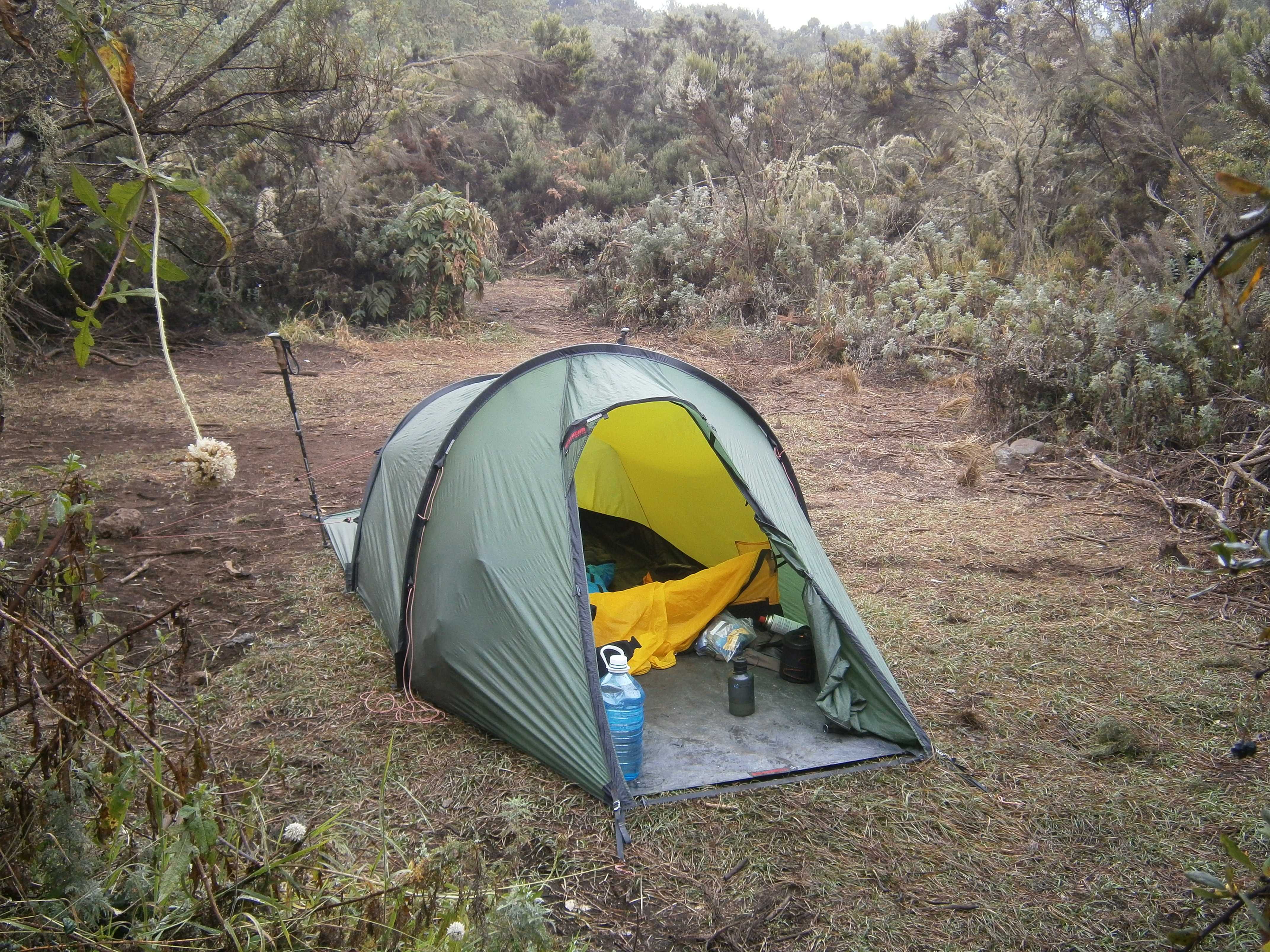
Police permits can be applied for here (In Chinese).  For the website to load, you need to use Internet Explorer and adjust the encoding for ‘Chinese Traditional, Big5′ (found through Page -> Encoding):
http://eli.npa.gov.tw/E7WebO/index02.jsp

North / West Hehuan Shan – 北合歡山 / 西合歡山 – April/May 2012

Looking out over the Hehuan Shan.

The Hehuan Shan mountain range is a popular tourist spot in Taiwan. Well known as home to the country’s highest road, several of the area’s mountaintops are easily accessible.  The Hehuan mountains are famous for their heavy snowfall in the wintertime, and vibrant rhododendron flowers in the spring. The Hehuan range is quite exposed, and receives more snowfall (and generally inclement weather) than most of Taiwan’s other mountains.

Rhododendrons and a great view.

In April I headed to Hehuanshan with a friend to hike the North-West ridgeline – a camel back of ups and downs, all over 3100m in elevation. The plan just barely fit into my weekend; I’d be able to get there Saturday, camp out on the ridge overnight, hike all day Sunday, and get home at a reasonable hour.  The April hike was so enjoyable, that I went and did it again in early May, this time with my friend Richard.  This journal provides a rough outline of both hikes.

Here is an outline of the itinerary we took for both trips:

A map of our two day itinerary.

Day 1: Both trips started with a ~4 hour bus from Taipei to Puli, a motorbike rental in Puli, and a 2 hour drive to the trailhead.  From the trailhead, we hiked for an hour or so to the North Peak, and then pitched camp nearby.

In clear weather Snow Mountain is visible from the North Peak of Hehuan Shan.

Chilai Shan’s North Peak (left) and Main Peak (right) can also be seen.

Day 2: Up early, we hiked across the entire North-West ridge, from the North Peak to the West Peak and back.  The West Peak has a great little sheltered spot to stop and eat lunch in a nearby patch of trees.  From the trailhead, we drove back to Puli, and caught a bus back to Taipei.

In clear weather, the views of surrounding terrain are lovely.

On both trips, we pitched camp nearby the 3422m North Peak.  There are lots of comfortable spots for this (albeit, none with a water source); don’t settle for the first one you see if it isn’t perfectly level!

Our very comfortable campsite on the April hike.

Our campsite for the May hike – not the best tent pitch, as the ground wasn’t perfectly level and the bushes prevented proper guy-line use.

The north-west ridge of Hehuan Shan is perhaps the only moderately challenging hike the Hehuan mountains have to offer.  Four of the nearby peaks offer trails which can be completed in between fifteen minutes and two hours, but the north-west ridge offers a solid 8-9 hour day of good hiking over very enjoyable terrain.

Many people come up the North Peak to take photographs of the flowers and beautiful terrain.

After waking up and eating breakfast, we set off west along the ridge, headed towards the 3145m West Peak.  The “West Peak” isn’t much of a mountain, more just the western-most termination point of this particular ridge.

Looking back at the North Peak behind us.

The trail continuously drops and climbs, and has five big ‘humps’ to travel over before reaching the West Peak.  The terrain is very aesthetic, with pastoral fields, intermittent pine forest, and Yushan cane. On both hikes, the rhododendrons were blooming, and their pink flowers were a common sight along the trail.

Rhododendron flowers.

Rhododendron flowers.

Patches of pine forest cover parts of the trail.

At times, the trail is quite steep.  With the entire ridge above 3100 meters, it makes for great exercise.

Heading down the ridge.

Some great views in clear weather. Nanhuda Shan and Zhongyangjian Shan.

Knowing that the objective of the hike, the diminutive and unimpressive West Peak, was somewhat uninspiring once achieved, we brought along snacks and a nice beer on both hikes.

The softly rounded West Peak in the distance. Zoom in and you can see some hikers on top.

About to enjoy a cold beer on the West Peak!

Accessibility

In great weather, this is a truly fantastic day hike.  Logistically, it takes some time to get to the trail, and might be best if done as a relaxed two or three day trip, with some time spent exploring the smaller trails in the area, or enjoying the high-end facilities of nearby resorts.  The cheapest way to get there, is to drive a car, or take a bus to Puli and rent a motorbike.  The North Peak trailhead is hard to miss, and is located right near the 37km marker of route 14, well past the Songsyue mountain lodge.

The North Peak offers some great terrain for camping.  Some of the best spots are just off the trail on the south side of the North Peak, a short distance below the top.  Unfortunately, there are no reliable water sources.

There are no national park permits for this particular hike, although a police-issued mountain entry permit is required.  There is nobody up there to check for it though, and it seems highly unlikely that anyone bothers with it, given the fairly crowded area around the base of the North Peak.  Police permits (In Chinese) can be applied for here.  For the website to load, you need to use Internet Explorer and adjust the encoding for ‘Chinese Traditional, Big5′ (found through Page -> Encoding):
http://eli.npa.gov.tw/E7WebO/index02.jsp